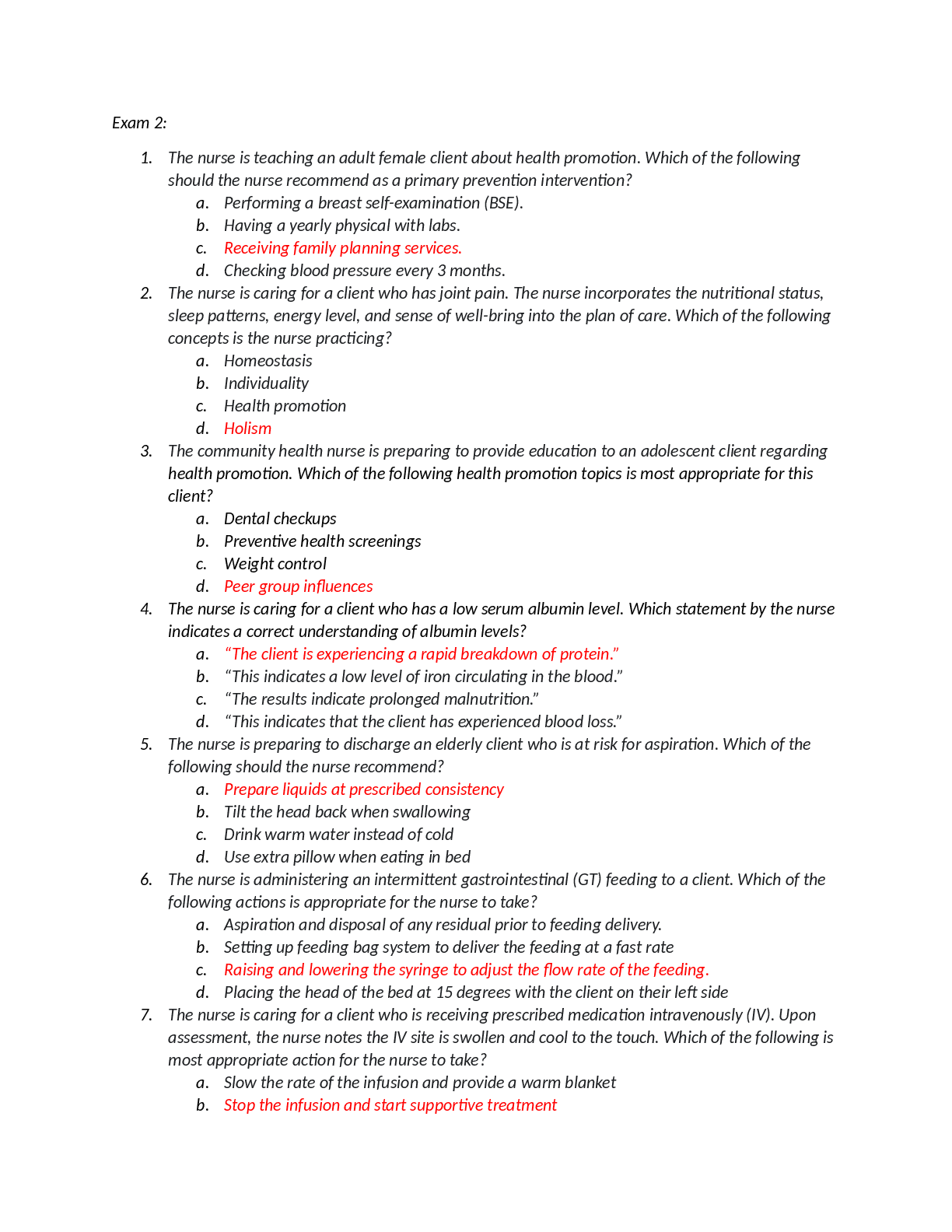
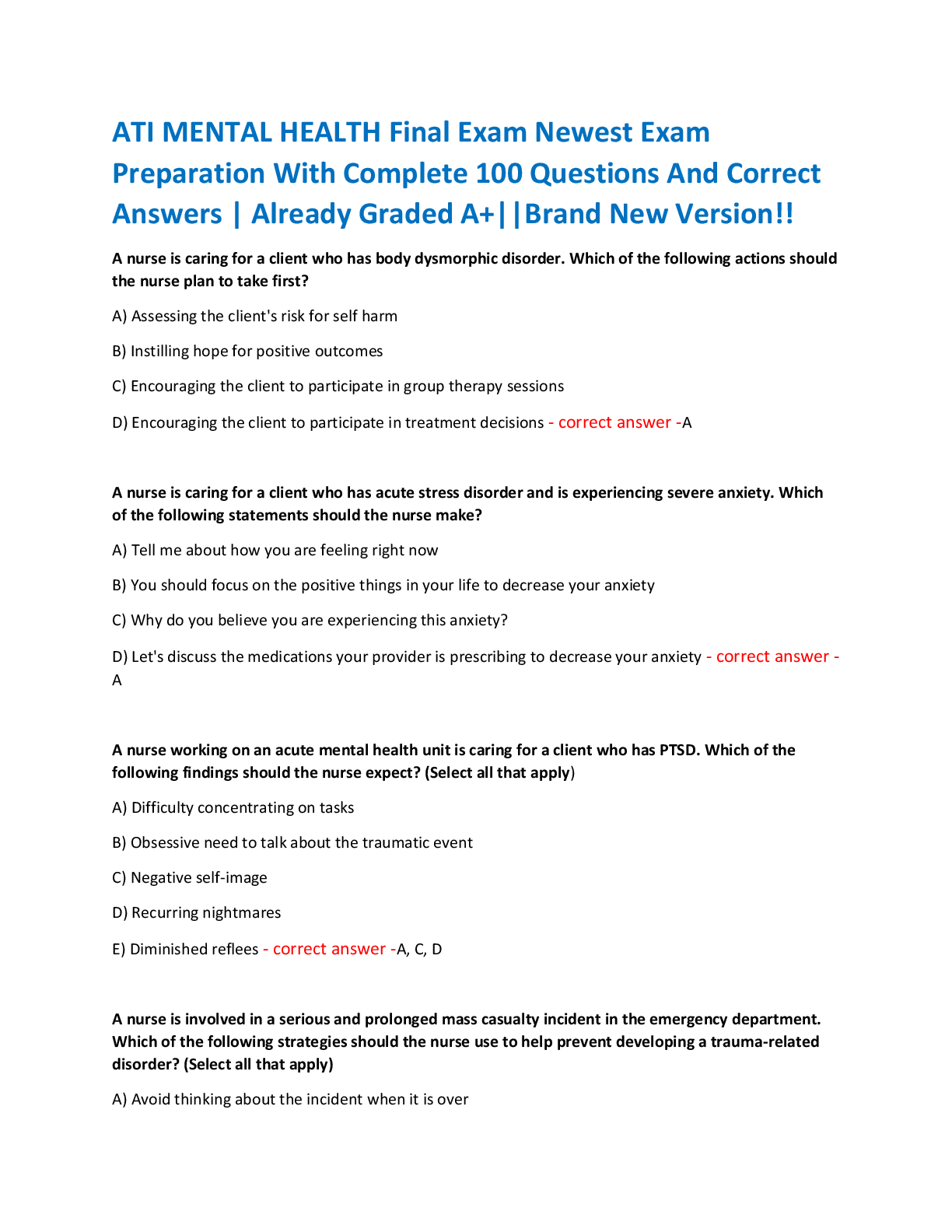
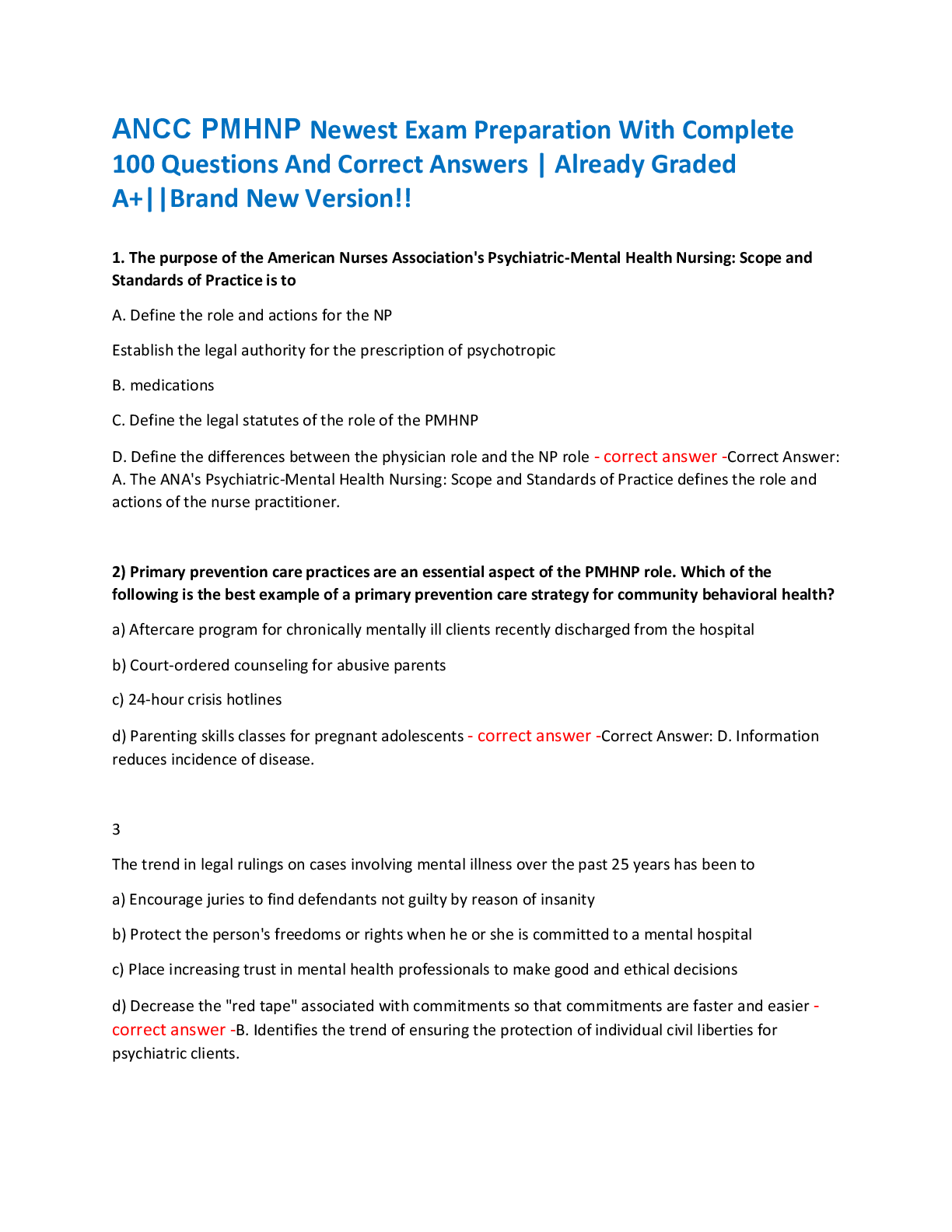
MDC1 Final exam TOTAL questions- #150= 300 points | Complete 100% Updated Spring 2026 - Rasmussen.
A nurse is reviewing the "Vital Knowledge" section in a module. What is the primary purpose of this resource?
a) To rep
...
MDC1 Final exam TOTAL questions- #150= 300 points | Complete 100% Updated Spring 2026 - Rasmussen.
A nurse is reviewing the "Vital Knowledge" section in a module. What is the primary purpose of this resource?
a) To replace reading the textbook
b) To help apply knowledge from readings and lectures
c) To provide dosage calculation practice only
d) To list all weekly discussion topics
According to the study roadmap, what is the recommended mastery level on PrepU quizzes before moving on?
a) 3 and above
b) 5 and above
c) 7 and above
d) 10 and above
When using PrepU, what is the recommended maximum number of questions per quiz to maximize learning?
a) 5 questions
b) 10 questions
c) 20 questions
d) 50 questions
A student misses a PrepU question. What should they do according to the roadmap?
a) Ignore it and move to the next chapter
b) Read the rationale and click the green tab to read the missed chapter section
c) Only review the correct answers
d) Retake the same quiz without changes
What is the recommended frequency for dosage calculation practice per the document?
a) 5-10 questions each week
b) 20 questions each module
c) 50 questions before the final exam
d) No practice needed
Module 2: Ensuring Safety and Effective Communication
Which of the following is an example of a therapeutic communication technique?
a) Asking multiple closed-ended questions in a row
b) Expressing disapproval to correct behavior
c) Active listening and showing interest
d) Changing the subject when the patient becomes emotional
A nurse tells a patient "Everything will be fine" without knowing the outcome. This is an example of:
a) Therapeutic communication
b) False reassurance
c) Empathy
d) Active listening
During which phase of the nurse-client relationship does the nurse establish rapport and trust?
a) Pre-interaction
b) Orientation
c) Working
d) Termination
A nurse says to a patient, "You shouldn't think that way." This is a barrier to communication known as:
a) Stereotyping
b) Expressing approval/disapproval
c) Offering advice
d) Changing the subject
Which of the following is a physiological change related to aging?
a) Increased skin elasticity
b) Thinner, more elastic skin
c) Increased muscle mass
d) Decreased risk of falls
A patient who is hard of hearing is admitted. Which is an appropriate way to communicate?
a) Shout loudly so they can hear
b) Face the patient directly and speak clearly
c) Turn away while speaking
d) Use complex medical terms without explanation
Which public health agency is responsible for tracking communicable diseases at a national level?
a) Local police department
b) Centers for Disease Control and Prevention (CDC)
c) Fire department
d) Department of Motor Vehicles
A systemic complication of immobility includes:
a) Increased appetite
b) Venous stasis and risk of thrombus formation
c) Decreased heart workload
d) Improved bone density
Module 3: Mobility and Safety Across the Lifespan
An intervention to prevent complications of immobility is:
a) Keeping the patient strictly on bed rest
b) Turning the patient every 2 hours
c) Restricting fluid intake
d) Avoiding any range-of-motion exercises
The nurse hears a "crackling" sound when assessing a patient's lungs. This is called:
a) Crepitus
b) Rhonchi
c) Stridor
d) Wheeze
A patient with osteoporosis is at highest risk for:
a) Bleeding disorders
b) Fractures from minor bumps or sneezing
c) Skin infections
d) Hearing loss
A deep vein thrombosis (DVT) is most commonly associated with:
a) Arterial bleeding
b) A blood clot in a deep vein, usually in the legs
c) A heart arrhythmia
d) Lung infection
Module 4: Musculoskeletal Disorders
The most common type of arthritis in the United States is:
a) Rheumatoid arthritis
b) Gout
c) Osteoarthritis
d) Lupus
A patient with osteoarthritis experiences joint pain due to:
a) Autoimmune destruction of synovium
b) Urate crystal deposits
c) Bone rubbing against bone in the joint space
d) Infection of the joint fluid
A patient who had a hip arthroplasty should be positioned to prevent:
a) Hip adduction and internal rotation
b) Hip abduction and external rotation
c) Lying flat on the operative side
d) Keeping the knees together at all times
A nurse is caring for a patient following an arthroscopy. Which finding requires immediate action?
a) Slight clear drainage
b) Cold, pale, pulseless extremity distal to the site
c) Mild pain rated 3/10
d) Small amount of bruising
A diagnostic test for a musculoskeletal disorder often includes:
a) Tonometry
b) X-ray
c) Pulmonary function test
d) Electroencephalogram
Which type of cancer originates in bone tissue?
a) Lymphoma
b) Leukemia
c) Osteosarcoma
d) Melanoma
A patient with gout should be educated to avoid:
a) Increased fluid intake
b) Organ meats and shellfish
c) Colchicine as prescribed
d) Low-purine diet
Module 5: Fractures and Musculoskeletal Trauma
A patient with a new cast reports severe pain and numbness in the fingers. The nurse should first:
a) Apply heat to the cast
b) Perform a neurovascular assessment
c) Cut the cast off immediately
d) Administer pain medication and wait
A patient has a fracture where the bone is completely separated. This is called:
a) Incomplete fracture
b) Complete fracture
c) Greenstick fracture
d) Compression fracture
A patient in Buck's traction reports pain at the pin site. The nurse notes purulent drainage. This indicates:
a) Normal healing
b) Infection
c) Allergic reaction
d) Improper traction weight
A complication of a fracture includes fat embolism syndrome. Early signs include:
a) Bradycardia and hypotension
b) Tachypnea and petechiae on chest
c) Polyuria and thirst
d) Constipation and abdominal pain
A nurse provides cast care education. Which statement by the patient indicates a need for further teaching?
a) "I will keep the cast dry."
b) "I can use a knitting needle to scratch under the cast if it itches."
c) "I will check the skin around the cast edges daily."
d) "I will report any foul odor from the cast."
A patient with a fractured femur is in skeletal traction. The nurse should ensure:
a) Weights are resting on the floor
b) Weights are hanging freely off the bed
c) The patient is in high Fowler's position
d) Traction is removed every 2 hours for skin care
Module 6: Disorders of the Eyes and Ears
The nurse is teaching a patient with open-angle glaucoma. Which statement is correct?
a) "You will have rapid, painful vision loss."
b) "This type of glaucoma is a medical emergency."
c) "You may lose peripheral vision gradually."
d) "Surgery is always the first treatment."
A patient with cataracts is likely to report:
a) Sudden, severe eye pain
b) Seeing halos around lights and foggy vision
c) Bloodshot eyes with discharge
d) Double vision that resolves with blinking
The test used to measure intraocular pressure is:
a) Gonioscopy
b) Tonometry
c) Audiometry
d) Ophthalmoscopy
An appropriate way to communicate with a patient who is hard of hearing includes:
a) Speaking very loudly close to their ear
b) Facing the patient so they can see your lips
c) Writing everything down without speaking
d) Speaking from another room to reduce distraction
A patient with Meniere's disease is likely to experience:
a) Vertigo, tinnitus, and hearing loss
b) Painless progressive vision loss
c) Dry eyes and mouth
d) Double vision and drooping eyelids
A patient after eye surgery should be educated to avoid:
a) Using prescribed eye drops
b) Bending at the waist
c) Wearing an eye shield at night
d) Sleeping with the head elevated
Module 7: Skin, Pressure Injuries, and Burns
A patient has intact skin over the sacrum that does not blanch when pressed. This is a:
a) Stage 1 pressure injury
b) Stage 2 pressure injury
c) Stage 3 pressure injury
d) Unstageable pressure injury
A full-thickness pressure injury with exposed muscle and bone is a:
a) Stage 2
b) Stage 3
c) Stage 4
d) Deep tissue injury
Which patient is at highest risk for pressure injuries?
a) A 25-year-old with a sprained ankle
b) An elderly bed-bound patient with incontinence
c) A middle-aged patient with hypertension
d) A child with a cold
A nurse observes black, leathery tissue in a wound bed. This is called:
a) Slough
b) Granulation
c) Eschar
d) Serous drainage
An intervention to promote wound healing includes:
a) High-protein diet with vitamins A and C
b) Low-calorie, low-fat diet
c) Restricting fluids to prevent edema
d) Keeping the wound open to air at all times
A patient with cellulitis has a red, swollen area on the leg. The nurse should:
a) Apply heat and massage the area
b) Mark the borders with a pen to monitor spread
c) Elevate the leg only if pain is severe
d) Keep the leg in a dependent position
Which skin cancer is most likely to metastasize?
a) Basal cell carcinoma
b) Squamous cell carcinoma
c) Melanoma
d) Actinic keratosis
An age-related skin change includes:
a) Increased collagen production
b) Thicker, more elastic skin
c) Increased sweat gland activity
d) Thinning skin and age spots
The Braden Scale assesses risk for:
a) Falls
b) Pressure injuries
c) Aspiration
d) Delirium
Module 8: Infection Control and Precautions
A patient with Clostridioides difficile (C. diff) requires which type of isolation?
a) Airborne
b) Droplet
c) Contact
d) Protective environment
A patient with active pulmonary tuberculosis requires:
a) Contact precautions
b) Droplet precautions
c) Airborne precautions with N95 mask
d) Standard precautions only
Which personal protective equipment (PPE) is required for droplet precautions?
a) N95 mask, gown, gloves
b) Surgical mask, gown, gloves
c) Gloves only
d) Gown and gloves only
The most effective way to break the chain of infection is:
a) Wearing gloves for all patient contact
b) Hand hygiene
c) Isolating all patients
d) Administering antibiotics to all admissions
A patient with HIV is at risk for opportunistic infections because:
a) They have too many white blood cells
b) Their immune system is impaired
c) They are allergic to antibiotics
d) They have excessive antibody production
An example of a susceptible host is:
a) A healthy 30-year-old
b) A patient receiving cancer chemotherapy
c) A vaccinated healthcare worker
d) A patient with a healed surgical incision
Standard precautions apply to:
a) Only patients with known infections
b) All patients regardless of diagnosis
c) Only patients in intensive care
d) Only patients with fever
A patient with influenza requires:
a) Airborne precautions
b) Droplet precautions
c) Contact precautions
d) No precautions
The nurse is caring for a patient with MRSA in a wound. Which precaution is correct?
a) Place a surgical mask on the patient for transport
b) Wear an N95 respirator during dressing changes
c) Use contact precautions including gown and gloves
d) No additional precautions beyond standard
Module 9: HIV/AIDS, C. Diff, TB, and STIs
A patient with AIDS and a cough, fever, and night sweats should be evaluated for:
a) Tuberculosis (TB)
b) Common cold
c) Allergic rhinitis
d) Gastroesophageal reflux
A patient with suspected TB is placed in an airborne infection isolation room (AIIR). The nurse knows:
a) The door may remain open for ventilation
b) Staff must wear an N95 respirator
c) The patient can go to the cafeteria with a mask
d) No special precautions are needed after 24 hours of antibiotics
A patient with C. diff diarrhea has an order for a stool test. The nurse should:
a) Send a random stool sample
b) Wear gloves and use contact precautions
c) Collect the sample from the toilet bowl
d) No precautions needed as it's not airborne
A patient with HIV is experiencing depression and suicidal ideation. The priority nursing intervention is:
a) Encourage group therapy
b) Refer to a support group
c) Ensure patient safety with 1:1 observation
d) Increase antiretroviral dosage
Which STI is caused by a bacterium and can be treated with antibiotics?
a) HIV
b) Herpes simplex virus
c) Chlamydia
d) Hepatitis B
A patient with HIV has a CD4 count of 180/mm³. This indicates:
a) Normal immune function
b) Mild immune suppression
c) AIDS diagnosis (severe immunosuppression)
d) No risk of infection
A patient with active TB is being discharged. Education should include:
a) Stop medications when symptoms resolve
b) Take all medications as prescribed for the full course
c) No need for follow-up cultures
d) Masks are only needed at home
Module 10: Rheumatoid Arthritis, Lupus, and Gout
A patient with rheumatoid arthritis (RA) has joint deformities. The underlying cause is:
a) Wear and tear of cartilage
b) Autoimmune attack on synovial joints
c) Uric acid crystal deposition
d) Bacterial infection of the joint
The leading cause of death in patients with systemic lupus erythematosus (SLE) is:
a) Stroke
b) Lupus nephritis
c) Heart attack
d) Infection
A patient with SLE presents with a butterfly-shaped rash across the nose and cheeks. This is called:
a) Malar rash
b) Psoriasis
c) Herpes zoster
d) Contact dermatitis
A patient with gout is started on colchicine. The nurse should teach:
a) Take with food to reduce GI upset
b) Stop at the first sign of joint pain
c) Double the dose if a dose is missed
d) Avoid all fluids while taking it
A patient with systemic sclerosis (scleroderma) reports Raynaud's phenomenon. This means:
a) Fingers turn white, blue, then red with cold
b) Joint swelling and warmth
c) Butterfly rash on face
d) Dry eyes and mouth
CREST syndrome is a form of:
a) Osteoarthritis
b) Scleroderma
c) Gout
d) Fibromyalgia
A patient with fibromyalgia is likely to experience:
a) Widespread musculoskeletal pain and fatigue
b) Joint deformity and erosion
c) High fever and chills
d) Localized rash and blisters
General Nursing Process & Priority
The first step of the nursing process is:
a) Planning
b) Assessment
c) Implementation
d) Evaluation
A nurse finds a patient’s wound has dehisced. The first action is:
a) Call the surgeon
b) Cover with sterile saline-moistened dressing
c) Push the organs back in
d) Apply dry gauze
Evisceration occurs when:
a) The wound edges separate
b) Internal organs protrude through the wound
c) The wound becomes infected
d) Sutures become loose
A nurse is evaluating care. This step involves:
a) Collecting subjective data
b) Reviewing if desired outcomes were met
c) Writing nursing diagnoses
d) Administering medications
Pain Management
Pain that originates from internal organs such as the intestines is called:
a) Cutaneous pain
b) Visceral pain
c) Somatic pain
d) Neuropathic pain
A patient describes pain from an amputated leg. This is:
a) Radiating pain
b) Referred pain
c) Phantom pain
d) Acute pain
Pain that lasts longer than 6 months and interferes with ADLs is:
a) Acute pain
b) Chronic pain
c) Breakthrough pain
d) Cutaneous pain
A patient having a heart attack reports pain in the left jaw. This is:
a) Radiating pain
b) Referred pain
c) Phantom pain
d) Visceral pain
Vital Signs & Assessment
Normal adult oral temperature range is:
a) 95.0 – 97.5°F
b) 96.4 – 99.5°F
c) 98.6 – 100.4°F
d) 99.0 – 101.5°F
A normal adult resting heart rate is:
a) 40-60 bpm
b) 60-100 bpm
c) 100-120 bpm
d) 120-140 bpm
Normal adult respiratory rate is:
a) 8-12 breaths/min
b) 12-20 breaths/min
c) 20-30 breaths/min
d) 30-40 breaths/min
A blood pressure reading of 120/80 mmHg is classified as:
a) Hypotension
b) Normal
c) Elevated
d) Hypertensive crisis
Safety & Fall Prevention
A "never event" in healthcare includes:
a) Patient requesting pain medication
b) Fall with serious injury
c) Discharge to home
d) A normal lab value
A fall prevention intervention includes:
a) Keeping lights dim to promote sleep
b) Placing call light within reach
c) Using throw rugs for comfort
d) Encouraging barefoot walking
A patient is at risk for falls. The nurse should:
a) Apply nonslip socks
b) Raise all four side rails
c) Keep the bed in high position
d) Restrain the patient
Wound Healing & Drainage
Clear, watery drainage from a wound is called:
a) Serous
b) Sanguineous
c) Serosanguineous
d) Purulent
Yellowish-green, thick drainage indicates:
a) Normal healing
b) Infection
c) Serous fluid
d) Lymphatic fluid
A wound healing by primary intention means:
a) Edges are brought together
b) Wound is left open to granulate
c) Delayed closure
d) Healing occurs from inside out
Red, moist, shiny tissue in a wound bed is called:
a) Slough
b) Eschar
c) Granulation tissue
d) Necrotic tissue
Medications & Treatments
A patient with rheumatoid arthritis is prescribed steroids. The nurse monitors for:
a) Hypoglycemia
b) Weight loss
c) Infection and hyperglycemia
d) Hypotension
A patient with gout should avoid which medication that can increase uric acid?
a) Acetaminophen
b) Aspirin (low dose)
c) Colchicine
d) Allopurinol
A patient with osteoarthritis reports pain. First-line treatment includes:
a) Opioids
b) Acetaminophen or NSAIDs
c) Methotrexate
d) Colchicine
The nurse administers colchicine for gout. Patient education includes:
a) It is an analgesic for immediate pain
b) It works best when taken at the first sign of flare
c) No side effects occur
d) Take on an empty stomach
Neurovascular Assessment (6 P's)
Components of a neurovascular assessment include all except:
a) Pain
b) Pulse
c) Pallor
d) Pulse oximetry
A patient after casting reports paresthesia. This means:
a) Inability to move
b) Numbness or tingling
c) Pale skin
d) Severe pain
Wound & Pressure Injury Staging
A pressure injury with partial-thickness skin loss of epidermis or dermis, presenting as a blister, is stage:
a) 1
b) 2
c) 3
d) 4
An unstageable pressure injury has:
a) Full thickness with exposed bone
b) Slough or eschar covering the wound bed
c) Intact skin with blanching
d) Partial thickness with red-pink bed
The Braden Scale categories include:
a) Age and gender
b) Sensory perception, moisture, activity, mobility, nutrition, friction/shear
c) Blood pressure and heart rate
d) Pain and fall history
Elderly & Immobility
A systemic effect of immobility on the cardiovascular system is:
a) Increased heart contractility
b) Venous stasis and DVT risk
c) Decreased blood viscosity
d) Increased arterial dilation
A patient on bed rest is at risk for constipation due to:
a) Increased peristalsis
b) Decreased metabolic rate and immobility
c) High fiber diet
d) Increased fluid intake
An elderly patient is at risk for skin breakdown due to:
a) Increased subcutaneous fat
b) Thinning skin and decreased elasticity
c) Increased sweat production
d) Faster wound healing
A patient with a hip fracture is in Buck's traction. The nurse knows the purpose is to:
a) Reduce the fracture definitively
b) Immobilize and reduce muscle spasms
c) Provide continuous exercise
d) Allow immediate weight bearing
Cultural & Communication
A patient follows a magico-religious health belief system. This includes:
a) Use of antibiotics and surgery
b) Belief in supernatural forces for healing
c) Focus on harmony with nature
d) Only using scientifically proven treatments
A nurse uses silence to allow a patient to express feelings. This is:
a) Non-therapeutic
b) A barrier to communication
c) A therapeutic communication technique
d) Only for psychiatric patients
A patient says "I don't want to live anymore." The nurse’s best response is:
a) "Don't say that."
b) "You have so much to live for."
c) "Tell me more about how you are feeling."
d) "Everyone feels sad sometimes."
Diagnostic Tests
A gonioscopy is used to diagnose:
a) Cataracts
b) Open vs closed angle glaucoma
c) Hearing loss
d) Retinal detachment
A tonometry reading of 22 mmHg indicates:
a) Normal intraocular pressure
b) Elevated intraocular pressure
c) Low intraocular pressure
d) Cataract formation
A patient with suspected hearing loss should have which test?
a) Tonometry
b) Audiometry
c) Gonioscopy
d) OCT
Immune Disorders (Extra)
A patient with SLE is photosensitive. The nurse should recommend:
a) Tanning beds to build tolerance
b) Sunscreen and protective clothing
c) Avoiding all outdoor light permanently
d) No precautions needed
A patient with rheumatoid arthritis has swan-neck deformities. This is due to:
a) Uric acid deposits
b) Chronic inflammation of joints
c) Calcium deficiency
d) Muscle hypertrophy
A patient with scleroderma has esophageal dysfunction. The nurse teaches:
a) Lie flat after meals
b) Eat small, frequent meals and elevate HOB
c) Avoid all liquids
d) Increase caffeine intake
Raynaud's phenomenon is triggered by:
a) Heat and exercise
b) Cold and stress
c) Loud noises
d) Bright lights
Miscellaneous
A patient with a burn injury is at risk for which complication?
a) Hypertension
b) Infection and fluid loss
c) Increased urine output
d) Hypoglycemia
A nurse assesses a dark-skinned patient for pressure injury. The best method is:
a) Blanch test
b) Assess for skin temperature and hardness
c) Use only visual inspection
d) Wait for patient to report pain
A patient is on contact precautions for C. diff. The nurse uses:
a) Alcohol-based hand rub only
b) Soap and water for hand hygiene
c) No hand hygiene needed after gloves
d) Only wear gloves
A patient with TB has a negative pressure room. The door should be:
a) Kept open for ventilation
b) Kept closed at all times
c) Opened every hour
d) Removed for access
A patient with a new above-knee amputation reports phantom limb pain. The nurse:
a) Tells the patient it's not real
b) Validates the pain and administers prescribed meds
c) Ignores the complaint
d) Applies ice to the stump
A patient with osteoporosis should increase intake of:
a) Calcium and vitamin D
b) Iron and vitamin C
c) Potassium and magnesium
d) Sodium and phosphorus
A nurse is calculating intake and output. Which is included as intake?
a) Vomitus
b) Ice chips (melted)
c) Urine output
d) Wound drainage
A patient with a fever of 102°F and rigors likely has:
a) A cold
b) An infection
c) A medication reaction
d) Dehydration only
A patient after hip arthroplasty should avoid:
a) Using an elevated toilet seat
b) Crossing legs
c) Using a pillow between knees
d) Sitting in high chairs
A nurse uses the mnemonic RACE for fire safety. The "C" stands for:
a) Cut the oxygen
b) Contain/confine the fire
c) Call the family
d) Check the patient
A patient on droplet precautions needs transport. The patient should:
a) Not be transported at all
b) Wear a surgical mask during transport
c) Wear an N95 mask
d) No mask needed
A patient with a stage 3 pressure injury has a wound with tunneling. The nurse should:
a) Pack the tunnel loosely with moist gauze
b) Leave the tunnel open to air
c) Irrigate with full-strength betadine
d) Apply dry gauze tightly
A patient reports sudden, severe eye pain, nausea, and halos around lights. This suggests:
a) Cataracts
b) Open-angle glaucoma
c) Closed-angle glaucoma
d) Conjunctivitis
A patient with a fractured tibia has a sudden onset of chest pain and dyspnea. The nurse suspects:
a) Atelectasis
b) Pulmonary embolism
c) Pneumothorax
d) Asthma attack
A patient is at risk for hospital-acquired pressure injury (HAPI). An intervention is:
a) Use donut-ring cushions
b) Turn and reposition every 2 hours
c) Keep head of bed at 60 degrees always
d) Massage reddened bony prominences
The nurse understands that the most common cause of disability in the U.S. is:
a) Stroke
b) Osteoarthritis
c) Diabetes
d) Heart disease
A patient with gout has a tophus. This is:
a) A joint deformity
b) A deposit of urate crystals
c) A skin rash
d) An eye lesion
A patient with HIV who has a cough and fever for 3 weeks should be evaluated for:
a) TB
b) Sinusitis
c) Allergies
d) GERD
A patient with RA is on methotrexate. The nurse monitors for:
a) Hypertension
b) Bone marrow suppression
c) Hyperglycemia
d) Weight gain
A patient with SLE reports chest pain with deep breathing. The nurse suspects:
a) Pleuritis
b) Myocardial infarction
c) Pneumonia
d) Asthma
A patient with a new cast has a foul odor and purulent drainage at the cast edge. This indicates:
a) Normal healing
b) Infection under the cast
c) Allergic reaction
d) Cast too tight
A patient is 2 days post-op abdominal surgery. The wound edges separate slightly with serosanguineous drainage. This is:
a) Evisceration
b) Dehiscence
c) Normal healing
d) Hernia
A nurse is evaluating a patient's understanding of glaucoma treatment. Which statement indicates understanding?
a) "I can stop drops when my vision improves."
b) "I will use eye drops every day as prescribed."
c) "Glaucoma is curable with surgery."
d) "I only need to see the eye doctor if I have pain."
A patient with hearing loss has a hearing aid. The nurse should:
a) Turn it off before inserting
b) Check the battery and clean the earmold
c) Use water to clean it daily
d) Store it in direct sunlight
A patient with a recent cerebrovascular accident (stroke) is at risk for which complication of immobility?
a) Increased muscle mass
b) Contractures
c) Decreased bone density only
d) Hypercalcemia
A nurse is teaching about skin cancer prevention. Which advice is best?
a) Use tanning beds in winter
b) Apply sunscreen with SPF 15 daily
c) Avoid sun exposure 10am-4pm and use SPF 30+
d) Only protect skin on sunny days
A patient with a pressure injury is prescribed a high-protein diet. The nurse knows protein helps with:
a) Reducing pain
b) Tissue repair and wound healing
c) Decreasing inflammation
d) Increasing urine output
A nurse assesses a patient's wound and notes yellow, stringy tissue. This is:
a) Granulation
b) Slough
c) Eschar
d) Epithelial tissue
A patient with a fractured femur develops chest pain, petechiae on chest, and confusion. This is likely:
a) Pulmonary embolism
b) Fat embolism syndrome
c) Myocardial infarction
d) Anaphylaxis
A patient with systemic lupus erythematosus (SLE) should avoid:
a) Sun exposure
b) Rest periods
c) Low-sodium diet
d) Hydroxychloroquine
A nurse is performing a neurovascular check on a patient with a cast. The patient cannot wiggle toes. This is:
a) Paresthesia
b) Paralysis
c) Pallor
d) Pain
A patient with a stage 4 pressure injury has visible bone. The nurse expects:
a) No risk of infection
b) High risk of osteomyelitis
c) Spontaneous healing in 2 days
d) No need for wound care
A patient with fibromyalgia is prescribed low-dose amitriptyline. The nurse teaches:
a) It will cure the condition
b) Take at bedtime due to drowsiness
c) Take in the morning for energy
d) No side effects expected
A nurse caring for a patient with C. diff sees that the patient has 10 watery stools per day. The priority is:
a) Call dietary
b) Fluid and electrolyte replacement
c) Restrain the patient
d) Apply heat to abdomen
A patient with a new above-knee amputation is upset. The best response is:
a) "You'll get used to it."
b) "Tell me what is bothering you most right now."
c) "At least you're alive."
d) "Your other leg is fine."
A patient with osteoporosis has a vertebral compression fracture. The nurse should:
a) Encourage heavy lifting to strengthen bones
b) Use logrolling technique for turning
c) Maintain high Fowler's at all times
d) Avoid pain medication to prevent falls
A nurse is evaluating a patient with a new colostomy for signs of infection. Which finding is most concerning?
a) Redness around stoma
b) Purulent drainage and fever
c) Small amount of serous drainage
d) Stoma is pink and moist
A patient with TB is started on rifampin. The nurse teaches that this medication causes:
a) Blue urine
b) Orange-red discoloration of body fluids
c) Green stools
d) No side effects
A patient with RA reports morning stiffness lasting 2 hours. The nurse recommends:
a) Bed rest until it resolves
b) Warm shower and gentle range-of-motion exercises
c) Ice packs to all joints
d) Immobilization of stiff joints
A nurse is prioritizing care for four patients. Which should be seen first?
a) Patient with osteoarthritis requesting pain meds
b) Post-op patient with pulse 120 and pale, cool skin
c) Patient with gout eating breakfast
d) Patient with cataract surgery asking for eye drops
[Show More]








![Preview of eBook [PDF] Burns' Pediatric Primary Care 7th Edition BY Dawn Lee Garzon Maaks,, Nancy Bar](https://browseimages.nyc3.digitaloceanspaces.com/paper-images/2024/Aug/26/WR2rowXX2024-08-26-02-0966cc625bea839.png)

![Preview of eBook [PDF] Barash, Cullen, and Stoelting's Clinical Anesthesia 9th Edition By Bruce F. Cu](https://browseimages.nyc3.digitaloceanspaces.com/paper-images/2024/Aug/29/8DF2QRTq2024-08-29-10-3966d0259b7c4b5.png)