Infants Health promotion teaching on leading cause of death:
Aspiration of foreign objects
• Hold the infant for feedings; do not prop bottles.
• Small objects that can become dislodge in the throat (grapes, coins,
...
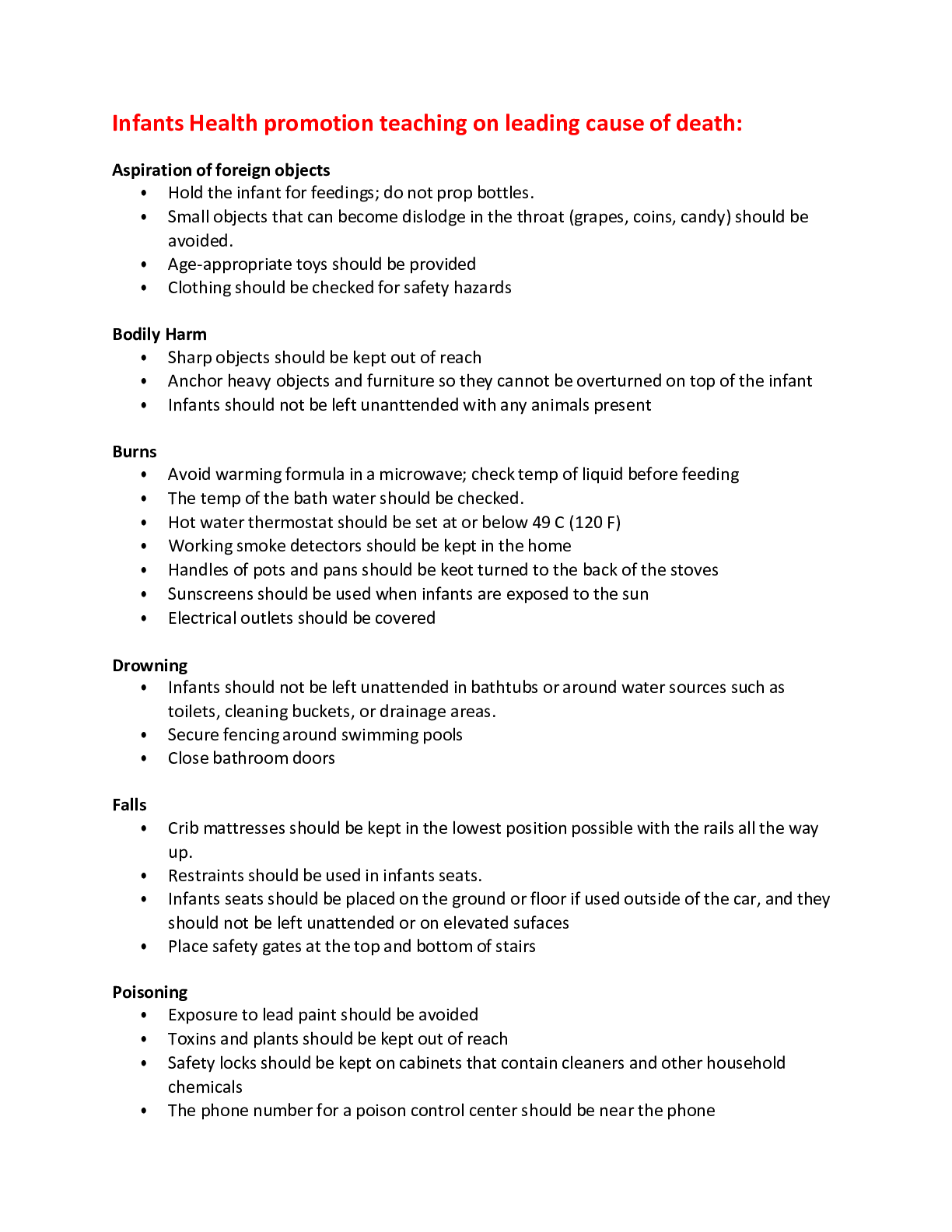
Infants Health promotion teaching on leading cause of death:
Aspiration of foreign objects
• Hold the infant for feedings; do not prop bottles.
• Small objects that can become dislodge in the throat (grapes, coins, candy) should be avoided.
• Age-appropriate toys should be provided
• Clothing should be checked for safety hazards
Bodily Harm
• Sharp objects should be kept out of reach
• Anchor heavy objects and furniture so they cannot be overturned on top of the infant
• Infants should not be left unanttended with any animals present
Burns
• Avoid warming formula in a microwave; check temp of liquid before feeding
• The temp of the bath water should be checked.
• Hot water thermostat should be set at or below 49 C (120 F)
• Working smoke detectors should be kept in the home
• Handles of pots and pans should be keot turned to the back of the stoves
• Sunscreens should be used when infants are exposed to the sun
• Electrical outlets should be covered
Drowning
• Infants should not be left unattended in bathtubs or around water sources such as toilets, cleaning buckets, or drainage areas.
• Secure fencing around swimming pools
• Close bathroom doors
Falls
• Crib mattresses should be kept in the lowest position possible with the rails all the way up.
• Restraints should be used in infants seats.
• Infants seats should be placed on the ground or floor if used outside of the car, and they should not be left unattended or on elevated sufaces
• Place safety gates at the top and bottom of stairs
Poisoning
• Exposure to lead paint should be avoided
• Toxins and plants should be kept out of reach
• Safety locks should be kept on cabinets that contain cleaners and other household chemicals
• The phone number for a poison control center should be near the phone
• Meds should be kept in childproof containers
• A working carbon monoxide detector should be kept in the home
Motor-Vehicle injuries
• Infant-only and convertible infant-toddler car seats are available.
• Infants and toddlers remain in a rear-facing car seat until the age of 2 yrs or the height recommended by the manufacturer
• The safest area for infants and children is the backseat of the car
• Do not place rear-facing car seats in the front seats of vehicles with passenger airbags
• Infants should not be left in parked cars
Suffocation
• Plastic bags should be avoided
• Balloons should be kept away from infants
• Crib mattress should fit snuggly
• Cribs slats should be no farther apart than 6 cm (2.375 in).
• Crib mobiles and/or crib gyms should be removed by 4 to 5 months of age
• Pilows should be kept out of the crib
• Infants should be placed on their backs for sleep
• Toys with small parts should be kept out of reach
• Drawstrings should be removed from jackets and other clothings.
S/S of Pain Infant Young Infant
• Loud cry
• Rigid body or thrashing
• Local Reflex withdrawal from pain stimulus
• Expressions of pain (eyes tightly closed, mouth open in a squarish shape, eyebrows lowered and drawn together)
• Lack of association b/w stimulus and pain
Older Infant
• Loud cry
• Deliberate w/drawal from pain
• Facial expression of pain
Abuse Indicators (More on pg 297-298 on ATI Book) RISK FACTORS
Warning signs of abuse
• Physical evidence of abuse
• History of injury incompatible w/ findings
• Vague explanation of injury
• Other injuries discorvered that are not r/t the original client concern
• Delay in seeking care
• Multiple fractures at different stages of healing
• Bruising in a nonmobile client
• Caregivers/client report conflicting histories
• Statement of possible abuse from a caregiver or client
Parental Characteristics
• Younger parents
• Single parents
• Social isolation
• Low-income
• Lack of education/self-esteem/parenting knowledge
• Substance use disorder
• History of having been abused
• Lack of support system
Characteristic of the Child
• 1 yr old or younger
• Infants & children who are unwanted, hyperactive, or who have a physical or mental disabilities are at risk
• Premature infants are at risk due to the possible failure of parent-child bonding at birth
Environmental Characteristics
• Chronic stress
• Divorce, alcohol use disorder, drug addiction, poverty, unemploy.etc
• Substitute caregivers
Pscychosocial needs of a hospitalized school age child School-age child
LEVEL OF UNDERSTANDING
• Beginning awareness of body functioning
• Ability to describe pain
• Increasing ability to understand cause and effect
IMPACT OF HOSPITALIZATION
• Fear of loss of control
• Seeks information as a way to maintain a sense of control
• Can sense when not being told the truth
• Can experience stress related to separation from peers and regular routine
Iron Deficiency Anemia
• Iron Deficiency anemia is the most common anemia in the US
• Adolescents are at risk due to poor diet, rapid growth, menses, strenuous activities, and obesity
• The production of hemoglobin requires iron. Iron deficiency will result in decreased Hgb levels
• Iron deficiency anemia usually results from an inadequate dietary supply of iron and is
the most preventable mineral disturbance
ASSESSMENT
Risk Factors
• Premature birth = decreased iron stores
• Excess intake of cows milk in toddlers
o Milk is not a good source of iron
o Milk takes the place of iron-rich solid foods
• Malabsorption disorders
• Poor dietary intake of iron
• Incresed iron requirements (blood loss) Expected Findings:
• Tachycardia
• Pallor
• Brittle, spoon-shaped fingernails
• Fatigue, irritability, and muscle weakness
• Systolic heart murmur Lab Tests
• CBC: Decreased RBC count, Hgb, and Hct
• Hgb Levels: Varies w/ age
• RBC indices: Decreased, indicating microcytic/hypochromic RBCs
o Mean corpuscular volume: Avg size of RBC
o Mean corpuscular Hgb: Avg weight of RBC
o Mean corpuscular hgb concentration: Amount of Hgb relative to size of cell
• Reticulocyte count: Can be decreased (indicates bone marrow production of RBCs)
• Total iron binding capacity: Elevated
PATIENT-CENTERED CARE
Nursing Care:
• Provide iron sup for preterms and LBW by the age of 2 months
• Provide iron sup to full term infants by age of 4 to 6 months
...........................................................CONTINUED....................................................................
[Show More]