JBL Module 2 Practice Exam Questions and Answers 100% Solved – EMT Module 2 – Practice Exam Material
Introduction
This document contains a comprehensive set of practice exam questions and verified answers for JBL E
...
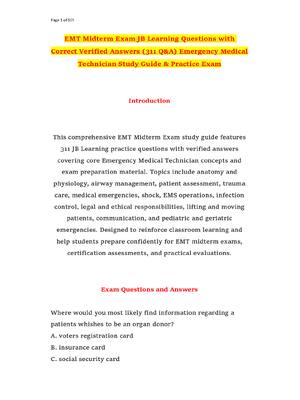
JBL Module 2 Practice Exam Questions and Answers 100% Solved – EMT Module 2 – Practice Exam Material
Introduction
This document contains a comprehensive set of practice exam questions and verified answers for JBL EMT Module 2. It covers essential topics including airway management, ventilation, oxygen therapy, CPR, patient assessment, respiratory emergencies, anatomy and physiology, and basic life support concepts. The material is presented in a multiple-choice format with the correct answer provided for each question, making it useful for exam preparation and self-assessment. It aligns with common EMT curriculum objectives and serves as a thorough review resource.
Exam Questions and Answers
The nasopharyngeal airway is MOST beneficial because it:
A. is generally well tolerated in conscious patients with an intact gag reflex.
B. can maintain a patent airway in a semiconscious patient with a gag reflex.
C. can effectively stabilize fractured nasal bones if it is inserted properly.
D. effectively maintains the airway of a patient in cardiopulmonary arrest. --- correct precise answer ---B. can maintain a patent airway in a semiconscious patient with a gag reflex.
The physical act of moving air into and out of the lungs is called:
A. oxygenation.
B. diffusion.
C. ventilation.
D. respiration.
Feedback
Chapter 10, page 393, Ph --- correct precise answer ---C. ventilation.
What occurs when a patient is breathing very rapidly and shallowly?
A. Air is forcefully drawn into the lungs due to the negative pressure created by the rapid respirations.
B. Minute volume increases because of a marked increase in both tidal volume and respiratory rate.
C. Air moves primarily in the anatomic dead space and does not participate in pulmonary gas exchange.
D. The majority of tidal volume reaches the lungs and diffuses across the alveolar-capillary membrane. --- correct precise answer ---C. Air moves primarily in the anatomic dead space and does not participate in pulmonary gas exchange.
[Show More]