Test Bank For FUNDAMENTALS OF NURSING Chapter-Wise Summary Notes For Nursing Diploma Students
Table of Contents
1. Introduction to Nursing Profession
2. Nursing Theories and Conceptual Models
3. Concepts of Health, W
...
Test Bank For FUNDAMENTALS OF NURSING Chapter-Wise Summary Notes For Nursing Diploma Students
Table of Contents
1. Introduction to Nursing Profession
2. Nursing Theories and Conceptual Models
3. Concepts of Health, Wellness, and Illness
4. The Nursing Process
5. Health Assessment and Physical Examination
6. Vital Signs
7. Documentation and Reporting
8. Therapeutic Communication in Nursing
9. Infection Control and Asepsis
10. Safety and Prevention of Injury
11. Personal Hygiene and Bed Making
12. Nutrition
13. Fluid, Electrolyte, and Acid-Base Balance
14. Urinary Elimination
15. Bowel Elimination
16. Oxygenation and Respiratory Care
17. Rest, Sleep, and Comfort
18. Pain Management
19. Medication Administration
20. Wound Care and Pressure Injury Prevention
21. Perioperative Nursing Care
22. Mobility, Immobility, and Body Mechanics
23. Sensory Perception
24. Loss, Grief, and End-of-Life Care
25. Legal and Ethical Aspects of Nursing
26. Admission, Transfer, and Discharge
27. Specimen Collection and Diagnostic Tests
28. Growth and Development Across the Lifespan
29. Cultural and Spiritual Aspects of Care
30. Stress, Coping, and Adaptation
31. First Aid and Emergency Nursing Basics
32. Complementary and Alternative Therapies
33. Leadership, Management, and Quality in Nursing
34. Community and Public Health Nursing Basics
35. Nursing Informatics and Documentation Technology
36. Glossary of Common Nursing and Medical Terms
37. Reference Table - Normal Laboratory and Vital Sign Values
38. Worked Example - Sample Nursing Care Plan
39. Step-by-Step Guide to Common Nursing Procedures
Chapter 1: Introduction to Nursing Profession
Nursing is a caring profession focused on promoting, maintaining, and restoring
health, and preventing illness, for individuals, families, and communities.
Definition of Nursing
• Florence Nightingale: 'Nursing is putting the patient in the best condition for
nature to act upon him.'
• Virginia Henderson: Nursing assists the individual, sick or well, in performing
activities contributing to health, recovery, or peaceful death.
• ICN (International Council of Nurses): Nursing encompasses autonomous and
collaborative care of individuals of all ages, families, groups and communities.
History and Evolution of Nursing
• Pre-Nightingale era: care provided mostly by religious orders and untrained
women.
• Florence Nightingale (1820-1910): Founder of modern nursing; established first
nursing school at St. Thomas Hospital, London (1860).
• Contribution during Crimean War: improved sanitation, reduced mortality rate.
• Development of nursing education, licensure, and professional bodies in the
20th century.
Characteristics of a Profession
• Specialized body of knowledge and skills.
• Formal education and training.
• Code of ethics and standards of practice.
• Autonomy and accountability.
• Service orientation to society.
Qualities of a Good Nurse
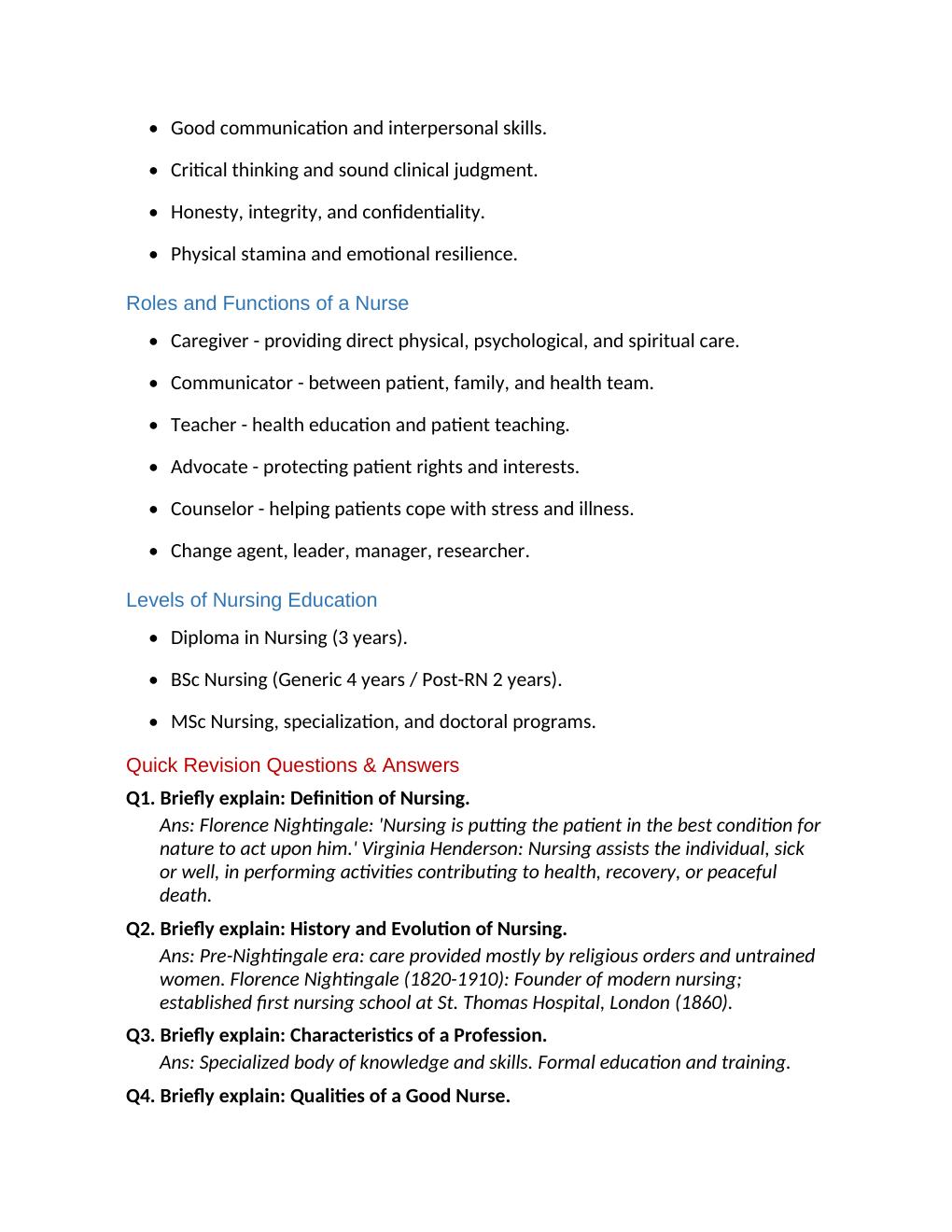
• Compassion, patience, and empathy.
• Good communication and interpersonal skills.
• Critical thinking and sound clinical judgment.
• Honesty, integrity, and confidentiality.
• Physical stamina and emotional resilience.
Roles and Functions of a Nurse
• Caregiver - providing direct physical, psychological, and spiritual care.
• Communicator - between patient, family, and health team.
• Teacher - health education and patient teaching.
• Advocate - protecting patient rights and interests.
• Counselor - helping patients cope with stress and illness.
• Change agent, leader, manager, researcher.
Levels of Nursing Education
• Diploma in Nursing (3 years).
• BSc Nursing (Generic 4 years / Post-RN 2 years).
• MSc Nursing, specialization, and doctoral programs.
Quick Revision Questions & Answers
Q1. Briefly explain: Definition of Nursing.
Ans: Florence Nightingale: 'Nursing is putting the patient in the best condition for
nature to act upon him.' Virginia Henderson: Nursing assists the individual, sick
or well, in performing activities contributing to health, recovery, or peaceful
death.
Q2. Briefly explain: History and Evolution of Nursing.
Ans: Pre-Nightingale era: care provided mostly by religious orders and untrained
women. Florence Nightingale (1820-1910): Founder of modern nursing;
established first nursing school at St. Thomas Hospital, London (1860).
Q3. Briefly explain: Characteristics of a Profession.
Ans: Specialized body of knowledge and skills. Formal education and training.
Q4. Briefly explain: Qualities of a Good Nurse.
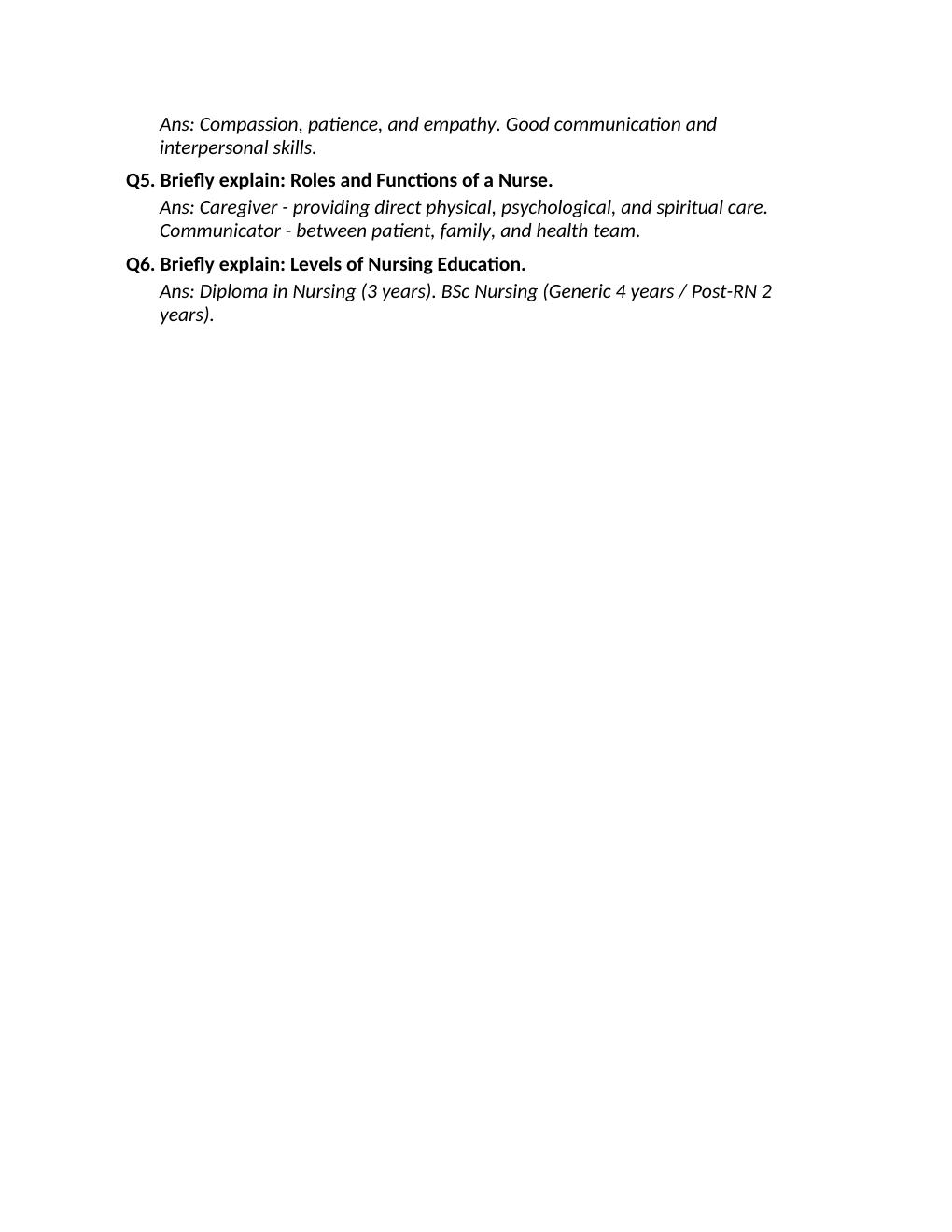
Ans: Compassion, patience, and empathy. Good communication and
interpersonal skills.
Q5. Briefly explain: Roles and Functions of a Nurse.
Ans: Caregiver - providing direct physical, psychological, and spiritual care.
Communicator - between patient, family, and health team.
Q6. Briefly explain: Levels of Nursing Education.
Ans: Diploma in Nursing (3 years). BSc Nursing (Generic 4 years / Post-RN 2
years).
[Show More]