Global Economy (Econ,IS 13) Homework
Document Content and Description Below
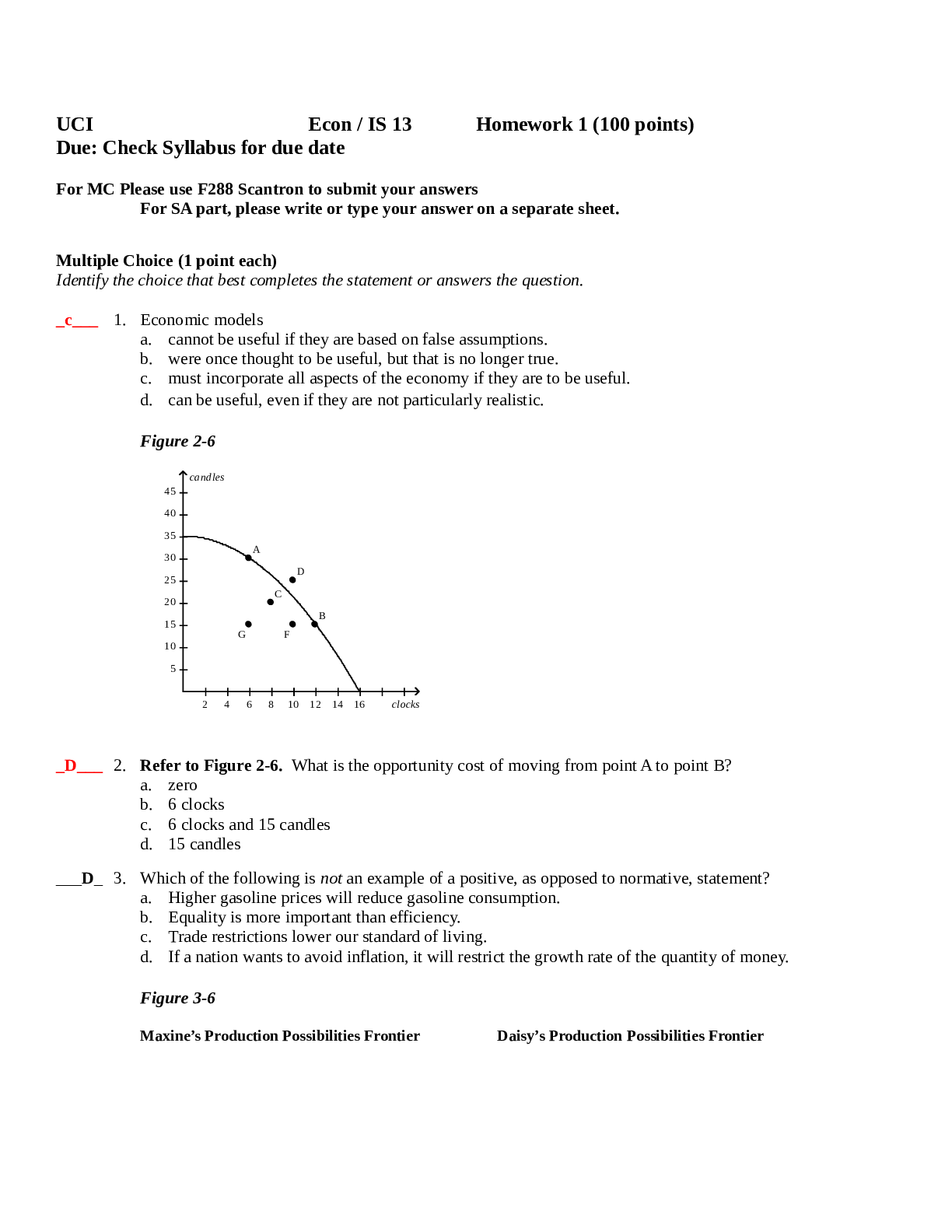
In the United States, incomes have historically grown
a. about 0.5 percent per year.
b. about 2 percent per year.
c. about 4 percent per year.
d. about 6 percent per year.
____ 2. Which of the following is an im
...
[Show More]
Last updated: 3 years ago
Preview 1 out of 18 pages
Instant download

Buy this Document to get the Full Access Instantly
Provided by Students Who Aced it
We Verify Document Content to Gurantee Accuracy
Reviews( 0 )
Document information
Connected school, study & course
About the document
Uploaded On
Jun 25, 2020
Number of pages
18
Written in
All

Additional information
This document has been written for:
Uploaded
Jun 25, 2020
Downloads
0
Views
206
Topic Tags
Related Subjects & Courses
Explore similar study resources and related concepts.
Recommended For You
Get more on EXAM »

$9
17 Pages
TEST BANK FOR ECON/IS 13. A COMPLETE GUIDE FOR EXAM PREPARATIO...

$12.5
18 Pages
University Of California | Econ-IS 13 Homework 2 .LATEST SOLUT...
$8
18 Pages
UCI Econ / IS 13 Homework 2 (100 points) Question and Answers
 Homework 1.png)
 Homework 2.png)

$6
9 Pages
BUIS1301 final exam study guide| 103 QUESTIONS| WITH COMPLETE...
$15
486 Pages
Solutions Manual for Financial Statement Analysis 13th Edition...

$24
715 Pages
Test Bank for Financial Statement Analysis 13th Edition by Cha...

$25
345 Pages
SOLUTIONS MANUAL for Financial Reporting and Analysis 13th Edi...

$12
144 Pages
Database Systems: Design, Implementation, & Management (Corone...

$15
275 Pages
Test Bank for Financial Statement Analysis 13th Edition By Cha...
$25
345 Pages
Instructor Manual With Test Bank For Research Methods, Design,...

$10
16 Pages
HIS 1301 Unit 2 Assessment .docx HIS ï‚·Question 1 Whi...

$9
133 Pages
Rasmussen College - NURSING 2058Health Assessment Exam 2 study...

More related documents below

.png)
.png)