CHE 131, Exam 3 Fall 2023 Form 1A
1
CHE 131 Exam 3 Fall 2023 Version 1A
Directions:
1. Do not open this exam until told to do so.
2. Place your ID (face up), pencils, erasers, and a scientific calculator at your des
...
CHE 131, Exam 3 Fall 2023 Form 1A
1
CHE 131 Exam 3 Fall 2023 Version 1A
Directions:
1. Do not open this exam until told to do so.
2. Place your ID (face up), pencils, erasers, and a scientific calculator at your desk.
3. Place all other items out of sight at the side of the room and/or under your seat.
4. Verify that the Form number (1A, 2B, 3C, or 4D) on your Scantron and your exam packet match.
a. On your Scantron, write and bubble in:
i. LAST NAME
ii. FIRST NAME
iii. IDENTIFICATION NUMBER
5. Under Course Name, write “CHE 131”.
6. All Scantron forms must be submitted by 9:50 pm. No extra time will be given.
7. All answers must be entered on the Scantron answer sheet, which you must turn in before leaving.
Scantrons will not be returned; record your answers in the space provided in the exam packet next to each
question for comparison with the answer keys when they are posted on Brightspace. Use blank spaces
between questions, backs of pages, and extra sheets for scratch work and calculations.
8. Once you open the exam, double check that you have all exam pages, including a Periodic Table and a
sheet of useful conversions, constants, and equations. Page numbers and total number of pages are at the
bottom of each page. If you are missing pages, request a new copy of the exam.
9. During the exam you will be asked to show your ID and sign in on an attendance sheet.
10. General Chemistry Policies:
a. Possession of cell phones, other digital devices, or any unauthorized materials during the exam
will result in a grade of 0 on this exam, a report to Academic Judiciary, and a possible grade of F
for the course.
b. If you do not have an ID to verify your identity, you must see Dr. Crapo the day after the exam
and show her a valid ID.CHE 131, Exam 3 Fall 2023 Form 1A
2
Blank PageCHE 131, Exam 3 Fall 2023 Form 1A
3
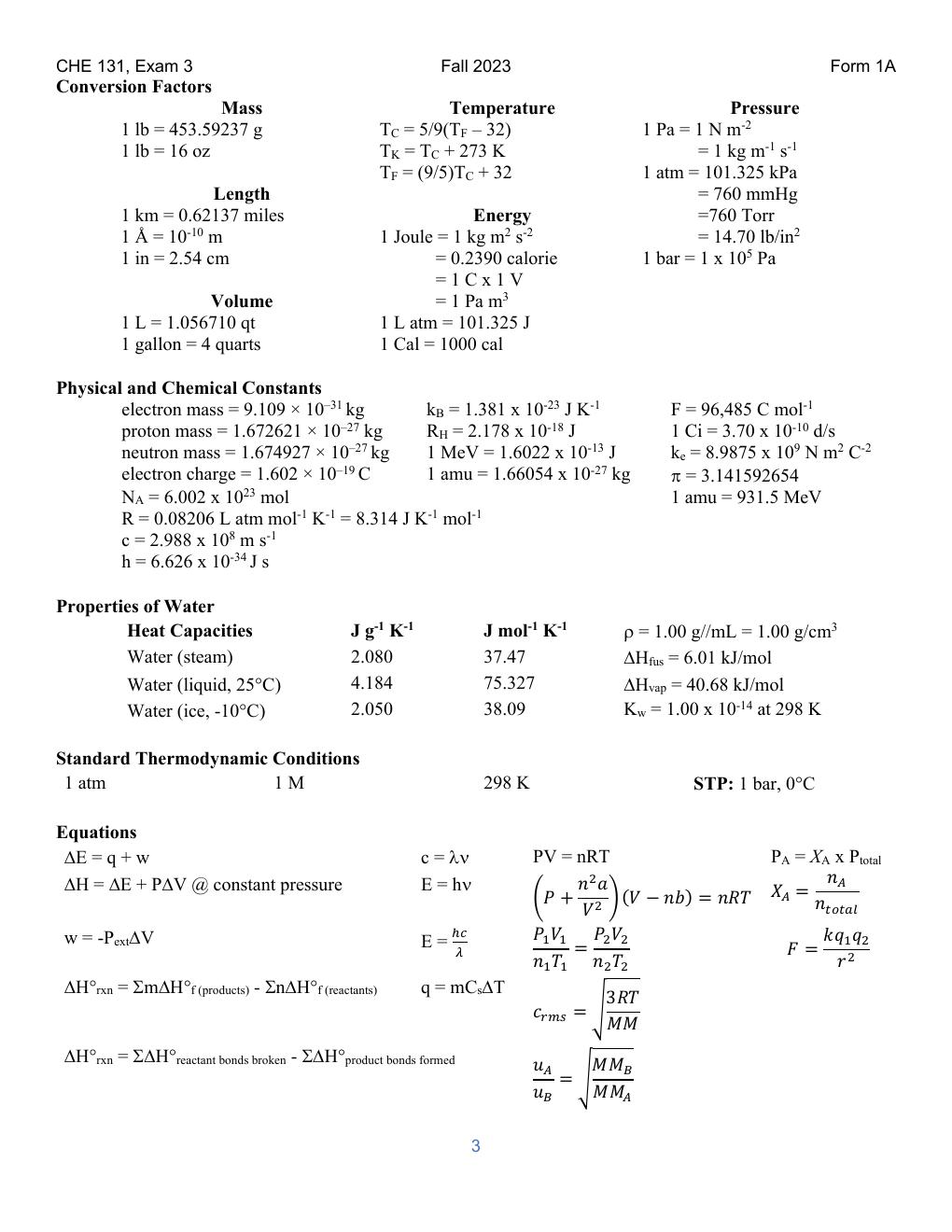
Conversion Factors
Mass Temperature Pressure
1 lb = 453.59237 g TC = 5/9(TF – 32) 1 Pa = 1 N m-2
1 lb = 16 oz TK = TC + 273 K = 1 kg m-1 s-1
TF = (9/5)TC + 32 1 atm = 101.325 kPa
Length = 760 mmHg
1 km = 0.62137 miles Energy =760 Torr
1 Å = 10-10 m 1 Joule = 1 kg m2 s-2 = 14.70 lb/in2
1 in = 2.54 cm = 0.2390 calorie 1 bar = 1 x 10⁵ Pa
= 1 C x 1 V
Volume = 1 Pa m3
1 L = 1.056710 qt 1 L atm = 101.325 J
1 gallon = 4 quarts 1 Cal = 1000 cal
Physical and Chemical Constants
electron mass = 9.109 × 10⁻³¹ kg kB = 1.381 x 10⁻²³ J K-1 F = 96,485 C mol-1
proton mass = 1.672621 × 10⁻²⁷ kg RH = 2.178 x 10⁻¹⁸ J 1 Ci = 3.70 x 10⁻¹⁰ d/s
neutron mass = 1.674927 × 10⁻²⁷ kg 1 MeV = 1.6022 x 10⁻¹³ J ke = 8.9875 x 10⁹ N m2 C-2
electron charge = 1.602 × 10⁻¹⁹ C 1 amu = 1.66054 x 10⁻²⁷ kg p = 3.141592654
NA = 6.002 x 10²³ mol 1 amu = 931.5 MeV
R = 0.08206 L atm mol-1 K-1 = 8.314 J K-1 mol-1
c = 2.988 x 10⁸ m s-1
h = 6.626 x 10⁻³⁴ J s
Properties of Water
Heat Capacities J g-1 K-1 J mol-1 K-1 r = 1.00 g//mL = 1.00 g/cm3
Water (steam) 2.080 37.47 DHfus = 6.01 kJ/mol
Water (liquid, 25°C) 4.184 75.327 DHvap = 40.68 kJ/mol
Water (ice, -10°C) 2.050 38.09 Kw = 1.00 x 10⁻¹⁴ at 298 K
Standard Thermodynamic Conditions
1 atm 1 M 298 K STP: 1 bar, 0°C
Equations
DE = q + w c = ln PV = nRT PA = XA x Ptotal
DH = DE + PDV @ constant pressure E = hn !𝑃 + 𝑛!𝑎
𝑉! ' (𝑉 − 𝑛𝑏) = 𝑛𝑅𝑇 𝑋" = 𝑛"
𝑛#$#%&
w = -PextDV E = '(
)
𝑃*𝑉*
𝑛*𝑇* =
𝑃!𝑉!
𝑛!𝑇! 𝐹 =
𝑘𝑞*𝑞!
𝑟!
DH°rxn = SmDH°f (products) - SnDH°f (reactants) q = mCsDT
𝑐
+,- = 53𝑅𝑇
𝑀𝑀
DH°rxn = SDH°reactant bonds broken - SDH°product bonds formed
𝑢"
𝑢.
= 5𝑀𝑀.
𝑀𝑀"CHE 131, Exam 3 Fall 2023
[Show More]