Scenario Overview
Patient: Marvin Hayes
Diagnosis: Laparoscopic abdominal perineal resection with sigmoid colostomy for rectal cancer (adenocarcinoma)
Brief Summary:
Marvin Hayes is a 43-year-old white male pat
...
Scenario Overview
Patient: Marvin Hayes
Diagnosis: Laparoscopic abdominal perineal resection with sigmoid colostomy for rectal cancer (adenocarcinoma)
Brief Summary:
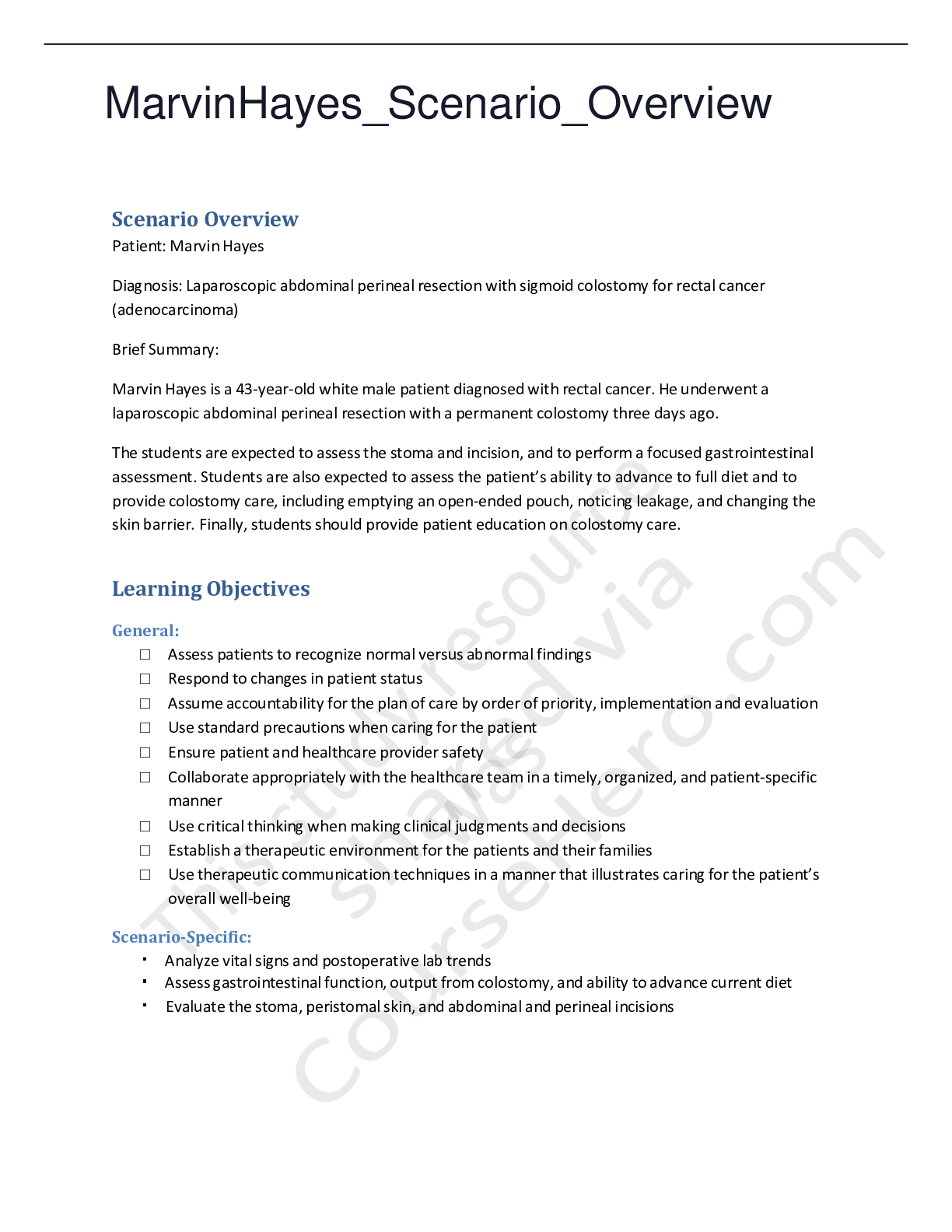
Marvin Hayes is a 43-year-old white male patient diagnosed with rectal cancer. He underwent a laparoscopic abdominal perineal resection with a permanent colostomy three days ago.
The students are expected to assess the stoma and incision, and to perform a focused gastrointestinal assessment. Students are also expected to assess the patient’s ability to advance to full diet and to provide colostomy care, including emptying an open-ended pouch, noticing leakage, and changing the skin barrier. Finally, students should provide patient education on colostomy care.
Learning Objectives
General:
□ Assess patients to recognize normal versus abnormal findings
□ Respond to changes in patient status
□ Assume accountability for the plan of care by order of priority, implementation and evaluation
□ Use standard precautions when caring for the patient
□ Ensure patient and healthcare provider safety
□ Collaborate appropriately with the healthcare team in a timely, organized, and patient-specific manner
□ Use critical thinking when making clinical judgments and decisions
□ Establish a therapeutic environment for the patients and their families
□ Use therapeutic communication techniques in a manner that illustrates caring for the patient’s overall well-being
Scenario-Specific:
Analyze vital signs and postoperative lab trends
Assess gastrointestinal function, output from colostomy, and ability to advance current diet
Evaluate the stoma, peristomal skin, and abdominal and perineal incisions
Demonstrate appropriate colostomy care, including emptying the ostomy pouch and changing the skin barrier
Patient Case Introduction to Students
Location: Surgical Unit 0800 Report from night nurse:
Situation: Mr. Hayes is a 43-year-old white male who underwent a laparoscopic abdominal perineal resection with a permanent sigmoid colostomy 3 days ago for rectal cancer.
Background: Mr. Hayes experienced weight loss, increasing fatigue, and narrowing stools with blood, which led to the diagnosis of rectal adenocarcinoma and the recent surgery.
Assessment: Vital signs have been stable with a saturation of 94%–97%. Pain level is currently 1 after pain medication was administered an hour ago. The colostomy appliance is an open-ended pouch attached to a skin barrier. The stoma is red and moist with liquid, brown stool output. The three small abdominal incisions are open to air. There is a clean pad covering the perineal incision. Mr. Hayes has been up and ambulating and is taking full liquids.
Recommendation: It is time for Mr. Hayes's morning assessment. Assess his colostomy, and empty the pouch, if necessary. He can advance to a regular diet as tolerated. Start providing patient education to prepare him for discharge in 2–3 days.
Patient Details
Patient Data: Male, White, 43 years. Weight: 75 kg (165 lb), Height: 178 cm (70 in.) DOB: 03/25/XX
Allergies: No known allergies Immunizations: Up to date Past Medical History:
□ No remarkable past medical history
□ Family history of colorectal cancer
Provider’s Orders
Post-op Orders:
• Vital signs every 6 hours
• Diet:
o Full liquids, advance to regular diet as tolerated
• Activity: Out of bed ad lib. Ambulate in hallway
• Labs: Complete blood count and basic metabolic panel daily
• Use incentive spirometer 10 times every hour
• Medication:
o Omeprazole 40 mg orally daily at 0900
o Enoxaparin sodium 40 mg subcutaneously daily at 0900
o Hydrocodone/Acetaminophen 10/325 mg orally prn for pain every 4 hours
• Call orders:
o HR less than 60/min, greater than 120/min
o RR less than 10/min, greater than 30/min
o SpO2 less than 94%
o Systolic BP less than 90 mm Hg, greater than 160 mm Hg
o Diastolic BP less than 50 mm Hg, greater than 90 mm Hg
o Temperature less than 36 °C (97 °F), greater than38.6 °C (101.3 °F)
Nursing Diagnoses
Impaired Skin Integrity related to disruption of skin from the surgical procedure, sigmoid colostomy formation, and potential skin irritation from feces and colostomy appliance
Defining Characteristics:
• Presence of three laparoscopic abdominal incisions and perineal incision
• Stoma in left lower quadrant with ostomy bag and fecal excretion
Imbalanced Nutrition: Less Than Body Requirements related to decreased preoperative intake associated with rectal cancer and surgery
Defining Characteristics:
• Weight loss prior to surgery
• Diet not meeting nutritional needs
Deficient Knowledge related to unfamiliarity with information resources on colostomy care and effects of diet on stool consistency and flatus
Defining Characteristics:
• Verbalization of lack of knowledge to perform colostomy care
• Limited exposure to colostomy care and diet with a new colostomy
Disturbed Body Image related to presence of permanent colostomy Defining Characteristics:
• Concern about stool in colostomy pouch
• Unease with loss of control of bowel elimination and odor
• Apprehension about reaction of others
Overview of Proposed Correct Treatment
• Wash hands, introduce self, and identify patient
• Obtain vital signs, including asking about allergies and pain level
• Auscultate lungs and abdomen
• Check the provider’s orders and diagnostics in the electronic health record (EHR)
• Assess IV site, the abdominal incisions, and the perineal incision
• Assess the ostomy and change the ostomy pouch
• Provide patient education on ostomy care, diet, and incentive spirometry
• Have the patient use the incentive spirometer
Case Considerations
This case presents a male patient diagnosed with rectal cancer. He underwent a laparoscopic abdominal perineal resection with a permanent colostomy 3 days ago. The students are expected to demonstrate basic assessments of the stoma and incision and a focused gastrointestinal assessment. Students are also expected to assess the patient's ability to advance to full diet and to provide colostomy care, including emptying an open-ended pouch, noticing leakage, and changing the skin barrier. Finally, the students should provide patient education on colostomy care. Students should assess the stoma for complications such as retraction, bleeding, or compromised circulation. The stoma appearance should be deep pink to red and moist, usually protruding ½ to 1 inch from the abdominal wall with some initial edema that should subside over a few weeks. The peristomal skin surrounding the stoma should be kept clean, dry, and protected to prevent irritation or breakdown. An open-ended or drainable pouch is emptied when it is one-third full. A close-ended pouch requires changing when it is half full. Failure to measure the stoma size and fit the pouch properly (an opening no more than 1/8 inch larger than the stoma) can injure the stoma, cause pouch leakage, and induce peristomal skin irritation. During ostomy care, the students can teach the patient about self-care and assess the patient's acceptance of the colostomy.
[Show More]