Guided Reflection Questions
Opening Questions
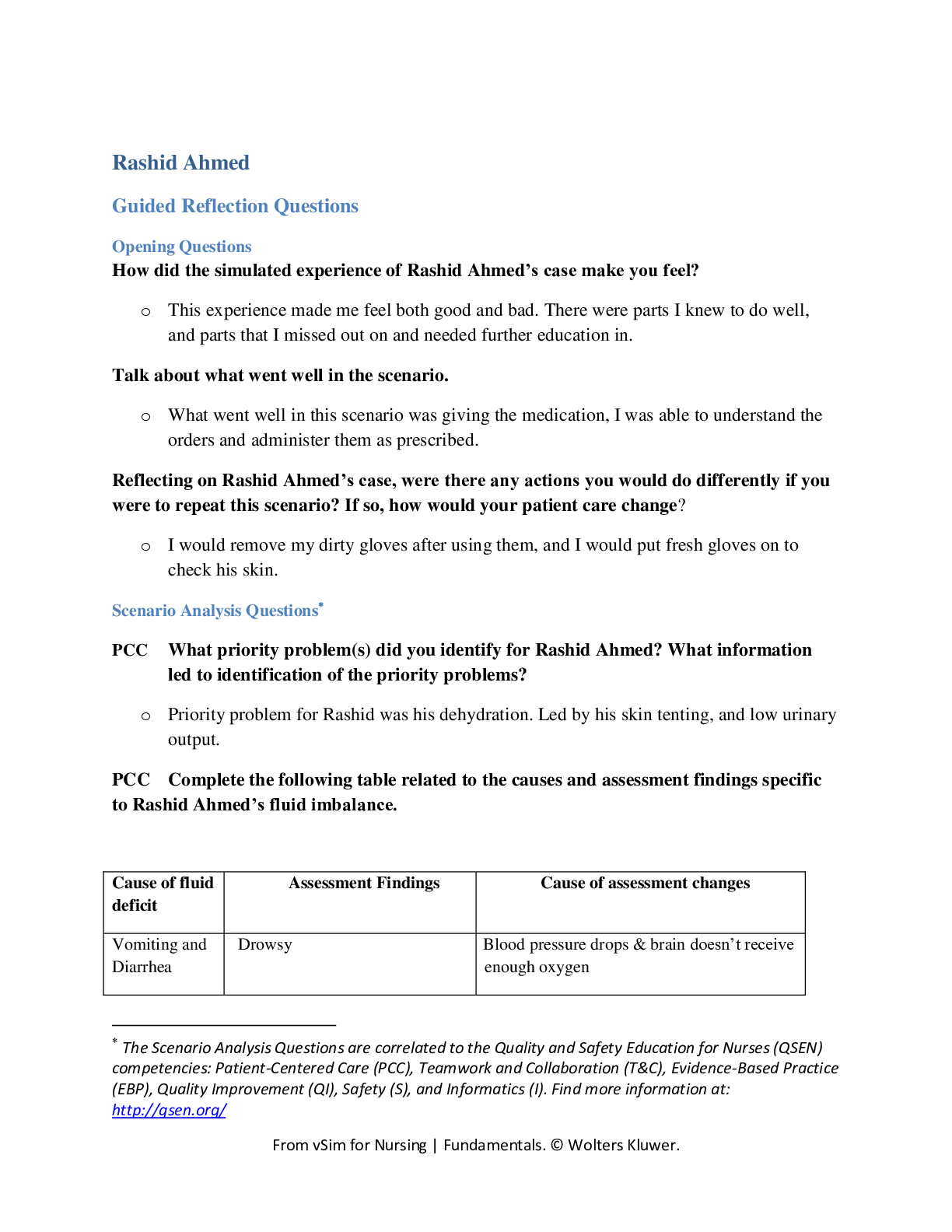
How did the simulated experience of Rashid Ahmed’s case make you feel?
It made me feel a bit frustrated because it took me a few times to master. I seemed to forget a fe
...
Guided Reflection Questions
Opening Questions
How did the simulated experience of Rashid Ahmed’s case make you feel?
It made me feel a bit frustrated because it took me a few times to master. I seemed to forget a few things each time. I think I am just tired from a long day.
Talk about what went well in the scenario.
Overall, the entire scenario went well. I felt comfortable in that I knew what to assess and what not to.
Reflecting on Rashid Ahmed’s case, were there any actions you would do differently if you were to repeat this scenario? If so, how would your patient care change?
Yes, I would be sure to assess the patient for nausea before giving PO medication. This was especially important for this patient given his recent history with nausea, but it it’s a good habit to form with any patient before PO medication administration in order to insure they are treated effectively and not to waste medication.
Scenario Analysis Questions?
PCC What priority problem(s) did you identify for Rashid Ahmed? What information led to identification of the priority problems?
1. At risk for injury AEB patients reports of dizziness, weakness and a recent history of nearly passing out while going to the bathroom.
2. Fluid volume deficit AEB nausea, vomiting, and severe diarrhea for 3 days and the patient inability to keep down water and fluids.
3. Fluid & Electrolyte Imbalance AEB hypokalemia and hyponatremia.
4. Acid base imbalance AEB ABG values of (pH: 7.31, Hco3: 15, PaCo2: 35) that indicate respiratory acidosis.
Cause of
fluid deficit Assessment Findings Cause of assessment
changes
Vomiting 3-day Hx of nausea, vomiting, and Possible food poisoning or food
and severe diarrhea. infection.
Diarrhea 10-pound weight loss reported by Patient reports food and fluid intake
Nausea patient during admission weight has been minimal to none since
assessment. beginning of his symptoms 3 days
ago.
PCC What potential problems could arise if the identified fluid and electrolyte imbalances are not corrected?
Possible complications of untreated or uncorrected hypokalemia are cardiac arrhythmia, cardiac arrest, ileus, rhabdomyolysis, respiratory failure, and death.
Possible complications of untreated or uncorrected hyponatremia are seizures, coma, permanent neurologic damage, and risk of brainstem herniation when sodium levels fall below 120 mEq/L.
EBP Identify the rationale for weighing Rashid Ahmed at the same time each day wearing the same clothing.
It is important to weight any patient who is under a strict I&O order at the same time and in the same clothing because that is when the patients baseline weight was established and keeping the patient as close to that same baseline situation is the best way to insure the I&O are accurate.
EBP Discuss the rationale for infusion of 0.9% normal saline.
Normal saline infusion is used for extracellular fluid replacement as treatment for dehydration as well mild cases of hyponatremia.
S Identify potential patient safety issues
Potential safety concerns for this patient is fall risk related to his dizziness, weakness and feeling of fainting when getting up to toilet recently
T&C What other interprofessional team members should be involved in Rashid Ahmed’s care? Cardiologist, pharmacy, nutrition, and respiratory therapy for ABG labs.
Concluding Questions
Describe how you would apply the knowledge and skills that you obtained in Rashid Ahmed’s case to an actual patient care situation.
I feel like the education portion of all the all the VSIMs thus far has been very helpful in helping me learn how to effectively teach patient in a real-life setting. Especially when it comes to important teaching about safety regarding environment, activity level and adverse reactions to medication. I feel like it will help me remember to be more thorough with my own a patient in the near future.
[Show More]