Med surg ATI|Solano Community College - NURSING nursing 1
• Accident/Error/Injury Prevention - (1)
o Spinal Cord Injury: Care of a Client who has a Halo Device (Active Learning Template - Therapeutic Procedure, RM AMS
...
Med surg ATI|Solano Community College - NURSING nursing 1
• Accident/Error/Injury Prevention - (1)
o Spinal Cord Injury: Care of a Client who has a Halo Device (Active Learning Template - Therapeutic Procedure, RM AMS RN 10.0 Chp 16)
o The purpose is to provide traction and/or immobilize the spinal column
Do not use the halo device to turn or move a client
If the client goes home with a halo fixation device on, provide instruction on pin and vest care.
Teach the client signs of infection and skin breakdown.
Maintain body alignment and ensure cervical tong weights hang freely.
Monitor skin integrity by providing pin care and assessing the skin under the halo fixation vest as appropriate.
• Standard Precautions/Transmission-Based Precautions/Surgical Asepsis - (1)
o Bacterial, Viral, Fungal, and Parasitic Infections: Isolation Precautions for Client Who Has Influenza (Active Learning Template - Basic Concept, RM FUND RN 9.0 Ch 56)
Contact: Clostridium difficile, herpes simplex virus, impetigo, methicillin‑resistant Staphylococcus aureus (MRSA), vancomycin‑resistant Staphylococcus aureus (VRSA)
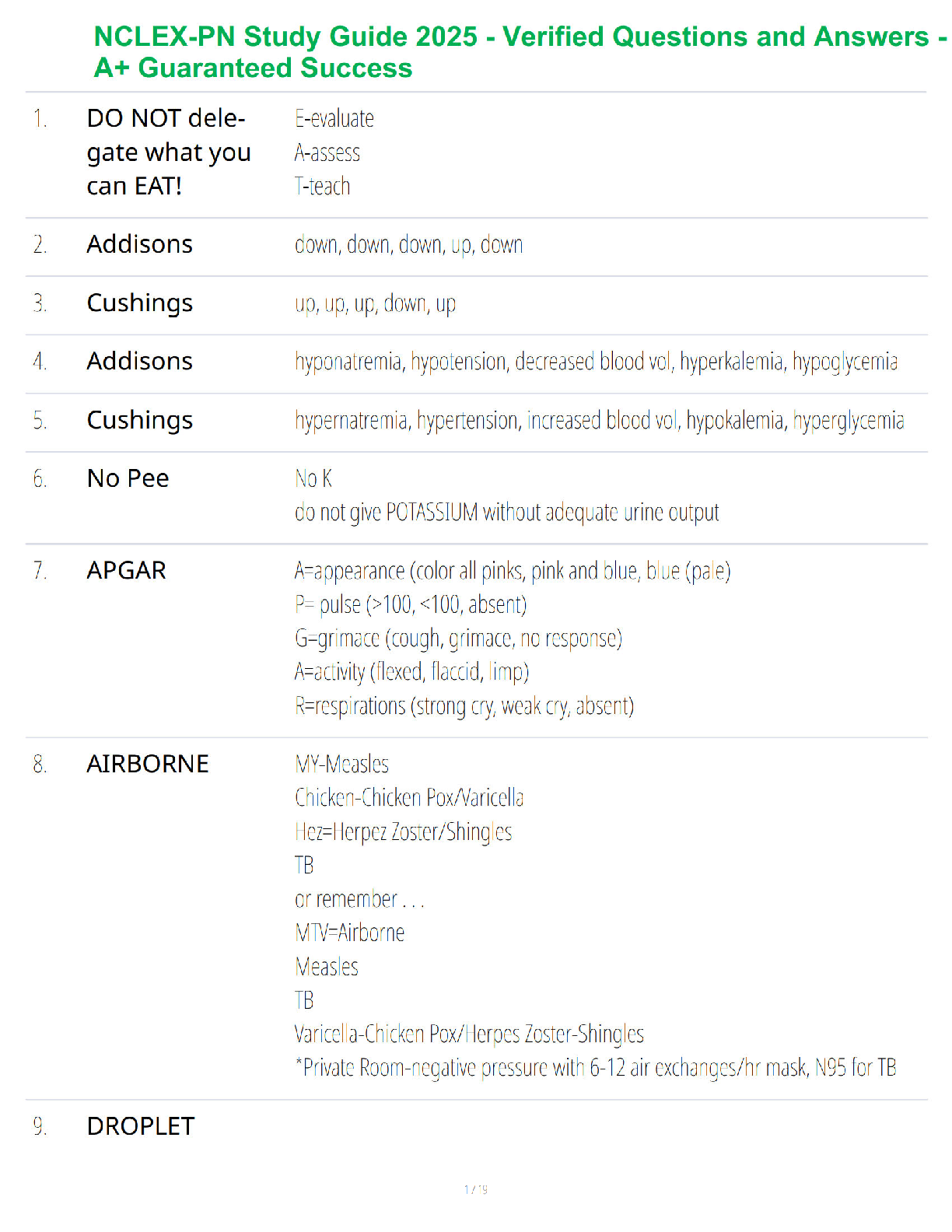
Airborne: Measles, varicella, tuberculosis
Droplet (3-6 ft): Haemophilus influenzae type B (Hib), pertussis, mumps, rubella, plague, streptococcal pneumonia, meningococcal pneumonia
• Tuberculosis: Priority Action for a Client in the Emergency Department (Active Learning Template - System Disorder, RM AMS RN 10.0 Chp 23)
Administer heated and humidified oxygen therapy as prescribed
The client should be transported using the shortest and least busy route
cough and expectorate sputum into tissues that are disposed of by the client into provided plastic bags or no‑touch receptacles
Clients are no longer considered infectious after three consecutive negative sputum cultures
• Adverse Effects/Contraindications/Side Effects/Interactions - (1)
o Electrolyte Imbalances: Manifestations of Hypokalemia (Active Learning Template - Medication, RM AMS RN 10.0 Chp 44)
VITAL SIGNS:
Decreased blood pressure, thready weak pulse, orthostatic hypotension
NEUROLOGIC:
Altered mental status, anxiety, and lethargy that progresses to acute confusion and coma
ECG:
Flattened T wave, prominent U waves, ST depression, prolonged PR interval
GASTROINTESTINAL:
Hypoactive bowel sounds, nausea, vomiting, constipation, abdominal distention. Paralytic ileus can develop.
MUSCULAR:
Weakness. Deep‑tendon reflexes can be reduced.
RESPIRATORY: Shallow breathing
• Blood and Blood Products - (1)
o Blood and Blood Product Transfusions: Steps to Administer a Blood Transfusion (Active Learning Template - Therapeutic Procedure, RM AMS RN 10.0 Chp 40)
● Verify the prescription for a specific blood product.
● Obtain consent for procedure if required.
● Obtain blood samples for compatibility determination, such as type and cross‑match.
● Assess for a history of blood‑transfusion reactions.
● Initiate large‑bore IV access. An 18‑ or 20‑gauge needle is standard for administering blood products.
● Obtain blood products from the blood bank. Inspect the blood for discoloration, excessive bubbles, or cloudiness.
● Prior to transfusion, two RNs must identify the correct blood product and client by looking at the hospital identification number (noted on the blood product) and the number identified on the client’s identification band to make sure the numbers match.
● The nurse completing the blood product verification must be one of the nurses who administers the blood product.
● Prime the blood administration set with 0.9% sodium chloride only. Never add medications to blood products. Y‑tubing with a filter is used to transfuse blood.
● Begin the transfusion, and use a blood warmer if indicated. Initiate the transfusion within 30 min of obtaining the blood product to reduce the risk of bacterial growth.
• Central Venous Access Devices - (2)
o Cardiovascular Diagnostic and Therapeutic Procedures: Administering Medication Through a Nontunneled Percutaneous Central Catheter (Active Learning Template - Therapeutic Procedure, RM AMS RN 10.0 Chp 27)
Insertion location:
subclavian vein, jugular vein; tip in the distal third of the superior vena cava
Indications: Short-term use only
administration of blood, long‑term administration of chemotherapeutic agents, antibiotics, and total parenteral nutrition
o Cardiovascular Diagnostic and Therapeutic Procedures: Removing a Peripherally Inserted Central Catheter (Active Learning Template - Therapeutic Procedure, RM AMS RN 10.0 Chp 27)
Length of use: up to 12 months
Assess Picc line every 8 hrs
Change tubes and caps every 3 days
Follow facility protocol for dressing changes, usually every 7 days and when indicated (wet, loose, soiled).
• Expected Actions/Outcomes - (1)
o Electrolyte Imbalances: Effective Action of Magnesium Sulfate (Active Learning Template - Medication, RM AMS RN 10.0 Chp 44)
IV route is used because IM can cause pain and tissue damage
Oral magnesium can cause diarrhea and increase magnesium depletion
Monitor Deep Tendon Reflex (DTR) hourly during administration of magnesium sulfate.
IV magnesium sulfate is given via an infusion pump not to exceed 150 mg/min, or 67 mEq over an 8‑hr period
Clients receiving digitalis should be monitored closely if magnesium is low because it predisposes the client to digitalis toxicity.
• Medication Administration - (1)
o Heart Failure and Pulmonary Edema: Client Teaching on Use of Furosemide (Active Learning Template - Medication, RM AMS RN 10.0 Chp 32)
Use to decrease preload
Teach clients taking loop or thiazide diuretics to ingest foods and drinks that are high in potassium to counter the effects of hypokalemia.
• Total Parenteral Nutrition (TPN) - (1)
o Electrolyte Imbalances: Adequate Nutritional Status with Total Parenteral Nutrition (Active Learning Template - Therapeutic Procedure, RM AMS RN 10.0 Chp 44)
The purpose of TPN administration is to prevent or correct nutritional deficiencies and minimize the adverse effects of malnourishment.
Hypertonic IV bolus solution.
TPN contains complete nutrition, including calories in a high concentration (10% to 50%) of dextrose, lipids/essential fatty acids, protein, electrolytes, vitamins, and trace elements.
INDICATIONS
Any condition that
●● Affects the ability to absorb nutrition.
●● Has a prolonged recovery.
●● Creates a hypermetabolic state.
●● Creates a chronic malnutrition.
• Diagnostic Tests - (1)
o Neurologic Diagnostic Procedures: Preparing a Client for a Lumbar Puncture (Active Learning Template - Diagnostic Procedure, RM AMS RN 10.0 Chp 3)
The risks versus benefits of a lumbar puncture should be discussed with the client prior to this procedure. DO NOT perform when pt has ICP or bleeding disorder or on anticoagulant
Nursing Actions
Ensure that all of the client’s jewelry is removed and that the client is wearing only a hospital gown
Void prior to procedure
Position Pt in “cannonball while on one side” or “stretch over an overbed table when sitting”
• System Specific Assessments - (1)
o Burns: Priority Action During Resuscitation Phase (Active Learning Template - System Disorder, RM AMS RN 10.0 Chp 75)
Emergent (resuscitative phase)
Begins with the injury and continues for 24 to 48 hr.
Priorities include securing the airway, supporting circulation and organ perfusion by fluid replacement, managing pain, preventing infection through wound care, maintaining body temperature, and providing emotional support.
• Alterations in Body Systems - (4)
o Respiratory Management and Mechanical Ventilation: Caring for a Client Who Has an Endotracheal Tube (Active Learning Template - Therapeutic Procedure, RM AMS RN 10.0 Chp 19)
Use caution when moving the client
Apply protective barriers (soft wrist restraints) according to hospital protocol to prevent self‑extubation
Use two staff members for repositioning and to resecuring the tube.
Suction oral and tracheal secretions to maintain tube patency
Have a resuscitation bag with a face mask available at the bedside at all times in case of ventilator malfunction or accidental extubation
Support ventilator tubing to prevent mucosal erosion and displacement.
Document tube placement in centimeters at the client’s teeth or lips.
Assess respiratory status every 1 to 2 hr:
Monitor and document ventilator settings hourly
Never turn off ventilator alarms.
Assess the cuff pressure at least every 8 hr. Maintain below 20 mm Hg
Assess for an air leak around the cuff (client speaking, air hissing, or decreasing SaO2)
o Chest Tube Insertion and Monitoring: Maintaining Drainage System (Active Learning Template - Nursing Skill, RM AMS RN 10.0 Chp 18)
Check the water seal level every 2 hr, and add fluid as needed. The fluid level should fluctuate with respiratory effort
Document the amount and color of drainage hourly for the first 24 hr and then at least every 8 hr.
Position the client in the semi‑to high‑Fowler’s position to promote optimal lung expansion and drainage of fluid from the lungs
Administer pain medications as prescribed
Do not strip or milk tubing; only perform this action when prescribed
Tape all connections between the chest tube and chest tube drainage system.
Keep two enclosed hemostats, sterile water, and an occlusive dressing located at the bedside at all times.
o Cancer Treatment Options: Teaching About Skin Care Following Radiation Treatment (Active Learning Template - Therapeutic Procedure, RM AMS RN 10.0 Chp 91)
Gently wash the skin over the irradiated area with mild soap and water. Dry the area thoroughly using patting motions
Do not remove or wash off radiation tattoos (markings) used to guide therapy. Do not apply powders, ointments, lotions, deodorants, or perfumes to the irradiated skin.
Wear soft clothing. Avoid tight or constricting clothes
Do not expose the irradiated skin to sun or a heat source
Inspect skin for evidence of damage and report to the provider
o Meningitis: Planning Interventions for Care (Active Learning Template - System Disorder, RM AMS RN 10.0 Chp 5)
Isolate the client in a private room as soon as meningitis is suspected. (droplet precaution)
Continue droplet precautions til antibiotics have been administered for 24 hr and secretions are no longer infectious
Clients who have bacterial meningitis might need to remain on droplet precautions continuously.
Implement fever-reduction measures, such as a cooling blanket
Decrease environmental stimuli.(quiet)
Minimize exposure to bright light
HOB 30 degrees
avoid coughing and sneezing
Seizure precaution
Older adults @ Increase risk for pneumonia
• Fluid and Electrolyte Imbalances - (1)
o Hyperthyroidism: Caring for Client Following a Thyroidectomy (Active Learning Template - System Disorder, RM AMS RN 10.0 Chp 78)
Keep the client in a semi-Fowler’s position. Support head and neck with pillows. Avoid neck extension.
monitor vital signs typically every 15 min until stable then every 30 min.
Assist with deep breathing exercises every 30 to 60 min
Check the surgical dressing and back of the neck for excessive bleeding
Check for laryngeal nerve damage by asking the client to speak as soon as awake from anesthesia and every 2 hr thereafter
Reassure the client that discomfort will resolve within a few days
Humidify air, assist to cough and deep breathe, and provide oral and tracheal suction if needed
• Hemodynamics - (2)
o Pacemakers: Evaluating Client Understanding of Discharge Teaching (Active Learning Template - Therapeutic Procedure, RM AMS RN 10.0 Chp 29)
Carry a pacemaker identification card at all times
Prevent wire dislodgement. (Wear sling when out of bed. Do not raise arm above shoulder for 1 to 2 weeks.)
Take pulse daily at the same time. Notify the provider if heart rate is less than the pacemaker rate
Report signs of dizziness, fainting, fatigue, weakness, chest pain, hiccupping, palpitations, difficulty breathing, or weight gain
Resume sexual activity as desired, avoiding positions that put stress on the incision site
[Show More]
_removed.png)






.png)





.png)