NR 602 Midterm Study Guide – Topics 26-30
Cryptosporidium
Pyloric Stenosis
Intussusception
Celiac Disease
Juvenile Idiopathic Arthritis (Page 551-554)
Questions for Thought with Answers & Rationale
The most comm
...
NR 602 Midterm Study Guide – Topics 26-30
Cryptosporidium
Pyloric Stenosis
Intussusception
Celiac Disease
Juvenile Idiopathic Arthritis (Page 551-554)
Questions for Thought with Answers & Rationale
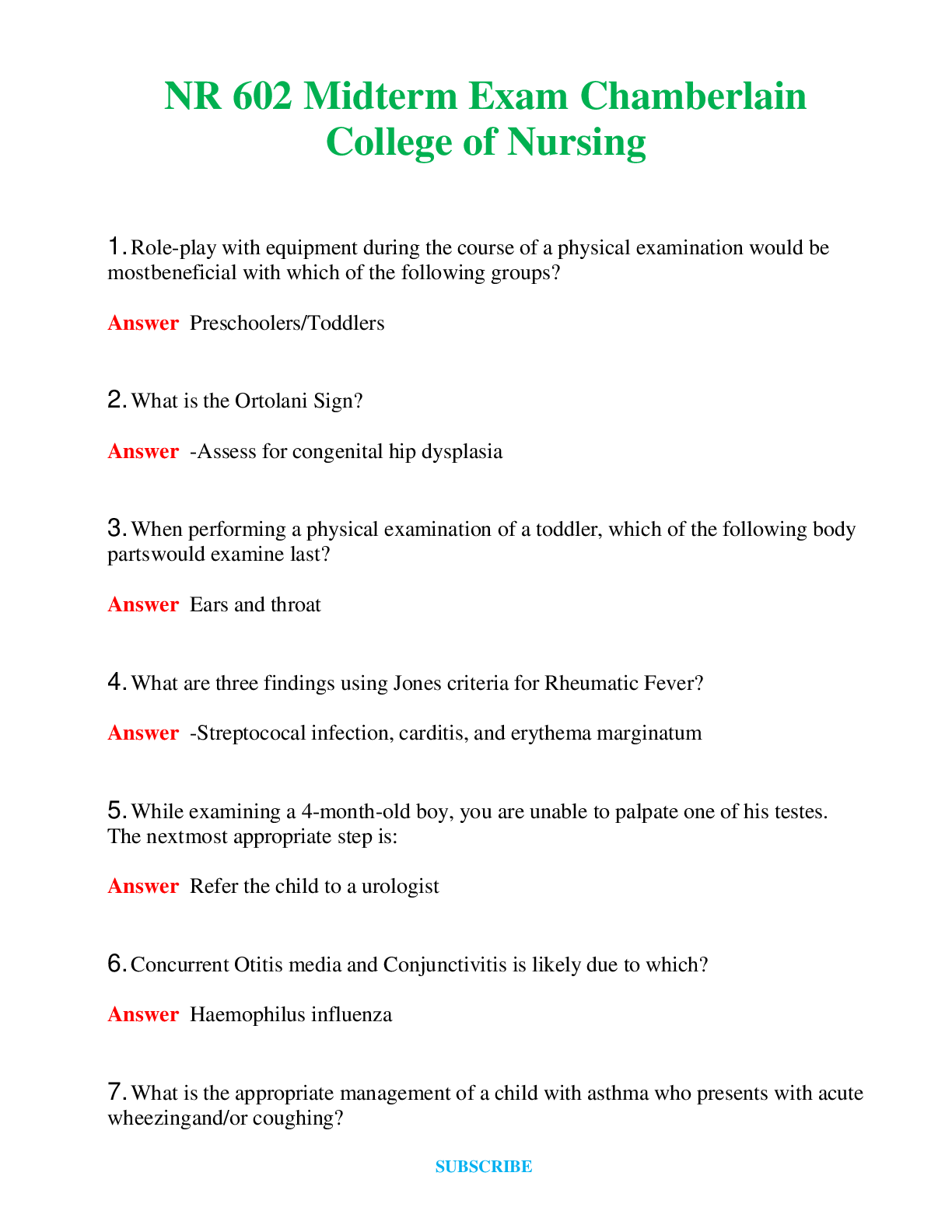
The most common rheumatoid disease of childhood is:
Systemic lupus erythematosus
Kawasaki disease
Juvenile idiopathic arthritis
Legg-Calve Perthes disease
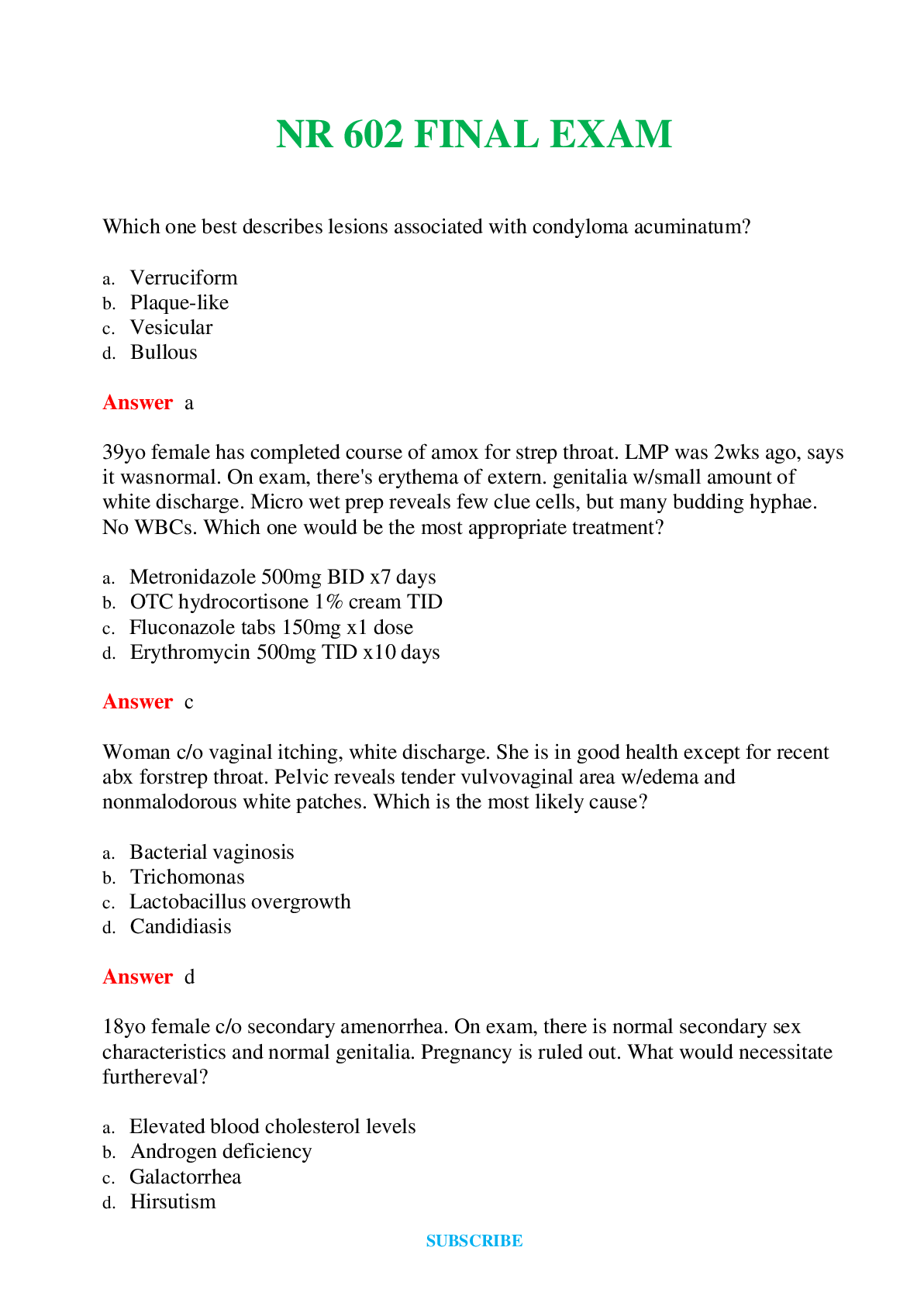
A 14-year-old boy os brought In by his mother who reports that her son has been complaining for several months of recurrent bloating, stomach upset, and occasional lose stools. She reports that he has difficulty gaining weight and is short for his age. … ahs noticed that his symptoms are worse after eating large amounts of crackers, cookies, and breads. She denies seeing blood in the boy’s stool. Which of the following conditions is most likely?
Amebiasis
Malabsorption
Chrohn’s colitis
Celiac disease
A common cause of acute abdominal pain in children under 5 years old?
Appendicitis
Intussusception
Incarcerated hernia
Gastroenteritis
An 18 -month old child is brought to the clinic by her mother and is c/o abrupt onset of vomiting, followed by more than 10 liquid stools with mucus for the past 48 hours. Temp is 100 degrees F orally. The stool smear obtained is negative for WBCs. What is the most likely etiologic pathogen for this young child’s gastroenteritis?
Rotavirus
Shigella dysenteriae
Campylobacter jejuni
Salmonella
The viral gastroenteritis seen in older children and adults has a short incubation (18-72 hours) and short incubation (24-48 hours), is characterized by abrupt onset of nausea and abdominal cramps, followed by vomiting and diarrhea, and is often accompanied by headache and myalgia. What causes this disorder?
Enteric adenovirus
Enteric calicivirus (Norwalk)
Rotavirus
Cytomegalovirus
The family nurse practitioner is interpreting the notation of “string sign” on an upper GI series performed on an infant. This is associated with the dx of:
Intussusception
Hirschsprung’s disease
Pyloric stenosis
GERD
What question by the FNP would be appropriate to ask the parents of an infant suspected of intussusception?
“Does the infant have clay colored stools?”
“Doe.s the infant have projectile vomiting?”
Does the infant have constant abdominal pain?”
Doe.s the infant have red currant jelly stools?”
A 6 year old patient with sore throat has coryza, hoarseness, and diarrhea. What is the likely etiology?
Group A Strep
Parainfluenzae
Viral etiology
Mycoplasma
Which of the following findings could be expected to occur in a baby with intussusception?
Inconsolable screaming
Olive- shaped mass
Left to right peristaltic waves
Weight loss
Vomiting in infancy has a long list of differential diagnoses. Which accompanying symptom would likely point to pyloric stenosis?
Diarrhea
Appropriate growth
Acts hungry after vomiting
Sausage-shaped mass in abdomen
[Show More]




![Preview of WEEK **5 [Chamberlain university]NR 602 IHUMAN Case Week #5 Deborah Arnaudin 54 Year Old](https://browseimages.nyc3.digitaloceanspaces.com/paper-images/2026/03/31/zbQKePwt2026-03-31-11-4669cc328fcad96.png)




 Rasmussen College.png)