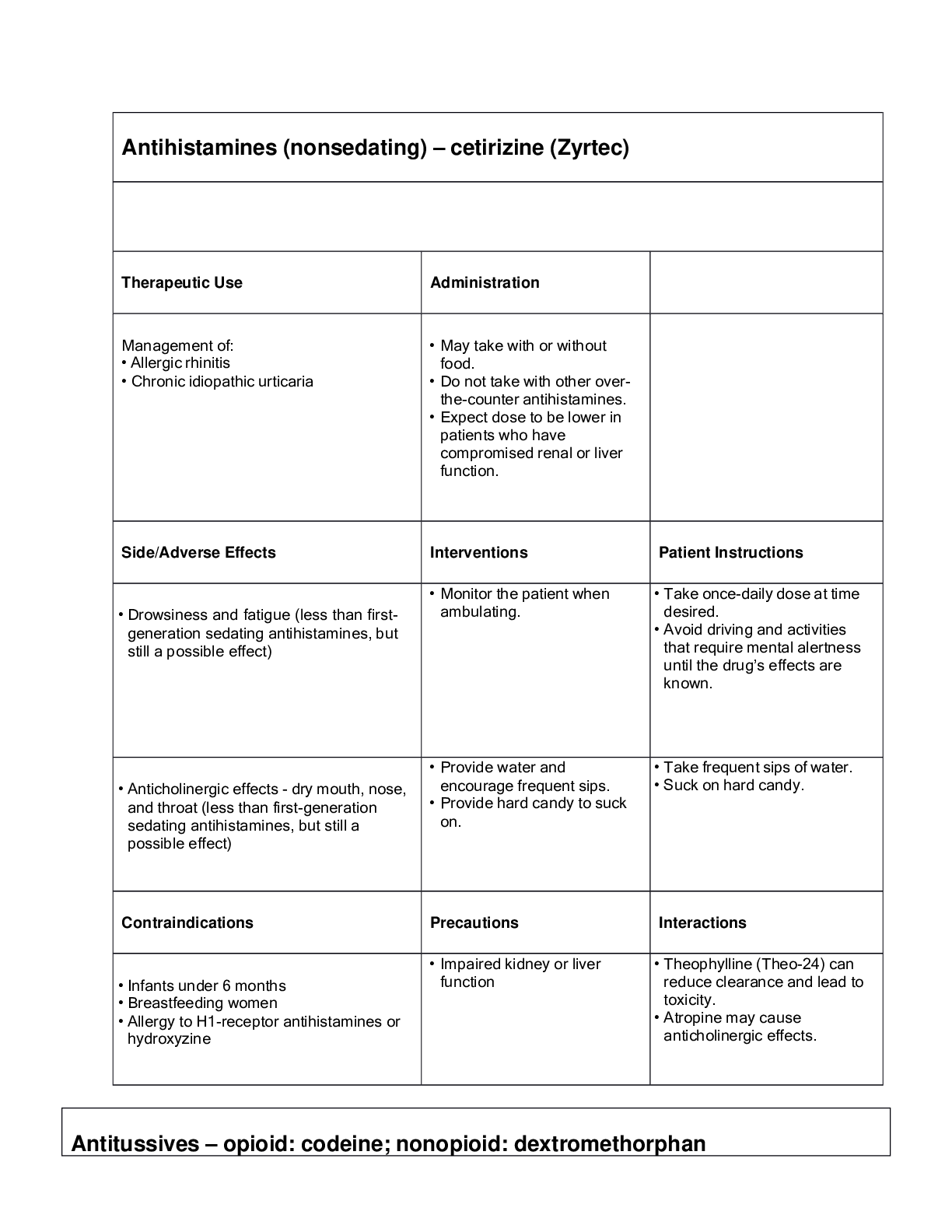
Antihistamines (nonsedating) – cetirizine (Zyrtec)
Therapeutic Use
Administration
Management of:
• Allergic rhinitis
• Chronic idiopathic urticaria
• May take with or without food.
• Do not take with othe
...
Antihistamines (nonsedating) – cetirizine (Zyrtec)
Therapeutic Use
Administration
Management of:
• Allergic rhinitis
• Chronic idiopathic urticaria
• May take with or without food.
• Do not take with other over- the-counter antihistamines.
• Expect dose to be lower in patients who have compromised renal or liver function.
Side/Adverse Effects
Interventions
Patient Instructions
• Drowsiness and fatigue (less than first- generation sedating antihistamines, but still a possible effect) • Monitor the patient when ambulating. • Take once-daily dose at time desired.
• Avoid driving and activities that require mental alertness until the drug’s effects are known.
• Anticholinergic effects - dry mouth, nose, and throat (less than first-generation sedating antihistamines, but still a possible effect) • Provide water and encourage frequent sips.
• Provide hard candy to suck on. • Take frequent sips of water.
• Suck on hard candy.
Contraindications
Precautions
Interactions
• Infants under 6 months
• Breastfeeding women
• Allergy to H1-receptor antihistamines or hydroxyzine • Impaired kidney or liver function • Theophylline (Theo-24) can reduce clearance and lead to toxicity.
• Atropine may cause anticholinergic effects.
(Delsym)
Therapeutic Use
Administration
• Suppression of chronic, nonproductive cough • Use only on a short-term basis.
• Use the lowest effective dose.
• Use only when needed.
Side/Adverse Effects
Interventions
Patient Instructions
• CNS depression (drowsiness, sedation - common with opioid antitussives; only occurs in nonopioid antitussives if you give large doses or other CNS depressant drugs concurrently)
• Dizziness, lightheadedness
(more common with opioid antitussives) • Monitor patients when changing positions or ambulating. • Change positions gradually and sit or lie down if feeling lightheaded
• Avoid alcohol and other CNS depressants when taking opioid antitussives
• Do not take opioid antitussive prior to driving or activities requiring mental alertness.
• Gastrointestinal distress (nausea, vomiting) • Administer drug with food or milk. • Take the drug with food or milk.
• Lie down when feeling nauseated.
• Constipation (opioids only) • Encourage diet high in fluids and fiber.
• Administer stool softener such as docusate sodium (Colace) and
stimulant laxatives such as bisacodyl (Dulcolax). • Increase fluid and dietary fiber intake.
•
..... .....................................................continued........................................................
[Show More]