Medsurg
1. Emergency community plan
An emergency response plan is a formal plan of action for coordinating the response of the
health care agency staff in the event of a disaster in the health care agency or
surrou
...
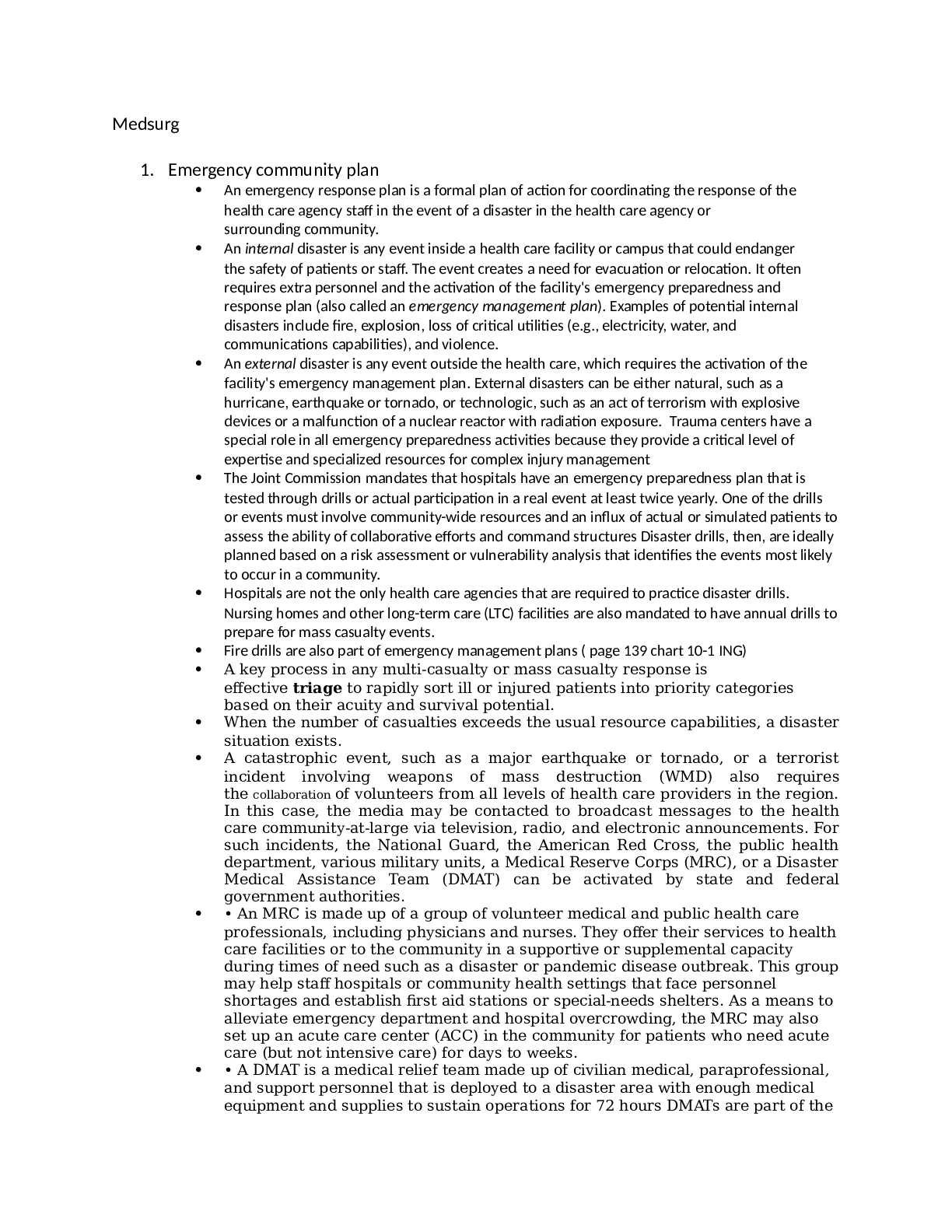
Medsurg
1. Emergency community plan
An emergency response plan is a formal plan of action for coordinating the response of the
health care agency staff in the event of a disaster in the health care agency or
surrounding community.
An internal disaster is any event inside a health care facility or campus that could endanger
the safety of patients or staff. The event creates a need for evacuation or relocation. It often
requires extra personnel and the activation of the facility's emergency preparedness and
response plan (also called an emergency management plan). Examples of potential internal
disasters include fire, explosion, loss of critical utilities (e.g., electricity, water, and
communications capabilities), and violence.
An external disaster is any event outside the health care, which requires the activation of the
facility's emergency management plan. External disasters can be either natural, such as a
hurricane, earthquake or tornado, or technologic, such as an act of terrorism with explosive
devices or a malfunction of a nuclear reactor with radiation exposure. Trauma centers have a
special role in all emergency preparedness activities because they provide a critical level of
expertise and specialized resources for complex injury management
The Joint Commission mandates that hospitals have an emergency preparedness plan that is
tested through drills or actual participation in a real event at least twice yearly. One of the drills
or events must involve community-wide resources and an influx of actual or simulated patients to
assess the ability of collaborative efforts and command structures Disaster drills, then, are ideally
planned based on a risk assessment or vulnerability analysis that identifies the events most likely
to occur in a community.
Hospitals are not the only health care agencies that are required to practice disaster drills.
Nursing homes and other long-term care (LTC) facilities are also mandated to have annual drills to
prepare for mass casualty events.
Fire drills are also part of emergency management plans ( page 139 chart 10-1 ING)
A key process in any multi-casualty or mass casualty response is
effective triage to rapidly sort ill or injured patients into priority categories
based on their acuity and survival potential.
When the number of casualties exceeds the usual resource capabilities, a disaster
situation exists.
A catastrophic event, such as a major earthquake or tornado, or a terrorist
incident involving weapons of mass destruction (WMD) also requires
the collaboration of volunteers from all levels of health care providers in the region.
In this case, the media may be contacted to broadcast messages to the health
care community-at-large via television, radio, and electronic announcements. For
such incidents, the National Guard, the American Red Cross, the public health
department, various military units, a Medical Reserve Corps (MRC), or a Disaster
Medical Assistance Team (DMAT) can be activated by state and federal
government authorities.
• An MRC is made up of a group of volunteer medical and public health care
professionals, including physicians and nurses. They offer their services to health
care facilities or to the community in a supportive or supplemental capacity
during times of need such as a disaster or pandemic disease outbreak. This group
may help staff hospitals or community health settings that face personnel
shortages and establish first aid stations or special-needs shelters. As a means to
alleviate emergency department and hospital overcrowding, the MRC may also
set up an acute care center (ACC) in the community for patients who need acute
care (but not intensive care) for days to weeks.
• A DMAT is a medical relief team made up of civilian medical, paraprofessional,
and support personnel that is deployed to a disaster area with enough medical
equipment and supplies to sustain operations for 72 hours DMATs are part of the
[Show More]