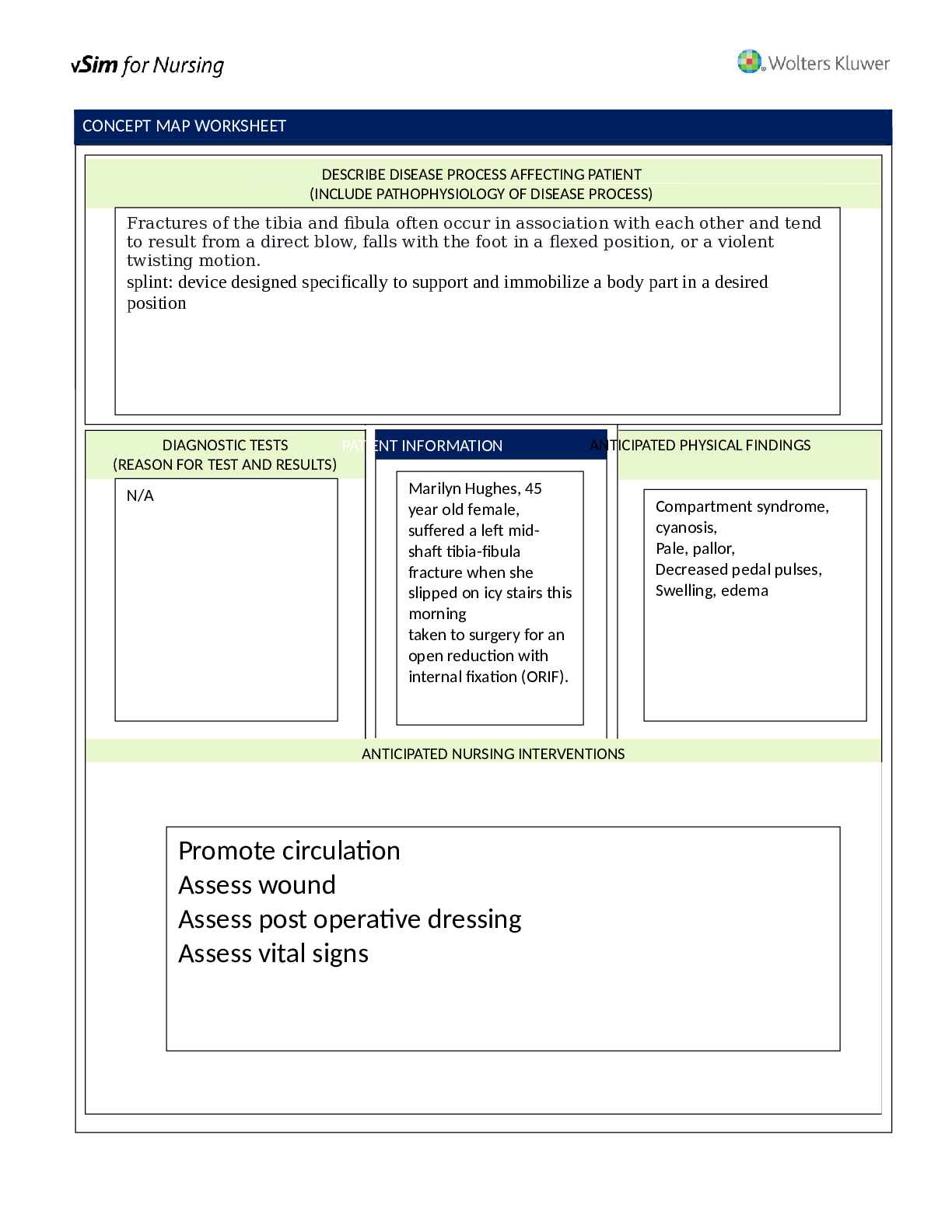
Fractures of the tibia and fibula often occur in association with each other and tend to result from a direct blow, falls with the foot in a flexed position, or a violent twisting motion.
splint: device designed specifi
...
Fractures of the tibia and fibula often occur in association with each other and tend to result from a direct blow, falls with the foot in a flexed position, or a violent twisting motion.
splint: device designed specifically to support and immobilize a body part in a desired position
DIAGNOSTIC TESTS (REASON FOR TEST AND RESULTS)
PATIENT INFORMATION ANTICIPATED PHYSICAL FINDINGS
ANTICIPATED NURSING INTERVENTIONS
vSim ISBAR ACTIVITY STUDENT WORKSHEET
INTRODUCTION Karen Brito RN , Med Surge Unit
Your name, position (RN), unit you are working on
SITUATION Marilyn Hughes, 45 year old female, suffered a left mid-shaft tibia- fibula fracture
Patient’s name, age, specific reason for visit
BACKGROUND Primary diagnosis is compartment syndrome after the surgery , date of admission 4/12/2020, current orders are morphine and to assess vital signs and assess post operative dressing
Patient’s primary diagnosis, date of admission, current orders for patient
ASSESSMENT Lower left leg looks cyanotic, dressing seems really tight, prolonged capillary refill in the toes on the left side, normal skin turgor, skin is cool and she is very sweaty
Current pertinent assessment data using head to toe approach, pertinent diagnostics, vital signs
RECOMMENDATION Recommendations is to loosen dressing, assess pedal pulses, vital signs q 15 mins, provide PRN medication for pain, assess pain, circulation
Any orders or recommendations you mayhave for this patient
PHARM-4-FUN PATIENT EDUCATION WORKSHEET
NAME OF MEDICATION, CLASSIFICATION, AND INCLUDE PROTOTYPE
MEDICATION: morphine hydrochloride
CLASSIFICATION: Therapeutic class: Opioid analgesics Pharmacologic class: Opioids
SAFE DOSE OR DOSE RANGE, SAFE ROUTE
Adults: Initially, 10 mg (based on 70 kg individual) IM or 0.1 to 0.2 mg/kg IV every 4 hours p.r.n.
Or, 15 to 30 mg (immediate-release tablets) PO, or 10 to 20 mg (oral solution) PO, or 10 to 20 mg PR every 4 hours p.r.n.
PURPOSE FOR TAKING THIS MEDICATION
Severe pain (the 20 mg/mL oral solution concentration should only be used in opioid-tolerant patients).
PATIENT EDUCATION WHILE TAKING THIS MEDICATION
● Instruct patient how and when to ask for pain medication. ● May cause drowsiness or dizziness. Caution patient to call for assistance when ambulating or smoking and to avoid driving or other activities requiring alertness until response to medication is known. ● Advise patient to change positions slowly to minimize orthostatic hypotension.
● Caution patient to avoid concurrent use of alcohol or other CNS depressants with this medication. ● Encourage patients who are immobilized or on prolonged bedrest to turn, cough
Clinical Worksheet
Date: 4/12/2020 Student Name: Karen Brito Assigned vSim: Marilyn Hughes
Initials:
MH Diagnosis:
Compartment Syndrome HCP:N/A Isolation:N/A IV Type: Location: RUA Critical Labs:N/A Other Services:N/A
Fall Risk:
Age: Consults:N/A Consults Needed:N/A
45
Length of Stay:
N/ATran Fluid/Rate: IV of
Lactated Ringer’s infusing at 75 mL/hour
M/F:F
1 sfer:N/A
Code Status:Full
dayAllergies:N
/A
Why is your patient in the hospital (Answer in your own words and include the History of present Illness)?: Patient is in hospital because she suffered a left mid- shaft tibia-fibula fracture when she slipped on icy stairs this morning. She was taken to surgery for an open reduction with internal fixation (ORIF).
Health History/Comorbities (that relate to this hospitalization):
Shift Goals/ Patient Education Needs:
1. Loosen Dressing
2. Assess pedal pulses
3. Assess vital signs q 15
4. Assess for signs of bleeding of infection
Path to Discharge: Make sure that circulation returns to left lower extremity and pulses/color return to leg
Path to Death or Injury: No promotion to leg can lead to thrombus/clot
Alerts:
What are you on alert for with this patient? (Signs & Symptoms)
1. Pallor
2. Parathesia
3. Numbing/pulse
What Assessments will focus on for this patient? (How will I identify the above signs &Symptoms?)
1. Pedal pulses
2. 6 P’s
3. Circulation/capillary refill time
List Complications that may occur related to dx, procedure, comorbidities:
1. Ischemia
2. Compartment Syndrome
3. Loss of limb
What nursing or medical interventions may prevent the above Alert or complications?
1. Promoting circulation
2. Blood flow to the extremity
3. Color of toes and foot goes back to normal
4. Managing pain
Management of Care: What needs to be done for this Patient Today?
1. Elevate leg to heart level
2. Assess the 6 P’s
4. Manage pain
5. Educate patient on postoperative care
6. Vital signs q 15
7. Assess dressing
Priorities for Managing the Patient’s Care Today
1. Decrease swelling
2. Promote healing
3. Return blood flow
4. Loosen dressing
What aspects of the patient care can be Delegated and who can do it? Delegate vital signs q 15 to LPN.
Clinical Worksheet
. How did the scenario make you feel?
Reflection Questions
Paste your reflection questions in the box below
I am comfortable with compartment syndrome, therefore I felt ok during this assignment.
2. How would you recognize that Marilyn Hughes’ condition was deteriorating?
She would show signs of increased pain, such as increased blood pressure, heart rate, and respirations. She would also complain that medication isn’t reducing her pain.
Her feet and toes would also become pale and pulseless.
3. What interventions exist to alleviate compartment syndrome, and what assessments indicate improved perfusion to the extremity?
Lowering the leg to heart level which will increase circulation to the extremity, loosening the dressing so that it is not so tight, signs of improved perfusion which includes return of color to the foot, and the return of pedal pulses.
4. Why is it important to maintain the limb at heart level versus elevating it above heart level? Having the limb at heart levels improves arterial perfusion and prevents further fluid accumulation.
5. What could have happened in this scenario if Marilyn Hughes’ condition was not treated expediently?
If the patient’s circulation the limb is not restored, she could potentially lose her limb due to ischemia of the tissues.
6. What key elements would you include in the handoff report for this patient? Consider the SBAR (situation, background, assessment, recommendation) format.
Marilyn Hughes is a 45-year-old female who suffered a left mid-shaft tibia-fibula fracture when she slipped on icy stairs this morning. She was taken to surgery for an open reduction with internal fixation (ORIF). She returned from surgery at 1:45 p.m. with a below-the-knee ace/splint dressing. Vital signs have been stable, and neurovascular checks have been within normal range. She has an IV of Lactated Ringer’s infusing at 75 mL/hour and is tolerating liquids well without nausea. Her diet could probably be advanced to regular dinner this evening. A family member has been with her at the bedside throughout the day. She began complaining of pain shortly after returning from surgery and was given morphine 6 mg IV at 2:15 p.m. She is now on every-30-minute postoperative vital signs. Last vital signs were BP: 130/82, HR: 88, RR: 16.
7. What would you do differently if you were to repeat this scenario? How would your patient care change?
I would know the signs of compartment syndrome and how to assess it earlier on.
Clinical Judgement Components
Exemplary = 4 point Scoring: Accomplished = 3 points
Beginning = 1 point
Developing = 2 points
Noticing: Score: vSim 1 Score: vSim 2
4 Score: vSim 2
4
Focused Observation: E A D B Recognizing Deviations from
Expected Patterns: E A D B
Information Seeking: E A D B 4
Total for category:
Interpreting:
Prioritizing Data: E A D B
Making Sense of Data: E A D B
Total for category: 4 4 4
Responding:
Calm, Confident Manner: E A D B Clear Communication: E A D B Well-Planned Intervention/Flexibility:
E A D B
Being Skillful E A D B
Total for category: 4 4 4
Reflecting:
Evaluation/Self-Analysis: E A D B Commitment to Improvement: E A D B
Total for category: 4 4 4
[Show More]