Students_ SurgicalCase02_StanChecketts_DA.
Scenario Overview
Patient: Stan Checketts
Medical Diagnosis: Preoperative Bowel Obstruction-Fluid and Electrolyte Imbalance
Brief Summary: This case presents a preoper
...
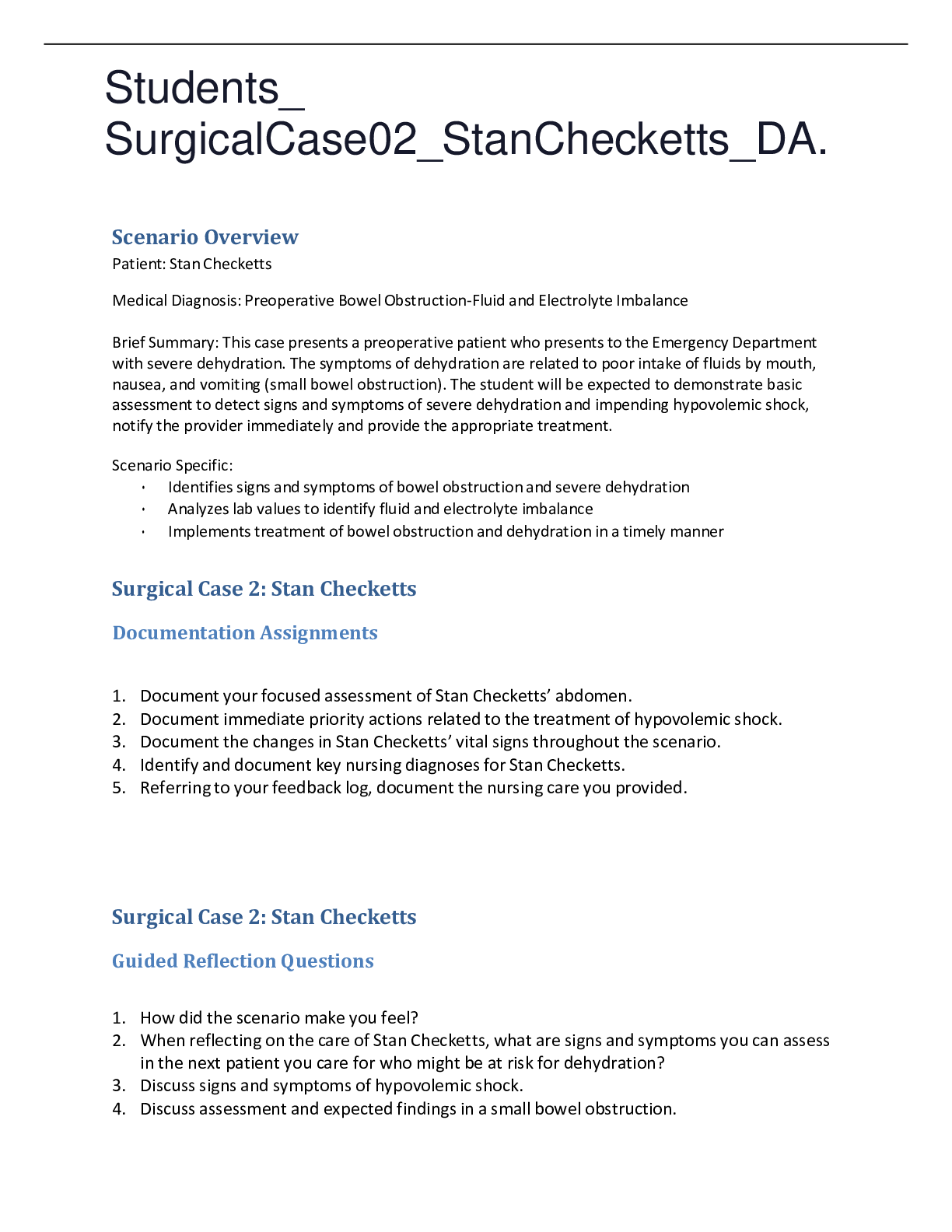
Students_ SurgicalCase02_StanChecketts_DA.
Scenario Overview
Patient: Stan Checketts
Medical Diagnosis: Preoperative Bowel Obstruction-Fluid and Electrolyte Imbalance
Brief Summary: This case presents a preoperative patient who presents to the Emergency Department with severe dehydration. The symptoms of dehydration are related to poor intake of fluids by mouth, nausea, and vomiting (small bowel obstruction). The student will be expected to demonstrate basic assessment to detect signs and symptoms of severe dehydration and impending hypovolemic shock, notify the provider immediately and provide the appropriate treatment.
Scenario Specific:
• Identifies signs and symptoms of bowel obstruction and severe dehydration
• Analyzes lab values to identify fluid and electrolyte imbalance
• Implements treatment of bowel obstruction and dehydration in a timely manner
Surgical Case 2: Stan Checketts
Documentation Assignments
1. Document your focused assessment of Stan Checketts’ abdomen.
2. Document immediate priority actions related to the treatment of hypovolemic shock.
3. Document the changes in Stan Checketts’ vital signs throughout the scenario.
4. Identify and document key nursing diagnoses for Stan Checketts.
5. Referring to your feedback log, document the nursing care you provided.
Surgical Case 2: Stan Checketts
Guided Reflection Questions
1. How did the scenario make you feel?
2. When reflecting on the care of Stan Checketts, what are signs and symptoms you can assess in the next patient you care for who might be at risk for dehydration?
3. Discuss signs and symptoms of hypovolemic shock.
4. Discuss assessment and expected findings in a small bowel obstruction.
5. What key questions does the nurse ask in an acute abdominal pain assessment?
6. In evaluating Stan Checketts’ laboratory values, what if any abnormalities did you find?
7. Stan Checketts had a nasogastric (NG) tube inserted for gastric decompression. What are the preferred methods for confirming placement of the NG tube?
8. What key elements would you include in the handoff report for this patient? Consider the SBAR (situation, background, assessment, recommendation) format.
9. What would you do differently if you were to repeat this scenario? How would your patient care change?
[Show More]