Walden University NURS 6640 Midterm Exam
Question 1
1 out of 1 points
A 35-year-old patient seeks treatment for depression and anxiety after an abusive
relationship. To help empower the patient, the PMHNP wants to te
...
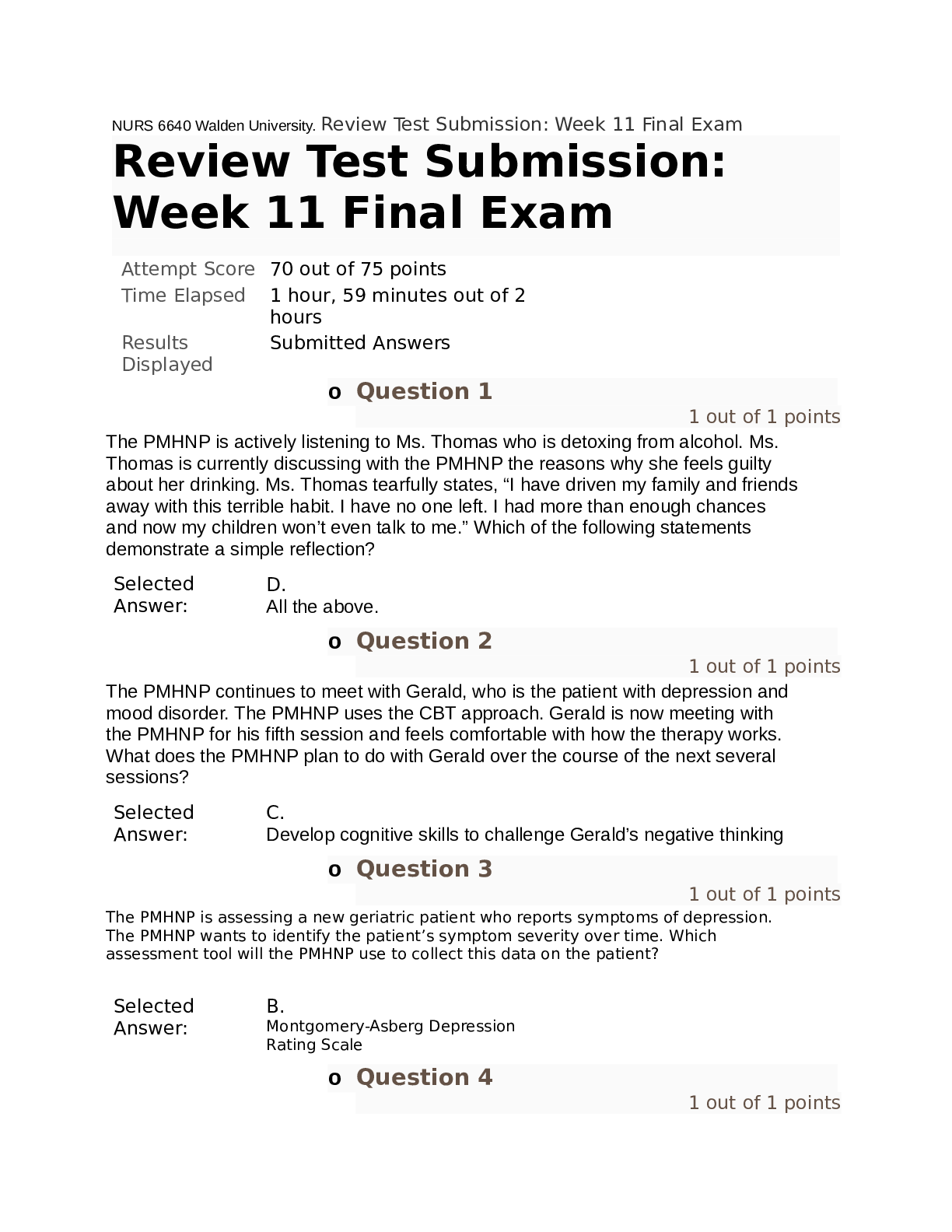
Walden University NURS 6640 Midterm Exam
Question 1
1 out of 1 points
A 35-year-old patient seeks treatment for depression and anxiety after an abusive
relationship. To help empower the patient, the PMHNP wants to teach the safe-place
exercise to create a feeling of calm. In order to walk the patient through the exercise,
the PMHNP first says:
Selected
Answer:
A.
“Identify an image of a safe place that makes you feel calm.”
Question 2
1 out of 1 points
The PMHNP is working with a patient who has dissociative disorder and requests
pharmacological interventions for dealing with her trauma. What education does the
PMHNP provide to the patient regarding medication therapy?
Selected
Answer:
C.
“The medication may provide symptom relief, but you still need
psychotherapy.”
Question 3
1 out of 1 points
The patient attempts the PMHNP’s sleep hygiene recommendations for 2 weeks, but
does not make any progress mitigating nightmares and hyperarousal. Which
behavioral strategy does the PMHNP suggest next?
Selected
Answer:
D.
All of the above
Question 4
1 out of 1 points
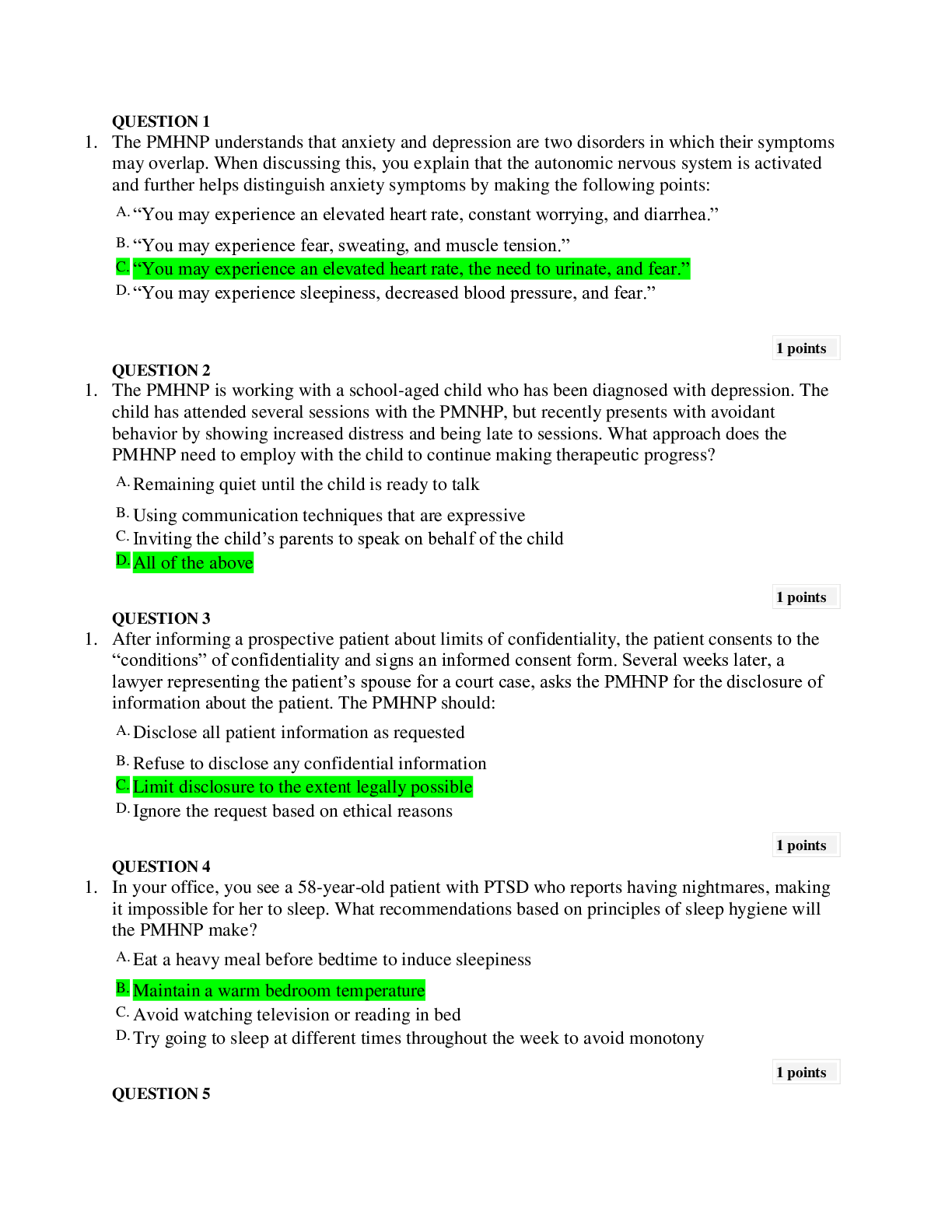
After informing a prospective patient about limits of confidentiality, the patient
consents to the “conditions” of confidentiality and signs an informed consent form.
Several weeks later, a lawyer representing the patient’s spouse for a court case,
asks the PMHNP for the disclosure of information about the patient. The PMHNP
should:
Selected
Answer:
C.
Limit disclosure to the extent legally possible
Question 5
1 out of 1 points
The PMHNP meets with an adolescent patient who has depression and often
presents with resistance when discussing his parent’s divorce. For the past couple of
sessions, the patient has been quiet, sometimes refusing to speak. To further support
the therapeutic relationship, the PMNHP:
Selected
Answer:
A.
Observes and points out the behavior
Question 6
1 out of 1 points
The PMHNP employs psychodynamic psychotherapy with a patient who experiences
anxiety and depression. As the process enters the psychoanalytic end of the
psychodynamic continuum, the PMNHP will focus on:
Selected
Answer:
A.
Interpreting unconscious conflict in the patient
Question 7
1 out of 1 points
The PMHNP is working with a patient who witnessed her father pass away after
suffering for several months from terminal cancer. The PMHNP sees this as a
traumatic event. The patient reports sometimes feeling out of touch with
surroundings; almost as if things feel like a dream. “Sometimes that sensation lingers
for a while,” the patient says, “and other times I snap out of it quickly.” What does the
PMHNP infer about the condition based on psychotherapy concepts for trauma?
Selected
Answer:
B.
The patient is reporting signs of dissociation.
Question 8
1 out of 1 points
The PMHNP is working with a school-aged child who has been diagnosed with
depression. The child has attended several sessions with the PMNHP, but recently
presents with avoidant behavior by showing increased distress and being late to
sessions. What approach does the PMHNP need to employ with the child to continue
making therapeutic progress?
Selected
Answer:
B.
Using communication techniques that are expressive
Question 9
1 out of 1 points
An 11-year-old patient has been exhibiting low self-esteem at school and acting out.
According to Maslow’s hierarchy of needs, which of the following questions would
best be addressed first by the PMHNP?
Selected
Answer:
C.
“Is Joel getting enough sleep at home?”
Question 10
1 out of 1 points
The PMHNP is working with a patient who experiences anxiety around her parents
that later leads to poor impulse control. What will the PMHNP do to employ
psychodynamic psychotherapy properly for this patient?
Selected
Answer:
D.
All of the above
Question 11
1 out of 1 points
The patient is a 56-year-old female patient diagnosed with panic disorder and reports
symptoms that include heart palpitations, frequent trembling, and feelings of choking
in stressful situations. What special consideration does the PMHNP make?
Selected
Answer:
D.
A and B
Question 12
1 out of 1 points
The PMHNP is working with a veteran who has posttraumatic stress disorder
(PTSD). The PMHNP believes that dual awareness will be beneficial in allowing the
patient to focus on the here and now. What strategies can the PMHNP use to
develop dual awareness in the patient?
Selected
Answer:
D.
All of the above
Question 13
1 out of 1 points
The PMHNP has been treating a 15-year-old patient with a history of abuse and
neglect. Thirty minutes into their therapy session the patient jumps up and begins to
pace around the room. Utilizing Socratic dialogue (SD) the PMHNP’s best action
would be to:
Selected
Answer:
C.
Say, “I noticed a change. Can you tell me what happened?”
Question 14
1 out of 1 points
The PMHNP is caring for a patient with borderline personality disorder. Using a
psychoanalytic psychotherapy approach, the PMHNP attempts to intensify the
patient’s transference to enhance emotional processing by:
Selected
Answer:
D.
Increasing the number of sessions per
week
Question 15
0 out of 0 points
When completing this exam, did you comply with Walden University’s Code of
Conduct including the expectations for academic integrity?
Selected Ye
Answer: s
Question 16
1 out of 1 points
An initial evaluation reveals that an 11-year-old patient has moved to a new school
after her parents’ recent divorce, and is having trouble making friends. The patient
has normal mental status and exhibits appropriate behavior. What is the most
appropriate scale for the PMHNP to use to get more information?
Selected
Answer:
D.
Impact of Event Scale
Question 17
1 out of 1 points
A PMHNP is treating a 50-year-old patient who suffers from depression. When he was
growing up, he was often responsible for taking care of his three younger siblings. Since
then, the patient puts other people’s needs before his own. Based on this information,
the PMHNP would conclude that his interpersonal style is __________.
Selected
Answer:
A.
overly
nurturing
Question 18
1 out of 1 points
The PMHNP is assessing a patient who grew up in a foster home because she was
neglected and abused by her birth parents at a young age. The patient admits to
having difficulty forming and maintaining relationships throughout her life.
Understanding maladaptive schemas, which statement does the PMHNP predict that
the patient is likely to make?
Selected
Answer:
C.
“It takes me a while to warm up to people; people often wear
masks.”
Question 19
1 out of 1 points
A 28-year-old male patient is experiencing distress related to the workplace. What
might the PMHNP ask to assess affective development?
Selected
Answer:
D.
All of the above.
Question 20
1 out of 1 points
The PMHNP is meeting with a new patient who is a young veteran back from serving
two tours overseas. When reviewing the patient’s health history file that was sent
from the VA, the PMHNP learns that several months ago, the patient was diagnosed
with PTSD, but never followed up with treatment for it. After a comprehensive mental
health assessment, the PMHNP confirms the PTSD diagnosis and understands that
which therapeutic approach will be the most effective as a first-line treatment
modality?
Selected
Answer:
B.
Employing cognitive behavioral therapy with the
patient
Question 21
1 out of 1 points
An elderly patient in a nursing home has been losing interest in activities and now
refuses to leave his room. After a physical exam, he is referred to a PMHNP for an
initial assessment.
True or false: After speaking with the patient, an appropriate screening tool for the
PMHNP to use would be the Geriatric Depression Scale.
Selected
Answer:
Tru
e
Question 22
1 out of 1 points
A 65-year-old patient has suffered the loss of his wife. He is in a state of
hyperarousal with increased sympathetic nervous system arousal. One or more
interventions may help the patient to deal with this arousal. To decrease sympathetic
nervous system arousal, the PMHNP’s treatment strategy is ___________.
Selected
Answer:
D.
all of the above
Question 23
1 out of 1 points
The PMHNP is treating a patient with a substantial fear of feeling closed in
(claustrophobia). Thus, the patient will not get into an elevator. The office where he
works is on the 10th floor and this requires that he walk up and down the stairs in the
morning and evening to get to his office. With permission from the patient, the
PMHNP is beginning systematic desensitization to address the patient’s need to use
the elevator. What is the PMHNP’s best plan of action?
Selected
Answer:
A.
Begin by having the patient stand in front of the elevator and write
down his feelings
Question 24
1 out of 1 points
The PMHNP has a session with a patient who was injured and traumatized from an
explosion at the industrial plant where he used to work. During the session, an
outside noise startles the patient and he experiences a flashback of the
loud boom from the explosion. The PMHNP witnesses the patient present with
anxiety and belabored breathing. What is the appropriate action of the PMHNP?
Selected
Answer:
D.
Have the patient use the relaxation response (take a deep breath,
exhale long, and slow down)
Question 25
1 out of 1 points
When the patient comes into the office, she says, “I just saw a friend of mine out in
the waiting room. What’s wrong with him?” The PMHNP says, “He’ll be fine. He has
mild depression.” Which of the following statement is correct related to confidentiality
rights?
Selected
Answer:
A.
The PMHNP was not protecting patient confidentially rights.
Question 26
1 out of 1 points
You are seeing a 29-year-old widow whose husband recently died overseas while
serving his country in the military. She has been mourning the loss of her husband
for several months, and continues to grieve. She refuses to...
[Show More]










.png)


