EHR LI NA CHEN PART 1
Patient Introduction
Location: Patient room on a mental health unit
Time: 20:00
Report from the charge nurse:
Situation: Li Na Chen is a 40-year-old Chinese female who presented to the
...
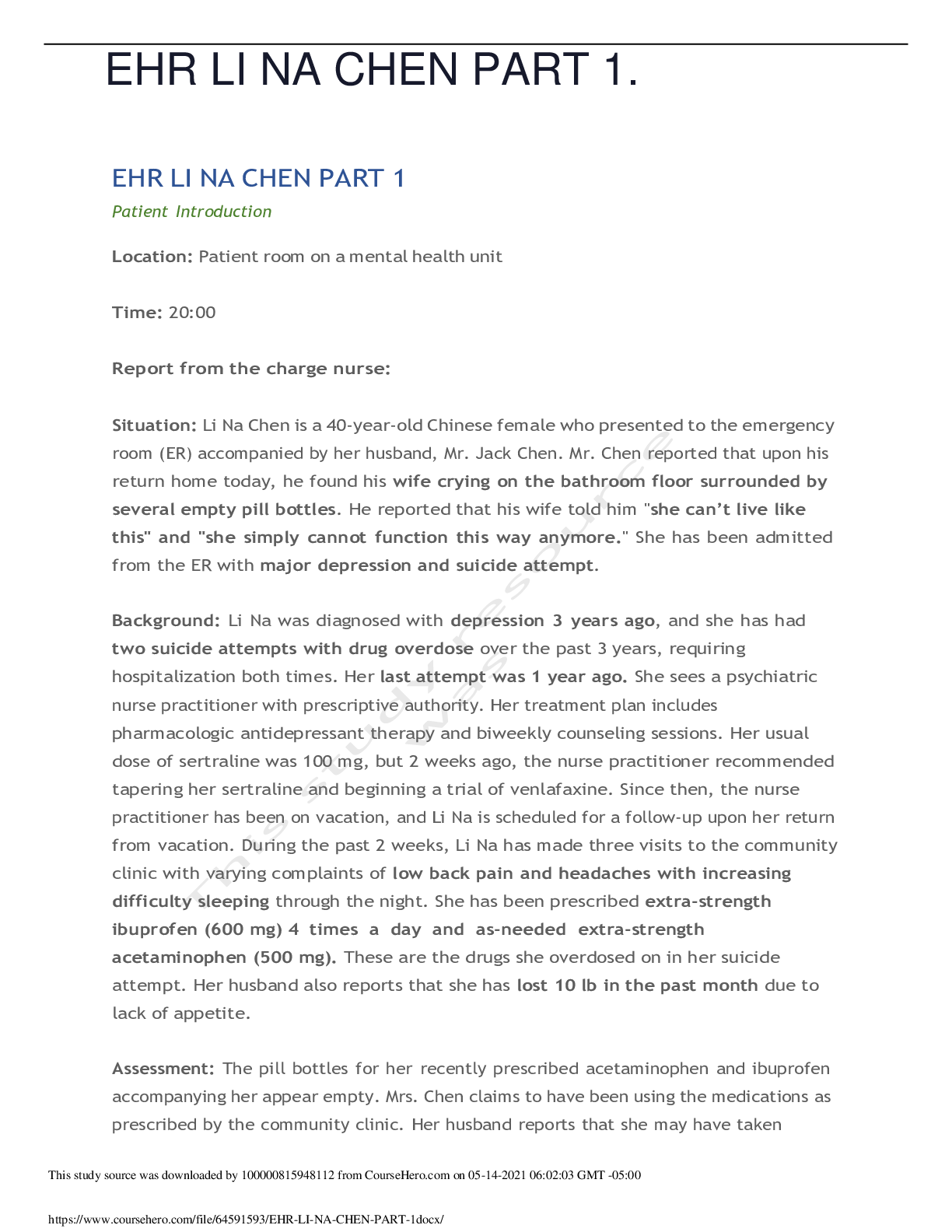
EHR LI NA CHEN PART 1
Patient Introduction
Location: Patient room on a mental health unit
Time: 20:00
Report from the charge nurse:
Situation: Li Na Chen is a 40-year-old Chinese female who presented to the emergency room (ER) accompanied by her husband, Mr. Jack Chen. Mr. Chen reported that upon his return home today, he found his wife crying on the bathroom floor surrounded by several empty pill bottles. He reported that his wife told him "she can’t live like this" and "she simply cannot function this way anymore." She has been admitted from the ER with major depression and suicide attempt.
Background: Li Na was diagnosed with depression 3 years ago, and she has had two suicide attempts with drug overdose over the past 3 years, requiring hospitalization both times. Her last attempt was 1 year ago. She sees a psychiatric nurse practitioner with prescriptive authority. Her treatment plan includes pharmacologic antidepressant therapy and biweekly counseling sessions. Her usual dose of sertraline was 100 mg, but 2 weeks ago, the nurse practitioner recommended tapering her sertraline and beginning a trial of venlafaxine. Since then, the nurse practitioner has been on vacation, and Li Na is scheduled for a follow-up upon her return from vacation. During the past 2 weeks, Li Na has made three visits to the community clinic with varying complaints of low back pain and headaches with increasing difficulty sleeping through the night. She has been prescribed extra-strength ibuprofen (600 mg) 4 times a day and as-needed extra-strength acetaminophen (500 mg). These are the drugs she overdosed on in her suicide attempt. Her husband also reports that she has lost 10 lb in the past month due to lack of appetite.
Assessment: The pill bottles for her recently prescribed acetaminophen and ibuprofen accompanying her appear empty. Mrs. Chen claims to have been using the medications as prescribed by the community clinic. Her husband reports that she may have taken
approximately 6000 mg of acetaminophen and 4800 mg of ibuprofen. Acetylcysteine 7000 mg in 200 mL of 5% dextrose in water was given in the ER, and she underwent a gastric lavage; many recognizable pills were identified in the contents. Her vital signs are being monitored; the results of her last set of vital signs, which were taken in the ER, are as follows: temperature, 37°C (98.6°F); heart rate, 100 beats/min; respiratory rate, 20 breaths/min; and blood pressure, 110/70 mmHg. Blood for laboratory tests was obtained in the ER. The results are available in the chart. The acetaminophen level was 80 mcg/mL, and the ibuprofen level was 150 mcg/mL. They also assessed her depression in the ER using the Hamilton Depression Scale. The result is in her chart.
Safe acetaminophen levels—10-20 mcg/mL Safe ibuprophen level--
Recommendation: Admit the patient to the mental health unit with suicide precautions and safety checks. They have not searched her personal belongings for dangerous items in the ER, so please also do that. Please also take vital signs, complete a mental health assessment and call me with a report when you’re done.
SOAP
SUBJECTIVE:
Depressed mood Disruption in sleep Disruption in appetite Worthlessness
OBJECTIVE:
10 lb weight loss in past month
ASSESSMENT:
The patient is at risk for suicide as she states she “cant do anything right” and is “nothing”, she is a risk for complicated grieving as her go to is trying to commit suicide, she thinks she is a burden to the family and finds no joy in art as she once did
PLAN:
During Li Na Chens stay the plan is to keep her as comfortable as possible and get her to open up through group therapy sessions as well as solo therapy sessions. We will keep her on her new medication regimen as ordered and see how she does with it during her stay.
SBAR
SITUATION:
I have just assessed Li Na Chen a 40 year old Chinese woman who has recently been admitted because of a suicide attempt.
Her vitals are
Respiration—16 equally SPO2—99%
Radial pulse—strong 80 and regular BP—112/70
Temp—98.6 Auscultate
lung sounds—clear and equal bilaterally
heart sounds—HR and rhythm reg without murmurs
All of her vitals are within normal limits however I am concerned about her worsening symptoms of major depression and what this may mean for her care plan here.
Medication Levels:
Acetaminophen—80 (normal 5-20mcg/mL) Ibuprofen—150 (normal 10-50 mcg/mL)
BACKGROUND:
The patients mental status is alert, she is goal oriented however states that she “doesn’t have energy for this” She also stated many times that she was “nothing” and “cant do anything right”. Her hair is unkept but her hygiene is good. She expresses hopelessness, depression, worry and frustration. The skin turgor is normal and she is not sweating, cold, etc.
ASSESSMENT:
The problem is her symptoms of overwhelming major depression. I believe she may have long term deficits
RECOMMENDATION
I recommend that we do our best to stick to the medication regimen and get her ack into enjoying her activities like art. It is important to make sure that her surroundings have nothing she could use to harm herself with.
VITALS
Respiration—16 equally SPO2—99%
Radial pulse—strong 80 and regular BP—112/70
Temp—98.6
Auscultate
lung sounds—clear and equal bilaterally
heart sounds—HR and rhythm reg without murmers skin—normal
ovservations—
middle age woman short black hair not combed hygiene good
downcast eye
no consistant eye contact
abele to focus for concrete questions movement slow
speech hesitant volume is low
thought process is linear and goal directed unable to answer complicated qs answers “idk”
MENTAL HEALTH ASSESSMENT
Alert—I guess Name—yepp
Where are we—hospital Todays date—16th
Describe mood—no energy for this
Does lack of energy contribute to low mood—yes cant do things I want to do
Lost interest In activities once enjoyed—all I wanna do is work with art but I don’t feel like doing anything and I don’t know why
Activity that enjoy—art but not anymore Presidents—I don’t know cant think Breakfast—nothing
Suicidal ideation—cant do one thing right; I took all those pills and that did not work I cant do anything right
Better if not alive—don’t want help just want to get away from this pain Don’t want to talk about pain
Harm others—no
Desired outcome—I don’t know. I cant do anything right How do you understand ur problems—im nothing
No self worth—at least need to take care of my family and now they have to take care of
me
Worry about many things No hallunications
Frightened—no one will care about me anymore
MMSE
You submitted the Mental Status Examination form. Some of your assessment answers were incorrect.Regarding the indicator "1. Appearance. Grooming": You should not have checked any indications. Regarding the indicator "3.
Mood. Indicate mood": You should have indicated "Depressed."Regarding the indicator "6. Thought content. Indications of": You should have indicated "Worries," "Frustrations," and "Hopelessness or helplessness." Regarding the indicator "10. Level of interest. Anhedonia": You should have indicated "Yes."Regarding the indicator "11. Orientation and cognitive functions.
Memory.": You should have indicated "Long-term deficits."Regarding the indicator "11. Orientation and cognitive functions. Insight.": You should have indicated "Good."
HISOTRY
Orientation
Doesn’t think meds are working
I don’t think I can do this again—last time I felt better then all of my insecurities came back Feel bes—I feel better but it all crumbles down
I tried to work but with kids and jack its too much to handle
Pain
No diff breathing No chest pain
Food and intake
Changes in appetite—not hungry Weight loss—about 10 pounds
Changes in sleep
Sleep all the time ever feel rested All I want to do is sleep
Want to talk about healthy sleep habits
Energy
Cant do this anymore—feeling down all the time makes me feel like I have no energy Im too tired to answer your questions—no matter how much sleep I get I still feel like I
have no energy
CHIEF COMPLAINT
HOP
NURSING DIAGNOSIS
Disturbed thought process related to depressed mood as evidence by negative rumination Chronic low self-esteem related to major depression as evidence by patient stating “I am nothing”
Allow the patient to perform personal care activities. Give positive feedback after a task is achieved.
Allow the patient to engage in simple recreational activities, advancing to a more complex activities in a group environment
[Show More]