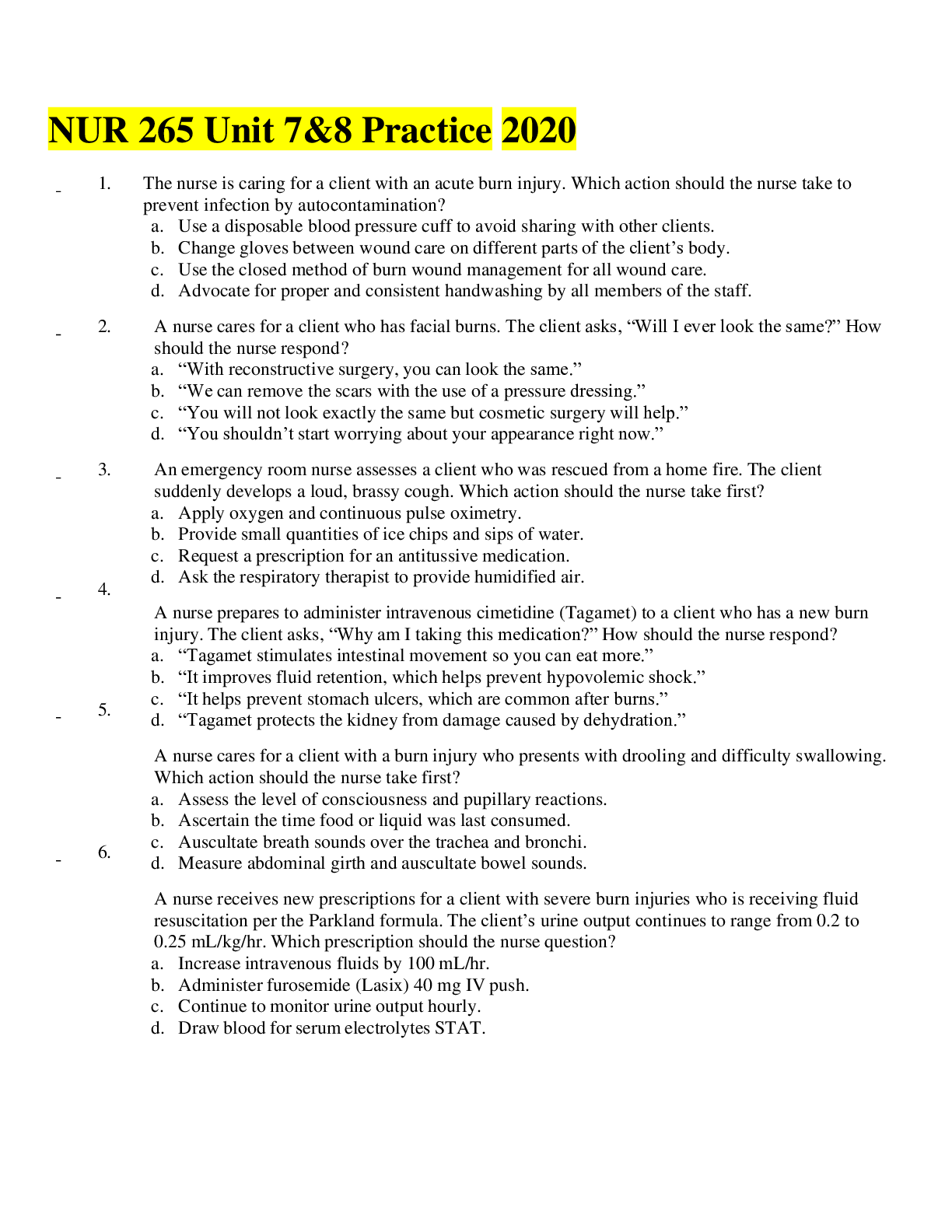
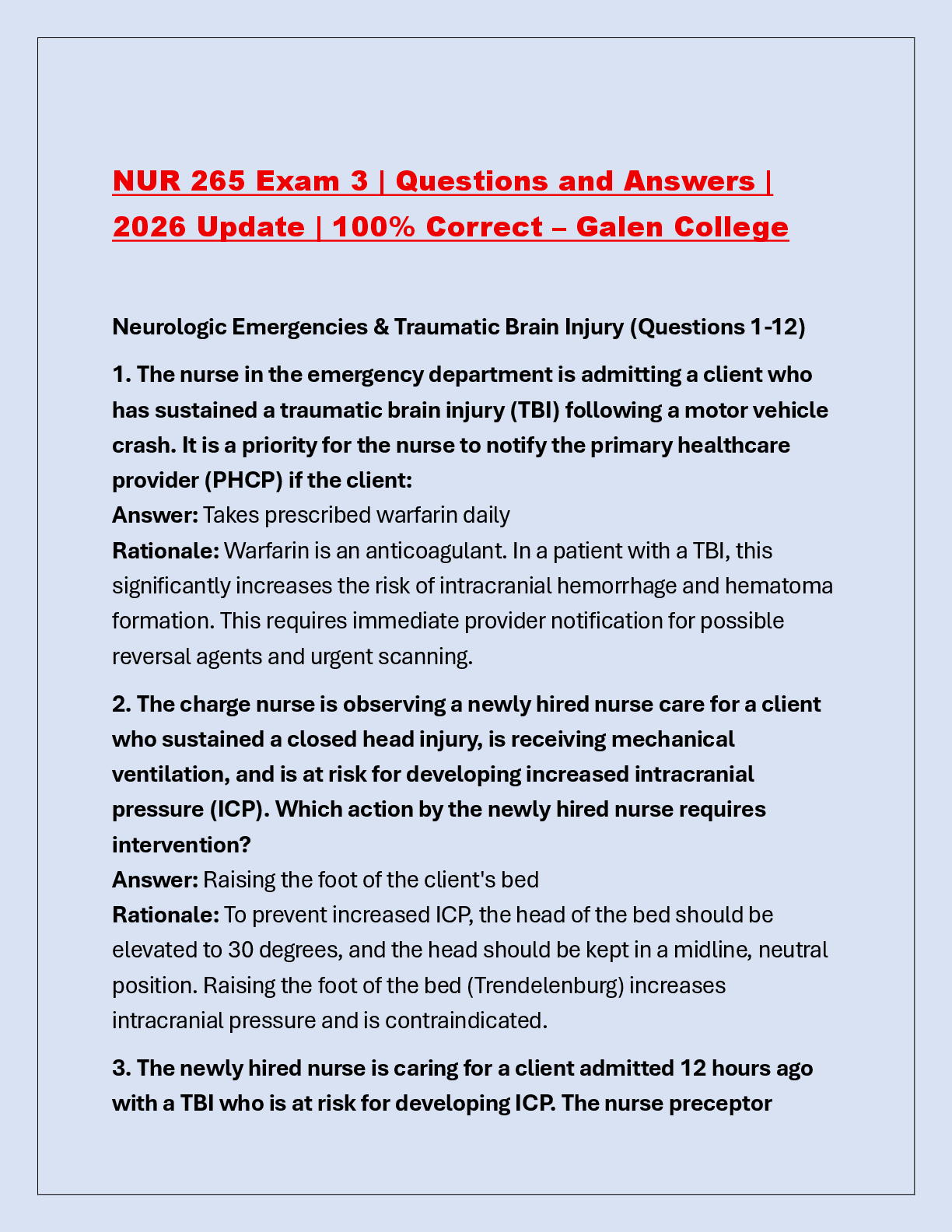
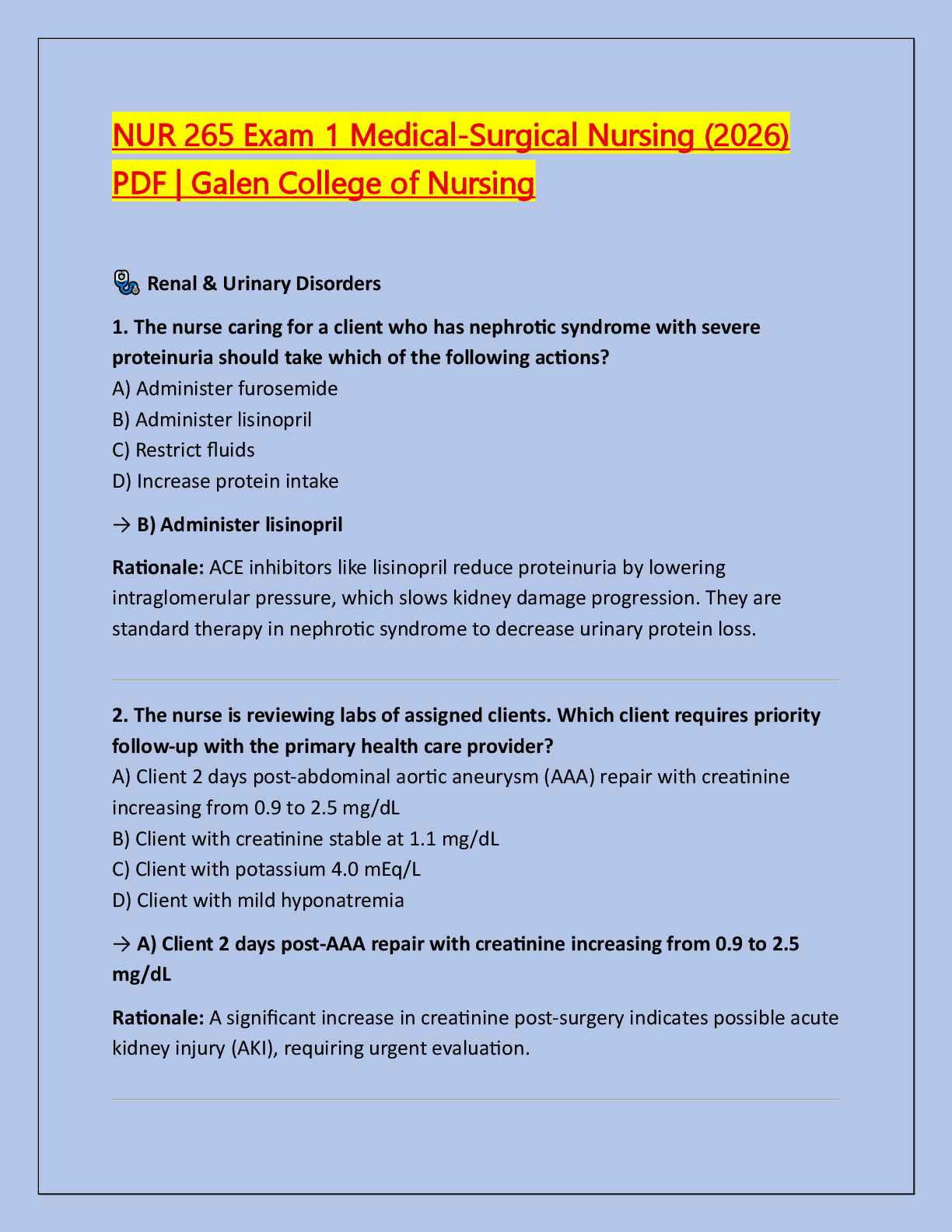
1. The nurse is caring for a client with an acute burn injury. Which action should the nurse take to prevent infection by anticontamination?
2. A nurse cares for a client who has facial burns. The client asks, “Will I
...
1. The nurse is caring for a client with an acute burn injury. Which action should the nurse take to prevent infection by anticontamination?
2. A nurse cares for a client who has facial burns. The client asks, “Will I ever look the same?” How should the nurse respond?
3. An emergency room nurse assesses a client who was rescued from a home fire. The client suddenly develops a loud, brassy cough. Which action should the nurse take first?
4. A nurse prepares to administer intravenous cimetidine (Tagamet) to a client who has a new burn injury. The client asks, “Why am I taking this medication?” How should the nurse respond?
5. A nurse cares for a client with a burn injury who presents with drooling and difficulty swallowing. Which action should the nurse take first?
6. A nurse receives new prescriptions for a client with severe burn injuries who is receiving fluid resuscitation per the Parkland formula. The client’s urine output continues to ?
7.A nurse reviews the laboratory results for a client who was burned 24 hours ago. Which laboratory result should the nurse report to the health care provider immediately?
8. A nurse assesses a client who has burn injuries and notes crackles in bilateral lung bases, a respiratory rate of 40 breaths/min, and a productive cough with blood-tinged sputum. Which action should the nurse take next?
9. A nurse cares for a client who has burn injuries. The client’s wife asks, “When will his high risk for infection decrease?” How should the nurse respond?
”
10. A nurse administers topical gentamicin sulfate (Garamycin) to a client’s burn injury. Which laboratory value should the nurse monitor while the client is prescribed this therapy?
11. A nurse cares for a client with burn injuries. Which intervention should the nurse implement to appropriately reduce the client’s pain?
12. A nurse cares for a client with burn injuries from a house fire. The client is not consistently oriented and reports a headache. Which action should the nurse take?
13. A nurse teaches a client being treated for a full-thickness burn. Which statement should the nurse include in this client’s discharge teaching?
14. A nurse assesses bilateral wheezes in a client with burn injuries inside the mouth. Four hours later the wheezing is no longer heard. Which action should the nurse take?
15. A nurse uses the rule of nines to assess a client with burn injuries to the entire back region and left arm. How should the nurse document the percentage of the client’s body that sustained burns?
16. A nurse assesses a client admitted with deep partial-thickness and full-thickness burns on the face, arms, and chest. Which assessment finding should alert the nurse to a potential complication?
17. A nurse reviews the following data in the chart of a client with burn injuries:
Admission Notes Wound Assessment
36-year-old female with bilateral leg burns NKDA
Health history of asthma and seasonal allergies Bilateral leg burns present with a white and leather-like appearance. No blisters or bleeding present. Client
rates pain 2/10 on a scale of 0-10.
Based on the data provided, how should the nurse categorize this client’s injuries?
18. After assessing an older adult client with a burn wound, the nurse documents the findings as follows:
Vital Signs Laboratory Results Wound Assessment
Heart rate: 110 beats/min Blood pressure: 112/68 mm
Hg
Respiratory rate: 20 breaths/min
Oxygen saturation: 94% Pain: 3/10 Red blood cell count: 5,000,000/mm3
White blood cell count: 10,000/mm3
Platelet count: 200,000/mm3 Left chest burn wound, 3 cm 2.5 cm 0.5 cm, wound bed pale, surrounding tissues with edema present
Based on the documented data, which action should the nurse take next?
19. A student is caring for a client who suffered massive blood loss after trauma. How does the student correlate the blood loss with the client’s mean arterial pressure (MAP)?
20. A nurse is caring for a client after surgery. The client’s respiratory rate has increased from 12 to 18 breaths/min and the pulse rate increased from 86 to 98 beats/min since they were last assessed 4 hours ago. What action by the nurse is best?
21. The nurse gets the hand-off report on four clients. Which client should the nurse assess first?
22. A nurse caring for a client notes the following assessments: white blood cell count 3800/mm3, blood glucose level 198 mg/dL, and temperature 96.2° F (35.6° C). What action by the nurse takes priority?
23. A nurse works at a community center for older adults. What self-management measure can the nurse teach the clients to prevent shock?
24. A client arrives in the emergency department after being in a car crash with fatalities. The client has a nearly amputated leg that is bleeding profusely. What action by the nurse takes priority?
25. A client is receiving norepinephrine (Levophed) for shock. What assessment finding best indicates a therapeutic effect from this drug?
26. A client has been brought to the emergency department after being shot multiple times. What action should the nurse perform first?
27. A nurse is caring for several clients at risk for shock. Which laboratory value requires the nurse to communicate with the health care provider?
28. A client in shock is apprehensive and slightly confused. What action by the nurse is best?
29. A client is being discharged home after a large myocardial infarction and subsequent coronary artery bypass grafting surgery. The client’s sternal wound has not yet healed. What statement by the client most indicates a higher risk of developing sepsis after discharge?
30. A client in shock has been started on dopamine. What assessment finding requires the nurse to communicate with the provider immediately?
31. A nurse assesses a client with a spinal cord injury at level T5. The client’s blood pressure is 184/95 mm Hg, and the client presents with a flushed face and blurred vision. Which action should the nurse take first?
32. An emergency room nurse initiates care for a client with a cervical spinal cord injury who arrives via emergency medical services. Which action should the nurse take first?
33. An emergency department nurse cares for a client who experienced a spinal cord injury 1 hour ago.
Which prescribed medication should the nurse prepare to administer?
34. A nurse is caring for a client with paraplegia who is scheduled to participate in a rehabilitation program. The client states, “I do not understand the need for rehabilitation; the paralysis will not go away and it will not get better.” How should the nurse respond?
.”
35. After teaching a client with a spinal cord injury, the nurse assesses the client’s understanding.
Which client statement indicates a correct understanding of how to prevent respiratory problems at home?
36. A nurse assesses a client with a neurologic disorder. Which assessment finding should the nurse identify as a late manifestation of amyotrophic lateral sclerosis (ALS)?
37. A nurse cares for a client with amyotrophic lateral sclerosis (ALS). The client states, “I do not want to be placed on a mechanical ventilator.” How should the nurse respond?
38. A client is admitted with Guillain-Barré syndrome (GBS). What assessment takes priority?
39. The nurse learns that the pathophysiology of Guillain-Barré syndrome includes segmental demyelination. The nurse should understand that this causes what?
40. A client with Guillain-Barré syndrome is admitted to the hospital. The nurse plans caregiving priority to interventions that address which priority client problem?
41. The nurse is preparing a client for a Tensilon (edrophonium chloride) test. What action by the nurse is most important?
42. A client is taking long-term corticosteroids for myasthenia gravis. What teaching is most important?
.
43. A client with myasthenia gravis has the priority client problem of inadequate nutrition. What assessment finding indicates that the priority goal for this client problem has been met?
44. A client has trigeminal neuralgia and has begun skipping meals and not brushing his teeth, and his family believes he has become depressed. What action by the nurse is best?
45. A client is receiving plasmapheresis. What action by the nurse best prevents infection in this client?
46. An older client is hospitalized with Guillain-Barré syndrome. A family member tells the nurse the client is restless and seems confused. What action by the nurse is best?
47. A client with myasthenia gravis (MG) asks the nurse to explain the disease. What response by the nurse is best?
48. A client had an embolectomy for an arteriovenous malformation (AVM). The client is now reporting a severe headache and has vomited. What action by the nurse takes priority?
49. A client’s mean arterial pressure is 60 mm Hg and intracranial pressure is 20 mm Hg. Based on the client’s cerebral perfusion pressure, what should the nurse anticipate for this client?
50. A client has a traumatic brain injury. The nurse assesses the following: pulse change from 82 to 60 beats/min, pulse pressure increase from 26 to 40 mm Hg, and respiratory irregularities. What action by the nurse takes priority?
51. A nurse is caring for four clients in the neurologic intensive care unit. After receiving the hand-off report, which client should the nurse see first?
52. A client is in the clinic for a follow-up visit after a moderate traumatic brain injury. The client’s spouse is very frustrated, stating that the client’s personality has changed and the situation is intolerable. What action by the nurse is best?
53. The nurse is caring for four clients with traumatic brain injuries. Which client should the nurse assess first?
54. After a craniotomy, the nurse assesses the client and finds dry, sticky mucous membranes and restlessness. The client has IV fluids running at 75 mL/hr. What action by the nurse is best?
55. A nurse assesses a client with the National Institutes of Health (NIH) Stroke Scale and determines the client’s score to be 36. How should the nurse plan care for this client?
[Show More]