INTRODUCTION
This activity explores the research shown in the short film The Double Helix, which tells the story of how DNA’s
structure was discovered.
PROCEDURE
Use the information in the film to answer the followin
...
INTRODUCTION
This activity explores the research shown in the short film The Double Helix, which tells the story of how DNA’s
structure was discovered.
PROCEDURE
Use the information in the film to answer the following questions in the spaces provided. You may want to use
the film’s transcript as a reference.
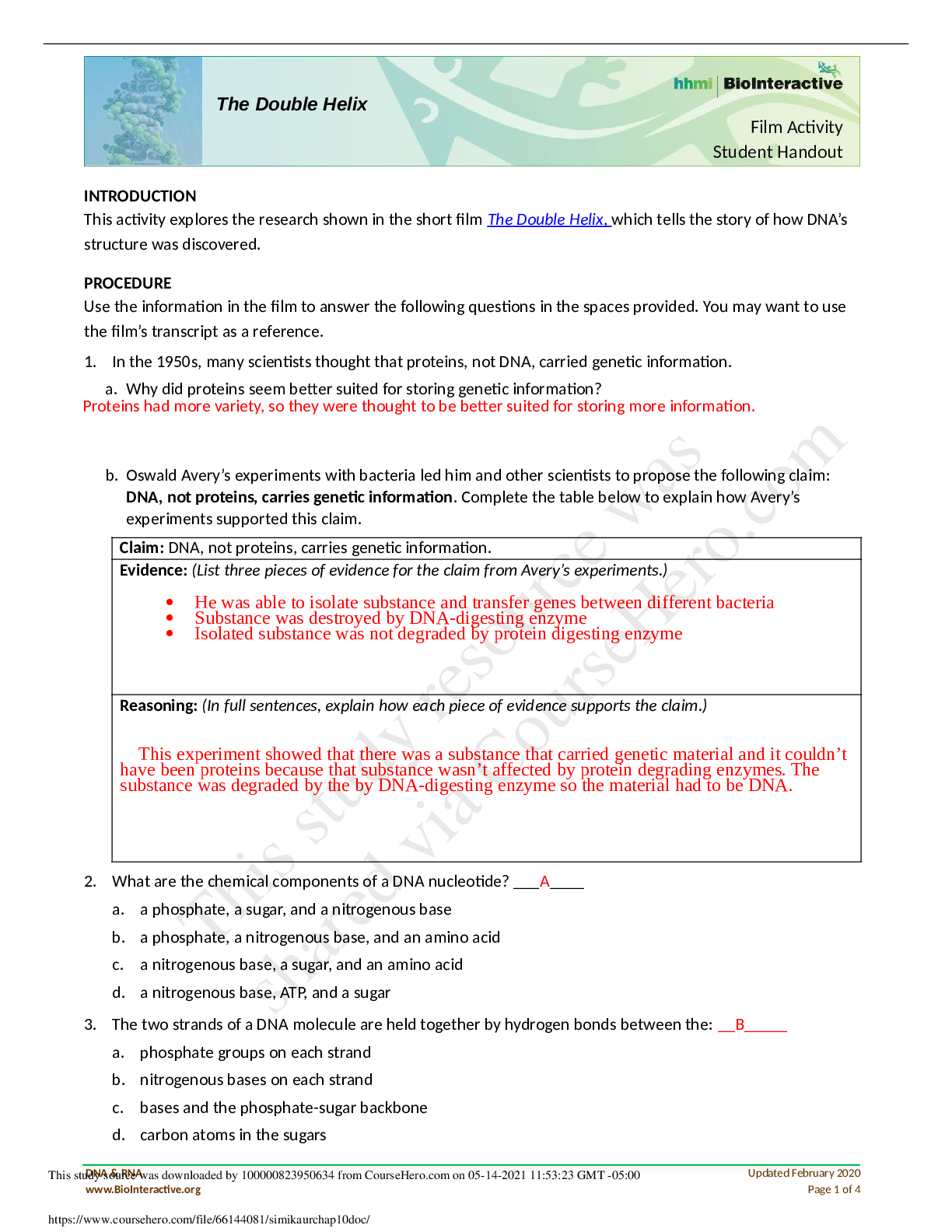
1. In the 1950s, many scientists thought that proteins, not DNA, carried genetic information.
a. Why did proteins seem better suited for storing genetic information?
Proteins had more variety, so they were thought to be better suited for storing more information.
b. Oswald Avery’s experiments with bacteria led him and other scientists to propose the following claim:
DNA, not proteins, carries genetic information. Complete the table below to explain how Avery’s
experiments supported this claim.
Claim: DNA, not proteins, carries genetic information.
Evidence: (List three pieces of evidence for the claim from Avery’s experiments.)
He was able to isolate substance and transfer genes between different bacteria
Substance was destroyed by DNA-digesting enzyme
Isolated substance was not degraded by protein digesting enzyme
Reasoning: (In full sentences, explain how each piece of evidence supports the claim.)
This experiment showed that there was a substance that carried genetic material and it couldn’t
have been proteins because that substance wasn’t affected by protein degrading enzymes. The
substance was degraded by the by DNA-digesting enzyme so the material had to be DNA.
2. What are the chemical components of a DNA nucleotide? ___A____
a. a phosphate, a sugar, and a nitrogenous base
b. a phosphate, a nitrogenous base, and an amino acid
c. a nitrogenous base, a sugar, and an amino acid
d. a nitrogenous base, ATP, and a sugar
3. The two strands of a DNA molecule are held together by hydrogen bonds between the: __B_____
a. phosphate groups on each strand
b. nitrogenous bases on each strand
c. bases and the phosphate-sugar backbone
d. carbon atoms in the sugars
DNA & RNA Updated February 2020
www.BioInteractive.org Page 1 of 4
[Show More]












.png)

.png)


