Department of Economics UN3412
Columbia University Fall 2020
SOLUTIONS to Problem Set 1
Introduction to Econometrics
for both sections
Michael C. Best and Seyhan Erden
______________________________________________
...
Department of Economics UN3412
Columbia University Fall 2020
SOLUTIONS to Problem Set 1
Introduction to Econometrics
for both sections
Michael C. Best and Seyhan Erden
__________________________________________________________________________________________
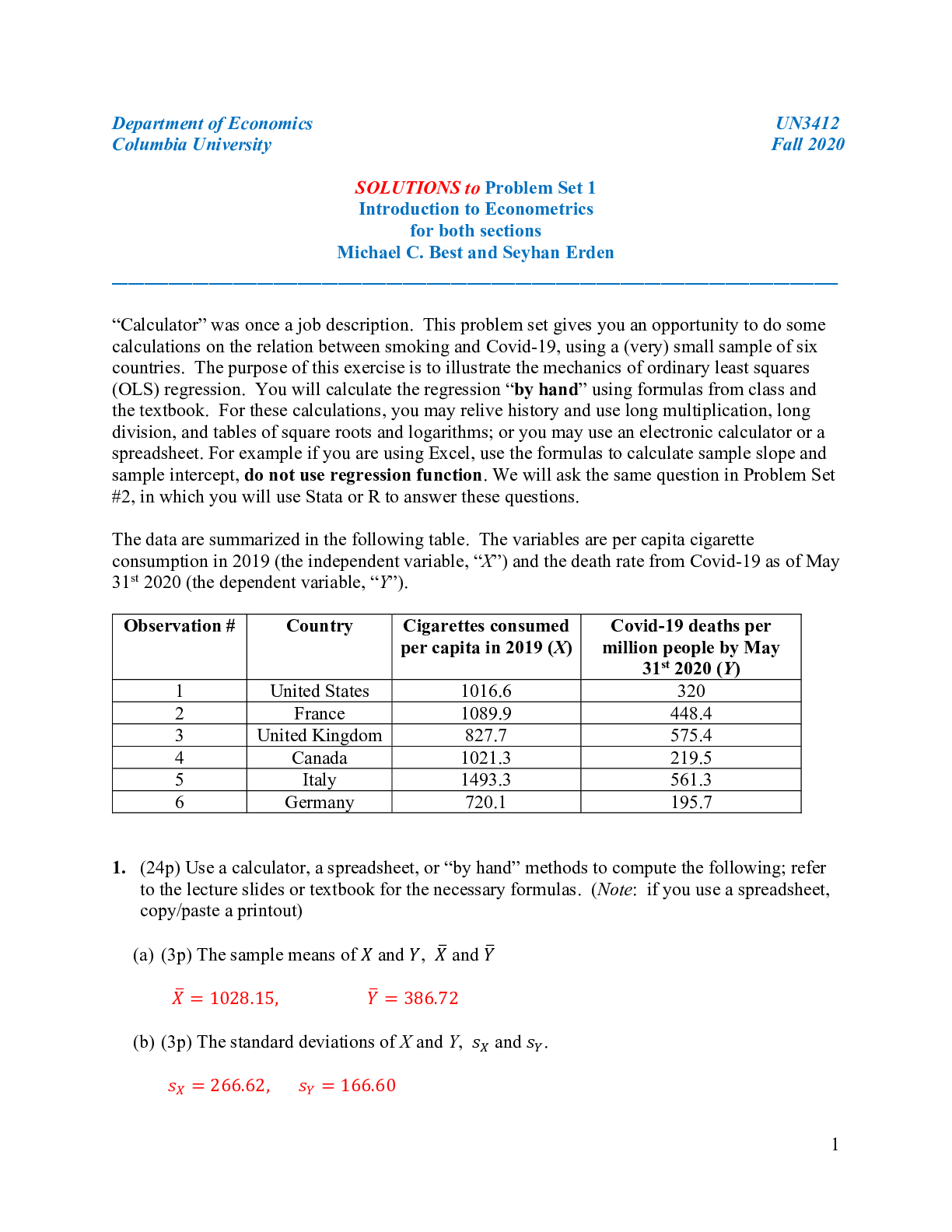
“Calculator” was once a job description. This problem set gives you an opportunity to do some
calculations on the relation between smoking and Covid-19, using a (very) small sample of six
countries. The purpose of this exercise is to illustrate the mechanics of ordinary least squares
(OLS) regression. You will calculate the regression “by hand” using formulas from class and
the textbook. For these calculations, you may relive history and use long multiplication, long
division, and tables of square roots and logarithms; or you may use an electronic calculator or a
spreadsheet. For example if you are using Excel, use the formulas to calculate sample slope and
sample intercept, do not use regression function. We will ask the same question in Problem Set
#2, in which you will use Stata or R to answer these questions.
The data are summarized in the following table. The variables are per capita cigarette
consumption in 2019 (the independent variable, “X”) and the death rate from Covid-19 as of May
31st 2020 (the dependent variable, “Y”).
Observation # Country Cigarettes consumed
per capita in 2019 (X)
Covid-19 deaths per
million people by May
31st 2020 (Y)
1 United States 1016.6 320
2 France 1089.9 448.4
3 United Kingdom 827.7 575.4
4 Canada 1021.3 219.5
5 Italy 1493.3 561.3
6 Germany 720.1 195.7
1. (24p) Use a calculator, a spreadsheet, or “by hand” methods to compute the following; refer
to the lecture slides or textbook for the necessary formulas. (Note: if you use a spreadsheet,
copy/paste a printout)
(a) (3p) The sample means of ? and ?, ?# and ?#
?# = 1028.15, ?# = 386.72
(b) (3p) The standard deviations of X and Y, ?1 and ?2.
?1 = 266.62, ?2 = 166.602
(c) (3p) Covariance X and Y, ?12.
?12 = 21590.7
(d) (3p) The correlation coefficient, r, between X and Y
? = 0.486
(e) (3p) ?78, the OLS estimated slope coefficient from the regression ?9 = ?7: + ?78?9 + ?9
?78 = 0.3037
(f) (3p) ?7:, the OLS estimated intercept term from the same regression
?7: = 74.44
(g) (3p) ?=9, ? = 1, … , ?, the predicted values for each country from the regression
[Show More]