Unit 9 Progress Check: MCQ
Copyright © 2020. The College Board. These materials are part of a College Board program. Use or distribution of these materials online or in print
beyond your school’s participation in the p
...
Unit 9 Progress Check: MCQ
Copyright © 2020. The College Board. These materials are part of a College Board program. Use or distribution of these materials online or in print
beyond your school’s participation in the program is prohibited. Page 1 of 21
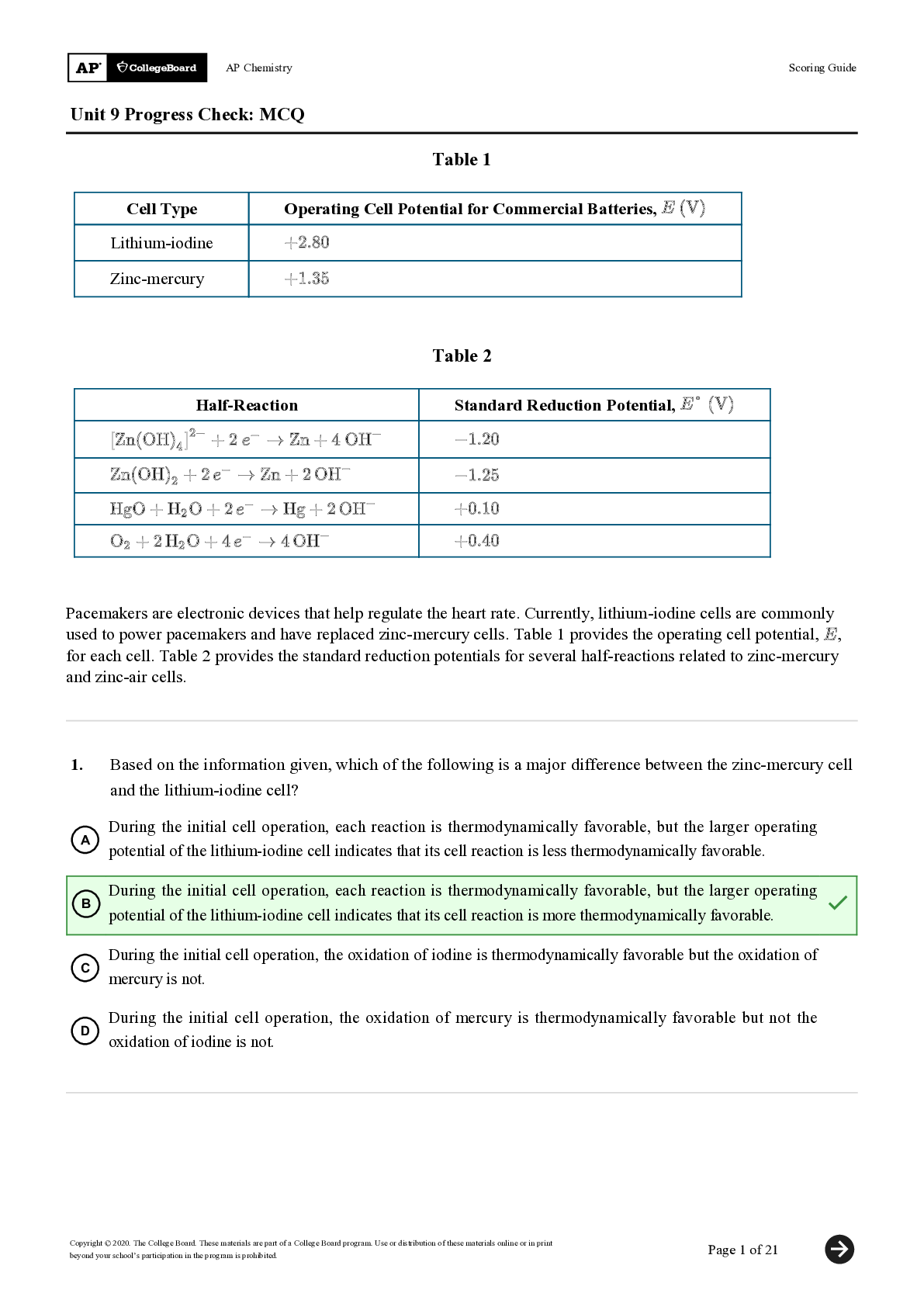
Table 1
Cell Type Operating Cell Potential for Commercial Batteries,
Lithium-iodine
Zinc-mercury
Table 2
Half-Reaction Standard Reduction Potential,
Pacemakers are electronic devices that help regulate the heart rate. Currently, lithium-iodine cells are commonly
used to power pacemakers and have replaced zinc-mercury cells. Table 1 provides the operating cell potential, ,
for each cell. Table 2 provides the standard reduction potentials for several half-reactions related to zinc-mercury
and zinc-air cells.
1. Based on the information given, which of the following is a major difference between the zinc-mercury cell
and the lithium-iodine cell?
A
During the initial cell operation, each reaction is thermodynamically favorable, but the larger operating
potential of the lithium-iodine cell indicates that its cell reaction is less thermodynamically favorable.
B
During the initial cell operation, each reaction is thermodynamically favorable, but the larger operating
potential of the lithium-iodine cell indicates that its cell reaction is more thermodynamically favorable.
C
During the initial cell operation, the oxidation of iodine is thermodynamically favorable but the oxidation of
mercury is not.
D
During the initial cell operation, the oxidation of mercury is thermodynamically favorable but not the
oxidation of iodine is not.AP Chemistry Scoring Guide
Unit 9 Progress Check: MCQ
Copyright © 2020. The College Board. These materials are part of a College Board program. Use or distribution of these materials online or in print
beyond your school’s participation in the program is prohibited. Page 2 of 21
2. On average, after one year of operation, the potential of a lithium-iodine cell decreases by 1%-2%. Which of
the following best helps to explain the cause for the decrease in cell potential?
A , and as the cell operates, decreases.
B , and as the cell operates, increases.
C , and as the cell operates, decreases.
D , and as the cell operates, increases.
[Show More]