Pharmacology  >  Study Notes  >  DRUG MECHANISM (All)

DRUG MECHANISM

Document Content and Description Below

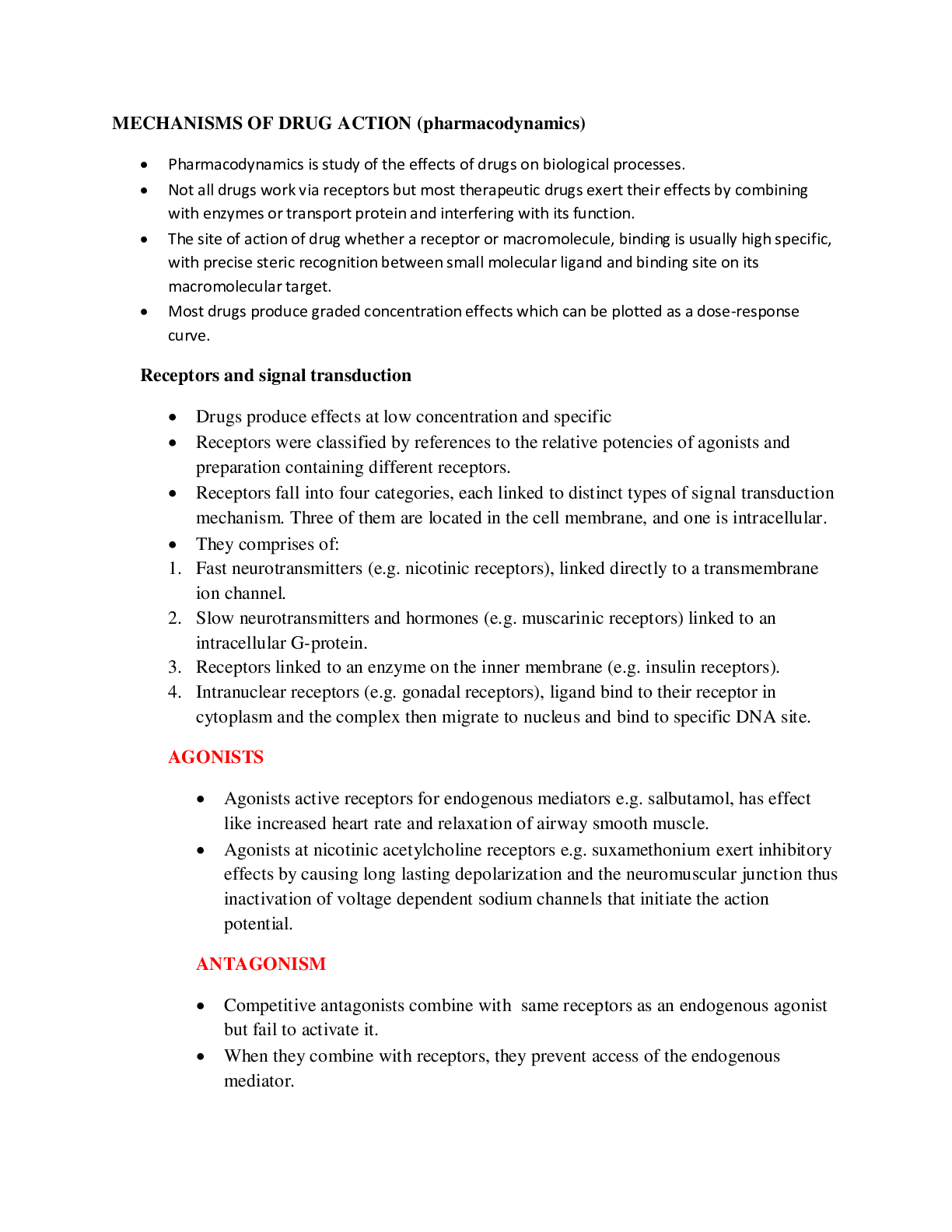
MECHANISMS OF DRUG ACTION (pharmacodynamics) • Pharmacodynamics is study of the effects of drugs on biological processes. • Not all drugs work via receptors but most therapeutic drugs exert thei ... r effects by combining with enzymes or transport protein and interfering with its function. • The site of action of drug whether a receptor or macromolecule, binding is usually high specific, with precise steric recognition between small molecular ligand and binding site on its macromolecular target. • Most drugs produce graded concentration effects which can be plotted as a dose-response curve. Receptors and signal transduction • Drugs produce effects at low concentration and specific • Receptors were classified by references to the relative potencies of agonists and preparation containing different receptors. • Receptors fall into four categories, each linked to distinct types of signal transduction mechanism. Three of them are located in the cell membrane, and one is intracellular. • They comprises of: 1. Fast neurotransmitters (e.g. nicotinic receptors), linked directly to a transmembrane ion channel. 2. Slow neurotransmitters and hormones (e.g. muscarinic receptors) linked to an intracellular G-protein. 3. Receptors linked to an enzyme on the inner membrane (e.g. insulin receptors). 4. Intranuclear receptors (e.g. gonadal receptors), ligand bind to their receptor in cytoplasm and the complex then migrate to nucleus and bind to specific DNA site. AGONISTS • Agonists active receptors for endogenous mediators e.g. salbutamol, has effect like increased heart rate and relaxation of airway smooth muscle. • Agonists at nicotinic acetylcholine receptors e.g. suxamethonium exert inhibitory effects by causing long lasting depolarization and the neuromuscular junction thus inactivation of voltage dependent sodium channels that initiate the action potential. ANTAGONISM • Competitive antagonists combine with same receptors as an endogenous agonist but fail to activate it. • When they combine with receptors, they prevent access of the endogenous mediator. • Antagonists that do not combine with the same receptor , reduce the slope of the log dose-response curve and depress its maximum. PARTIAL AGONISTS [Show More]

Last updated: 3 years ago

Preview 1 out of 2 pages

Buy Now

Instant download

We Accept:

Payment methods accepted on Scholarfriends (We Accept)
Preview image of DRUG MECHANISM document

Buy this document to get the full access instantly

Instant Download Access after purchase

Buy Now

Instant download

We Accept:

Payment methods accepted on Scholarfriends (We Accept)

Reviews( 0 )

$6.00

Buy Now

We Accept:

Payment methods accepted on Scholarfriends (We Accept)

Instant download

Can't find what you want? Try our AI powered Search

347
0

Document information


Connected school, study & course


About the document


Uploaded On

May 15, 2021

Number of pages

2

Written in

All

Seller


Profile illustration for Nurse Margaret
Nurse Margaret

Member since 4 years

Documents Sold

Additional information

This document has been written for:

Uploaded

May 15, 2021

Downloads

 0

Views

 347

Document Keyword Tags

More From Nurse Margaret

View all Nurse Margaret's documents »

Recommended For You

Get more on Study Notes »
$6.00
What is Scholarfriends

Scholarfriends.com Online Platform by Browsegrades Inc. 651N South Broad St, Middletown DE. United States.

We are here to help

We're available through e-mail, Twitter, Facebook, and live chat.
 FAQ
 Questions? Leave a message!

Follow us on
 Twitter

Copyright © Scholarfriends · High quality services·