Passpoint-Neonate Question 1 See full question
A neonate weighing 3 lb, 5 oz (1,503 g) is born at 32 weeks' gestation. During an
assessment 12 hours after birth, a nurse notices these signs and symptoms:
hy
...
Passpoint-Neonate Question 1 See full question
A neonate weighing 3 lb, 5 oz (1,503 g) is born at 32 weeks' gestation. During an
assessment 12 hours after birth, a nurse notices these signs and symptoms:
hyperactivity, a persistent shrill cry, frequent yawning and sneezing, and jitteriness.
These symptoms indicate:
You Selected:
hypoglycemia.
Correct response:
drug dependence.
Explanation:
Remediation:
Question 2 See full question
Just after delivery, a nurse measures a neonate's axillary temperature at 94.1°F
(34.5°C). What should the nurse do?
You Selected:
Rewarm the neonate gradually.
Correct response:
Rewarm the neonate gradually.
Explanation:
Remediation:
Question 3 See full question
Which complication is common in neonates who receive prolonged mechanical
ventilation at birth?
You Selected:
Bronchopulmonary dysplasia
Correct response:
Bronchopulmonary dysplasia
Explanation:
Remediation:
Question 4 See full question
A client in labor has meconium staining in the amniotic fluid. Which sequence of
events will most effectively decrease the risk of meconium aspiration?
You Selected:
Deliver the head, then suction the mouth and then the nose.
Correct response:
Deliver the head, then suction the mouth and then the nose.
Explanation:
Remediation:
Question 5 See full question
A nurse is assisting with a circumcision. After the physician has started the
procedure, the nurse reviews the neonate's medical record and notices that an
informed consent form hasn't been signed. What should the nurse do?
You Selected:
Tell the physician to stop the procedure immediately because an informed
consent form hasn't been signed.
Correct response:
Tell the physician to stop the procedure immediately because an informed
consent form hasn't been signed.
Explanation:
Remediation:
Question 6 See full question
While caring for a neonate born at 32 weeks’ gestation, which finding
would most suggest the infant is developing necrotizing enterocolitis (NEC)?
You Selected:
abdominal distention
Correct response:
abdominal distention
Explanation:
Remediation:
Question 7 See full question
The client who is breastfeeding asks the nurse if she should supplement
breastfeeding with formula feeding. The nurse bases the response on which
principle?
You Selected:
Formula feeding should be avoided to prevent interfering with the breast
milk supply.
Correct response:
Formula feeding should be avoided to prevent interfering with the breast
milk supply.
Explanation:
Remediation:
Question 8 See full question
During the first feeding, the nurse observes that the neonate becomes cyanotic
after gagging on mucus. What should the nurse do first?
You Selected:
Clear the neonate's airway with suction or gravity.
Correct response:
Clear the neonate's airway with suction or gravity.
Explanation:
Remediation:
Question 9 See full question
A client is exclusively breastfeeding her 1-week-old infant and is concerned about
her baby taking enough milk per day. The client tells the nurse that the infant has
six wet diapers per day. Which of the following responses by the nurse is most
appropriate?
You Selected:
“That many wet diapers indicates your infant is adequately hydrated.”
Correct response:
“That many wet diapers indicates your infant is adequately hydrated.”
Explanation:
Remediation:
Question 10 See full question
A neonate has been placed on cardiac and apnea monitoring in the neonatal
nursery. The nurse notes that the apnea alarm repeatedly triggers. Place the
following actions in the order in which they would be completed by the nurse. All
options must be used.
You Selected:
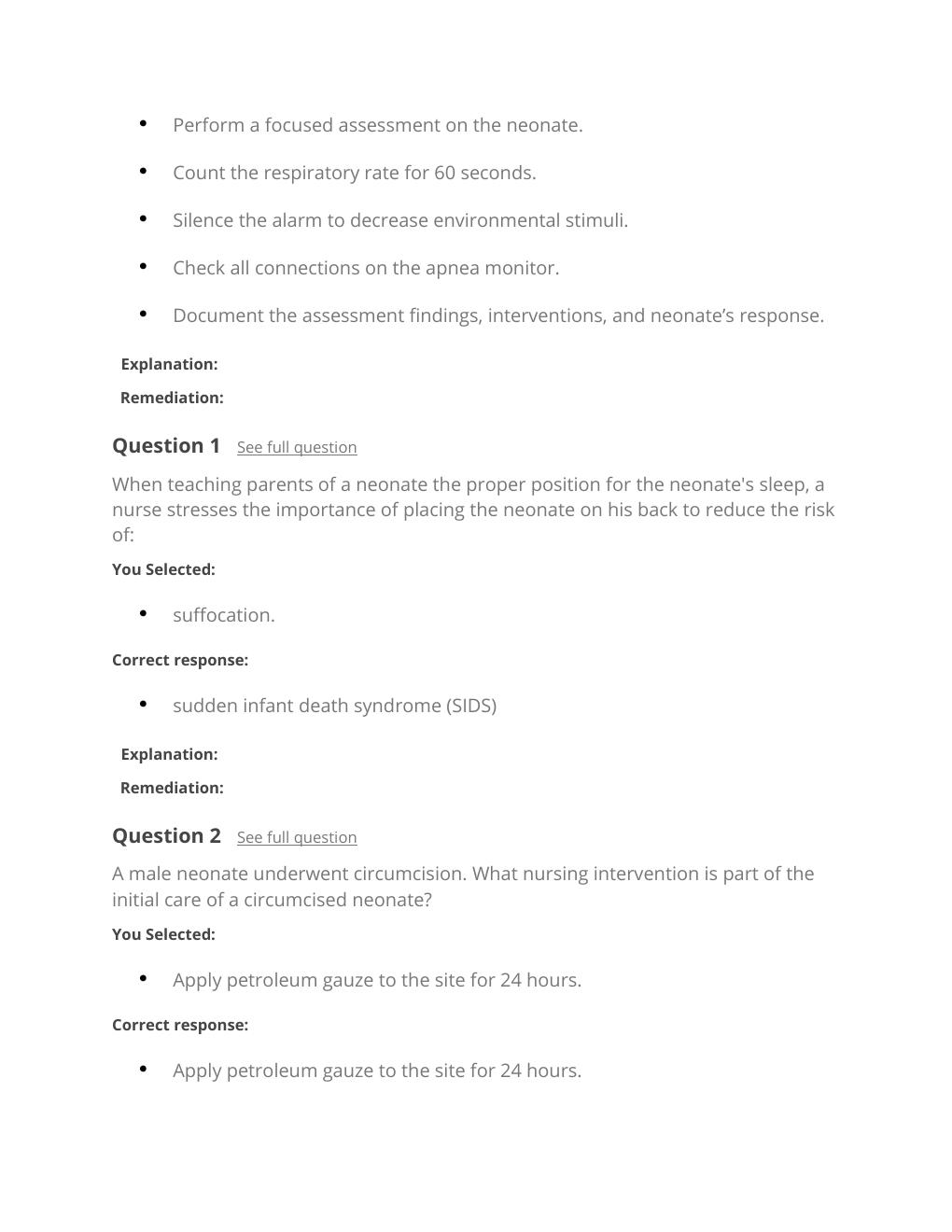
Silence the alarm to decrease environmental stimuli.
Check all connections on the apnea monitor.
Count the respiratory rate for 60 seconds.
Perform a focused assessment on the neonate.
Document the assessment findings, interventions, and neonate’s response.
Correct response:
Perform a focused assessment on the neonate.
Count the respiratory rate for 60 seconds.
Silence the alarm to decrease environmental stimuli.
Check all connections on the apnea monitor.
Document the assessment findings, interventions, and neonate’s response.
Explanation:
Remediation:
Question 1 See full question
When teaching parents of a neonate the proper position for the neonate's sleep, a
nurse stresses the importance of placing the neonate on his back to reduce the risk
of:
You Selected:
suffocation.
Correct response:
sudden infant death syndrome (SIDS)
Explanation:
Remediation:
Question 2 See full question
A male neonate underwent circumcision. What nursing intervention is part of the
initial care of a circumcised neonate?
You Selected:
Apply petroleum gauze to the site for 24 hours.
Correct response:
Apply petroleum gauze to the site for 24 hours