MEASUREMENTS
Glenn V. Lo
Department of Physical Sciences
Nicholls State University
MEASUREMENT
assigning a value to an observation
For science and trade: value assigned should
be in reference to or traceable to
...
MEASUREMENTS
Glenn V. Lo
Department of Physical Sciences
Nicholls State University
MEASUREMENT
assigning a value to an observation
For science and trade: value assigned should
be in reference to or traceable to a “standard”
Reported measurement generally has 2 parts:
■ Number (indicates the value)
■ Unit (indicates the standard)
■ Ex: 5.0 kg
◆ (means 5.0 times the mass of a cylinder stored in a vault at the
International Bureau of Weights and Measures in France; by
agreement the cylinder is defined to have a mass of 1 kg)
THE STANDARDS
US Trade
■ National Institute of Standards and Technology
(Gaithersburg, Maryland) http://www.nist.gov
■ English System of Units
International/Scientific
■ International Bureau of Weights and Measures
(BIPM) http://www.bipm.fr/enus/welcome.html
■ Systeme Internationale (SI) Units
◆ Evolved from metric system
The SI Units
Base units for
seven fundamental
quantities were officially adopted in
1960
What are they?
■ mass, length, time, temperature, etc.
■ http://www.bipm.fr/enus/3_SI/base_units.html
All other quantities can be derived from
measurements of fundamental quantities.
■ Example: speed = length divided by time
■ Units for derived quantities are combinations of
base units (speed: m/s). Some are given names (ex. Joule, J = kg m / s2)
special
http://www.bipm.fr/enus/3_SI/siderived.html
Units of Mass
SI Base unit for Mass: kg
Commonly used in Chem lab: g (gram)
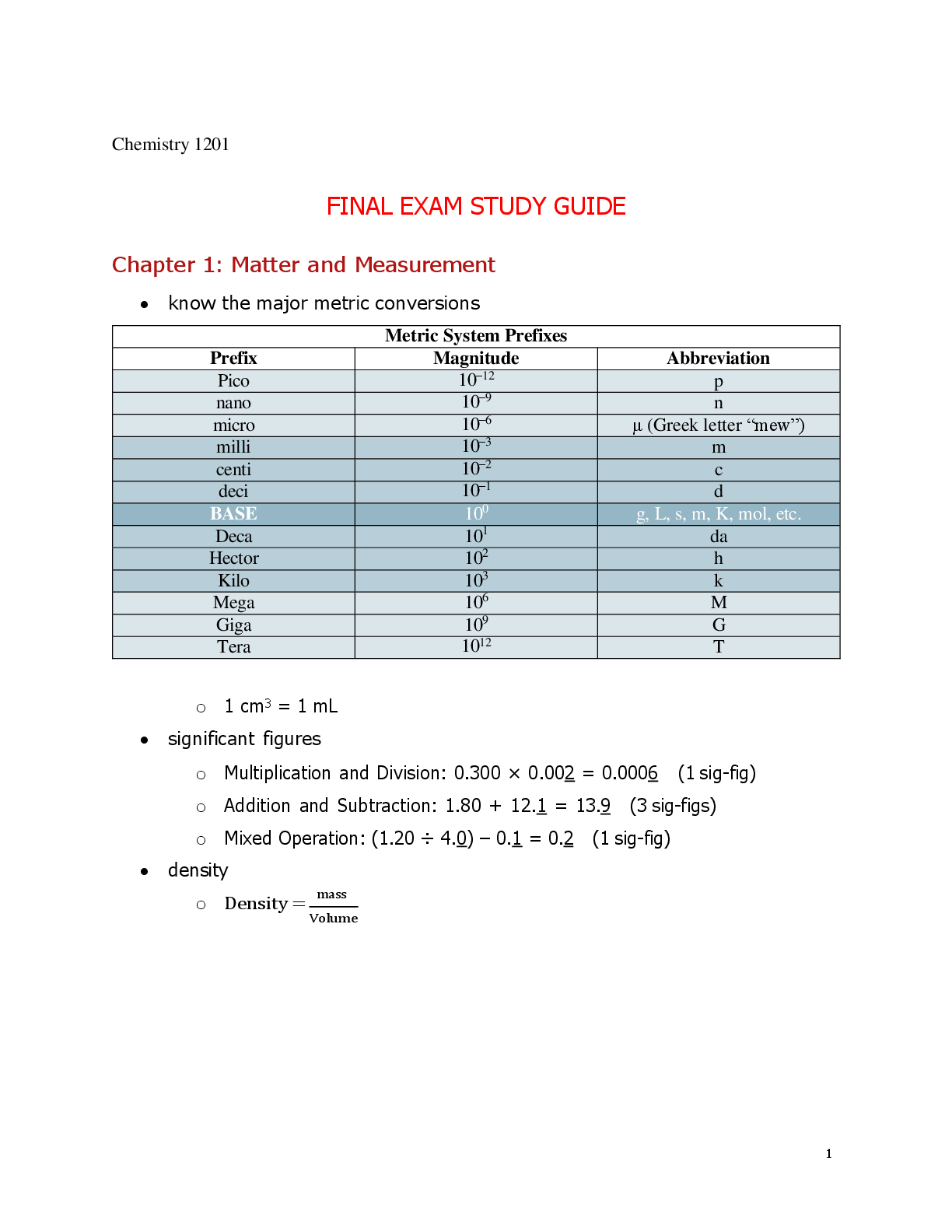
■ 1000 g = 1 kg, exactly
■ “k” stands for “kilo,” and means 1000
■ k (lower case!) is an official SI abbreviation
■ 1 packet of sugar is approx. 3.5 g
Relation to common English units:
■ A kilogram is a little over 2 pounds, 1 kg = 2.2 lb,
■ A pound is about ½ kilo, 1 lb = 454 g
■ An ounce is about 28 grams (8 packets of
sugar)
Units of Mass
Commonly used unit of mass in
medicines/vitamins: mg (milligram)
■ 1 mg = 0.001 g
■ “m” stands for “milli,” and means 1/1000
■ m (lower case!) is official SI abbreviation
■ There are 1000 milligrams in a gram
■ 1000 mg = 1 g
■ One Extra Strength Tylenol has 500 mg, or
½ gram, of acetaminophen
Jewelry
■ 1 carat = 200 mg
Mass
vs.
Weight
The words “weight” and “mass” are often
used interchangeably, but are not the same
■ Mass is amount of matter in an object
■ Weight is the magnitude of the force that pulls an
object towards the center of the earth (moon, or
whatever planet it’s on)
■ Mass does not depend on location;
weight does
Mass is proportional to weight. In Chem.
Lab.: “weigh” means “determine the mass”.
Units of Length
SI Base unit for Length: m (meter)
Commonly used in Chem lab: cm, mm
■ 1 cm = 0.01 m, exactly (c = “centi” = 1/100)
■ 1 mm = 0.001 m, exactly (m=“milli” = 1/1000)
■ c and m (lower case!) are official SI abbreviations
■ 100 cm = 1 m, 1000 mm = 1 m, 10 mm = 1 cm
Relation to common English units:
■ 1 inch is about 2½ cm, or 25 mm
◆ 1 inch = 2.54 cm = 25.4 mm, exactly
■ 1 yard is about 91 cm, about 4 a meter
inches shorter than
Units of Length
...........................................................continued.............................................
[Show More]