2017 PN Hesi Exit V3
1) The LPN/LVN receives the client's next scheduled bag of TPN labeled with the
additive NPH insulin. Which action should the nurse implement?
A.Hang the solution at the current rate.
B.Refrigera
...
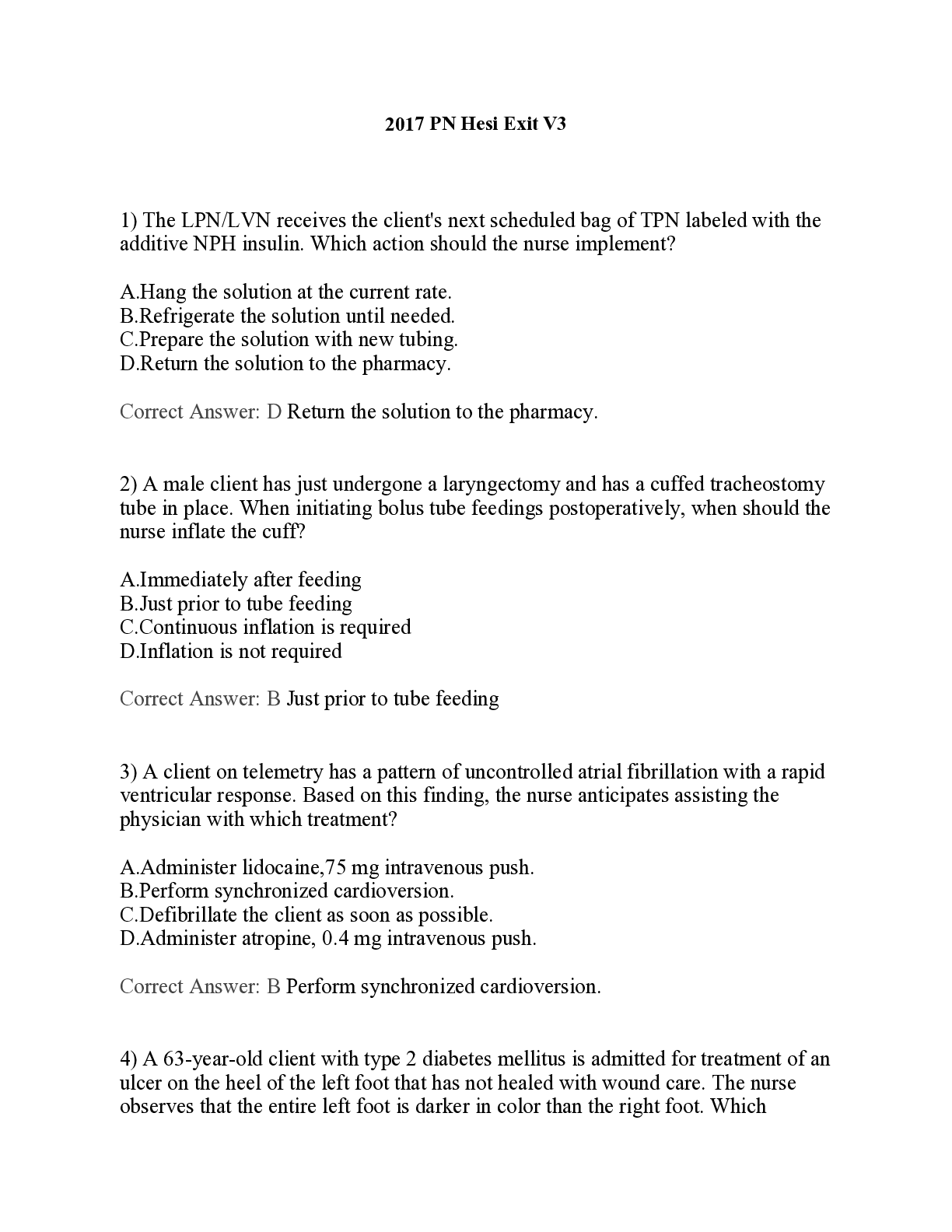
2017 PN Hesi Exit V3
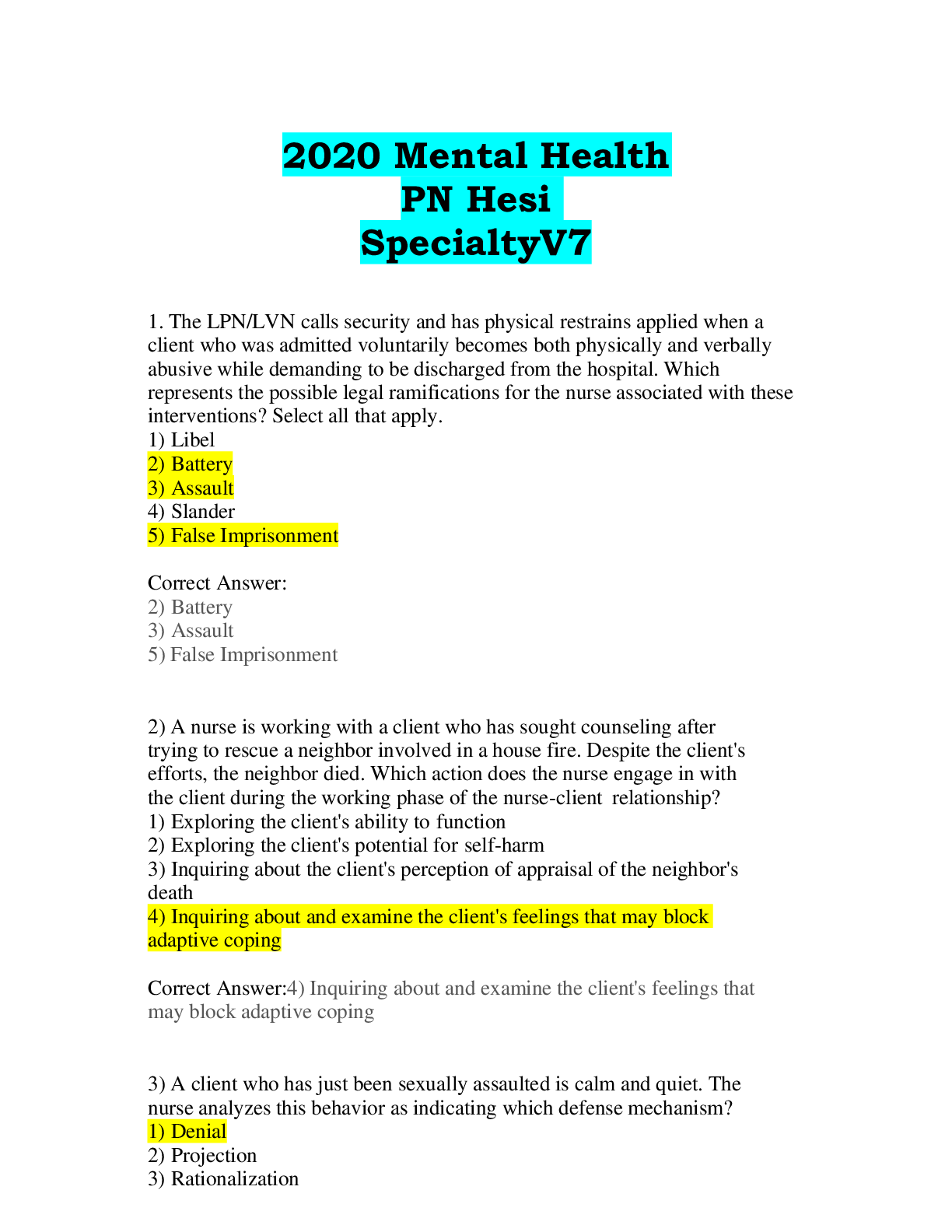
1) The LPN/LVN receives the client's next scheduled bag of TPN labeled with the
additive NPH insulin. Which action should the nurse implement?
A.Hang the solution at the current rate.
B.Refrigerate the solution until needed.
C.Prepare the solution with new tubing.
D.Return the solution to the pharmacy.
Correct Answer: D Return the solution to the pharmacy.
2) A male client has just undergone a laryngectomy and has a cuffed tracheostomy
tube in place. When initiating bolus tube feedings postoperatively, when should the
nurse inflate the cuff?
A.Immediately after feeding
B.Just prior to tube feeding
C.Continuous inflation is required
D.Inflation is not required
Correct Answer: B Just prior to tube feeding
3) A client on telemetry has a pattern of uncontrolled atrial fibrillation with a rapid
ventricular response. Based on this finding, the nurse anticipates assisting the
physician with which treatment?
A.Administer lidocaine,75 mg intravenous push.
B.Perform synchronized cardioversion.
C.Defibrillate the client as soon as possible.
D.Administer atropine, 0.4 mg intravenous push.
Correct Answer: B Perform synchronized cardioversion.
4) A 63-year-old client with type 2 diabetes mellitus is admitted for treatment of an
ulcer on the heel of the left foot that has not healed with wound care. The nurse
observes that the entire left foot is darker in color than the right foot. Whichadditional symptom should the nurse expect to find?
A.Pedal pulses will be weak or absent in the left foot.
B.The client will state that the left foot is usually warm.
C.Flexion and extension of the left foot will be limited.
D.Capillary refill of the client's left toes will be brisk.
Correct Answer: A Pedal pulses will be weak or absent in the left foot.
5) A client with cirrhosis develops increasing pedal edema and ascites. Which
dietary modification is most important for the nurse to teach this client?
A.Avoid high-carbohydrate foods.
B.Decrease intake of fat-soluble vitamins.
C.Decrease caloric intake.
D.Restrict salt and fluid intake.
Correct Answer: D Restrict salt and fluid intake.
6) During report, the nurse learns that a client with tumor lysis syndrome is
receiving an IV infusion containing insulin. Which assessment should the nurse
complete first?
A.Review the client's history for diabetes mellitus.
B.Observe the extremity distal to the IV site.
C.Monitor the client's serum potassium and blood glucose levels.
D.Evaluate the client's oxygen saturation and breath sounds.
Correct Answer: C Monitor the client's serum potassium and blood glucose levels.
7) A resident in a long-term care facility is diagnosed with hepatitis B. Which
intervention should the nurse implement with the staff caring for this client?
A.Determine if all employees have had the hepatitis B vaccine series.
B.Explain that this type of hepatitis can be transmitted when feeding the client.
C.Assure the employees that they cannot contract hepatitis B when providing
direct care.
D.Tell the employees that wearing gloves and a gown are required when providing
care.Correct Answer: A Determine if all employees have had the hepatitis B vaccine
series.
8) The LPN/LVN notes that the client's drainage has decreased from 50 to 5 mL/hr
12 hours after chest tube insertion for hemothorax. What is the best initial action
for the nurse to take?
A.Document this expected decrease in drainage.
B.Clamp the chest tube while assessing for air leaks.
C.Milk the tube to remove any excessive blood clot buildup.
D.Assess for kinks or dependent loops in the tubing.
Correct Answer: D Assess for kinks or dependent loops in the tubing.
9) The nurse notes that a client who is scheduled for surgery the next morning has
an elevated blood urea nitrogen (BUN) level. Which condition is most likely to
have contributed to this finding?
A.Myocardial infarction 2 months ago
B.Anorexia and vomiting for the past 2 days
C.Recently diagnosed type 2 diabetes mellitus
D.Skeletal traction for a right hip fracture
Correct Answer: B Anorexia and vomiting for the past 2 days
10) The nurse is reviewing routine medications taken by a client with chronic angle
closure glaucoma. Which medication prescription should the nurse question?
A.Antianginal with a therapeutic effect of vasodilation
B.Anticholinergic with a side effect of pupillary dilation
C.Antihistamine with a side effect of sedation
D.Corticosteroid with a side effect of hyperglycemia
Correct Answer:B Anticholinergic with a side effect of pupillary dilation
11) A 58-year-old client who has no health problems asks the nurse about
receiving the pneumococcal vaccine (Pneumovax). Which statement given by thenurse would offer the client accurate information about this vaccine?
A.The vaccine is given annually before the flu season to those older than 50 years.
B.The immunization is administered once to older adults or those at risk for illness.
C.The vaccine is for all ages and is given primarily to those persons traveling
overseas to areas of infection.
D.The vaccine will prevent the occurrence of pneumococcal pneumonia for up to 5
years.
Correct Answer: B The immunization is administered once to older adults or those
at risk for illness.
12) The nurse is assessing a male client with acute pancreatitis. Which finding
requires the MOST immediate intervention by the nurse?
A.The client's amylase level is three times higher than the normal level.
B.While the nurse is taking the client's blood pressure, he has a carpal spasm.
C.On a 1 to 10 scale, the client tells the nurse that his epigastric pain is at 7.
D.The client states that he will continue to drink alcohol after going home.
Correct Answer: B While the nurse is taking the client's blood pressure, he has a
carpal spasm.
13) During assessment of a client in the intensive care unit, the nurse notes
that the client's ARE CLEAR UPON AUSCULTATION, but jugular vein
distention and muffled heart sounds are present. Which intervention should the
nurse implement?
A.Prepare the client for a pericardial tap.
B.Administer intravenous furosemide (Lasix).
C.Assist the client to cough and breathe deeply.
D.Instruct the client to restrict the oral fluid intake.
Correct Answer: A. Prepare the client for a pericardial tap.
14) After attending a class on reducing cancer risk factors, a client selects bran
flakes with 2% milk and orange slices from a breakfast menu. In evaluating
the client's learning, the nurse affirms that the client has made good choices
and makes what additional recommendation?A.Switch to skim milk.
B.Switch to orange juice.
C.Add a source of protein.
D.Add herbal tea.
Correct Answer: A Switch to skim milk.
15) A client diagnosed with angina pectoris complains of chest pain while
ambulating in the hallway. Which action should the nurse implement first?
A.Support the client to a sitting position.
B.Ask the client to walk slowly back to the room.
C.Administer a sublingual nitroglycerin tablet.
D.Provide oxygen via nasal cannula.
Correct Answer: A. Support the client to a sitting position.
16) A client is diagnosed with an acute small bowel obstruction. Which
assessment finding requires the most immediate intervention by the nurse?
A.Fever of 102° F
B.Blood pressure of 150/90 mm Hg
C.Abdominal cramping
D.Dry mucous membranes
Correct Answer: A Fever of 102° F
17) A tornado warning alarm has been activated at the local hospital. Which
action should the charge nurse working on a surgical unit implement first?
A.Instruct the nursing staff to close all window blinds and curtains in clients'
rooms.
B.Move clients and visitors into the hallways and close all doors to clients'
rooms.
C.Visually confirm the location of the tornado by checking the windows on
the unit.
D.Assist all visitors with evacuation down the stairs in a calm and orderly
manner.Correct Answer: B. Move clients and visitors into the hallways and close all doors
to clients' rooms.
18) A client with alcohol-related liver disease is admitted to the unit. Which
prescription should the nurse call the health care provider about for
reverification for this client?
A.Vitamin K1 (AquaMEPHYTON), 5 mg IM daily
B.High-calorie, low-sodium diet
C.Fluid restriction to 1500 mL/day
D.Pentobarbital (Nembutal sodium) at bedtime for rest
Correct Answer: D. Pentobarbital (Nembutal sodium) at bedtime for rest
19) A female client who received a nephrotoxic drug is admitted with acute
renal failure and asks the nurse if she will need dialysis for the rest of her life.
Which pathophysiologic consequence should the nurse explain that supports
the need for temporary dialysis until acute tubular necrosis subsides?
A.Azotemia
B.Oliguria
C.Hyperkalemia
D.Nephron obstruction
Correct Answer: D Nephron obstruction
20) Which instruction should the nurse teach a female client about the
prevention of toxic shock syndrome?
A."Get immunization against human papillomavirus (HPV)."
B."Change your tampon frequently."
C."Empty your bladder after intercourse."
D."Obtain a yearly flu vaccination."
Correct Answer: B. "Change your tampon frequently."
21) A postoperative client receives a Schedule II opioid analgesic for pain.
Which assessment finding requires the most immediate intervention by thenurse?
A.Hypoactive bowel sounds with abdominal distention
B.Client reports continued pain of 8 on a 10-point scale
C.Respiratory rate of 12 breaths/min, with O2 saturation of 85%
D.Client reports nausea after receiving the medication
Correct Answer: C Respiratory rate of 12 breaths/min, with O2 saturation of 85%
22) A client is being discharged following radioactive seed implantation for
prostate cancer. What is the most important information that the nurse should
provide to this client's family?
A.Follow exposure precautions.
B.Encourage regular meals.
C.Collect all urine.
D.Avoid touching the client.
Correct Answer: A.Follow exposure precautions.
23) An emaciated homeless client presents to the emergency department
complaining of a productive cough, with blood-tinged sputum and night
sweats. Which action is most important for the emergency department triage
nurse to implement for this client?
A.Initiate airborne infection precautions.
B.Place a surgical mask on the client.
C.Don an isolation gown and latex gloves.
D.Start protective (reverse) isolation precautions.
Correct Answer: A.Initiate airborne infection precautions.
24) Which abnormal laboratory finding indicates that a client with diabetes
needs further evaluation for diabetic nephropathy?
A.Hypokalemia
B.Microalbuminuria
C.Elevated serum lipid levelsD.Ketonuria
Correct Answer: B.Microalbuminuria
25) An older client is admitted with a diagnosis of bacterial pneumonia.
Which symptom should the nurse report to the health care provider after
assessing the client?
A.Leukocytosis and febrile
B.Polycythemia and crackles
C.Pharyngitis and sputum production
D.Confusion and tachycardia
Correct Answer: D Confusion and tachycardia
26) Which nursing action is necessary for the client with a flail chest?
A.Withhold prescribed analgesic medications.
B.Percuss the fractured rib area with light taps.
C.Avoid implementing pulmonary suctioning.
D.Encourage coughing and deep breathing.
Correct Answer: D Encourage coughing and deep breathing.
27) When assigning clients on a medical-surgical floor to an RN and a PN, it
is best for the charge nurse to assign which client to the PN?
A.A young adult with bacterial meningitis with recent seizures
B.An older adult client with pneumonia and viral meningitis
C.A female client in isolation with meningococcal meningitis
D.A male client 1 day postoperative after drainage of a brain abscess
Correct Answer: B An older adult client with pneumonia and viral meningitis
28) When educating a client after a total laryngectomy, which instruction
would be most important for the nurse to include in the discharge teaching?
A.Recommend that the client carry suction equipment at all times.
B.Instruct the client to have writing materials with him at all times.
C.Tell the client to carry a medical alert card that explains his condition.D.Caution the client not to travel outside the United States alone.
Correct Answer: C. Tell the client to carry a medical alert card that explains his
condition.
29) A central venous catheter has been inserted via a jugular vein, and a
radiograph has confirmed placement of the catheter. A prescription has been
received for a medication STAT, but IV fluids have not yet been started.
Which action should the nurse take prior to administering the prescribed
medication?
A.Assess for signs of jugular venous distention.
B.Obtain the needed intravenous solution.
C.Flush the line with heparinized solution.
D.Flush the line with normal saline.
Correct Answer: D.Flush the line with normal saline.
30) In caring for a client with acute diverticulitis, which assessment data
warrants immediate nursing intervention?
A.The client has a rigid hard abdomen and elevated WBC.
B.The client has left lower quadrant pain and an elevated temperature.
C.The client is refusing to eat any of the meal and is complaining of nausea.
D.The client has not had a bowel movement in 2 days and has a soft abdomen.
Correct Answer: A.The client has a rigid hard abdomen and elevated WBC.
31) The nurse is giving preoperative instructions to a 14-year-old client
scheduled for surgery to correct a spinal curvature. Which statement by the
client best demonstrates that learning has taken place?
A."I will read all the teaching booklets you gave me before surgery."
B."I have had surgery before, so I know what to expect afterward."
C."All the things people have told me will help me take care of my back."
D."Let me show you the method of turning I will use after surgery."
Correct Answer: D."Let me show you the method of turning I will use after
surgery."32) The nurse on a medical surgical unit is receiving a client from the
postanesthesia care unit (PACU) with a Penrose drain. Before choosing a
room for this client, which information is most important for the nurse to
obtain?
A.If suctioning will be needed for drainage of the wound
B.If the family would prefer a private or semiprivate room
C.If the client also has a Hemovac in place
D.If the client's wound is infected
Correct Answer: D If the client's wound is infected
33) The nurse is completing an admission interview for a client with
Parkinson's disease. Which question will provide additional information about
manifestations that the client is likely to experience?
A."Have you ever experienced any paralysis of your arms or legs?"
B."Do you have frequent blackout spells?"
C."Have you ever been frozen in one spot, unable to move?"
D."Do you have headaches, especially ones with throbbing pain?"
Correct Answer: C. "Have you ever been frozen in one spot, unable to move?"
34) A hospitalized client is receiving nasogastric tube feedings via a smallbore tube and a continuous pump infusion. He begins to cough and produces a
moderate amount of white sputum. Which action should the nurse take
FIRST?
A.Auscultate the client's breath sounds.
B.Turn off the continuous feeding pump.
C.Check placement of the nasogastric tube.
D.Measure the amount of residual feeding.
Correct Answer: B.Turn off the continuous feeding pump.
35) The nurse is caring for a critically ill client with cirrhosis of the liver who
has a nasogastric tube draining bright red blood. The nurse notes that theclient's serum hemoglobin and hematocrit levels are decreased. Which
additional change in laboratory data should the nurse expect?
A.Increased serum albumin level
B.Decreased serum creatinine
C.Decreased serum ammonia level
D.Increased liver function test results
Correct Answer: C.Decreased serum ammonia level
36) During the shift report, the charge nurse informs a nurse that she has been
assigned to another unit for the day. The nurse begins to sigh deeply and
tosses about her belongings as she prepares to leave, making it known that she
is very unhappy about being floated to the other unit. What is the best
immediate action for the charge nurse to take?
A.Continue with the shift report and talk to the nurse about the incident at a
later time.
B.Ask the nurse to call the house supervisor to see if she must be reassigned.
C.Stop the shift report and remind the nurse that all staff are floated equally.
D.Inform the nurse that her behavior is disruptive to the rest of the staff.
Correct Answer: A.Continue with the shift report and talk to the nurse about the
incident at a later time.
37) The LPN/LVN is administering a nystatin suspension (Mycostatin) for
stomatitis. Which instruction will the nurse provide to the client when
administering this medication?
A."Hold the medication in your mouth for a few minutes before swallowing
it."
B."Do not drink or eat milk products for 1 hour prior to taking this
medication."
C."Dilute the medication with juice to reduce the unpleasant taste and odor."
D."Take the medication before meals to promote increased absorption."
Correct Answer: "Hold the medication in your mouth for a few minutes before
swallowing it."38) Which condition should the nurse anticipate as a potential problem in a
female client with a neurogenic bladder?
A.Stress incontinence
B.Infection
C.Painless gross hematuria
D.Peritonitis
Correct Answer: B.Infection
39) A client is ready for discharge following the creation of an ileostomy.
Which instruction should the nurse include in discharge teaching?
A.Replace the stoma appliance every day.
B.Use warm tap water to irrigate the ileostomy.
C.Change the bag when the seal is broken.
D.Measure and record the ileostomy output.
Correct Answer: C.Change the bag when the seal is broken.
40) In assessing a client with an arteriovenous (AV) shunt who is scheduled
for dialysis today, the nurse notes the ABSENCE of a thrill or bruit at the
shunt site. What action should the nurse take?
A.Advise the client that the shunt is intact and ready for dialysis as scheduled.
B.Encourage the client to keep the shunt site elevated above the level of the
heart.
C.Notify the health care provider of the findings immediately.
D.Flush the site at least once with a heparinized saline solution.
Correct Answer: C.Notify the health care provider of the findings immediately.
41) The nurse is preparing a 45-year-old client for discharge from a cancer
center following ileostomy surgery for colon cancer. Which discharge goal
should the nurse include in this client's discharge plan?
A.Reduce the daily intake of animal fat to 10% of the diet within 6 weeks.
B.Exhibit regular, soft-formed stool within 1 month.
C.Demonstrate the irrigation procedure correctly within 1 week.
D.Attend an ostomy support group within 2 weeks.Correct Answer: D.Attend an ostomy support group within 2 weeks.
42) A client with hypertension has been receiving ramipril (Altace), 5 mg PO,
daily for 2 weeks and is scheduled to receive a dose at 0900. At 0830, the
client's blood pressure is 120/70 mm Hg. Which action should the nurse take?
A.Administer the prescribed dose at the scheduled time.
B.Hold the dose and contact the health care provider.
C.Hold the dose and recheck the blood pressure in 1 hour.
D.Check the health care provider's prescription to clarify dose.
Correct Answer: A.Administer the prescribed dose at the scheduled time.
43) A client with type 2 diabetes takes metformin (Glucophage) daily. The
client is scheduled for major surgery requiring general anesthesia the next day.
The nurse anticipates which approach to manage the client's diabetes best
while the client is NPO during the perioperative period?
A.NPO except for metformin and regular snacks
B.NPO except for oral antidiabetic agent
C.Novolin N insulin subcutaneously twice daily
D.Regular insulin subcutaneously per sliding scale
Correct Answer: D.Regular insulin subcutaneously per sliding scale
44) The nurse is assessing a 75-year-old client for symptoms of
hyperglycemia. Which symptom of hyperglycemia is an OLDER adult most
likely to exhibit?
A.Polyuria
B.Polydipsia
C.Weight loss
D.Infection
Correct Answer: D.Infection
45) The nurse teaches a client with type 2 diabetes nutritional strategies to
decrease obesity. Which food item(s) chosen by the client INDICATESUNDERSTANDING of the teaching? (Select all that apply.)
A.White bread
B.Salmon
C.Broccoli
D.Whole milk
E.Banana
Correct Answer: B, C, E
B. Salmon
C.Broccoli
E.Banana
46) A practical nurse (PN) tells the charge nurse in a long-term facility that
she does not want to be assigned to one particular resident. She reports that the
male client keeps insisting that she is his daughter and begs her to stay in his
room. What is the best managerial decision?
A.Notify the family that the resident will have to be discharged if his behavior
does not improve.
B.Notify administration of the PN's insubordination and need for counseling
about her statements.
C.Ask the PN what she has done to encourage the resident to believe that she
is his daughter.
D.Reassign the PN until the resident can be assessed more completely for
reality orientation.
Correct Answer: D Reassign the PN until the resident can be assessed more
completely for reality orientation.
47) The nurse is preparing a teaching plan for a group of healthy adults.
Which individual is most likely to maintain optimum health?
A.A teacher whose blood glucose levels average 126 mg/dL daily with oral
anti diabetic drugs
B.An accountant whose blood pressure averages 140/96 mm Hg and who says
he does not have time to exercise
C.A stock broker whose total serum cholesterol level dropped to 290 mg/dL
with diet modifications
D.A recovering IV heroin user who contracted hepatitis more than 10 years
agoCorrect Answer: A.A teacher whose blood glucose levels average 126 mg/dL daily
with oral anti diabetic drugs
48) What is the most important nursing priority for a client who has been
admitted for a possible kidney stone?
A.Reducing dairy products in the diet
B.Straining all urine
C.Measuring intake and output
D.Increasing fluid intake
Correct Answer: B.Straining all urine
49) A client is admitted to the hospital with a diagnosis of severe acute
diverticulitis. Which nursing intervention has the highest priority?
A.Place the client on NPO status.
B.Assess the client's temperature.
C.Obtain a stool specimen.
D.Administer IV fluids.
Correct Answer: A.Place the client on NPO status.
50) The nurse includes frequent oral care in the plan of care for a client
scheduled for an esophagogastrostomy for esophageal cancer. This
intervention is included in the client's plan of care to address which nursing
diagnosis?
A.Fluid volume deficit
B.Self-care deficit
C.Risk for infection
D.Impaired nutrition
Correct Answer: C.Risk for infection
51) A family member was taught to suction a client's tracheostomy prior to the
client's discharge from the hospital. Which observation by the nurse indicatesthat the family member is capable of correctly performing the suctioning
technique?
A.Turns on the continuous wall suction to −190 mm Hg
B.Inserts the catheter until resistance or coughing occurs
C.Withdraws the catheter while maintaining suctioning
D.Reclears the tracheostomy after suctioning the mouth
Correct Answer: B.Inserts the catheter until resistance or coughing occurs
52) A client diagnosed with chronic kidney disease (CKD) 2 years ago is
regularly treated at a community hemodialysis facility. Before his scheduled
dialysis treatment, which electrolyte imbalance should the nurse anticipate?
A.Hypophosphatemia
B.Hypocalcemia
C.Hyponatremia
D.Hypokalemia
Correct Answer: B Hypocalcemia
53) As an adolescent is receiving care, he's inadvertently injured with a warm
compress. The nurse completes an incident report based on the knowledge that
identification of which of the following is a goal of the report?
1. To reprimand the involved staff members for their actions
2. To identify the learning needs of staff to prevent incident recurrences
3. To reprimand the nurse-manager responsible for the unit
4. To hold people accountable for their actions
Correct Answer: 2
54) As a client progresses through pregnancy, she develops constipation. What
is the primary cause of this problem during pregnancy?
1. Decreased appetite
2. Inadequate fluid intake
3. Prolonged gastric emptying4. Reduced intestinal motility
Correct Answer: 4 Reduced intestinal motility
55) An adolescent with type 1 diabetes mellitus is experiencing a growth
spurt. Which treatment approach would be most effective for this client?
1. Administering insulin once per day
2. Administering multiple doses of insulin
3. Limiting dietary fat intake
4. Substituting an oral anti diabetic agent for insulin
Correct Answer: 2. Administering multiple doses of insulin
56) A client is admitted to the health care facility with bowel obstruction
secondary to colon cancer. The nurse obtains a health history, measures vital
signs, and auscultates for bowel sounds. Which step of the nursing process is
the nurse performing?
1. Planning
2. Data collection
3. Evaluation
4. Implementation
Correct Answer: 2. Data collection
57) The physician prescribes meperidine (Demerol), 1.1 mg/kg I.M., for a 16-
month-old child who has just had abdominal surgery. When administering this
drug, the nurse should use a needle of which size?
1. 18G
2. 20G
3. 23G
4. 27G
Correct Answer: 3 23G58) Which finding in a neonate suggests hypothermia?
1. Bradycardia
2. Hyperglycemia
3. Metabolic alkalosis
4. Shivering
Correct Answer: 1 Bradycardia
59) Initial client assessment information includes blood pressure 160/110 mm
Hg, pulse 88 beats/minute, respiratory rate 22 breaths/minute, and reflexes
+3/+4 with 2 beat clonus. Urine specimen reveals +3 protein, negative sugar
and ketones. Based on these findings, the nurse would expect the client to
have which complaints?
1. Headache, blurred vision, and facial and extremity swelling
2. Abdominal pain, urinary frequency, and pedal edema
3. Diaphoresis, nystagmus, and dizziness
4. Lethargy, chest pain, and shortness of breath
Correct Answer: 1. Headache, blurred vision, and facial and extremity swelling
60) The nurse is performing a baseline assessment of a client's skin integrity.
Which of the following is a key assessment parameter?
1. Family history of pressure ulcers
2. Presence of existing pressure ulcers
3. Potential areas of pressure ulcer development
4. Overall risk of developing pressure ulcers
Correct Answer: 4. Overall risk of developing pressure ulcers
61) The nurse is preparing to boost a client up in bed. She instructs the client
to use the overbed trapeze. Which risk factor for pressure ulcer development is
the nurse reducing by instructing the client to move in this manner?1. Friction
2. Impaired circulation
3. Localized pressure
4. Shearing forces
Correct Answer: 4. Shearing forces
62) A geriatric client with Alzheimer's disease has been living with his grown
child's family for the last 6 months. He wanders at night and needs help with
activities of daily living. Which statement by his child suggests that the family
is successfully adjusting to this living arrangement?
1. "It's difficult dealing with Dad. It's a thankless job."
2. "We had no idea this would be so difficult. It's our cross to bear."
3. "Dad really seems to be making progress. We're hoping he'll be able to
move back into his house soon."
4. "Dad has presented many challenges. We have alarms on all the outside
doors now. Respite care gives us a break."
Correct Answer: 4 "Dad has presented many challenges. We have alarms on all
the outside doors now. Respite care gives us a break."
63) The nurse is assessing an elderly client. When performing the assessment,
the nurse should consider that one normal age-related change is:
1. cloudy vision.
2. incontinence.
3. diminished reflexes.
4. tremors.
Correct Answer: 3 diminished reflexes.
64) An agitated, confused client arrives in the emergency department. The
client's history includes type 1 diabetes, hypertension, andangina pectoris.
Assessment reveals pallor, diaphoresis, headache, and intense hunger. A stat
blood glucose sample measures 42 mg/dl, and the client is treated for an acutehypoglycemic reaction. After recovery, the nurse teaches the client to treat
hypoglycemiaby ingesting:
1. 2 to 5 g of a simple carbohydrate.
2. 10 to 15 g of a simple carbohydrate.
3. 18 to 20 g of a simple carbohydrate.
4. 25 to 30 g of a simple carbohydrate.
Correct Answer: 2 10 to 15 g of a simple carbohydrate.
65) A 43-year-old man was transferring a load of firewood from his front
driveway to his backyard woodpile at 10 a.m. when he experienced a
heaviness in his chest and dyspnea. He stopped working and rested, and the
pain subsided. At noon, the pain returned. At 1:30 p.m., his wife took him to
the emergency department. Around 2 p.m., the emergency department
physician diagnoses an anterior myocardial infarction (MI). The nurse should
anticipate which immediate order by the physician?
1. Lidocaine administration
2. Cardiac stress test
3. Serial liver enzyme testing
4. Tissue plasminogen activator (tPA)
Correct Answer: 4. Tissue plasminogen activator (tPA)
66) A nurse's neighbor complains of severe right flank pain. She explains that
it began during the night, but she was able to take acetaminophen (Tylenol)
and return to bed. When she awoke, the pain increased in intensity. How
should the nurse intervene?
1. Explain that she can't give medical advice.
2. Inform the neighbor that she might require surgery.
3. Advise the neighbor to seek medical attention.
4. Tell the neighbor that she'll be fine because she was able to get through the
night.Correct Answer: 3. Advise the neighbor to seek medical attention.
67) A client has a history of chronic undifferentiated schizophrenia. Because
she has a history of noncompliance with antipsychotic therapy, she'll receive
fluphenazine decanoate (Prolixin Decanoate) injections every 4 weeks. Before
discharge, what should the nurse include in her teaching plan?
1. Asking the physician for droperidol (Inapsine) to control any
extrapyramidal symptoms that occur
2. Sitting up for a few minutes before standing to minimize orthostatic
hypotension
3. Notifying the physician if her thoughts don't normalize within 1 week
4. Expecting symptoms of tardive dyskinesia to occur and to be transient
Correct Answer: 2. Sitting up for a few minutes before standing to minimize
orthostatic hypotension
68) One day after being admitted with bipolar disorder, a client becomes
verbally aggressive during a group therapy session. Which response by the
nurse would be therapeutic?
1. "You're behaving in an unacceptable manner, and you need to control
yourself."
2. "If you continue to talk like that, no one will want to be around you."
3. "You're disturbing the other clients. I'll walk with you around the patio to
help you release some of your energy."
4. "You're scaring everyone in the group. Leave the room immediately."
Correct Answer: 3 "You're disturbing the other clients. I'll walk with you around
the patio to help you release some of your energy."
69) A client comes to the emergency department complaining of headache,
malaise, chills, fever, and a stiff neck. Vital sign assessment reveals a
temperature elevation, increased heart and respiratory rates, and normal bloodpressure. On physical examination, the nurse notes confusion, a petechial rash,
nuchal rigidity, Brudzinski's sign, and Kernig's sign. What does Brudzinski's
sign indicate?
1. Increased intracranial pressure (ICP)
2. Cerebral edema
3. Low cerebrospinal fluid (CSF) pressure
4. Meningeal irritation
Correct Answer: 4. Meningeal irritation
70) During a routine examination, the nurse notes that the client seems
unusually anxious. Anxiety can affect the genitourinary system by:
1. slowing the glomerular filtration rate.
2. increasing sodium resorption.
3. decreasing potassium excretion.
4. stimulating or hindering micturition.
Correct Answer: 4. stimulating or hindering micturition.
71) The nurse is advising a mother about foods to avoid to prevent choking in
her toddler. Which foods should she include in her instruction?
1. Small pieces of banana
2. Large, round chunks of meat such as hot dog
3. Cooked vegetables such as lima beans and corn
4. Frozen desserts such as ice cream
Correct Answer: 2. Large, round chunks of meat such as hot dog
72) A client with a history of Addison's disease and flulike symptoms
accompanied by nausea and vomiting over the past week is brought to thefacility. The client's wife reports that she noticed that he acted confused and
was extremely weak when he woke up in the morning. The client's blood
pressure is 90/58 mm Hg, his pulse is 116 beats/minute, and his temperature is
101° F (38.3° C). A diagnosis of acute adrenal insufficiency is made. Which
of the following would the nurse expect to administer by I.V. infusion?
1. Insulin
2. Hydrocortisone
3. Potassium
4. Hypotonic saline
Correct Answer: 2. Hydrocortisone
73) A toddler is diagnosed with a dislocated right shoulder and a simple
fracture of the right humerus. Which behavior most strongly suggests that the
child's injuries stem from abuse?
1. Trying to sit up on the stretcher
2. Trying to move away from the nurse
3. Not answering the nurse's questions
4. Not crying when moved
Correct Answer: 4Not crying when moved
74) A client is scheduled for an excretory urography at 10 a.m. An order states
to insert a saline lock I.V. device at 9:30 a.m.. The client requests a local
anesthetic for the I.V. procedure and the physician orders lidocaine-prilocaine
cream (EMLA cream). The nurse should apply the cream at:
1. 7:30 a.m.
2. 6:30 a.m.
3. 9 a.m.
4. 9:30 a.m.
Correct Answer: 1 7:30 a.m.75) Which nursing action is essential when providing continuous enteral
feeding?
1. Elevating the head of the bed at least 30 degrees
2. Positioning the client on the left side
3. Warming the formula before administering it
4. Hanging a full day's worth of formula at one time
Correct Answer: 1. Elevating the head of the bed at least 30 degrees
76) When taking a dietary history from a newly admitted client, the nurse
should remember that which of the following foods is a common allergen?
1. Bread
2. Carrots
3. Oranges
4. Strawberries
Correct Answer: 4. Strawberries
77) The physician prescribes furosemide (Lasix), 2 mg/kg P.O., as a one-time
dose for an infant with fluid overload. The infant's documented weight is 14
lb. The oral solution contains 10 mg/ml. How many milliliters of solution
should the nurse administer?
Correct Answer: 1.3
78) For a client with Graves' disease, which nursing intervention promotes
comfort?
1. Restricting intake of oral fluids
2. Placing extra blankets on the client's bed
3. Limiting intake of high-carbohydrate foods
4. Maintaining room temperature in the low-normal rangeCorrect Answer: 4. Maintaining room temperature in the low-normal range
79) A client is admitted with a diagnosis of delusions of grandeur. This
diagnosis reflects a belief that he is:
1. highly important or famous.
2. being persecuted.
3. connected to events unrelated to himself.
4. responsible for the evil in the world.
Correct Answer: 1. highly important or famous.
80) A toddler is having a tonic-clonic seizure. What should the nurse do first?
1. Restrain the child.
2. Place a tongue blade in the child's mouth.
3. Remove objects from the child's surroundings.
4. Check the child's breathing.
Correct Answer: 3. Remove objects from the child's surroundings.
81) A 40-year-old client is admitted to the hospital for alcohol abuse for the
third time in the past 9 months. The health care team recommends
rehabilitative treatment for this client. Why was this treatment recommended?
1. It's the only option for controlling alcohol consumption.
2. It helps the client identify a new group of friends.
3. It helps the client understand the effects of alcohol on his body.
4. It helps the client identify the relationship between his problems and alcohol
consumption.Correct Answer: 4 It helps the client identify the relationship between his
problems and alcohol consumption.
82) A man at a pizza parlor verbally confronts the waiter for lack of
attentiveness. Later, in the back room, the waiter spits on the man's pizza. This
is an example of a behavior typical of which disorder?
1. Obsessive-compulsive
2. Narcissistic
3. Passive-aggressive
4. Dependent
Correct Answer: 3 Passive-aggressive
83) A client with end-stage acquired immunodeficiency syndrome (AIDS) has
profound manifestations of Cryptosporidium infection caused by the protozoa.
In planning the client's care, the nurse should focus on his need for:
1. pain management.
2. fluid replacement.
3. antiretroviral therapy.
4. high-calorie nutrition.
Correct Answer: 2 fluid replacement.
84) Following a small-bowel resection, a client develops fever and anemia.
The surface surrounding the surgical wound is warm to the touch and
necrotizing fasciitis is suspected. Another manifestation that would most
suggest necrotizing fasciitis is:
1. erythema.
2. leukocytosis.3. pressure like pain.
4. swelling.
Correct Answer: 3 pressure like pain.
85) A 42-year-old client comes to the clinic and is diagnosed with shingles.
Which findings confirm this diagnosis?
Select all that apply:
1. Severe, deep pain around the thorax
2. Red, nodular skin lesions around the thorax
3. Fever
4. Malaise
5. Diarrhea
Correct Answer: 1,2,3,4
86) A newly hired licensed practical nurse (LPN) is helping the charge nurse
admit a client. The charge nurse asks the LPN if she understands the facility's
rules of ethical conduct. Which statement by the LPN indicates the need for
further teaching?
1. "I make sure that I do everything in my client's best interest."
2. "I maintain client confidentiality at all times."
3. "I always support the Patient's Bill of Rights."
4. "I don't discuss advance directives unless the client initiates the
conversation."
Correct Answer: 4 "I don't discuss advance directives unless the client initiates
the conversation."
87) Which safety device is most restrictive for a client with dementia?
1. Walker
2. Childproof locks on cabinets and doors
3. Electronic monitoring system
4. Lap tray placed on a wheelchairCorrect Answer: 4 . Lap tray placed on a wheelchair
88) The nurse is teaching parents how to reduce the spread of impetigo. The
nurse should encourage parents to:
1. teach children to cover mouths and noses when they sneeze.
2. have their children immunized against impetigo.
3. teach children the importance of proper hand washing.
4. isolate the child with impetigo from other members of the family.
Correct Answer: 3 teach children the importance of proper hand washing.
89) A diabetic client develops sinusitis and otitis media accompanied by a
temperature of 100.8° F (38.2° C). What effect may these findings have on his
need for insulin?
1. They will have no effect.
2. They will decrease the need for insulin.
3. They will increase the need for insulin.
4. They will cause wide fluctuations in the need for insulin.
Correct Answer: 3 They will increase the need for insulin.
90) A school-age child with terminal leukemia is admitted to the pediatric
unit. The nurse must discuss advance directives with the child's parents. The
nurse should include which information?
1. Positive appraisal of the child's prognosis
2. Chemotherapy options
3. Comfort care options
4. Bone marrow transplantation information
Correct Answer: 3 Comfort care options91) A client is scheduled for surgery under general anesthesia. The night
before surgery, the client tells the nurse, "I can't wait to have breakfast
tomorrow." Based on this statement, the nurse should formulate which nursing
diagnosis?
1. Deficient knowledge related to food restrictions associated with anesthesia
2. Fear related to surgery
3. Risk for impaired skin integrity related to upcoming surgery
4. Ineffective coping related to the stress of surgery
Correct Answer: 1 Deficient knowledge related to food restrictions associated
with anesthesia
92) The nurse is caring for a client with skin grafts covering third-degree
burns on the arms and legs. During dressing changes, the nurse should be sure
to:
1. apply maximum bandages to allow for absorption of drainage.
2. wrap elastic bandages distally to proximally on dependent areas.
3. wrap elastic bandages on the arms and legs, proximally to distally, to
promote venous return.
4. put on sterile gloves only when removing bandages.
Correct Answer: 2. wrap elastic bandages distally to proximally on dependent
areas.
93) A client with hyperemesis gravidarum is on a clear liquid diet. The nurse
should serve this client:
1. milk and ice pops.
2. decaffeinated coffee and scrambled eggs.
3. tea and gelatin dessert.
4. apple juice and oatmeal.
Correct Answer: 3 tea and gelatin dessert.94) Because of difficulties with hemodialysis, peritoneal dialysis is initiated to
treat a client's uremia. Which finding signals a significant problem during this
procedure?
1. Blood glucose level of 200 mg/dl
2. White blood cell (WBC) count of 20,000/mm3
3. Potassium level of 3.8 mEq/L
4. Hematocrit (HCT) of 35%
Correct Answer: 2 White blood cell (WBC) count of 20,000/mm3
95) The nurse is collecting data on an 8-month-old infant during a wellness
checkup. Which of the following is a normal developmental task for an infant
this age?
1. Sitting without support
2. Saying two words
3. Feeding himself with a spoon
4. Playing patty-cake
Correct Answer: 1. Sitting without support
96) The nurse is caring for a client with tuberculosis. Which precautions
should the nurse take when providing care for this client?
Select all that apply:
1. Wear gloves when handling tissues containing sputum.
2. Wear a face mask at all times.
3. Keep the client in strict isolation.
4. When the client leaves the room for tests, have all people in contact with
him wear a mask.
5. Keep the client's door open to allow fresh air into room and prevent social
isolation.
6. Wash hands after direct contact with the client or contaminated articles.
Correct Answer: 1,2,697) A client with moderate pregnancy-induced hypertension (PIH) is a poor
candidate for regional anesthesia during labor and delivery. If she were to
receive this form of anesthesia, she might experience:
1. hypotension.
2. hypertension.
3. seizures.
4. renal toxicity.
Correct Answer: 1 hypotension.
98) A postpartum client requires teaching about breast-feeding. To prevent
breast engorgement, the nurse should instruct her to:
1. use an electric breast pump.
2. apply warm, moist compresses to the breasts.
3. breast-feed every 1½ to 3 hours.
4. wear a brassiere 24 hours per day.
Correct Answer: 3 breast-feed every 1½ to 3 hours.
99) A client with chronic renal failure has a serum potassium level of 6.8
mEq/L. What should the nurse assess first?
1. Blood pressure
2. Respirations
3. Temperature
4. Cardiac rhythm
Correct Answer: 4 Cardiac rhythm
100) A client asks the nurse, "Do you think I should leave my husband?" The
nurse responds, "You aren't sure if you should leave your husband?" The nurseis using which therapeutic technique?
1. Restating
2. Reframing
3. Reflecting
4. Offering a general lead
Correct Answer: 3 Reflecting
101) The nurse is teaching a client about malabsorption syndrome and its
treatment. The client asks which part of the GI tract absorbs food. The nurse
tells the client that products of digestion are absorbed mainly in the:
1. stomach.
2. small intestine.
3. large intestine.
4. rectum.
Correct Answer: 2 small intestine.
102) Which interventions are appropriate when caring for a client with acute
thrombophlebitis?
1. Apply cool soaks and keep the client's leg lower than the level of the heart.
2. Increase the client's activity level and encourage leg exercises.
3. Apply cool soaks and administer nitroglycerin.
4. Apply warm soaks and elevate the client's legs higher than the level of the
heart.
Correct Answer: 4 Apply warm soaks and elevate the client's legs higher than
the level of the heart.
103) Damage to which area of the brain results in receptive aphasia?1. Parietal lobe
2. Occipital lobe
3. Temporal lobe
4. Frontal lobe
Correct Answer: 3 Temporal lobe
104) A client with Alzheimer's disease mumbles incoherently and rambles in a
confused manner. To help redirect the client's attention, the nurse should
encourage the client to:
1. fold towels and pillowcases.
2. play cards with another client.
3. participate in a game of charades.
4. perform an aerobic exercise.
Correct Answer: 1 . fold towels and pillowcases.
105) The nurse is caring for a 16-year-old pregnant client who is taking an
iron supplement. Which instruction should the nurse include when teaching
the adolescent about ferrous sulfate?
Select all that apply:
1. Take the supplement with food.
2. Report black stools to the physician immediately.
3. Avoid taking the supplement with milk.
4. Avoid taking the supplement with antacids.
5. Avoid chewing the extended-release form of the drug.
Correct Answer: 3,4,5
106) A 76-year-old client is admitted to a long-term care facility with
Alzheimer's-type dementia. The client has been wearing the same dirty clothes
for several days. The nurse contacts the family and asks them to bring in clean
clothing. Which intervention would best prevent further regression in the
client's personal hygiene?1. Encouraging the client to perform as much self-care as possible
2. Making the client assume responsibility for physical care
3. Assigning a staff member to take over the client's physical care
4. Accepting the client's desire to go without bathing
Correct Answer: 1. Encouraging the client to perform as much self-care as possible
107) A client, age 20, is being treated for depression. During a conversation
with the nurse, she states that her father raped her when she was 7 years old.
She says she has nightmares about the experience and sometimes relives it.
She also reveals that she fears older men. The client may be exhibiting signs
of:
1. post traumatic stress disorder (PTSD), delayed onset.
2. multiple personality disorder.
3. anxiety disorder.
4. schizophrenia.
Correct Answer: 1 post traumatic stress disorder (PTSD), delayed onset.
108) In a client who's predisposed to bipolar disorder, a bipolar episode might
be triggered by:
1. hypothyroidism.
2. hyperglycemia.
3. hypertension.
4. antiseizure medication.
Correct Answer: 1 hypothyroidism.
109) One aspect of implementation related to drug therapy is:
1. developing a content outline.
2. documenting drugs given.
3. establishing outcome criteria.4. setting realistic client goals.
Correct Answer: 2 documenting drugs given.
110) A client who sustained an L1 to L2 spinal cord injury in a construction
accident asks a nurse if he'll ever be able to walk again. Which response by the
nurse is appropriate?
1. "If you keep a positive attitude, you can do anything."
2. "What makes you think you won't be able to walk again?"
3. "What has your physician told you about your ability to walk again?"
4. "Most likely you won't be able to, but we never know for sure."
Correct Answer: 3 . "What has your physician told you about your ability to
walk again?"
111) While obtaining a health history, the nurse learns that the client is allergic
to bee stings. When obtaining this client's medication history, the nurse should
determine if the client keeps which medication on hand?
1. diphenhydramine hydrochloride (Benadryl)
2. pseudoephedrine hydrochloride (Sudafed)
3. guaifenesin (Robitussin)
4. loperamide (Imodium)
Correct Answer: 1 diphenhydramine hydrochloride (Benadryl)
112) The nurse is caring for a client with delirium. Which of the following is
most important for the nurse to provide the client?
1. A safe environment
2. An opportunity to release frustration3. Prescribed medications
4. Medications as needed, judiciously
Correct Answer: 1 A safe environment
113) The surgeon is discussing surgery with a client diagnosed with colon
cancer. The client is visibly shaken over the possibility of acolostomy. Based
on the client's response, the surgeon should collaborate with which health
team member?
1. Social worker
2. Staff nurse
3. Clinical educator
4. Enterostomal nurse
Correct Answer: 4 Enterostomal nurse
114) A client, age 21, is admitted with bacterial meningitis. Which hospital
room would be the appropriate choice for this client?
1. A private room down the hall from the nurses' station
2. An isolation room close to the nurses' station
3. A semiprivate room with a 32-year-old client who has viral meningitis
4. A two-bed room with a client who previously had bacterial meningitis
Correct Answer: 2 An isolation room close to the nurses' station
115) Which psychological or personality factor is likely to predispose an
individual to medication abuse?
1. Low self-esteem and unresolved rage
2. Desire to inflict pain upon one's self
3. Dependent personality disorder
4. Antisocial personality disorderCorrect Answer: 1 Low self-esteem and unresolved rage
116) Which detail of a client's drug therapy is the nurse legally responsible for
documenting?
1. Peak concentration time of the drug
2. Safe ranges of the drug
3. Client's socioeconomic data
4. Client's reaction to the drug
Correct Answer: 4 Client's reaction to the drug
117) The nurse is performing a neurologic assessment on a 1-day-old neonate.
Which of the following findings would indicate possible asphyxia in utero?
Select all that apply:
1. The neonate grasps the nurse's finger when she puts it in the palm of his
hand.
2. The neonate does stepping movements when held upright with his sole
touching a surface.
3. The neonate's toes don't curl downward when his soles are stroked.
4. The neonate doesn't respond when the nurse claps her hands above him.
5. The neonate turns toward an object when the nurse touches his cheek with
it.
6. The neonate displays weak, ineffective sucking.
Correct Answer: 3,4,6
118) The mother of a 3-year-old has been told that her child has a brain tumor.
She initially begins to cry and accuses the physicians of lying. Which of the
following stages is the mother most likely experiencing?
1. Acceptance
2. Psychotic episode
3. Anger
4. DenialCorrect Answer: 3 Anger
119) A client with pregnancy-induced hypertension (PIH) receives magnesium
sulfate, 4 g in 50% solution I.V. over 20 minutes. What is the purpose of
administering magnesium sulfate to this client?
1. To lower blood pressure
2. To prevent seizures
3. To inhibit labor
4. To block dopamine receptors
Correct Answer: 2 To prevent seizures
120) The nurse assesses a client who gave birth 24 hours earlier. Which of the
following findings reveals the need for further evaluation?
1. Chills
2. Scant lochia rubra
3. Thirst and fatigue
4. Temperature of 100.2° F (37.9° C)
Correct Answer: 2 Scant lochia rubra
121) A client with chronic obstructive pulmonary disease, who has been
receiving mechanical ventilation for the past 5 days, expresses to a nurse his
desire to have treatment withdrawn. Which statement about the client's legal
rights is true in this situation?
1. The nurse's assessment of the client and communication with the family
guides the decision-making process.
2. The nurse is an advocate for the client and should encourage the client to
accept his current treatment regimen.
3. The health care team must follow the treatment plan that was already
established with client and family input.4. The client has the right to refuse treatment at any time.
Correct Answer: 4 The client has the right to refuse treatment at any time.
122) A client with newly diagnosed breast cancer asks the nurse, "Why me?
I've always been a good person. What have I done to deserve this?" Which
response by the nurse would be most therapeutic?
1. "Don't worry. You'll probably live longer than I will."
2. "I'm sure a cure will be found soon."
3. "You seem upset. Let's talk about something happy."
4. "Would you like to talk about this?"
Correct Answer: 4 "Would you like to talk about this?"
123) The mother of a 3-year-old child is complaining that her son still throws
temper tantrums when he doesn't get his way. How should the nurse advise the
mother to respond?
1. Tell the mother to ignore the child because eventually he will stop having
temper tantrums.
2. Tell the mother to promise him a new toy if he stops the tantrum.
3. Tell the mother to give in to his demands; he is only 3-years-old.
4. Tell the mother to mimic him so that he can see what his behavior looks
like.
Correct Answer: 1 Tell the mother to ignore the child because eventually he will
stop having temper tantrums.
124) A client asks the nurse about the rhythm (calendar-basal body
temperature) method of family planning. The nurse explains that this method
involves:1. chemical barriers that act as spermicidal agents.
2. hormones that prevent ovulation.
3. mechanical barriers that prevent sperm from reaching the cervix.
4. determination of the fertile period to identify safe times for sexual
intercourse.
Correct Answer: 4 determination of the fertile period to identify safe times for
sexual intercourse.
125) The nurse-manager overhears a nurse tell a client, "If I were you, I'd ask
the doctor for something for pain; you shouldn't have to suffer during labor."
How should the nurse-manager respond to the nurse's comment?
1. Don't respond because the nurse's statement is correct.
2. Confront the nurse in the client's room and remind her that it's inappropriate
to administer pain medications to clients in labor.
3. Inform the nurse that she'd like to speak with her, then discuss the
inappropriateness of her comment in a private location.
4. Notify the physician of the client's pain and request that he prescribe pain
medication for the client.
Correct Answer: 3 Inform the nurse that she'd like to speak with her, then
discuss the inappropriateness of her comment in a private location.
126) A client is receiving an I.V. infusion of mannitol (Osmitrol) after
undergoing intracranial surgery to remove a brain tumor. To determine
whether this drug is producing its therapeutic effect, the nurse should consider
which finding the most significant?
1. Decreased level of consciousness (LOC)
2. Elevated blood pressure
3. Increased urine output
4. Decreased heart rate
Correct Answer: 3 Increased urine output
127) A hospitalized client asks the nurse for "something for pain." Whichinformation is most important for the nurse to gather before administering the
medication?
Select all that apply:
1. Administration time of the last dose
2. Client's pain level on a scale of 1 to 10
3. Type of medication the client has been taking
4. Client's reaction to the previous dose
5. Client's most current height and weight
6. Effectiveness of prior dose of medication
Correct Answer: 1,2,3,4,6
128) The nurse collects data on a client shortly after kidney transplant surgery.
Which postoperative finding must the nurse report to the physician
immediately?
1. Serum potassium level of 4.9 mEq/L
2. Serum sodium level of 135 mEq/L
3. Temperature of 99.2° F (37.3° C)
4. Urine output of 20 ml/hour
Correct Answer: 4 Urine output of 20 ml/hour
129) A client receiving total parental nutrition is prescribed a 24-hour urine
test. When initiating a 24-hour urine specimen, the collection time should:
1. start with the first voiding.
2. start after a known voiding that empties the bladder.
3. always be with first morning urine.
4. always be the last evening's void as the last sample.
Correct Answer: 2 start after a known voiding that empties the bladder.
130) A client is receiving nitroglycerin ointment (Nitrol) to treat angina
pectoris. The nurse evaluates the therapeutic effectiveness of this drug byassessing the client's response and checking for adverse effects. Which vital
sign is most likely to reflect an adverse effect of nitroglycerin?
1. Heart rate
2. Respiratory rate
3. Blood pressure
4. Temperature
Correct Answer: 3 Blood pressure
131) Which drugs may be abused because of tolerance and physiologic
dependence?
1. Lithium (Lithobid) and divalproex (Depakote).
2. Verapamil (Calan) and chlorpromazine (Thorazine)
3. Alprazolam (Xanax) and phenobarbital (Luminal)
4. Clozapine (Clozaril) and amitriptyline (Elavil)
Correct Answer: 3 Alprazolam (Xanax) and phenobarbital (Luminal)
132) When collecting data on a neonate, the nurse observes a vaguely outlined
area of scalp edema. Which term should the nurse use when documenting this
observation?
1. Cephalhematoma
2. Petechiae
3. Subdural hematoma
4. Caput succedaneum
Correct Answer: 4 Caput succedaneum
133) A 50-year-old male client is hospitalized in a psychiatric unit for treatment of
an acute phase of paranoid schizophrenia with delusions of persecution. At the end
of her shift, a licensed practical nurse reports the client's status to a registered
nurse. Which observation by the licensed practical nurse indicates that the client'scondition is improving?
1. The client sits and stares at the television for several hours.
2. After shaving and showering, the client reports that the voices have been quiet
for several days.
3. The client reports that the television transmits thoughts to his mind less
frequently than it did before.
4. The client searches his room for hidden transmitters.
Correct Answer: 2 After shaving and showering, the client reports that the voices
have been quiet for several days.
134) For a child who's admitted to the emergency department with an acute
asthma attack, nursing data collection is most likely to reveal:
1. apneic periods.
2. expiratory wheezing.
3. inspiratory stridor.
4. absent breath sounds.
Correct Answer: 2 expiratory wheezing.
135) The physician diagnoses leukemia in a child, age 4, who complains of
being tired and sleeps most of the day. Which nursing diagnosis reflects the
nurse's understanding of the pathophysiology behind leukemia?
1. Ineffective airway clearance related to fatigue
2. Activity intolerance related to anemia
3. Imbalanced nutrition: More than body requirements related to lack of activity
4. Ineffective cerebral tissue perfusion related to central nervous system
infiltration by leukemic cells
Correct Answer: 2 Activity intolerance related to anemia
136) The nurse is collecting data on a 38-year-old client diagnosed with
multiple sclerosis. Which of the following symptoms would the nurse expect
to find?
1. Vision changes2. Absent deep tendon reflexes
3. Tremors at rest
4. Flaccid muscles
Correct Answer: 1 Vision changes
137) A client who returned from a cystoscopic examination complains of pain
while attempting to void. Which intervention should a nurse suggest to ease
the client's pain while attempting to void?
1. Drink plenty of fluids.
2. Pour water over the perineal area.
3. Run water in the bathroom sink.
4. Sit in a warm sitz bath.
Correct Answer: 4 Sit in a warm sitz bath.
138) A client has a nursing diagnosis of Risk for injury related to adverse effects
of potassium-wasting diuretics. What is a correctly written client outcome for
this nursing diagnosis?
1. "Before discharge, the client correctly identifies three potassium-rich food
sources."
2. "The client knows the importance of consuming potassium-rich foods daily."
3. "Before discharge, the client knows which food sources are high in
potassium."
4. "The client understands all complications of the disease process."
Correct Answer: 1 "Before discharge, the client correctly identifies three
potassium-rich food sources."
139) To minimize the amount of a drug received by an infant through breastfeeding, the nurse should tell the mother to:
1. take the medication immediately before breast-feeding.
2. take the medication immediately after breast-feeding.
3. feed the infant 2 hours after taking the medication.
4. feed the infant 4 hours after taking the medication.Correct Answer: 2 take the medication immediately after breast-feeding.
140) Which task can the licensed practical nurse (LPN) appropriately delegate
to the nursing assistant?
1. Obtaining vital signs on a client who has just returned from undergoing a
colonoscopy
2. Feeding a client for the first time after he has experienced a stroke
3. Administering feedings through a nasogastric tube
4. Encouraging a client to drink fluids
Correct Answer: 4 Encouraging a client to drink fluids
[Show More]


 Questions, Answers & Rationale, A+ Guide.png)