FUNDAMENTALS 512 CHAMBERLAIN COLLEGE
1.) A nurse is caring for a client who is postoperative following a urinary diversion to treat bladder cancer. Which of the following interventions should the nurse include in the
...
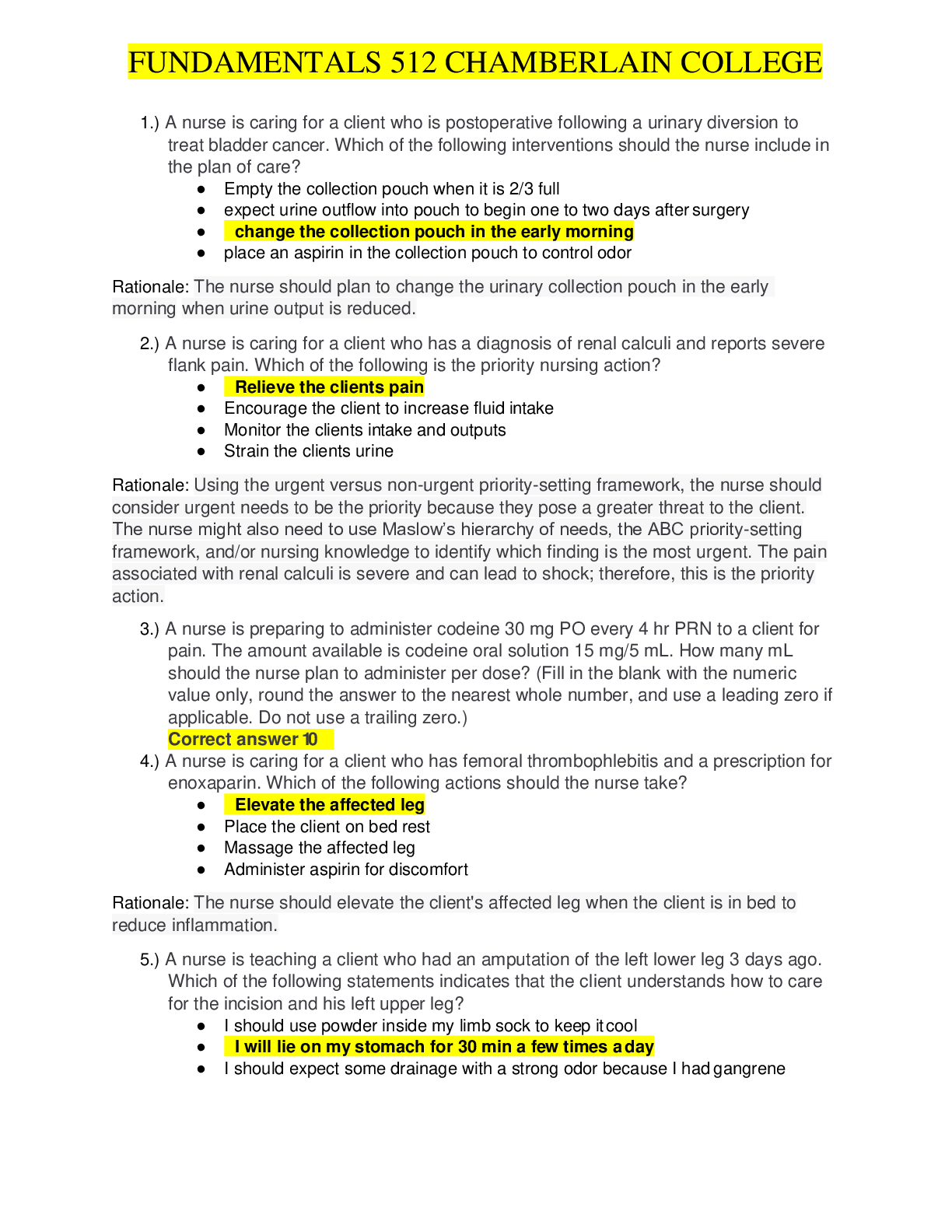
FUNDAMENTALS 512 CHAMBERLAIN COLLEGE
1.) A nurse is caring for a client who is postoperative following a urinary diversion to treat bladder cancer. Which of the following interventions should the nurse include in the plan of care?
● Empty the collection pouch when it is 2/3 full
● expect urine outflow into pouch to begin one to two days after surgery
● change the collection pouch in the early morning
● place an aspirin in the collection pouch to control odor
2.) A nurse is caring for a client who has a diagnosis of renal calculi and reports severe flank pain. Which of the following is the priority nursing action?
● Relieve the clients pain
● Encourage the client to increase fluid intake
● Monitor the clients intake and outputs
● Strain the clients urine
3.) A nurse is preparing to administer codeine 30 mg PO every 4 hr PRN to a client for pain. The amount available is codeine oral solution 15 mg/5 mL. How many mL should the nurse plan to administer per dose? (Fill in the blank with the numeric value only, round the answer to the nearest whole number, and use a leading zero if applicable. Do not use a trailing zero.)
4.) A nurse is caring for a client who has femoral thrombophlebitis and a prescription for enoxaparin. Which of the following actions should the nurse take?
● Elevate the affected leg
● Place the client on bed rest
● Massage the affected leg
● Administer aspirin for discomfort
5.) A nurse is teaching a client who had an amputation of the left lower leg 3 days ago. Which of the following statements indicates that the client understands how to care for the incision and his left upper leg?
● I should use powder inside my limb sock to keep it cool
● I will lie on my stomach for 30 min a few times a day
● I should expect some drainage with a strong odor because I had gangrene
● I will keep elevating my leg on 2 pillows to keep the swelling down
6.) During a neurological assessment, a nurse asks how the client arrived at the appointment and with whom. Which of the following types of memory is the nurse testing?
● Remote
● Immediate
● Recall
● Past
7.) A nurse is preparing a client for a bronchoscopy. Which of the following actions should the nurse take? (Select all that apply.)
● Explained that the client will receive sedation and will not remember the procedure
● verify that the client understands the purpose and nature of the procedure
● offer the client sips of clear liquids until one hour before the test
● obtain a pre procedural sputum specimen
● instruct the client to keep his neck in a neutral position
8.) A nurse is caring for a client who is postoperative following a lumbar disk excision. Which of the following interventions should the nurse include in the client's plan of care?
● Keep the client's leg flat with the knees extended
● encourage the client to sit up in a chair for as long as possible
● log roll the client in bed for care procedures
● expect urinary retention for the first postoperative day
9.) A nurse is assessing a client who is 24 hr postoperative following an above-the- elbow amputation. Which of the following findings should the nurse identify as the priority?
● Client reports of muscle spasms
● inability to get dressed without assistance
● client reports of feelings of anger
● refusal to look at the affected limb
10.)A nurse is caring for a client who is postoperative following shoulder surgery. The client has a prescription to keep the affected arm adducted. Which of the following instructions should the nurse share with the client?
● Keep your arm bent at the elbow
● use a pillow to prop your shoulder up close to your ear
● hold your arm against the side of your body
● position your arm with the shoulder at a 90 degree angle
11.)A nurse in an acute care facility is preparing to admit a client who has myasthenia gravis. Which of the following supplies should the nurse place at the client’s bedside?
● Metered dose inhaler
● Continuous passive motion machine
● Oral nasal suction equipment
● External defibrillator pads
12.)A nurse is monitoring a client for reperfusion following thrombolytic therapy to treat acute myocardial infarction (MI). Which of the following indicators should the nurse identify to confirm reperfusion?
● Ventricular dysrhythmias
● Appearance of Q waves
● Elevated ST segments
● Recurrence of chest pain
13.)A nurse is caring for a client for whom the respiratory therapist has just removed the endotracheal tube. Which of the following actions should the nurse take first?
● Instruct the client to cough
● Administer oxygen via face mask
● Evaluate the client for stridor
● Keep the client in a semi to high fowlers position
14.)A nurse in an emergency department is assessing a client who sustained a fall off of a roof. Which of the following findings should the nurse identify as an indication of a basilar skull fracture?
● Depressed fracture of the forehead
● Clear fluid coming from the nares
● Motor loss on one side of the body
● Bleeding from the top of the scalp
15.)A nurse is caring for a client who has encephalitis due to West Nile virus. Which of the following actions should the nurse take? (Select all that apply.)
● Place the client in respiratory isolation
● monitor vital signs every two hours
● assess neurological status every four hours
● maintain the client in a modified trendelenburg position
● keep the clients room darkened
16.)A nurse is teaching a client who has AIDS about the transmission of Pneumocystis jiroveci pneumonia (PCP). Which of the following pieces of information should the nurse include in the teaching?
● PCP is sexually transmitted from person to person
● you were most likely exposed to a contaminated surface such as a drinking glass
● PCP results from an impaired immune system
● you might have contracted PCP from a family petdevelops into a fungus. It becomes an aggressive pathogen when the immune system is compromised, causing infection.
17.)A nurse in an emergency department is assessing a client who has extensive burns, including on her face. Which of the following assessments should the nurse perform first?
● Estimation of burn injury
● characteristics of cough and sputum
● extent of peripheral edema
● amount of urine output
18.)A nurse is planning care for a client who has pernicious anemia. Which of the following interventions should the nurse include in the plan?
● Administer ferrous sulfate supplementations
● increase dietary intake of folic acid
● initiate weekly injections of vitamin B12
● initiate a blood transfusion
19.) A nurse is showing a client who has right-sided heart failure an illustration of the heart. Which of the following blood vessels carry deoxygenated blood to the right atrium?
● Right coronary artery
● Left carotid artery
● Aorta
● Superior vena cava
20.) A nurse is providing teaching about nutrients to a client. Which of the following statements should the nurse include?
● Carbohydrates transport nutrients throughout the body
● Fats prevent ketosis
● protein builds and repairs body tissue
● carbohydrates help regulate body temperature
[Show More]