Chapter 3--Theory Building
Student: ___________________________________________________________________________
1. A theory is an abstract, untestable explanation of some events. True False
2. Knowledge and confirmati
...
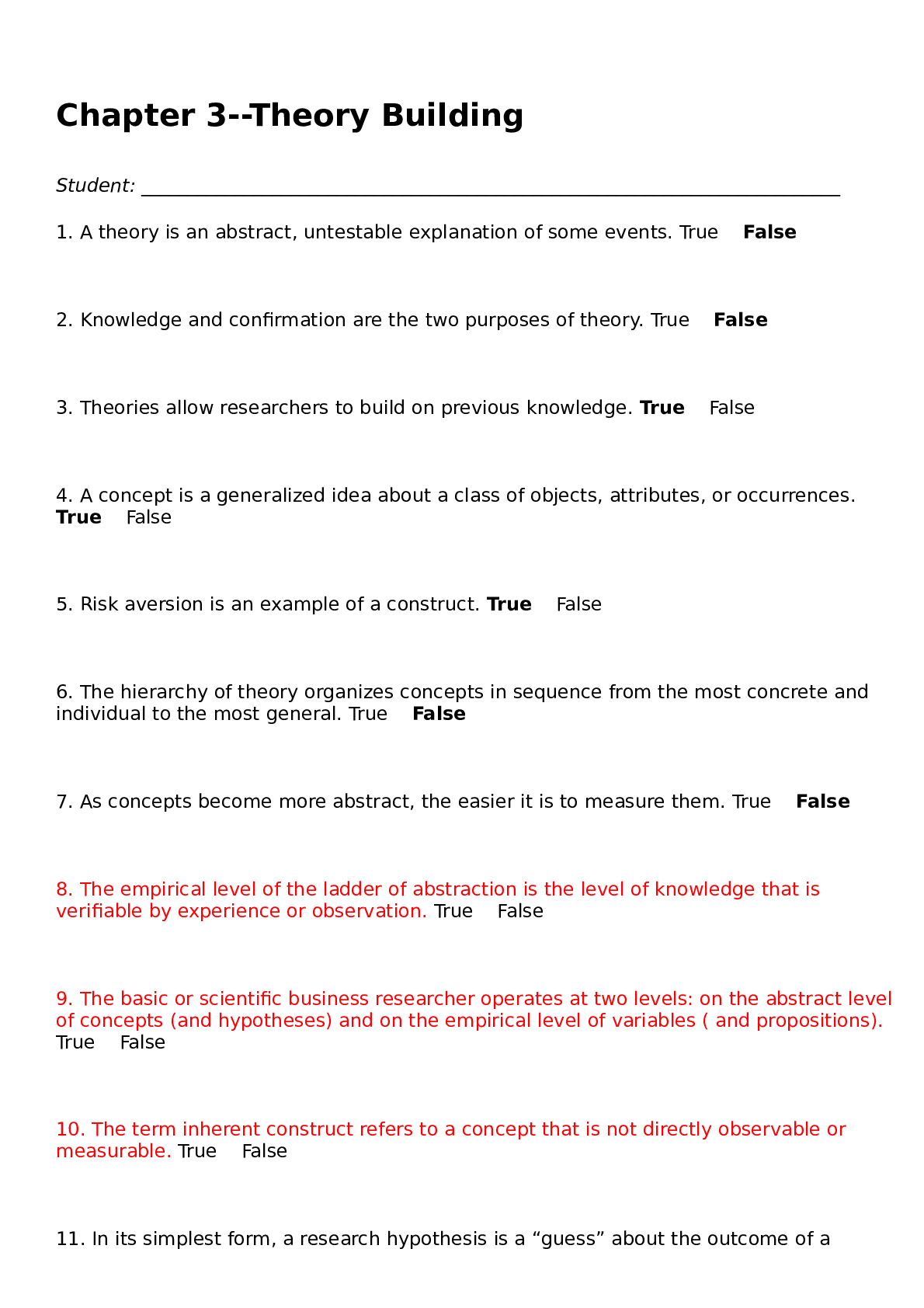
Chapter 3--Theory Building
Student: ___________________________________________________________________________
1. A theory is an abstract, untestable explanation of some events. True False
2. Knowledge and confirmation are the two purposes of theory. True False
3. Theories allow researchers to build on previous knowledge. True False
4. A concept is a generalized idea about a class of objects, attributes, or occurrences.
True False
5. Risk aversion is an example of a construct. True False
6. The hierarchy of theory organizes concepts in sequence from the most concrete and
individual to the most general. True False
7. As concepts become more abstract, the easier it is to measure them. True False
8. The empirical level of the ladder of abstraction is the level of knowledge that is
verifiable by experience or observation. True False
9. The basic or scientific business researcher operates at two levels: on the abstract level
of concepts (and hypotheses) and on the empirical level of variables ( and propositions).
True False
10. The term inherent construct refers to a concept that is not directly observable or
measurable. True False
11. In its simplest form, a research hypothesis is a “guess” about the outcome of aresearch study. True False
12. Empirical testing means that something has been examined against reality using
data. True False
13. A concept is a formal statement explaining some outcome. True False
14. Statistics can be used to prove that a research hypothesis is true. True False
15. The process of identifying the actual measurement scales to asses the variables of
interest is known as operationalizing. True False
16. In most scientific situations there is typically only one theory to explain certain
phenomena. True False
17. Theories are derived from deductive reasoning and selective reasoning. True False
18. Deductive reasoning derives a conclusion about a general knowledge based on
specific instances. True False
19. The scientific method is a set of prescribed procedures for establishing and
connecting theoretical statements about events, for analyzing empirical evidence, and
for predicting events yet unknown. True False
20. The first step in the scientific method is to formulate concepts and propositions.
True False
21. A formal, logical explanation of some events that includes descriptions of how things
relate to one another is called a(n) _____. A. hypothesisB. theoryC. causal statement
D. empirical study
22. Psychologists explain that humans’ better recall of information that is presentedvisually compared to information presented verbally is due to the fact that the
information is stored both visually and verbally. Because it is stored using this dualcoding process, it is easier to retrieve from memory. This formal logical explanation of
this phenomenon is an example of a(n) _____. A. theoryB. constructC. operationalization
D. abstraction
23. What are the two goals of theory? A. speculating and confirmingB. understanding
and predictingC. deducting and inductingD. abstracting and concretizing
24. A(n) ____ is a generalized idea about a class of objects that has been given a name.
A. variableB. theoryC. nodeD. construct
25. Which of the following is considered the basic unit for theory development?
A. conceptB. propositionC. hypothesisD. variable
26. Self-efficacy, which is a generalized idea about how humans perceive their own
abilities, is an example of a(n) _____. A. hypothesisB. propositionC. conceptD. abstraction
27. The organization of concepts in sequence from the most concrete and individual to
the most general is called the _____. A. conceptual hierarchyB. ladder of abstraction
C. conceptual progressionD. operationalization of constructs
28. In theory development, which of the following is the level of knowledge expressing a
concept that exists only as an idea or a quality apart from an object? A. empirical level
B. primary levelC. conceptual levelD. abstract level
29. At what level do we “experience” reality? A. empirical levelB. abstract level
C. primary levelD. secondary level
30. A concept that is not directly observable or measurable but can be estimated
through proxy measures is called a(n) _____. A. indirect constructB. secondary construct
C. higher order constructD. latent construct
31. Empathy is a concept that is not directly observable or measurable but is measured
through other measures, such as an individual’s thoughts and behaviors toward others.
This is an example of a(n) _____. A. latent constructB. empirical constructC. secondaryconstructD. higher order construct
32. Which of the following is a statement explaining the logical linkage among certain
concepts by asserting a universal connection between concepts? A. hypothesis
B. propositionC. constructD. theory
33. “Employees dressed professionally will perform better than those dressed casually” is
an example of a _____. A. theoryB. propositionC. hypothesisD. variation
34. Which of the following means that something has been examined against reality
using data? A. causalityB. manipulationC. empirical testingD. spurious association
35. When a researcher collects data to test the hypothesis that consumers will be more
satisfied if a business offers compensation after the consumer complains, we say that
_____ testing is being conducted. A. validationB. confirmationC. observationalD. empirical
36. Anything that may assume different numerical values is considered a(n) _____.
A. variableB. constructC. itemD. data point
37. Which of the following is an empirical assessment of a concept? A. hypothesis
B. variableC. constructD. item
38. When the data from an empirical study are consistent with a research hypothesis, we
say that the hypothesis is _____. A. confirmedB. conclusiveC. supportedD. true
39. The process of identifying the actual measurement scales to assess the variables of
interest is called _____. A. operationalizingB. synthesizingC. verifyingD. conceptualizing
40. _____ is the logical process of deriving a conclusion about a specific instance based
on a known general premise or something known to be true. A. Deductive reasoning
B. Inductive reasoningC. Latent reasoningD. Abstract reasoning
41. The logical process of establishing a general proposition on the basis of observation
of particular facts is known as _____. A. deductive reasoningB. generalized reasoningC. inductive reasoningD. conceptual reasoning
42. If all the trees a person has seen in his life have been green and therefore he
concludes that all trees are green, which type of reasoning is he using? A. deductive
reasoningB. inductive reasoningC. generalized reasoningD. conceptual reasoning
43. A researcher is testing the hypothesis stating a positive relationship between
business owners’ level of risk tolerance and the insurance coverage for the business. To
test this, the researcher uses a set of prescribed procedures for establishing and
connecting theoretical statements about these two constructs, for analyzing empirical
evidence gathered through surveys, and for predicting future behavior. This researcher
is following the _____. A. hypothetical methodB. scientific methodC. deductive method
D. inductive method
44. Which of the following is a step involved in the application of the scientific method?
A. statement of hypothesesB. formulation of concepts and propositionsC. analysis and
evaluation of dataD. all of these choices
45. What is the LAST step in the application of the scientific method? A. assessment of
relevant existing knowledge of a phenomenonB. proposal of an explanation of the
phenomenon and statement of new problems raised by the researchC. design of research
to test the hypothesisD. acquisition of meaningful empirical data
46. A formal, logical explanation of some events that includes predictions of how things
relate to one another is known as a(n) _____. ________________________________________
47. The two purpose of theory are understanding and _____.
________________________________________
48. _____ are the building blocks of theory. ________________________________________
49. The organization of concepts in sequence from the most concrete and individual to
the most general is called the _____. ________________________________________
50. In theory development, the level of knowledge expressing a concept that exists only
as an idea or a quality apart from an object is the ____ level.________________________________________
51. A concept that is not directly observable or measurable, but can be estimated
through a proxy measure is known as a(n) _____ construct.
________________________________________
52. Statements explaining the logical linkage among certain concepts by asserting a
universal connection between concepts are called _____.
________________________________________
53. A(n) _____ is a formal statement explaining some outcome and is testable.
________________________________________
54. _____ involves applying statistics to data to test hypotheses.
________________________________________
55. When the data are inconsistent with a hypothesis, we say the hypothesis is _____,
________________________________________
56. If it is hypothesized that higher levels of compensation will positively influence
workers’ intention to stay with a company, level of compensation measured in dollars
and intentions to stay using a scale are examples of _____.
________________________________________
57. A researcher is using income, education, and zip code as an indication of social
class. This process of identifying the actual measurement scales to assess social class is
called _____. ________________________________________
58. Going from the general to the specific is done in _____ reasoning.
________________________________________
59. _____ reasoning establishes a general proposition on the basis of observation of
particular facts. ________________________________________60. A set of prescribed procedures for establishing and connecting theoretical statements
about events, for analyzing empirical evidence, and for predicting events yet unknown is
called the _____. ________________________________________
61. What is a theory and a hypothesis, and what role do they play in marketing
research?
62. Explain the difference between aconcept and a variable and give an example of
each.
63. How does a hypothesis differ from a proposition? Give an example of each.
64. Discuss the types of reasoning researchers use to build theories.
65. List the steps a researcher will likely follow when applying the scientific method to
develop and test theories
Chapter 3--Theory Building Key
1. A theory is an abstract, untestable explanation of some events. FALSE2. Knowledge and confirmation are the two purposes of theory. FALSE
3. Theories allow researchers to build on previous knowledge. TRUE
4. A concept is a generalized idea about a class of objects, attributes, or occurrences.
TRUE
5. Risk aversion is an example of a construct. TRUE
6. The hierarchy of theory organizes concepts in sequence from the most concrete and
individual to the most general. FALSE
7. As concepts become more abstract, the easier it is to measure them. FALSE
8. The empirical level of the ladder of abstraction is the level of knowledge that is
verifiable by experience or observation. TRUE
9. The basic or scientific business researcher operates at two levels: on the abstract level
of concepts (and hypotheses) and on the empirical level of variables ( and propositions).
FALSE
10. The term inherent construct refers to a concept that is not directly observable or
measurable. FALSE
11. In its simplest form, a research hypothesis is a “guess” about the outcome of a
research study. TRUE
12. Empirical testing means that something has been examined against reality using
data. TRUE13. A concept is a formal statement explaining some outcome. FALSE
14. Statistics can be used to prove that a research hypothesis is true. FALSE
15. The process of identifying the actual measurement scales to asses the variables of
interest is known as operationalizing. TRUE
16. In most scientific situations there is typically only one theory to explain certain
phenomena. FALSE
17. Theories are derived from deductive reasoning and selective reasoning. FALSE
18. Deductive reasoning derives a conclusion about a general knowledge based on
specific instances. FALSE
19. The scientific method is a set of prescribed procedures for establishing and
connecting theoretical statements about events, for analyzing empirical evidence, and
for predicting events yet unknown. TRUE
20. The first step in the scientific method is to formulate concepts and propositions.
FALSE
21. A formal, logical explanation of some events that includes descriptions of how things
relate to one another is called a(n) _____. A. hypothesisB. theoryC. causal statement
D. empirical study
22. Psychologists explain that humans’ better recall of information that is presented
visually compared to information presented verbally is due to the fact that the
information is stored both visually and verbally. Because it is stored using this dualcoding process, it is easier to retrieve from memory. This formal logical explanation of
this phenomenon is an example of a(n) _____. A. theoryB. constructC. operationalization
D. abstraction
23. What are the two goals of theory? A. speculating and confirmingB. understandingand predictingC. deducting and inductingD. abstracting and concretizing
24. A(n) ____ is a generalized idea about a class of objects that has been given a name.
A. variableB. theoryC. nodeD. construct
25. Which of the following is considered the basic unit for theory development?
A. conceptB. propositionC. hypothesisD. variable
26. Self-efficacy, which is a generalized idea about how humans perceive their own
abilities, is an example of a(n) _____. A. hypothesisB. propositionC. conceptD. abstraction
27. The organization of concepts in sequence from the most concrete and individual to
the most general is called the _____. A. conceptual hierarchyB. ladder of abstraction
C. conceptual progressionD. operationalization of constructs
28. In theory development, which of the following is the level of knowledge expressing a
concept that exists only as an idea or a quality apart from an object? A. empirical level
B. primary levelC. conceptual levelD. abstract level
29. At what level do we “experience” reality? A. empirical levelB. abstract level
C. primary levelD. secondary level
30. A concept that is not directly observable or measurable but can be estimated
through proxy measures is called a(n) _____. A. indirect constructB. secondary construct
C. higher order constructD. latent construct
31. Empathy is a concept that is not directly observable or measurable but is measured
through other measures, such as an individual’s thoughts and behaviors toward others.
This is an example of a(n) _____. A. latent constructB. empirical constructC. secondary
constructD. higher order construct
32. Which of the following is a statement explaining the logical linkage among certain
concepts by asserting a universal connection between concepts? A. hypothesis
B. propositionC. constructD. theory33. “Employees dressed professionally will perform better than those dressed casually” is
an example of a _____. A. theoryB. propositionC. hypothesisD. variation
34. Which of the following means that something has been examined against reality
using data? A. causalityB. manipulationC. empirical testingD. spurious association
35. When a researcher collects data to test the hypothesis that consumers will be more
satisfied if a business offers compensation after the consumer complains, we say that
_____ testing is being conducted. A. validationB. confirmationC. observationalD. empirical
36. Anything that may assume different numerical values is considered a(n) _____.
A. variableB. constructC. itemD. data point
37. Which of the following is an empirical assessment of a concept? A. hypothesis
B. variableC. constructD. item
38. When the data from an empirical study are consistent with a research hypothesis, we
say that the hypothesis is _____. A. confirmedB. conclusiveC. supportedD. true
39. The process of identifying the actual measurement scales to assess the variables of
interest is called _____. A. operationalizingB. synthesizingC. verifyingD. conceptualizing
40. _____ is the logical process of deriving a conclusion about a specific instance based
on a known general premise or something known to be true. A. Deductive reasoning
B. Inductive reasoningC. Latent reasoningD. Abstract reasoning
41. The logical process of establishing a general proposition on the basis of observation
of particular facts is known as _____. A. deductive reasoningB. generalized reasoning
C. inductive reasoningD. conceptual reasoning
42. If all the trees a person has seen in his life have been green and therefore he
concludes that all trees are green, which type of reasoning is he using? A. deductive
reasoningB. inductive reasoningC. generalized reasoningD. conceptual reasoning43. A researcher is testing the hypothesis stating a positive relationship between
business owners’ level of risk tolerance and the insurance coverage for the business. To
test this, the researcher uses a set of prescribed procedures for establishing and
connecting theoretical statements about these two constructs, for analyzing empirical
evidence gathered through surveys, and for predicting future behavior. This researcher
is following the _____. A. hypothetical methodB. scientific methodC. deductive method
D. inductive method
44. Which of the following is a step involved in the application of the scientific method?
A. statement of hypothesesB. formulation of concepts and propositionsC. analysis and
evaluation of dataD. all of these choices
45. What is the LAST step in the application of the scientific method? A. assessment of
relevant existing knowledge of a phenomenonB. proposal of an explanation of the
phenomenon and statement of new problems raised by the researchC. design of
research to test the hypothesisD. acquisition of meaningful empirical data
46. A formal, logical explanation of some events that includes predictions of how things
relate to one another is known as a(n) _____. theory
47. The two purpose of theory are understanding and _____. predicting
48. _____ are the building blocks of theory. Concepts
49. The organization of concepts in sequence from the most concrete and individual to
the most general is called the _____. ladder of abstraction
50. In theory development, the level of knowledge expressing a concept that exists only
as an idea or a quality apart from an object is the ____ level. abstract
51. A concept that is not directly observable or measurable, but can be estimated
through a proxy measure is known as a(n) _____ construct. latent
52. Statements explaining the logical linkage among certain concepts by asserting a
universal connection between concepts are called _____. propositions53. A(n) _____ is a formal statement explaining some outcome and is testable.
hypothesis
54. _____ involves applying statistics to data to test hypotheses. Empirical testing
55. When the data are inconsistent with a hypothesis, we say the hypothesis is _____, not
supported
56. If it is hypothesized that higher levels of compensation will positively influence
workers’ intention to stay with a company, level of compensation measured in dollars
and intentions to stay using a scale are examples of _____. variables
57. A researcher is using income, education, and zip code as an indication of social
class. This process of identifying the actual measurement scales to assess social class is
called _____. operationalizing
58. Going from the general to the specific is done in _____ reasoning. deductive
59. _____ reasoning establishes a general proposition on the basis of observation of
particular facts. Inductive
60. A set of prescribed procedures for establishing and connecting theoretical statements
about events, for analyzing empirical evidence, and for predicting events yet unknown is
called the _____. scientific method
61. What is a theory and a hypothesis, and what role do they play in marketing
research?
A theory is a formal, logical explanation of some events that includes predictions of how
things relate to one another. The two purposes of theory are understanding and
predicting. Accomplishing the first goal allows the theorist to gain an understanding of
the relationship among various phenomena. Thus a theory enables us to predict the
behavior or characteristics of one phenomenon from the knowledge of another
phenomenon.A hypothesis is a formal statement explaining some outcome.
Hypotheses must be testable and should be written as propositions. We often apply
statistics to data to empirically test hypotheses. When the data are consistent with ahypothesis, we say the hypothesis is supported. When the data are inconsistent with the
hypothesis, we say the hypothesis is not supported. Because our results are based on
statistics, there is always the possibility that our conclusion is wrong, so from an absolute
perspective, statistics cannot prove a hypothesis is true.
62. Explain the difference between aconcept and a variable and give an example of
each.
A concept (or construct) is a generalized idea about a class of objects, attributes,
occurrences, or processes that has been given a name. Supervisory behavior or risk
aversion are examples of concepts. A variable is anything that may assume different
numerical values and is the empirical assessment of a concept. For example,
supervisory behavior may be assessed through variables such as amount of time spent
training employees, number of employees supervised, and degree to which employees
are involved in decision-making.
63. How does a hypothesis differ from a proposition? Give an example of each.
Propositions are statements explaining the logical linkage among certain concepts by
asserting a universal connection between concepts. An example of a proposition might
be: Changes in tax law will influence individuals’ charitable giving. A hypothesis is a
formal statement of an unproven proposition that is empirically testable. An example of
a hypothesis might be: Tax laws limiting the deductibility of charitable contributions will
decrease charitable giving.
64. Discuss the types of reasoning researchers use to build theories.
At the abstract, conceptual level, a theory may be developed with deductive reasoning
by going from a general statement to a specific assertion. Deductive reasoning is the
logical process of deriving a conclusion about a specific instance, based on a known
general premise or something known to be true. At the empirical level, a theory may be
developed with inductive reasoning, which is the logical process of establishing a
general proposition on the basis of observation of particular facts.
65. List the steps a researcher will likely follow when applying the scientific method to
develop and test theories
1. Assessment of relevant existing knowledge of a phenomenon2. Formulation of
concepts and propositions3. Statement of hypotheses4. Design of research to test the
hypotheses5. Acquisition of meaningful empirical data6. Analysis and evaluation of data
7. Proposal of an explanation of the phenomenon and statement of new problems raised
by the research
[Show More]