Chemistry  >  GIZMOS  >  Questions and Answers>GIZMOS>Polarity and Intermolecular Forces - Complete Solution (All)

Questions and Answers>GIZMOS>Polarity and Intermolecular Forces - Complete Solution

Document Content and Description Below

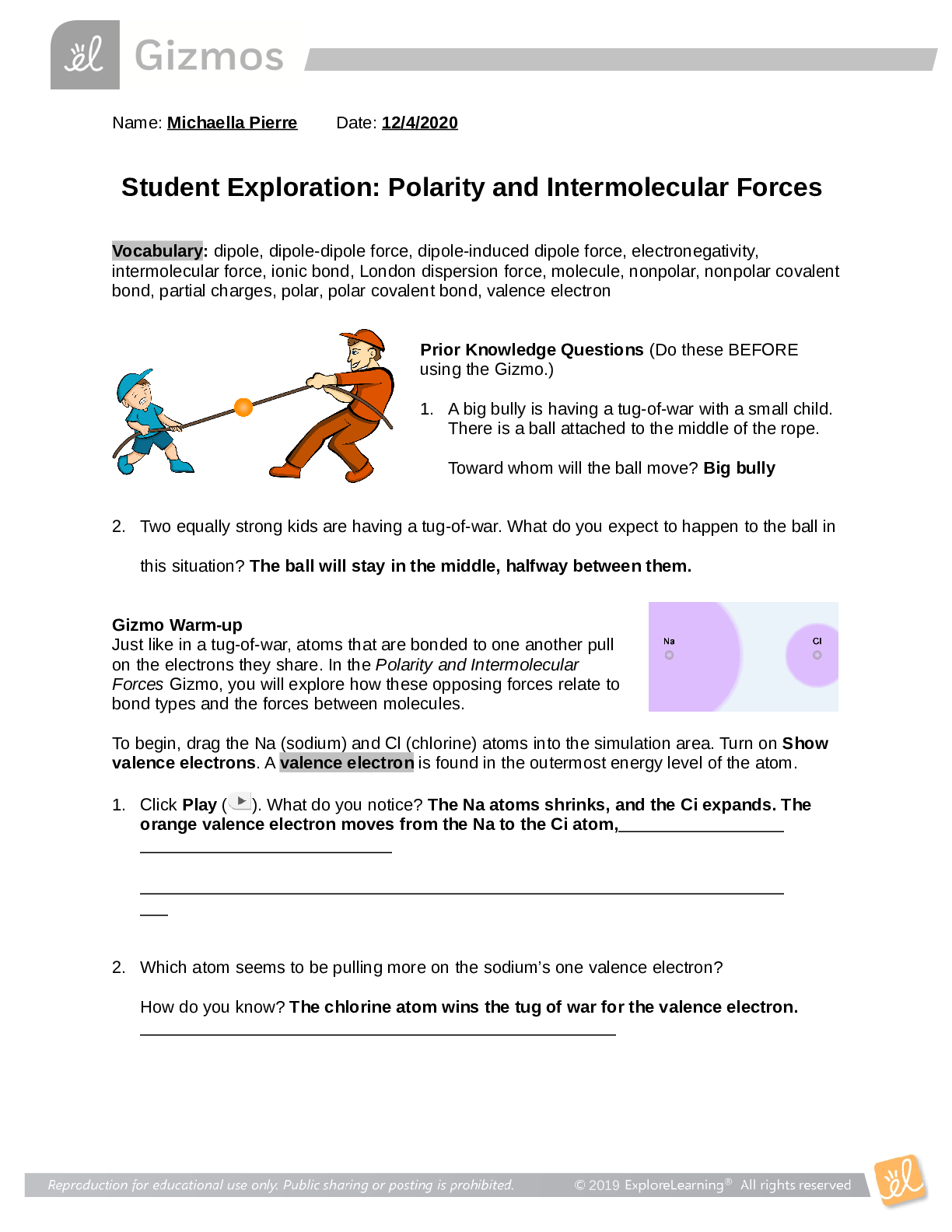
Polarity and Intermolecular Forces Vocabulary: dipole, dipole-dipole force, dipole-induced dipole force, electronegativity, intermolecular force, ionic bond, London dispersion force, molecule, nonpola ... r, nonpolar covalent bond, partial charges, polar, polar covalent bond, valence electron Prior Knowledge Questions (Do these BEFORE using the Gizmo.) 1. A big bully is having a tug-of-war with a small child. There is a ball attached to the middle of the rope. Toward whom will the ball move? Big bully 2. Two equally strong kids are having a tug-of-war. What do you expect to happen to the ball in this situation? The ball will stay in the middle, halfway between them. Gizmo Warm-up Just like in a tug-of-war, atoms that are bonded to one another pull on the electrons they share. In the Polarity and Intermolecular Forces Gizmo, you will explore how these opposing forces relate to bond types and the forces between molecules. To begin, drag the Na (sodium) and Cl (chlorine) atoms into the simulation area. Turn on Show valence electrons. A valence electron is found in the outermost energy level of the atom. 1. Click Play ( ). What do you notice? The Na atoms shrinks, and the Ci expands. The orange valence electron moves from the Na to the Ci atom, 2. Which atom seems to be pulling more on the sodium’s one valence electron? How do you know? The chlorine atom wins the tug of war for the valence electron. 2019 3. What happens to the colors of the simulated atoms, and what does this indicate? The Na atoms turns blue, indicating a positive charge the Ci atom turns red indicating a negative charge. Activity A: Bond polarity Get the Gizmo ready:  On the BOND POLARITY tab, click Reset ( ).  Drag the atoms out of the simulation area. Introduction: A neutral atom has the same number of protons as electrons. Atoms that gain electrons become negatively charged, while those that lose electrons become positive. A polar bond forms when shared electrons are pulled closer to one atom than another, causing the bonded atoms to become partially charged. In a nonpolar bond, electrons are shared equally. [Show More]

Last updated: 3 years ago

Preview 1 out of 10 pages

Buy Now

Instant download

We Accept:

Payment methods accepted on Scholarfriends (We Accept)
Preview image of Questions and Answers>GIZMOS>Polarity and Intermolecular Forces - Complete Solution document

Buy this document to get the full access instantly

Instant Download Access after purchase

Buy Now

Instant download

We Accept:

Payment methods accepted on Scholarfriends (We Accept)

Also available in bundle (1)

Click Below to Access Bundle(s)
(BUNDLE) Gizmos | STEM Simulations & Virtual Labs -ANSWER KEYS

(BUNDLE) Gizmos | STEM Simulations & Virtual Labs -ANSWER KEYS

By Academia1434 1 year ago

$90

57  

Reviews( 0 )

$12.00

Buy Now

We Accept:

Payment methods accepted on Scholarfriends (We Accept)

Instant download

Can't find what you want? Try our AI powered Search

156
0

Document information


Connected school, study & course


About the document


Uploaded On

May 21, 2021

Number of pages

10

Written in

All

Seller


Profile illustration for Academia1434
Academia1434

Member since 5 years

211 Documents Sold

Reviews Received
36
2
4
2
17
Additional information

This document has been written for:

Uploaded

May 21, 2021

Downloads

 0

Views

 156

Document Keyword Tags

Recommended For You

Get more on GIZMOS »

$12.00
What is Scholarfriends

Scholarfriends.com Online Platform by Browsegrades Inc. 651N South Broad St, Middletown DE. United States.

We are here to help

We're available through e-mail, Twitter, Facebook, and live chat.
 FAQ
 Questions? Leave a message!

Follow us on
 Twitter

Copyright © Scholarfriends · High quality services·