SCIN130 Lab 6: The Origin of Corn
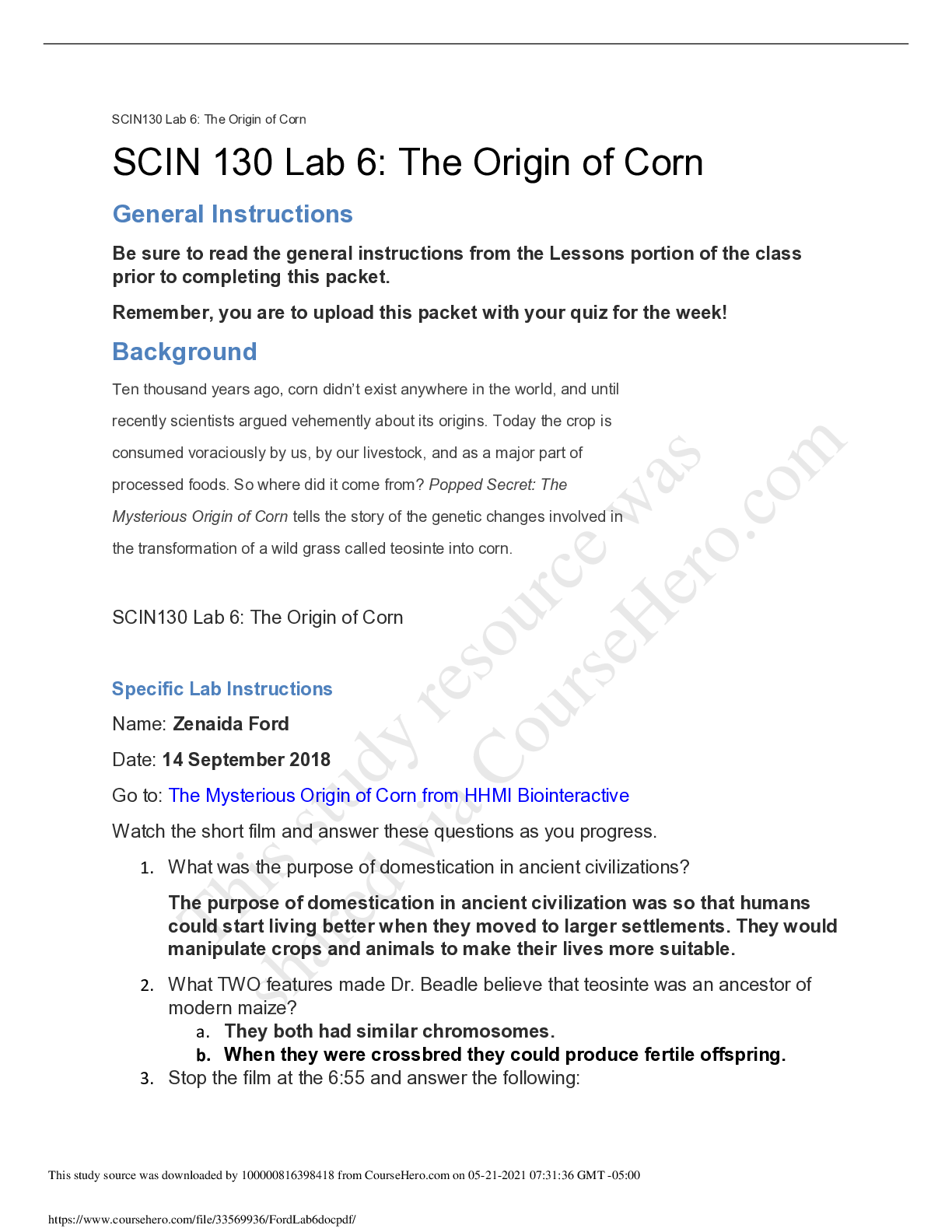
SCIN 130 Lab 6: The Origin of Corn
General Instructions
Be sure to read the general instructions from the Lessons portion of the class
prior to completing this packet.
Remember, you
...
SCIN130 Lab 6: The Origin of Corn
SCIN 130 Lab 6: The Origin of Corn
General Instructions
Be sure to read the general instructions from the Lessons portion of the class
prior to completing this packet.
Remember, you are to upload this packet with your quiz for the week!
Background
Ten thousand years ago, corn didn’t exist anywhere in the world, and until
recently scientists argued vehemently about its origins. Today the crop is
consumed voraciously by us, by our livestock, and as a major part of
processed foods. So where did it come from? Popped Secret: The
Mysterious Origin of Corn tells the story of the genetic changes involved in
the transformation of a wild grass called teosinte into corn.
SCIN130 Lab 6: The Origin of Corn
Specific Lab Instructions
Name: Zenaida Ford
Date: 14 September 2018
Go to: The Mysterious Origin of Corn from HHMI Biointeractive
Watch the short film and answer these questions as you progress.
1. What was the purpose of domestication in ancient civilizations?
2. What TWO features made Dr. Beadle believe that teosinte was an ancestor of
modern maize?
3. Stop the film at the 6:55 and answer the following:
a. Answer the Let’s Review Questions. Embed a screenshot of your answer
to question 1 in this packet:
b. Why did botanists expect the wild relative of maize to look similar to
modern maize?
c. Why did Dr. Beadle use so many plants in his experiments? Would his
data have been as meaningful if he had grown only 1,000 plants? Why or
why not?
d. How many genes did Dr. Beadle deduce were involved in the changes
between maize and teosinte?
4. Resume the film. Near what river did Dr. Doebley discover that all modern maize
varieties originate?
5. What type of evidence left behind on the plant grinding tools was Dr. Piperno
looking for to show the presence of maize?
6. Stop again at 12:10 and answer the following
a. How did archaeological evidence support the molecular evidence for the
timing and geographic location of maize domestication?
b. Based on the quiz in the video, Dr. Doebley and his team compared the
DNA sequence of maize to that of a number of teosinte varieties from
throughout Mexico. What did their analysis reveal? Select all that apply.
❑ That teosinte and maize have the same number of
chromosomes.
❑ That maize and teosinte could interbreed to produce viable
hybrid plants.
7. Watch the film to the end.
a. Fill in the table below to compare teosinte and maize.
Extent of branching Number of rows of kernels per cob Kernel type (naked or enclosed
in a hard fruitcase)
Teosint
e
Many branches Two rows of 6 to 12 kernels Hard fruitcase
Maize Very few branches Hundreds of kernels in 6 to 18
rows.
Naked
b. Pick one of the characteristics of maize from the table above and explain
how it makes the crop more useful to humans than teosinte?
c. What does the fact that teosinte can be “popped” help to explain?
8. Explain how changes in a small number of genes can result in very different
looking plants.
[Show More]