An 18-year-old pregnant woman, gravida 1, is admitted to the labor and birth unit with moderate
contractions every 5 minutes that last 40 seconds. The woman states, “My contractions are so
strong that I don’t know what
...
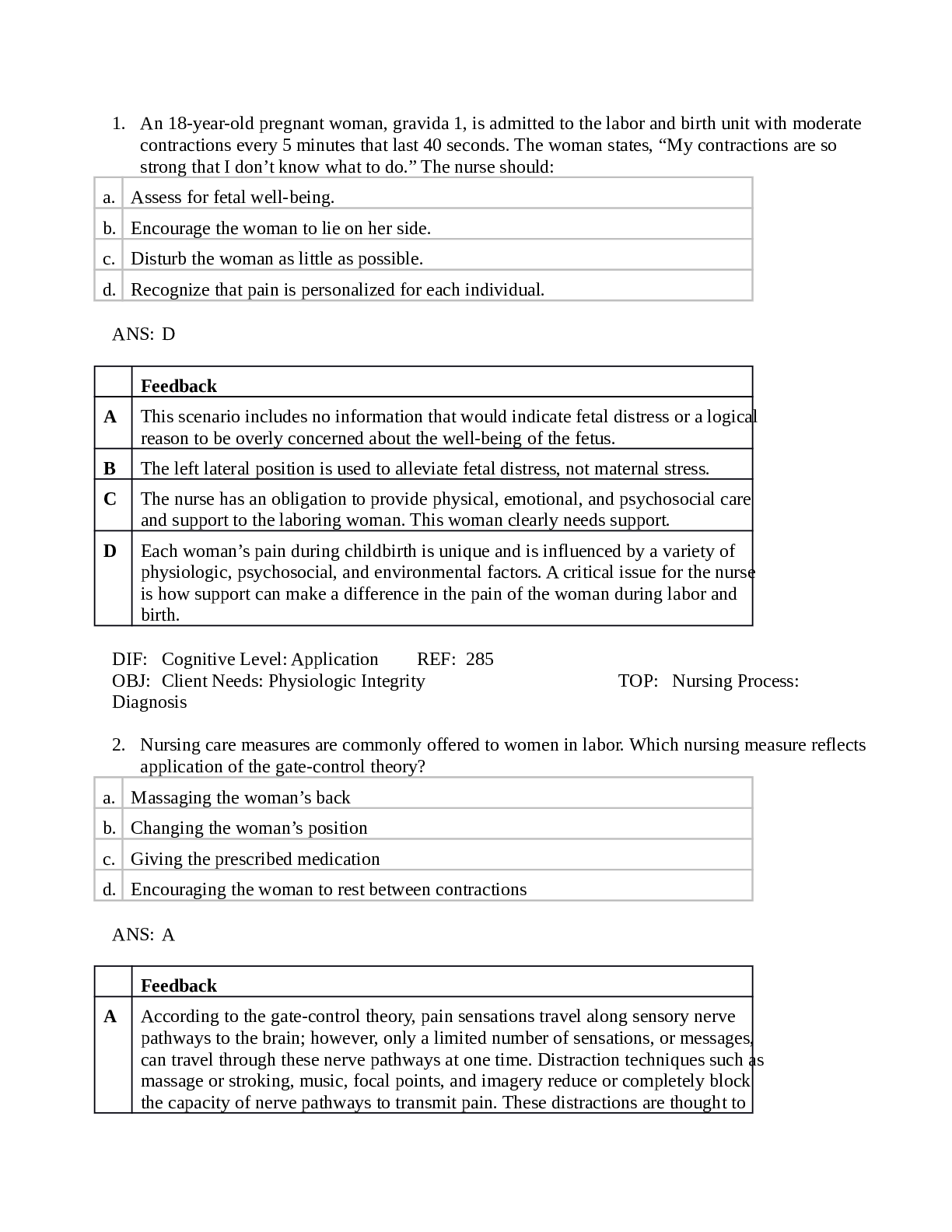
An 18-year-old pregnant woman, gravida 1, is admitted to the labor and birth unit with moderate
contractions every 5 minutes that last 40 seconds. The woman states, “My contractions are so
strong that I don’t know what to do.” The nurse should:
a. Assess for fetal well-being.
b. Encourage the woman to lie on her side.
c. Disturb the woman as little as possible.
d. Recognize that pain is personalized for each individual.
ANS: D
Feedback
A This scenario includes no information that would indicate fetal distress or a logical
reason to be overly concerned about the well-being of the fetus.
B The left lateral position is used to alleviate fetal distress, not maternal stress.
C The nurse has an obligation to provide physical, emotional, and psychosocial care
and support to the laboring woman. This woman clearly needs support.
D Each woman’s pain during childbirth is unique and is influenced by a variety of
physiologic, psychosocial, and environmental factors. A critical issue for the nurse
is how support can make a difference in the pain of the woman during labor and
birth.
DIF: Cognitive Level: Application REF: 285
OBJ: Client Needs: Physiologic Integrity TOP: Nursing Process:
Diagnosis
2. Nursing care measures are commonly offered to women in labor. Which nursing measure reflects
application of the gate-control theory?
a. Massaging the woman’s back
b. Changing the woman’s position
c. Giving the prescribed medication
d. Encouraging the woman to rest between contractions
ANS: A
Feedback
A According to the gate-control theory, pain sensations travel along sensory nerve
pathways to the brain; however, only a limited number of sensations, or messages,
can travel through these nerve pathways at one time. Distraction techniques such as
massage or stroking, music, focal points, and imagery reduce or completely block
the capacity of nerve pathways to transmit pain.
[Show More]