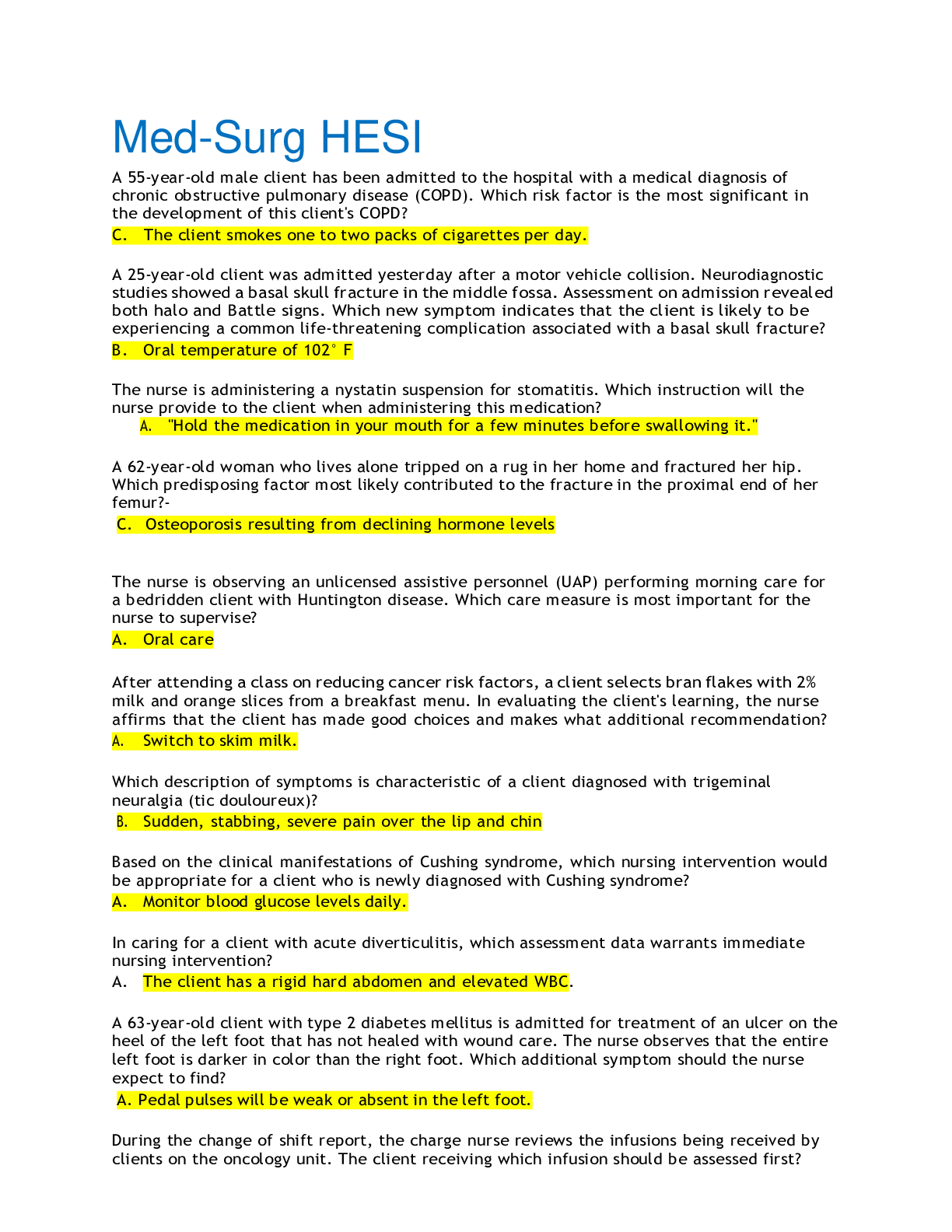
Med-Surg HESI
A 55-year-old male client has been admitted to the hospital with a medical diagnosis of chronic obstructive pulmonary disease (COPD). Which risk factor is the most significant in the development of this cl
...
Med-Surg HESI
A 55-year-old male client has been admitted to the hospital with a medical diagnosis of chronic obstructive pulmonary disease (COPD). Which risk factor is the most significant in the development of this client's COPD?
C. The client smokes one to two packs of cigarettes per day.
A 25-year-old client was admitted yesterday after a motor vehicle collision. Neurodiagnostic studies showed a basal skull fracture in the middle fossa. Assessment on admission revealed both halo and Battle signs. Which new symptom indicates that the client is likely to be experiencing a common life-threatening complication associated with a basal skull fracture?
B. Oral temperature of 102° F
The nurse is administering a nystatin suspension for stomatitis. Which instruction will the nurse provide to the client when administering this medication?
A. "Hold the medication in your mouth for a few minutes before swallowing it."
A 62-year-old woman who lives alone tripped on a rug in her home and fractured her hip. Which predisposing factor most likely contributed to the fracture in the proximal end of her femur?-
C. Osteoporosis resulting from declining hormone levels
The nurse is observing an unlicensed assistive personnel (UAP) performing morning care for a bedridden client with Huntington disease. Which care measure is most important for the nurse to supervise?
A. Oral care
After attending a class on reducing cancer risk factors, a client selects bran flakes with 2% milk and orange slices from a breakfast menu. In evaluating the client's learning, the nurse affirms that the client has made good choices and makes what additional recommendation?
A. Switch to skim milk.
Which description of symptoms is characteristic of a client diagnosed with trigeminal neuralgia (tic douloureux)?
B. Sudden, stabbing, severe pain over the lip and chin
Based on the clinical manifestations of Cushing syndrome, which nursing intervention would be appropriate for a client who is newly diagnosed with Cushing syndrome?
A. Monitor blood glucose levels daily.
In caring for a client with acute diverticulitis, which assessment data warrants immediate nursing intervention?
A. The client has a rigid hard abdomen and elevated WBC.
A 63-year-old client with type 2 diabetes mellitus is admitted for treatment of an ulcer on the heel of the left foot that has not healed with wound care. The nurse observes that the entire left foot is darker in color than the right foot. Which additional symptom should the nurse expect to find?
A. Pedal pulses will be weak or absent in the left foot.
During the change of shift report, the charge nurse reviews the infusions being received by clients on the oncology unit. The client receiving which infusion should be assessed first?
C. Continuous epidural infusion of morphine
The nurse is assessing a 75-year-old client for symptoms of hyperglycemia. Which symptom of hyperglycemia is an older adult most likely to exhibit?
D. Infection
The nurse is assessing a client who presents with jaundice. Which assessment finding is most important for the nurse to follow up?
D. Elevated serum amylase and lipase levels
A client with hypertension has been receiving ramipril (Altace), 5 mg PO, daily for 2 weeks and is scheduled to receive a dose at 0900. At 0830, the client's blood pressure is 120/70 mm Hg. Which action should the nurse take?
A. Administer the prescribed dose at the scheduled time.
A client diagnosed with chronic kidney disease (CKD) 2 years ago is regularly treated at a community hemodialysis facility. Before his scheduled dialysis treatment, which electrolyte imbalance should the nurse anticipate?
B. Hypocalcemia
Which statement reflects the highest priority nursing diagnosis for an older client recently admitted to the hospital for a new-onset cardiac dysrhythmia?
D. Risk for injury related to syncope and confusion
A female client who received a nephrotoxic drug is admitted with acute renal failure and asks the nurse if she will need dialysis for the rest of her life. Which pathophysiologic consequence should the nurse explain that supports the need for temporary dialysis until acute tubular necrosis subsides?
D. Nephron obstruction
The nurse is caring for a client with a fractured right elbow. Which assessment finding has the highest priority and requires immediate intervention?
B. Deep unrelenting pain in the right arm
A client is ready for discharge following the creation of an ileostomy. Which instruction should the nurse include in discharge teaching?
C. Change the bag when the seal is broken.
The nurse is performing hourly neurologic checks for a client with a head injury. Which new assessment finding warrants immediate intervention by the nurse?
A. A unilateral pupil that is dilated and nonreactive to light
One day after a Billroth II surgery, a male client suddenly grabs his right chest and becomes pale and diaphoretic. Vital signs are assessed as blood pressure 100/80 mm Hg, pulse 110 beats/min, and respirations 36 breaths/min. Which action is most important for the nurse to take?
D. Apply oxygen at 2 L via nasal cannula.
When a nurse assesses a client receiving total parenteral nutrition (TPN), which laboratory value is most important for the nurse to monitor regularly?
C. Glucose
Which data would the nurse expect to find when reviewing laboratory values of an 80-year- old man who is in good health overall?
C. Urinalysis reveals slight protein in the urine and bacteriuria, with pyuria.
The nurse is reviewing routine medications taken by a client with chronic angle-closure glaucoma. Which medication prescription should the nurse question?
B. Anticholinergic with a side effect of pupillary dilation
Client census is often used to determine staffing needs. Which method of obtaining census determination for a particular unit provides the best formula for determining long-range staffing patterns?
C. Average daily census
An emaciated homeless client presents to the emergency department complaining of a productive cough, with blood-tinged sputum and night sweats. Which action is most important for the emergency department triage nurse to implement for this client?
A. Initiate airborne infection precautions.
The nurse assesses a postoperative client whose skin is cool, pale, and moist. The client is very restless and has scant urine output. Oxygen is being administered at 2 L/min, and a saline lock is in place. Which intervention should the nurse implement first?
B. Obtain IV fluids for infusion per protocol.
The nurse teaches a client with type 2 diabetes nutritional strategies to decrease obesity. Which food items chosen by the client indicate understanding of the teaching? (Select all that apply.)
B. Salmon
C. Broccoli
E. Banana
The nurse is caring for a critically ill client with cirrhosis of the liver who has a nasogastric tube draining bright red blood. The nurse notes that the client's serum hemoglobin and hematocrit levels are decreased. Which additional change in laboratory data should the nurse expect?
C. Decreased serum ammonia level
A client diagnosed with angina pectoris complains of chest pain while ambulating in the hallway. Which action should the nurse implement first?
A. Support the client to a sitting position.
The nurse assesses a client who has been prescribed furosemide (Lasix) for cardiac disease. Which electrocardiographic change would be a concern for a client taking a diuretic?
D. Presence of a U wave
A client is placed on a mechanical ventilator following a cerebral hemorrhage, and vecuronium bromide, 0.04 mg/kg every 12 hours IV, is prescribed. What is the priority nursing diagnosis for this client?
A. Impaired communication related to paralysis of skeletal muscles
The nurse is conducting an osteoporosis screening clinic at a health fair. What information should the nurse provide to individuals who are at risk for osteoporosis? (Select all that apply.)
A. Encourage alcohol and smoking cessation.
C. Promote regular weight-bearing exercises.
D. Implement a home safety plan to prevent falls.
A client with alcohol-related liver disease is admitted to the unit. Which prescription should the nurse call the health care provider about for reverification for this client?
D. Nembutal sodium at bedtime for rest
A postoperative client receives a Schedule II opioid analgesic for pain. Which assessment finding requires the most immediate intervention by the nurse?
C. Respiratory rate of 12 breaths/min, with O2 saturation of 85%
A 77-year-old female client is admitted to the hospital with confusion and anorexia of several days' duration. She has symptoms of nausea and vomiting and is currently complaining of a headache. The client's pulse rate is 43 beats/min. The nurse is most concerned about the client's history related to which medication?
D. Digoxin
A female client with a nasogastric tube attached to low suction states that she is nauseated. The nurse assesses that there has been no drainage through the nasogastric tube in the last 2 hours. Which action should the nurse take first?
B. Reposition the client on her side.
A client with type 2 diabetes takes metformin (Glucophage) daily. The client is scheduled for major surgery requiring general anesthesia the next day. The nurse anticipates which approach to manage the client's diabetes best while the client is NPO during the perioperative period?
D. Regular insulin subcutaneously per sliding scale
The nurse is planning care for a client with diabetes mellitus who has gangrene of the toes to the midfoot. Which goal should be included in this client's plan of care?
B. Prevent infection.
A central venous catheter has been inserted via a jugular vein, and a radiograph has confirmed placement of the catheter. A prescription has been received for a medication STAT, but IV fluids have not yet been started. Which action should the nurse take prior to administering the prescribed medication?
D. Flush the line with normal saline.
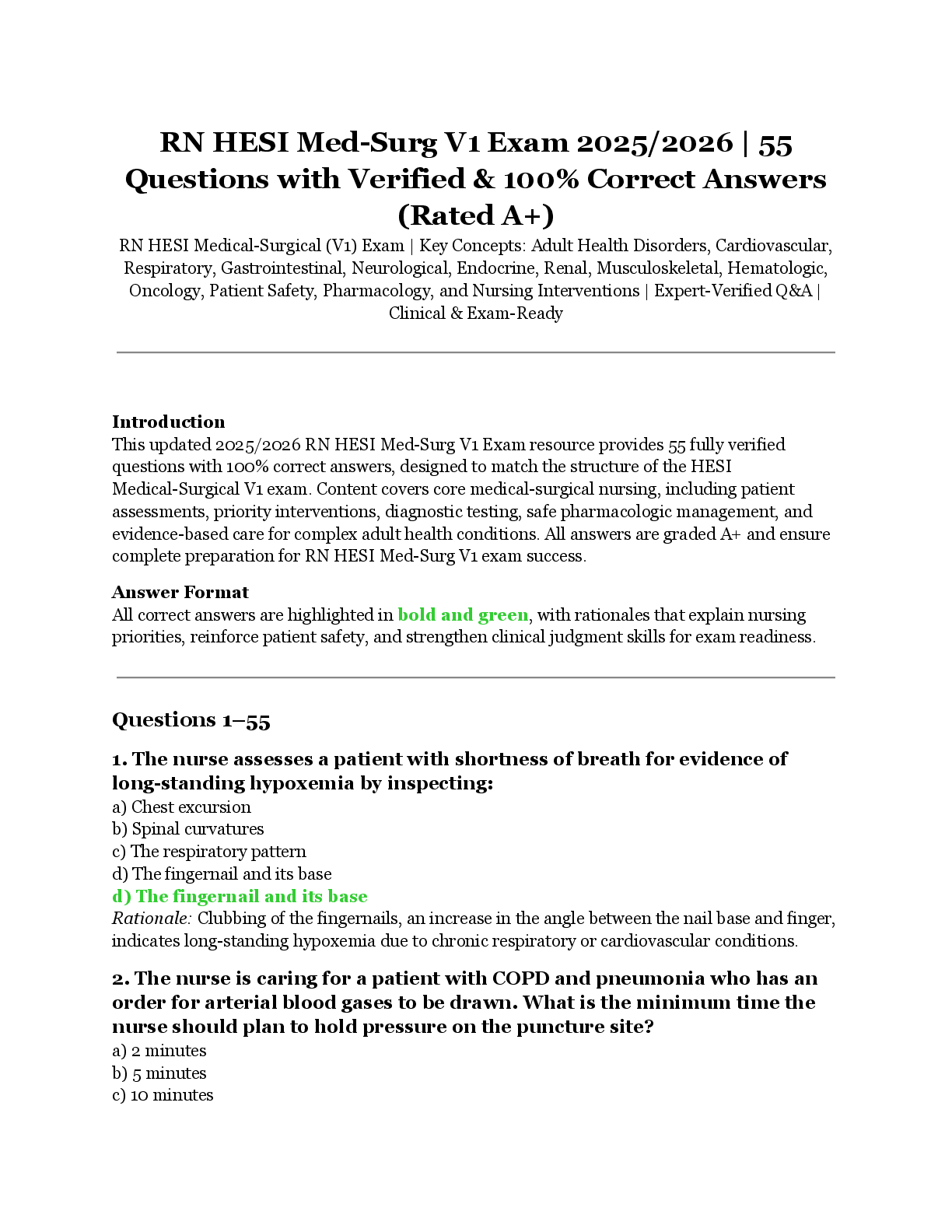
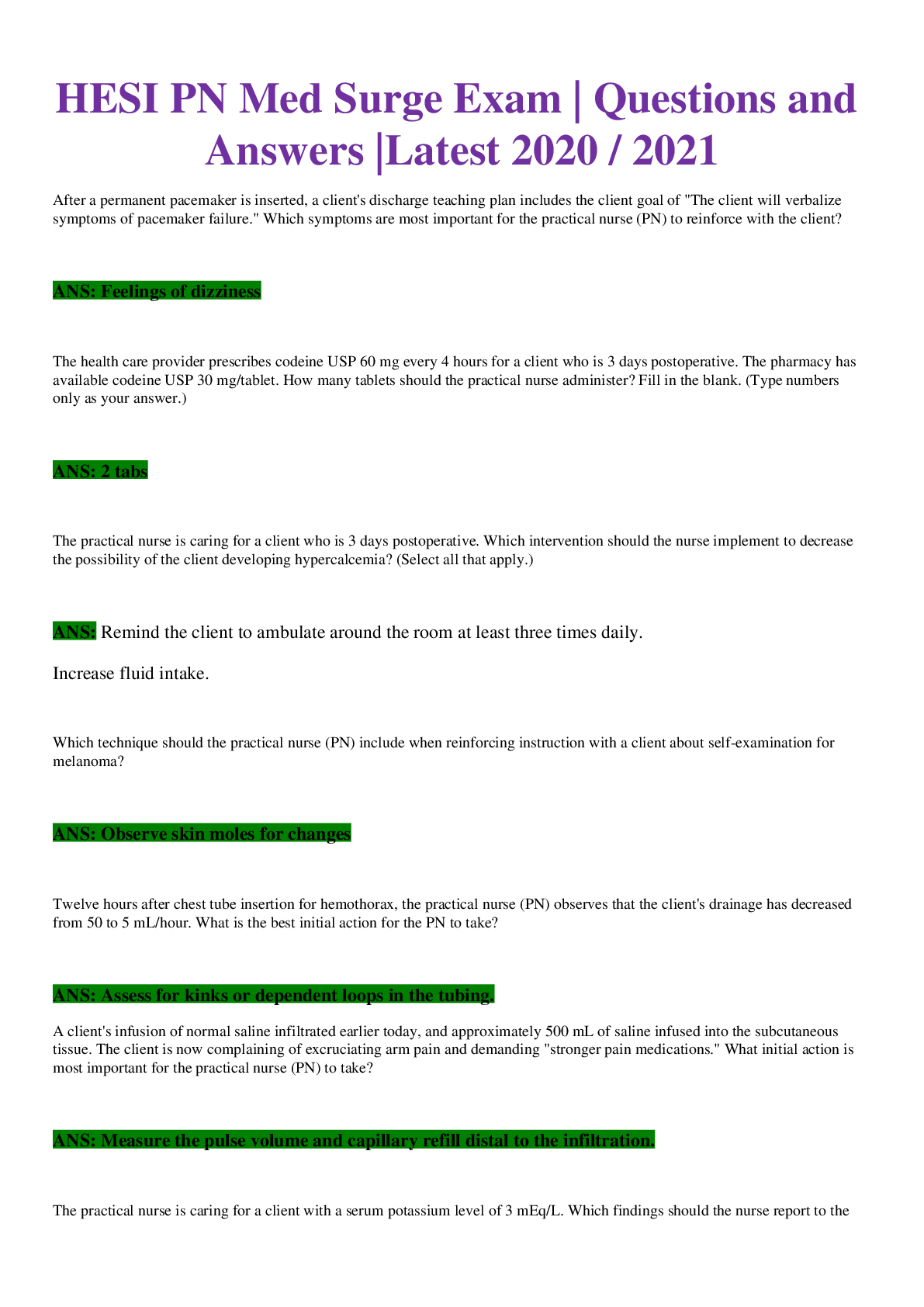
The nurse notes that the client's drainage has decreased from 50 to 5 mL/hr 12 hours after chest tube insertion for hemothorax. What is the best initial action for the nurse to take?
D. Assess for kinks or dependent loops in the tubing.
A family member was taught to suction a client's tracheostomy prior to the client's discharge from the hospital. Which observation by the nurse indicates that the family member is capable of correctly performing the suctioning technique?
B. Inserts the catheter until resistance or coughing occurs.
A hospitalized client is receiving nasogastric tube feedings via a small-bore tube and a continuous pump infusion. He begins to cough and produces a moderate amount of white sputum. Which action should the nurse take first?
B. Turn off the continuous feeding pump.
Which content about self-care should the nurse include in the teaching plan of a female client who has genital herpes? (Select all that apply.)
A. Encourage annual physical and Pap smear.
B. Take antiviral medication as prescribed.
C. Use condoms to avoid transmission to others.
D. Warm sitz baths may relieve itching.
The nurse is interviewing a client who is taking interferon-alfa-2a (Roferon-A) and ribavirin (Virazole) combination therapy for hepatitis C. The client reports experiencing overwhelming feelings of depression. Which action should the nurse implement first?
B. Review the medication actions and interactions.
Which instruction should the nurse teach a female client about the prevention of toxic shock syndrome?
B. "Change your tampon frequently."
A 43-year-old homeless, malnourished female client with a history of alcoholism is transferred to the ICU. She is placed on telemetry, and the rhythm strip shown is obtained. The nurse palpates a heart rate of 160 beats/min, and the client's blood pressure is 90/54 mm Hg. Based on these findings, which IV medication should the nurse administer?
B. Magnesium sulfate
In assessing a client diagnosed with primary aldosteronism, the nurse expects the laboratory test results to indicate a decreased serum level of which substance?
C. Potassium
When developing a discharge teaching plan for a client after the insertion of a permanent pacemaker, the nurse writes a goal of "The client will verbalize symptoms of pacemaker failure." Which behavior indicates that the goal has been met?
D. The client states that changes in the pulse and feelings of dizziness are significant changes.
A resident in a long-term care facility is diagnosed with hepatitis B. Which intervention should the nurse implement with the staff caring for this client?
A. Determine if all employees have had the hepatitis B vaccine series.
A client with congestive heart failure and atrial fibrillation develops ventricular ectopy with a pattern of 8 ectopic beats/min. Which action should the nurse take based on this observation?
B. Increase oxygen flow via nasal cannula.
Which change in laboratory values indicates to the nurse that a client with rheumatoid arthritis may be experiencing an adverse effect of methotrexate (Mexate) therapy?
B. Decrease in hemoglobin level
The nurse is assessing a male client with acute pancreatitis. Which finding requires the most immediate intervention by the nurse?
B. While the nurse is taking the client's blood pressure, he has a carpal spasm.
The nurse is preparing a teaching plan for a group of healthy adults. Which individual is most likely to maintain optimum health?
A. A teacher whose blood glucose levels average 126 mg/dL daily with oral antidiabetic drugs
A client is admitted to the hospital with a diagnosis of severe acute diverticulitis. Which nursing intervention has the highest priority?
A. Place the client on NPO status.
An older client is admitted with a diagnosis of bacterial pneumonia. Which symptom should the nurse report to the health care provider after assessing the client?
D. Confusion and tachycardia
A client who is receiving an angiotensin-converting enzyme (ACE) inhibitor for hypertension calls the clinic and reports the recent onset of a cough to the nurse. Which action should the nurse implement?
D. Encourage the client to keep taking the drug until seen by the health care provider.
The nurse includes frequent oral care in the plan of care for a client scheduled for an esophagogastrostomy for esophageal cancer. This intervention is included in the client's plan of care to address which nursing diagnosis?
C. Risk for infection
A practical nurse (PN) tells the charge nurse in a long-term facility that she does not want to be assigned to one particular resident. She reports that the male client keeps insisting that she is his daughter and begs her to stay in his room. What is the best managerial decision?
D. Reassign the PN until the resident can be assessed more completely for reality orientation.
A tornado warning alarm has been activated at the local hospital. Which action should the charge nurse working on a surgical unit implement first?
B. Move clients and visitors into the hallways and close all doors to clients' rooms.
The nurse on a medical-surgical unit is receiving a client from the postanesthesia care unit (PACU) with a Penrose drain. Before choosing a room for this client, which information is most important for the nurse to obtain?
D. If the client's wound is infected
The nurse is caring for a client who is one day post–acute myocardial infarction. The client is receiving oxygen at 2 L/min via nasal cannula and has a peripheral saline lock. The nurse notes that the client is having eight premature ventricular contractions (PVCs) per minute.
Which intervention should the nurse implement first?
B. Increase the client's oxygen flow rate.
A male client has just undergone a laryngectomy and has a cuffed tracheostomy tube in place. When initiating bolus tube feedings postoperatively, when should the nurse inflate the cuff?
B. Just prior to tube feeding
When educating a client after a total laryngectomy, which instruction would be most important for the nurse to include in the discharge teaching?
C. Tell the client to carry a medical alert card that explains his condition.
The nurse is counseling a healthy 30-year-old female client regarding osteoporosis prevention. Which activity would be most beneficial in achieving the client's goal of osteoporosis prevention?
A. Cross-country skiing
The nurse is completing an admission interview for a client with Parkinson disease. Which question will provide additional information about manifestations that the client is likely to experience?
C. "Have you ever been frozen in one spot, unable to move?"
What is the most important nursing priority for a client who has been admitted for a possible kidney stone?
B. Straining all urine
Which nursing action is necessary for the client with a flail chest?
D. Encourage coughing and deep breathing.
The nurse is caring for a client with a chest tube to water seal drainage that was inserted 10 days ago because of a ruptured bullae and pneumothorax. Which finding should the nurse report to the health care provider before the chest tube is removed?
A. Tidaling of water in water seal chamber
During assessment of a client in the intensive care unit, the nurse notes that the client's breath sounds are clear on auscultation, but jugular vein distention and muffled heart sounds are present. Which intervention should the nurse implement?
A. Prepare the client for a pericardial tap.
In assessing a client with an arteriovenous (AV) shunt who is scheduled for dialysis today, the nurse notes the absence of a thrill or bruit at the shunt site. What action should the nurse take?
C. Notify the health care provider of the findings immediately.
The nurse is giving preoperative instructions to a 14-year-old client scheduled for surgery to correct a spinal curvature. Which statement by the client best demonstrates that learning has taken place?
D. "Let me show you the method of turning I will use after surgery."
The nurse observes ventricular fibrillation on telemetry and, on entering the client's bathroom, finds the client unconscious on the floor. Which intervention should the nurse implement first?
B. Start cardiopulmonary resuscitation.
A nurse is assisting an 82-year-old client with ambulation and is concerned that the client may fall. Which area contains the older person's center of gravity?
B. Upper torso
A 74-year-old male client is admitted to the intensive care unit (ICU) with a diagnosis of respiratory failure secondary to pneumonia. Currently, he is ventilator-dependent, with settings of tidal volume (VT) of 750 mL and an intermittent mandatory ventilation (IMV) rate of 10 breaths/min. Arterial blood gas (ABG) results are as follows: pH, 7.48; PaCO2, 30 mm Hg; PaO2, 64 mm Hg; HCO3, 25 mEq/L; and FiO2, 0.80. Which intervention should the nurse implement first?
D. Add 5 cm positive end-expiratory pressure (PEEP).
A 58-year-old client who has no health problems asks the nurse about receiving the pneumococcal vaccine. Which statement given by the nurse would offer the client accurate information about this vaccine?
B. The immunization is administered once to older adults or those at risk for illness.
Which condition should the nurse anticipate as a potential problem in a female client with a neurogenic bladder?
B. Infection
Which consideration is most important when the nurse is assigning a room for a client being admitted with progressive systemic sclerosis (scleroderma)?
A. Provide a room that can be kept warm.
The nurse witnesses a baseball player receive a blunt trauma to the back of the head with a softball. What assessment data should the nurse collect immediately?
D. Ability to open the eyes spontaneously before any tactile stimuli are given
Which abnormal laboratory finding indicates that a client with diabetes needs further evaluation for diabetic nephropathy?
B. Microalbuminuria
During a health fair, a male client with emphysema tells the nurse that he fatigues easily. Assessment reveals marked clubbing of the fingernails and an increased anteroposterior chest diameter. Which instruction is best to provide the client?
A. "Pace your activities and schedule rest periods."
A client with chronic asthma is admitted to the PACU complaining of pain at a level of 8 on a 1 to 10 scale, with a blood pressure of 124/78 mm Hg, pulse of 88 beats/min, and respirations of 20 breaths/min. The PACU recovery prescription is "Morphine, 2 to 4 mg IV push, while in recovery for pain level over 5." Which intervention should the nurse implement?
B. Call the anesthesia provider for a different medication for pain.
A client is diagnosed with an acute small bowel obstruction. Which assessment finding requires the most immediate intervention by the nurse?
A. Fever of 102° F
When assigning clients on a medical-surgical floor to an RN and a PN, it is best for the charge nurse to assign which client to the PN?
B. An older adult client with pneumonia and viral meningitis
Zolpidem tartrate, 1.75 mg PRN at bedtime, is prescribed for rest. The scored tablets are labeled 3.5 mg per tablet. How many tablets should the nurse plan to administer?
A. ½ tablet
A home health nurse knows that a 70-year-old male client who is convalescing at home following a hip replacement is at risk for developing pressure ulcers. Which physical characteristic of aging puts the client at risk?
C. Thinning of the skin, with loss of elasticity
Which age-related change in the older adult has the highest safety implication for the client?
C. Stooped posture
The nurse initiates neurologic checks for a client who is at risk for neurologic compromise. Which manifestation typically provides the first indication of altered neurologic function?
A. Change in level of consciousness
A client is being discharged following radioactive seed implantation for prostate cancer. What is the most important information that the nurse should provide to this client's family?
A. Follow exposure precautions.
The nurse notes that a client who is scheduled for surgery the next morning has an elevated blood urea nitrogen (BUN) level. Which condition is most likely to have contributed to this finding?
B. Anorexia and vomiting for the past 2 days
An 81-year-old male client has emphysema. He lives at home with his cat and manages self- care with no difficulty. When making a home visit, the nurse notices that this client's tongue is somewhat cracked and his eyeballs appear sunken into his head. Which nursing intervention is indicated?
A. Help the client determine ways to increase his fluid intake.
A client on telemetry has a pattern of uncontrolled atrial fibrillation with a rapid ventricular response. Based on this finding, the nurse anticipates assisting the physician with which treatment?
B. Perform synchronized cardioversion.
An older male client comes to the outpatient clinic complaining of pain in his left calf. The nurse notices a reddened area on the calf of his right leg that is warm to the touch, and the nurse suspects that the client may have thrombophlebitis. Which additional assessment is most important for the nurse to perform?
B. Auscultate the client's breath sounds.
The home health nurse is assessing a male client being treated for Parkinson disease with carbidopa-levodopa. The nurse observes that he does not demonstrate any apparent emotion when speaking and rarely blinks. Which intervention should the nurse implement?
C. Document the presence of these assessment findings
The nurse is preparing a 45-year-old client for discharge from a cancer center following ileostomy surgery for colon cancer. Which discharge goal should the nurse include in this client's discharge plan?
D. Attend an ostomy support group within 2 weeks.
A client in the emergency department is bleeding profusely from a gunshot wound to the abdomen. What action should the nurse immediately take to promote maintenance of the client's blood pressure above a systolic pressure of 90 mm Hg?
C. Maintain the client in a supine position to reduce diaphragmatic pressure and visualize the wound.
During the shift report, the charge nurse informs a nurse that she has been assigned to another unit for the day. The nurse begins to sigh deeply and tosses about her belongings as she prepares to leave, making it known that she is very unhappy about being floated to the other unit. What is the best immediate action for the charge nurse to take?
A. Continue with the shift report and talk to the nurse about the incident at a later time.
During report, the nurse learns that a client with tumor lysis syndrome is receiving an IV infusion containing insulin. Which assessment should the nurse complete first?
C. Monitor the client's serum potassium and blood glucose levels.
A client with cirrhosis develops increasing pedal edema and ascites. Which dietary modification is most important for the nurse to teach this client?
D. Restrict salt and fluid intake.
The nurse receives the client's next scheduled bag of TPN labeled with the additive NPH insulin. Which action should the nurse implement?
D. Return the solution to the pharmacy.
What is the correct location for placement of the hands for manual chest compressions during cardiopulmonary resuscitation (CPR) on the adult client?
C. Just above the xiphoid process, on the lower third of the sternum
[Show More]

 Test Bank.png)

 All 160 Qs & As Included - Guaranteed Pass A+!!! (All Brand New Q&A Pics Included).png)



 Correct Study Guide, Download to Score A.png)
 Correct Study Guide, Download to Score A.png)
 Correct Study Guide, Download to Score A.png)




.png)

 (1).png)

 (1).png)
 (1).png)
 (1).png)

