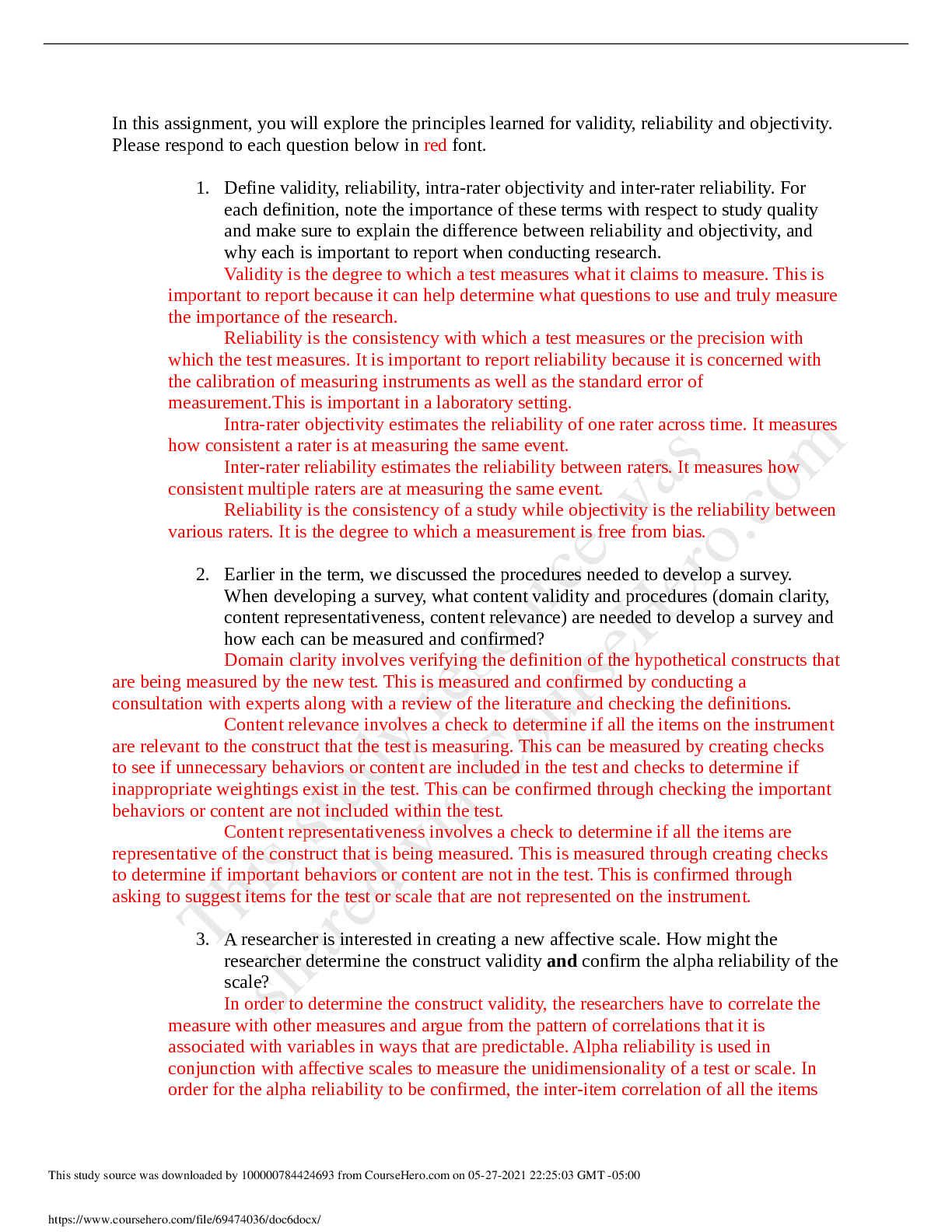
In this assignment, you will explore the principles learned for validity, reliability and objectivity.
Please respond to each question below in red font.
1. Define validity, reliability, intra-rater objectivity and int
...
In this assignment, you will explore the principles learned for validity, reliability and objectivity.
Please respond to each question below in red font.
1. Define validity, reliability, intra-rater objectivity and inter-rater reliability. For
each definition, note the importance of these terms with respect to study quality
and make sure to explain the difference between reliability and objectivity, and
why each is important to report when conducting research.
Validity is the degree to which a test measures what it claims to measure. This is
important to report because it can help determine what questions to use and truly measure
the importance of the research.
Reliability is the consistency with which a test measures or the precision with
which the test measures. It is important to report reliability because it is concerned with
the calibration of measuring instruments as well as the standard error of
measurement.This is important in a laboratory setting.
Intra-rater objectivity estimates the reliability of one rater across time. It measures
how consistent a rater is at measuring the same event.
Inter-rater reliability estimates the reliability between raters. It measures how
consistent multiple raters are at measuring the same event.
Reliability is the consistency of a study while objectivity is the reliability between
various raters. It is the degree to which a measurement is free from bias.
2. Earlier in the term, we discussed the procedures needed to develop a survey.
When developing a survey, what content validity and procedures (domain clarity,
content representativeness, content relevance) are needed to develop a survey and
how each can be measured and confirmed?
Domain clarity involves verifying the definition of the hypothetical constructs that
are being measured by the new test. This is measured and confirmed by conducting a
consultation with experts along with a review of the literature and checking the definitions.
Content relevance involves a check to determine if all the items on the instrument
are relevant to the construct that the test is measuring. This can be measured by creating checks
to see if unnecessary behaviors or content are included in the test and checks to determine if
inappropriate weightings exist in the test. This can be confirmed through checking the important
behaviors or content are not included within the test.
Content representativeness involves a check to determine if all the items are
representative of the construct that is being measured. This is measured through creating checks
to determine if important behaviors or content are not in the test. This is confirmed through
asking to suggest items for the test or scale that are not represented on the instrumen
[Show More]

.png)




![Preview of eBook EPUB [PDF] The West Virginia State Constitution By Robert M. Bastress Jr.](https://browseimages.nyc3.digitaloceanspaces.com/paper-images/2026/02/16/LBVUG7FG2026-02-16-04-3769931daf95530.png)





.png)

.png)


