Question 1
1.334 out of 1.334 points
A child is diagnosed with cystic fibrosis. History reveals that the child’s
parents are siblings. Cystic fibrosis was most likely the result of:
Selected
Answer:
consanguinity
...
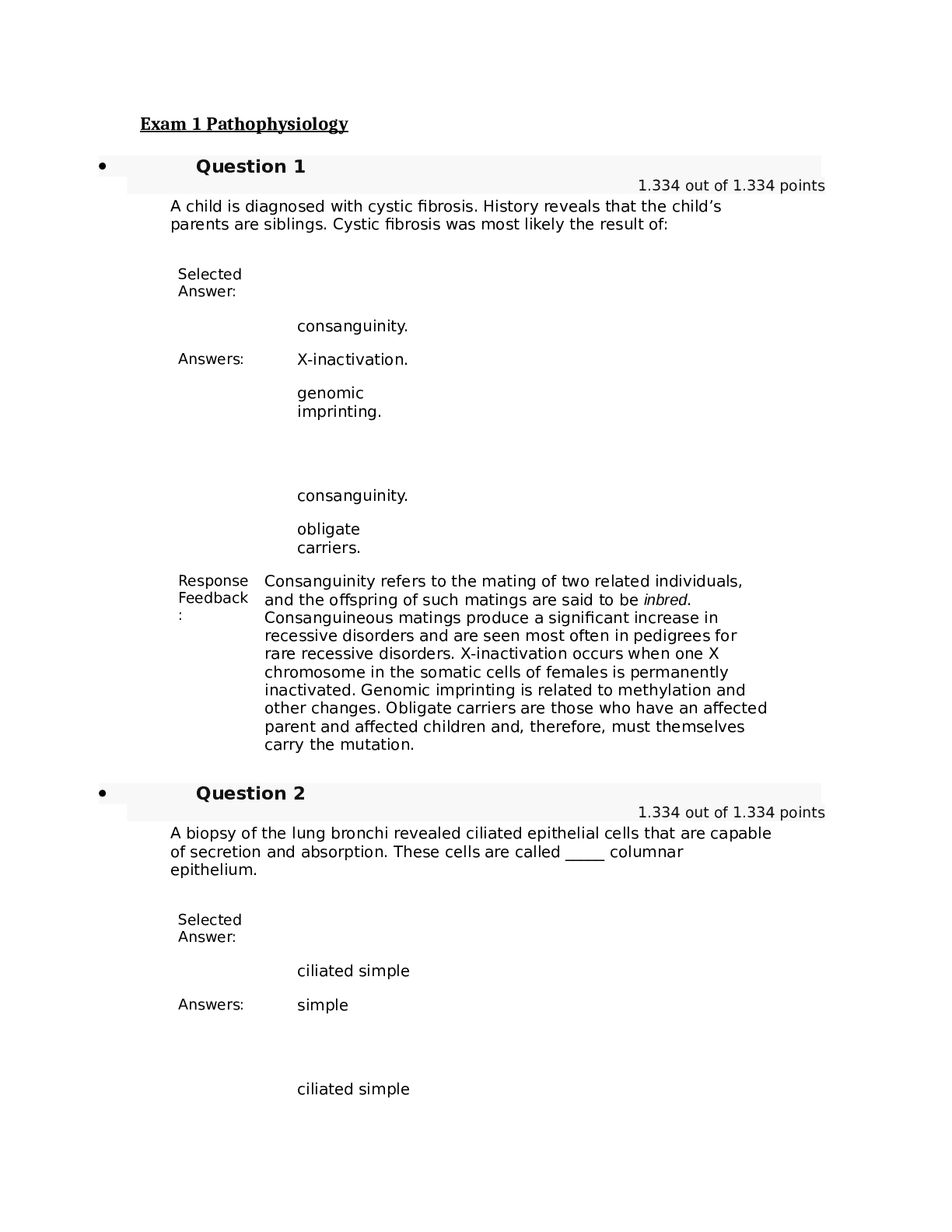
Question 1
1.334 out of 1.334 points
A child is diagnosed with cystic fibrosis. History reveals that the child’s
parents are siblings. Cystic fibrosis was most likely the result of:
Selected
Answer:
consanguinity.
Answers: X-inactivation.
genomic
imprinting.
consanguinity.
obligate
carriers.
Response
Feedback
:
Consanguinity refers to the mating of two related individuals,
and the offspring of such matings are said to be inbred.
Consanguineous matings produce a significant increase in
recessive disorders and are seen most often in pedigrees for
rare recessive disorders. X-inactivation occurs when one X
chromosome in the somatic cells of females is permanently
inactivated. Genomic imprinting is related to methylation and
other changes. Obligate carriers are those who have an affected
parent and affected children and, therefore, must themselves
carry the mutation.
Question 2
1.334 out of 1.334 points
A biopsy of the lung bronchi revealed ciliated epithelial cells that are capable
of secretion and absorption. These cells are called _____ columnar
epithelium.
Selected
Answer:
ciliated simple
Answers: simple
ciliated simple
stratified
pseudostratified
ciliated
Response
Feedback
:
Ciliated simple columnar epithelium is found in the lungs.
Simple columnar epithelium is found from the stomach to the
anus. Stratified columnar epithelium is found in the lining of the
epiglottis, part of the pharynx, the anus, and the male urethra.
Pseudostratified ciliate columnar epithelium is found in the
lining of the large ducts of some glands (parotid, salivary), male
urethra, respiratory passages, and Eustachian tubes of the ears.
Question 3
1.334 out of 1.334 points
A biologist is explaining how RNA directs the synthesis of protein. Which
process is the biologist describing?
Selected
Answer:
Translation
Answers: Terminatio
n
Transcripti
on
Translocati
on
Translation
Response
Feedback
:
In translation, RNA directs the synthesis of a polypeptide,
interacting with transfer RNA (tRNA), a cloverleaf-shaped strand
of about 80 nucleotides. Termination does not involve synthesis
of protein. Transcription is the process by which DNA specifies a
sequence of messenger RNA (mRNA). Translocation is the
interchange of genetic material between nonhomologous
chromosomes.
[Show More]