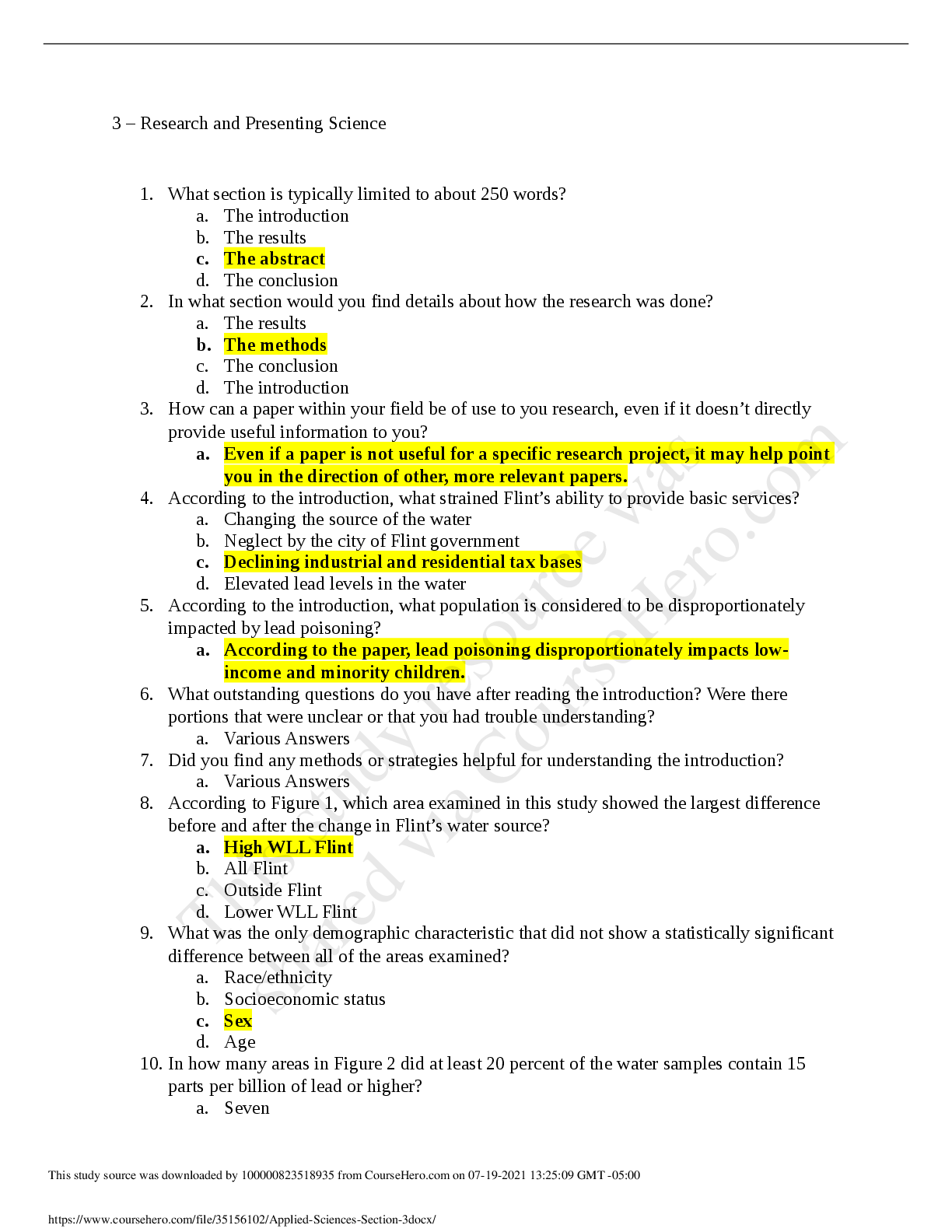
According to Ariely, many of the poor decisions that we make are:
Question 1 options:
Systematic, repeated, and predictable
Generally avoidable, if we understand why we make them
A part of our make-up -- we'll never
...
According to Ariely, many of the poor decisions that we make are:
Question 1 options:
Systematic, repeated, and predictable
Generally avoidable, if we understand why we make them
A part of our make-up -- we'll never be completely perfect
All of the above
None of the above
According to Ariely, experiments:
Question 2 options:
Help us to isolate the causes and effects of the phenomena that we're interested in
Can only ever tell us about the effects of treatments under the specific conditions of the experiments
Are impossibly difficult and expensive to carry out because they have to take place in laboratories
All of the above
None of the above
According to Wheelan, descriptive statistics are:
Question 3 options:
Possibly dangerous, sometimes deceptive
Relevant to your life, in one way or another
Simplifications of complex circumstances
All of the above
None of the above
According to Wheelan, which measure of central tendency is the best?
Question 4 options:
The mean
The median
The mode
The standard deviation
It depends on the data and what you're trying to measure
Question 5 (1 point)
According to Wheelan, what's wrong with the United States' current per capita income as a measure of the
health of the American middle class?
Question 5 options:
It is expressed in per capita units, which don't really mean
anything.
It doesn't represent the well-being of the average middle-class
American.
Income is no longer as good a measure of economic health as
credit ratings.
All of the above
None of the above
Save
Question 6 (1 point)
Why is the mean sometimes a poor measure of the "middle" of a data set?
Question 6 options:
The mean actually is a good measure for the middle of a data set.
The mean is the most common observation, whether it is in the
middle or not.
Uncommon and yet influential outliers can skew the statistic.
All of the above
None of the above
Save
Question 7 (1 point)
The standard deviation:
Question 7 options:
Tells us how dispersed a set of data is
Is used to determine the value of the median
Only exists within the normal distribution
All of the above
None of the above
Save
Question 8 (1 point)
The normal distribution:
Question 8 options:
Is nearly flat, with almost the same number of observations at each
point along the scale.
Makes it easy to calculate the probability of falling within any
given part of the distribution
Unfortunately isn't that common in the world -- most phenomena
are distributed differently
All of the above
None of the above
Question 9 (1 point)
This study source was downloaded by 100000819946675 from CourseHero.com on 05-31-2021 17:49:06 GMT -05:00
https://www.coursehero.com/file/31135977/Quiz-1-305docx/
This study resource was
shared via CourseHero.com
An index:
Question 9 options:
Combines two or more other descriptive statistics
Is a potential source of data manipulation and deception
Can give more importance to some variables than others
All of the above
None of the above
Save
Question 10 (1 point)
Precision in descriptive statistics:
Question 10 options:
Means exactly the same thing as accuracy
Is different from accuracy but ensures that a statistic is accurate
Is different from accuracy but always follows from accuracy
Is different from accuracy and is more important than accuracy
Is different from accuracy and is less important than accuracy
Save
Question 11 (1 point)
The descriptive statistic that tells us the most about how an individual observed value compares to the
overall distribution of observed values is:
Question 11 options:
The mean
The median
The mode
The index
The standard deviation
Save
Question 12 (1 point)
Frank owns a hot dog stand, which he cleverly named Frank's Franks. Last week Frank reduced the original
price of a hot dog, $2.00, by 25%, so last week the cost of a hot dog was $1.50. This week Frank wants to raise
this new price by 25%. How much will Frank charge for a hot dog this week?
Question 12 options:
$2.00
$1.88
$1.75
$1.53
None of the above
The median:
Question 13 options:
Is the average value of the observations in a data set
Can be skewed if there are influential outliers in the
data set
Splits a data set's observations in half -- half fall
above the median and half fall below
All of the above
None of the above
Save
Question 14 (1 point)
I just purchased the brand new iSlab Air for $2,000, and I'm particularly excited to have gotten a great deal on
it. Why do I feel that this was such a good deal?
Question 14 options:
Although the product is the first of its kind, it
promises to be the next big thing, so it must be
worth a pretty penny -- or two.
It seems to me that, given its material and volume,
and given the size of the manufacturer, the price is
lower than it could be.
The iSlab salesman told me so, and we're all such
naive creatures that, naturally, I believed him and
bought it immediately.
It seems a more reasonable price than that of the
iSlab Air Pro Plus, which costs as much as $2,500
and has only a few more features.
Well I don't, really, but I can't resist the temptation
to own this new marvel of slab technology -- I don't
care how much it costs.
Save
Question 15 (1 point)
Arbitrary coherence:
Question 15 options:
Coherently determines future evaluations of the
value of a given item
Arbitrarily determines current evaluations of the
value of a given item
Is a form of anchoring that affects my short- and
long-term decision-making
All of the above
None of the above
Save
Question 16 (1 point)
Which of the following brands of deodorant might Ariely think most likely to be successful?
Question 16 options:
A luxury brand that smells like "Driven," the
cologne designed by Derek Jeter
A brand promising a whole week of protection from
moisture and odor
A brand with scratch 'n' sniff packaging, so you
know exactly what you're getting
A run-of-the-mill brand that offers the third stick
purchased at half-price
A fairly cheap brand that offers the fifth stick
purchased for free
I'm in the market for a new toaster. What kind of anchoring should I look out for as I shop for one?
Question 17 options:
The price tag on the high-quality Toast90X -- very
tempting, indeed, but a little too pricey for me.
The price that my friend offered me for his old
toaster, which I considered but passed up for
something new.
The price that I recall paying last time I bought a
toaster, which was nearly ten years ago.
All of the above
None of the above
Save
Question 18 (1 point)
How does arbitrary coherence relate to traditional views of economics?
Question 18 options:
It supports the traditional assumption that
consumers' preferences will drive demand.
It undermines the traditional assumption that
consumers' preferences will drive demand.
It confirms the traditional assumption that supply
and demand are independent forces.
It forces behavioral economists to wonder if
traditional economics was right about anything.
It doesn't relate, because traditional economics
doesn't account for individuals at all.
Save
Question 19 (1 point)
As of 2006, an American male, aged 20-29 years old, would fall into the third quartile of height for his
demographic if he were 6 feet tall. If I fit this description, what exactly does it mean to say that I fall into the
third quartile?
Question 19 options:
One-fourth of the demographic are shorter than I
am.
One-third of the demographic are shorter than I am.
Half of the demographic are shorter than I am.
Two-thirds of the demographic are shorter than I
am.
Three-fourths of the demographic are shorter
than I am.
Save
Question 20 (1 point)
Of all of my friends, John and Tim are the most attractive. I'm also friends with Tom, Tim's brother, and Tom
looks a lot like Tim but less attractive. Who would Ariely say that I am most likely to date?
Question 20 options:
John -- He stands out as especially attractive
because nobody looks like him, whereas Tim,
although very attractive, reminds me of Tom, who is
less attractive.
John -- I don't know what John's brother looks like,
which allows me to imagine that his whole family is
gorgeous, whereas I already know that Tim's brother
Tom is not so hot.
Tim -- Both Tim and John are very attractive,
but Tom's relative ugliness makes Tim appear
even more attractive in comparison, whereas I
have nobody to compare John to.
Tim -- The nice thing about dating Tim would be
that if he dumped me, I could then date Tom, who
would remind me of beautiful Tim, even if he's less
attractive.
Tom -- I could never be happy with either John or
Tim, because I would always wonder if I had chosen
the most attractive one, but if I date Tom at least I'll
know what I have.
I want to open a restaurant similar to McDonald's but make it outrageously expensive. How can I
best get away with this?
Question 21 options:
I'll make my restaurant seem as similar to
McDonald's as possible -- a familiar and
comfortable alternative.
I'll make my restaurant seem similar to other
competitors, to show that McDonald's has no
monopoly on fast food.
I'll make my restaurant seem wholly different
from McDonald's -- an unprecedented experience
that is worth a little extra.
The name will have to be MacDonald's, so that
customers mistake it for McDonald's and don't even
look at the prices.
There is no getting away with it -- consumers can
always tell when something is over-priced.
Save
Question 22 (1 point)
According to Ariely, the difference between a price of one cent and FREE! is so great because:
Question 22 options:
We rightly assume that there is no loss to fear --
How can we lose anything if the price is FREE!?
We assume, often wrongly, that there is no loss to
fear -- sometimes FREE! can cost us later.
Cents add up -- The best part about FREE! is that it
never adds up to anything but more FREE!.
These days nobody carries coins, especially pennies,
so really cheap things might as well be FREE!.
Actually it isn't -- Ariely's subjects acted in the same
way toward one cent as they did toward FREE!.
Save
Question 23 (1 point)
According to Wheelan, we should all learn statistics so that:
Question 23 options:
We can evaluate the effectiveness of government
policies and programs
We can improve law enforcement practices,
marketing strategies, etc.
We can each make better decisions about our dayto-day lives
All of the above
None of the above
[Show More]


.png)
.png)
.png)
.png)





 Charles Herrick - 100 Q&A About Alcoholism & Drug Addiction-Jones and Bartlett Publishers, Inc.png)