Unit 3 Assessment for feedback and grading
Task 1: Universal Gravitation and Gravitational Fields
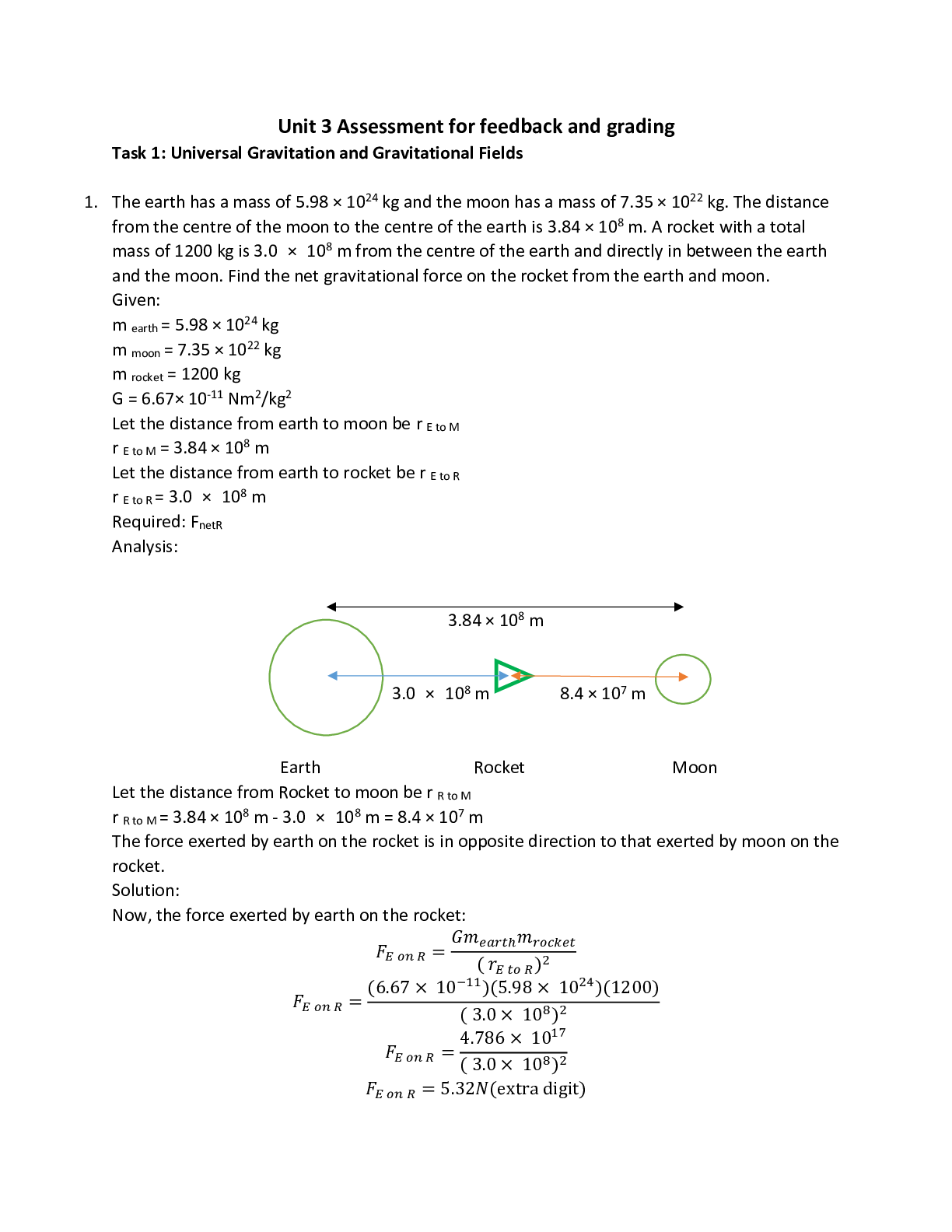
1. The earth has a mass of 5.98 × 1024 kg and the moon has a mass of 7.35 × 10²² kg. The distance
from the centre of t
...
Unit 3 Assessment for feedback and grading
Task 1: Universal Gravitation and Gravitational Fields
1. The earth has a mass of 5.98 × 1024 kg and the moon has a mass of 7.35 × 10²² kg. The distance
from the centre of the moon to the centre of the earth is 3.84 × 10⁸ m. A rocket with a total
mass of 1200 kg is 3.0 × 10⁸ m from the centre of the earth and directly in between the earth
and the moon. Find the net gravitational force on the rocket from the earth and moon.
Given:
m earth = 5.98 × 1024 kg
m moon = 7.35 × 10²² kg
m rocket = 1200 kg
G = 6.67× 10⁻¹¹ Nm2/kg2
Let the distance from earth to moon be r E to M
r E to M = 3.84 × 10⁸ m
Let the distance from earth to rocket be r E to R
r E to R = 3.0 × 10⁸ m
Required: FnetR
Analysis:
3.84 × 10⁸ m
3.0 × 10⁸ m 8.4 × 10⁷ m
| Earth
Let the distance from Rocket to moon be r R to M | Rocket | Moon
r R to M = 3.84 × 10⁸ m - 3.0 × 10⁸ m = 8.4 × 10⁷ m
The force exerted by earth on the rocket is in opposite direction to that exerted by moon on the
rocket.
Task 2: Coulomb’s Law and Electric Fields
1. In this unit, you were learning about different yet similar laws of physics - Newton’s universal
law of gravitation and Coulomb’s law of electrostatics. Describe one similarity and one
difference for these two laws.
Similarity: Both Newton’s universal law of gravitation and Coulomb’s law of electrostatics use
inverse square law i.e. the forces are inversely proportional to the square of the distances
between charges in case of Coulomb's law and between masses in case of Newton's law of
gravitation. Both forces are action-at-a-distance forces and get weaker with the increase in
distance.
Difference: Coulomb's law defines force between charges whereas Newton's law of gravitation
defines force between masses. Gravitational field only causes attraction, while electric field
causes both attraction and repulsion. Therefore, in Coulomb's Law the electrostatic force may
be positive or negative but In Newton's universal Law of Gravitation the force is always
negative.
2. Refer to the following two images for the questions that follow.
a. Refer to Figure 1:
i. State whether the source charge is positively or negatively charged.
The electric field lines around the source charge are pointing away from it. Therefore, the
source charge is positively charged.
ii. Figure 1 contains arrows that are outwardly pointing. By convention, state how the directions
of field lines are detected.
By convention, small positively charged particles are used to test the field lines. To detect the
electric field, a small positive test charge is placed near the source charge. Since, the source
charge is positively charged the test charge is repelled away.
b. Comparing Figure 1 and Figure 2, you can see Figure 2 does not have any arrowheads. Observe
the sign of charges for each source charge, (in Figure 2) and state the direction the arrowheads
should be pointing to make it accurate.
Since, the electric field lines start on a positive charge and end on a negative charge.
Therefore, the direction of arrowheads between the given two charges points to the right.
The direction of the arrowheads on the electric field lines leaving the positive charge will be
outwards and those approaching the negative charge will be inwards.
3. Examine the charge distribution in the diagram below.
a. Determine the net force charge acting at q1 (+ 2.0 × 10⁻⁵C), caused by q2 (-4.0 × 10⁻⁵ C) and q3
[Show More]