Econ
551
Assignment
1:
Solutions
Due:
Thursday,
September
18,
2014,
5pm
1a.
A
consumer
is
considering
how
much
to
work
(each
week).
She
c
...
Econ
551
Assignment
1:
Solutions
Due:
Thursday,
September
18,
2014,
5pm
1a.
A
consumer
is
considering
how
much
to
work
(each
week).
She
can
work
a
maximum
of
80
hours
per
week.
Each
hour
she
doesn’t
work
is
an
hour of
leisure,
l.
For
each
hour
she
works,
she
gets
paid
a
wage
w.
With
the
money
she
earns,
she
can
buy
a
single
consumption
good,
c,
whose
price
is
set
equal
to
one.
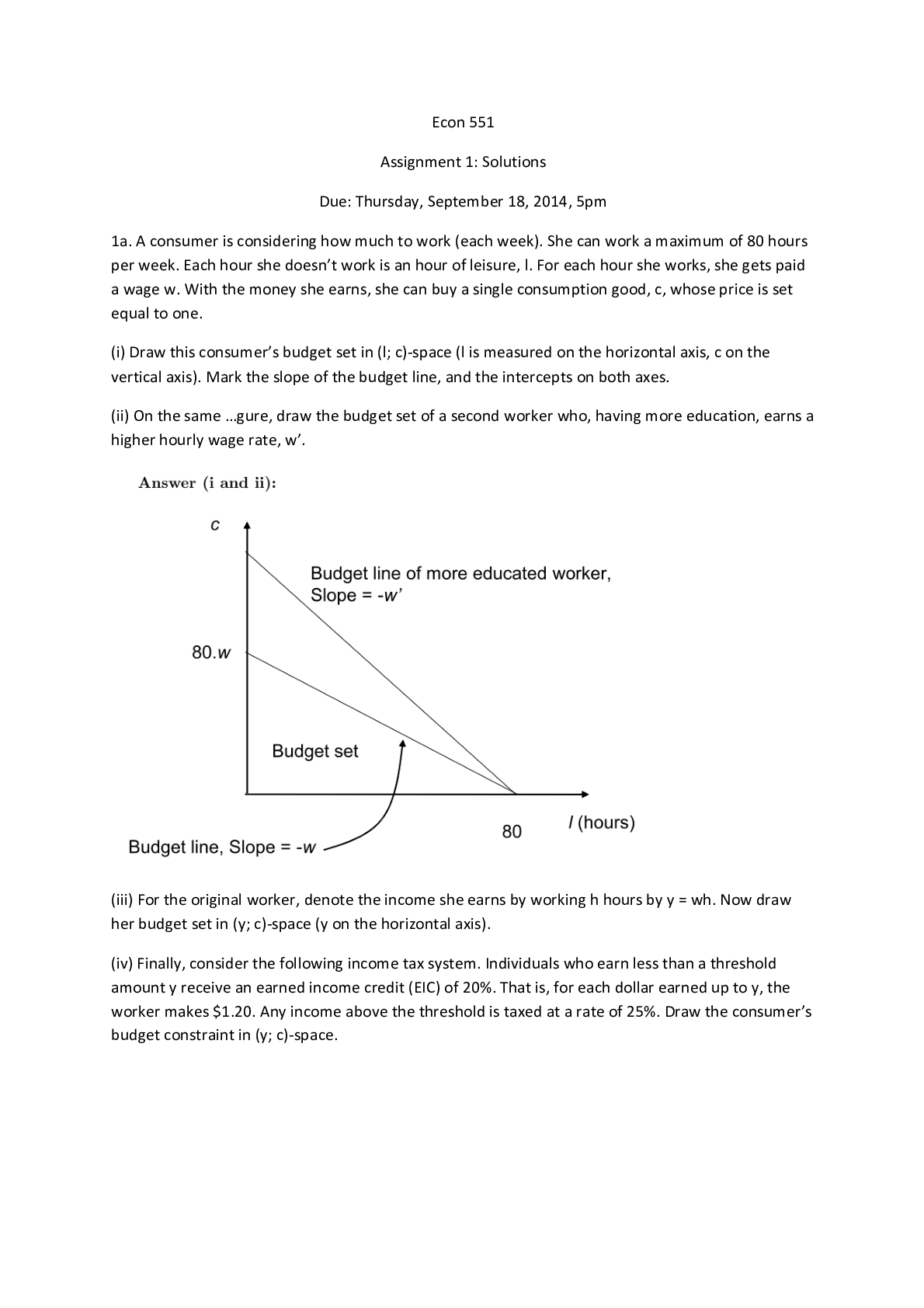
(i)
Draw
this
consumer’s
budget
set
in
(l;
c)-‐space
(l
is
measured
on
the horizontal
axis, c
on
the
vertical
axis).
Mark
the
slope
of
the
budget
line,
and
the
intercepts
on
both
axes.
(ii)
On
the
same
…gure,
draw
the
budget
set
of
a
second
worker
who,
having
more
education,
earns
a
higher
hourly
wage
rate,
w’.
(iii)
For
the
original
worker,
denote
the
income
she
earns
by
working
h
hours
by
y
=
wh.
Now
draw
her
budget
set
in
(y;
c)-‐space
(y
on
the
horizontal
axis).
(iv)
Finally,
consider
the
following
income
tax
system.
Individuals
who
earn
less
than
a
threshold
amount
y
receive
an
earned
income
credit
(EIC)
of
20%.
That
is,
for
each
dollar
earned
up
to
y,
the
worker
makes
$1.20.
Any
income
above
the
threshold
is
taxed
at
a
rate
of
25%.
Draw
the
consumer’s
budget constraint
in
(y;
c)-‐space.Let
us
now
assume
that
the
wage
is
$1
per
hour,
and
that
the
consumer
only
likes
an
hour
of
leisure
when
she
has
something
to
consume
during
that
hour.
That
is,
an
extra
hour
is
worthless,
unless
complemented
with
an
extra
unit
of
the
consumption
good.
Similarly,
an
extra
unit
of
the
consumption
good
is
useless
unless
she
has
time
to
consume
it.
(v)
Draw
and
label
the
consumer’s
budget
constraint
in
(l;
c)-‐space,
and
on the
same
picture
draw
her
indifference
curves.
How
much
leisure
does
the
consumer
choose,
how
much
of
the
consumption
good
does
she
buy,
and
how
many
hours
per
week
does
she
work?When
she
has
a
wage
of
$1
per
hour,
she
chooses
point
A,
at
which
she
enjoys
40
hours
of
leisure
(l
=
40),
and
consumes
40
units
of
the
consumption
good.
She
works
40
hours
per
week.
(vi)
Now
suppose
this
person
becomes
educated
and
her
wage
increases
to
$3
per
hour.
On
the
same
diagram,
draw
and
label
the
consumer’s
new
budget constraint.
What
are
her
optimal
choices
of
leisure
and
the
consumption
good
now?
Answer
(vi):
With
the
higher
wage,
the
consumer
chooses
point
B
in
the
diagram.
Here
she
enjoys
more
leisure
than
before
-‐ 60
hours
per
week,
and
she
works
only
20
hours
per
week.
But
her
consumption
of
the
consumption
good
also
increases,
to
60
units.
To
see
how
to
get
these
numbers,
note
that
if
the
consumer
worked
as
much
as
she
could
(80
hours),
she
would
have
$240.
Each
hour
of
leisure
she
chooses
reduces
her
income
by
$3,
so
we
can
think
of
her
as
facing
a
"price
of
leisure"
of
$3.
The
price
of
the
consumption
good
is
$1.
We
know
she
will
purchase
equal quantities
of
leisure
and
the
consumption
good
-‐ that
is,
l
=
c.
Her
budget
constraint
is
then
just
c
+
3l
=
240
or
4c
=
240:
But
this
means
c
=
60,
and
hence
l
=
60.
1b.
Consider
a
consumer
with
total
income
of
$200
signing
up
for
new
internet
service.
He
has
the
choice
between
standard
and
premium
service
packages.
Under
the
sta
[Show More]