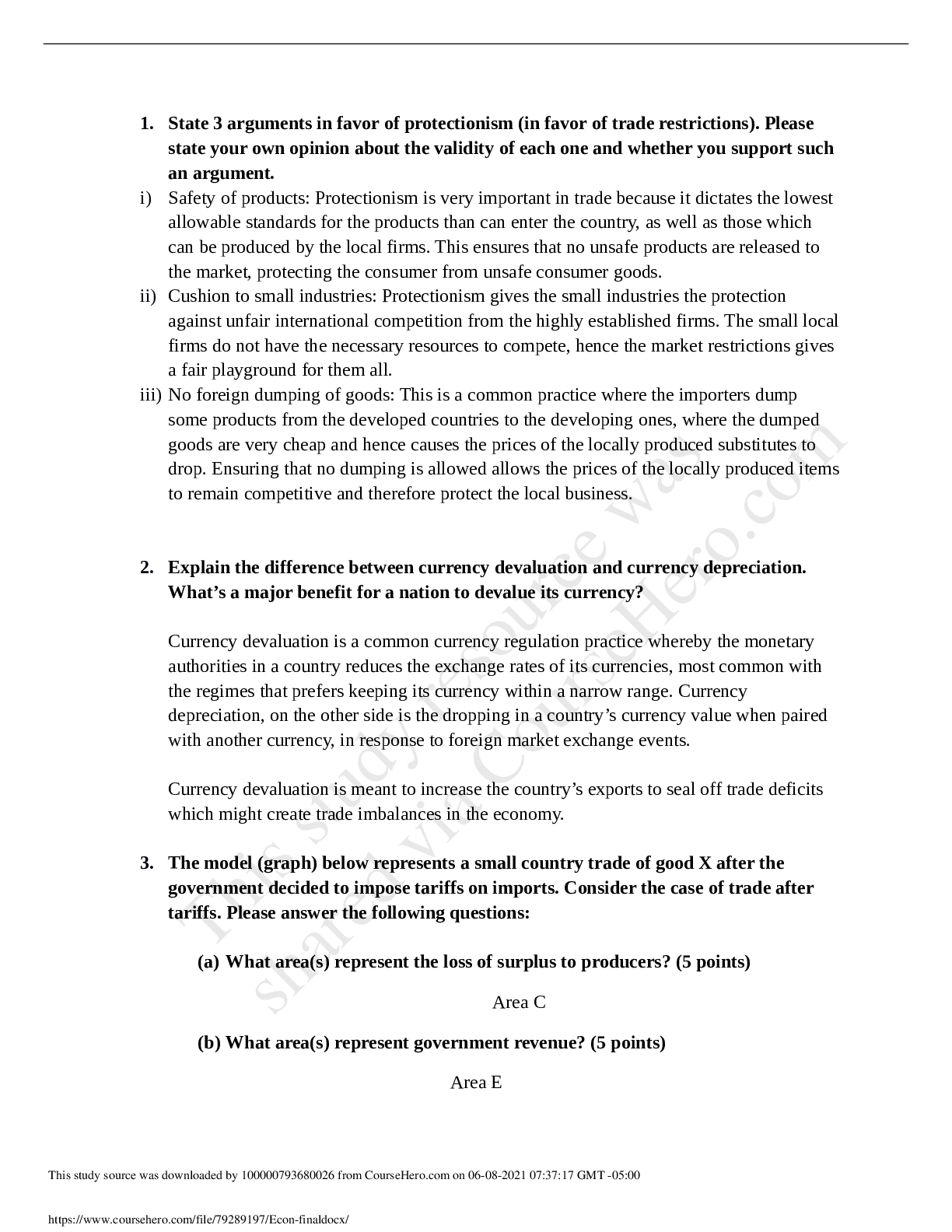
1. State 3 arguments in favor of protectionism (in favor of trade restrictions). Please
state your own opinion about the validity of each one and whether you support such
an argument.
i) Safety of products: Protection
...
1. State 3 arguments in favor of protectionism (in favor of trade restrictions). Please
state your own opinion about the validity of each one and whether you support such
an argument.
i) Safety of products: Protectionism is very important in trade because it dictates the lowest
allowable standards for the products than can enter the country, as well as those which
can be produced by the local firms. This ensures that no unsafe products are released to
the market, protecting the consumer from unsafe consumer goods.
ii) Cushion to small industries: Protectionism gives the small industries the protection
against unfair international competition from the highly established firms. The small local
firms do not have the necessary resources to compete, hence the market restrictions gives
a fair playground for them all.
iii) No foreign dumping of goods: This is a common practice where the importers dump
some products from the developed countries to the developing ones, where the dumped
goods are very cheap and hence causes the prices of the locally produced substitutes to
drop. Ensuring that no dumping is allowed allows the prices of the locally produced items
to remain competitive and therefore protect the local business.
2. Explain the difference between currency devaluation and currency depreciation.
What’s a major benefit for a nation to devalue its currency?
Currency devaluation is a common currency regulation practice whereby the monetary
authorities in a country reduces the exchange rates of its currencies, most common with
the regimes that prefers keeping its currency within a narrow range. Currency
depreciation, on the other side is the dropping in a country’s currency value when paired
with another currency, in response to foreign market exchange events.
Currency devaluation is meant to increase the country’s exports to seal off trade deficits
which might create trade imbalances in the economy.
3. The model (graph) below represents a small country trade of good X after the
government decided to impose tariffs on imports. Consider the case of trade after
tariffs. Please answer the following questions:
(a) What area(s) represent the loss of surplus to producers? (5 points)
Area C
(b) What area(s) represent government revenue? (5 poin
[Show More]

.png)
.png)