2018
Name: ______________________________________ Date: ________________________
Student Exploration: Circulatory System
Vocabulary: artery, atrium, blood vessel, capillary, circulatory system, heart, heart valves,
p
...
2018
Name: ______________________________________ Date: ________________________
Student Exploration: Circulatory System
Vocabulary: artery, atrium, blood vessel, capillary, circulatory system, heart, heart valves,
platelet, pulmonary artery, pulmonary vein, red blood cell, urea, ventricle, vein, white blood cell
Prior Knowledge Questions (Do these BEFORE using the Gizmo.)
1. Why do you need blood? _____________________________________________________
_________________________________________________________________________
2. What organ pushes blood through your body? _______________
Gizmo Warm-up
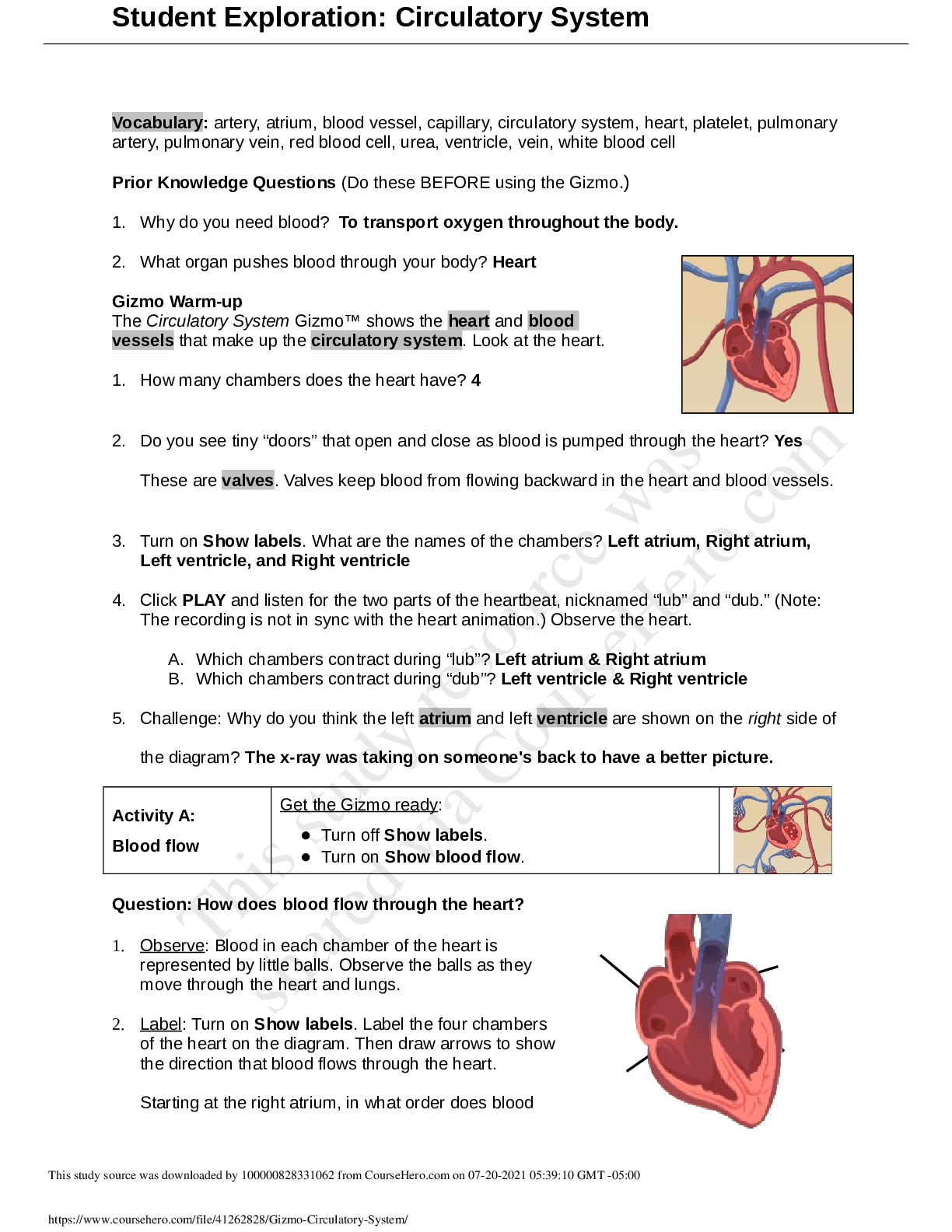
The Circulatory System Gizmo shows the heart and blood vessels
that make up the circulatory system. Look at the heart.
1. How many chambers does the heart have? _______________
2. Turn on Show labels. What are the names of the chambers? _______________________,
_______________________, _______________________, _______________________
3. Do you see tiny “doors” that open and close as blood is pumped through the heart? ______
These are heart valves. Heart valves control the flow of blood through the heart.
4. Click Heartbeat sound and listen for the two parts of the heartbeat, nicknamed “lub” and
“dub.” Observe the heart. (Note: The recording is not in sync with the heart animation.)
What do you think causes heartbeat sounds?
In fact, the “lub” sound is caused by valves from the atria to the ventricles closing, and the
“dub” sound is caused by the valves from the ventricles to the blood vessels closing.
5. Challenge: Why do you think the left atrium and left ventricle are shown on the right side of
the diagram? ______________________________________________________________
Youneeditbecauseit carriesoxygen nutrientsto
thebodybut also carriescozt waste out of thebody
heart
4
rightatrium
left atrium rightventricle left ventricle
yes
the closingof the valves
They are on the left side of thebody
2018
Activity A:
Blood flow
Get the Gizmo ready:
x Turn off Show labels.
x Turn on Show blood flow.
Question: How does blood flow through the heart?
1. Observe: Blood in each chamber of the heart is
represented by little balls. Click Play ( ) and observe
the balls as they move through the heart and lungs.
2. Label: Click Pause ( ) and turn on Show labels. Label the
four chambers of the heart on the diagram. Then draw arrows
to show the direction that blood flows through the heart.
Starting at the right atrium, in what order does blood
flow through the four chambers?
Right atrium, ____________________, ____________________, ____________________
3. Analyze: Click Play. Observe the path of blood that leaves each ventricle.
A. Where does blood from the right ventricle go? ______________________________
B. Where does blood from the left ventricle go? _______________________________
4. Collect data: Use the syringe to collect a blood sample from the right ventricle (on the left
side of the heart diagram). Look at the Data from blood sample numbers.
A. What is the concentration of oxygen in this sample? ____________________
B. What is the concentration of carbon dioxide in this sample? ____________________
5. Collect data: Now collect a blood sample from the left atrium.
A. What is the concentration of oxygen in this sample? ____________________
B. What is the concentration of carbon dioxide in this sample? ____________________
6. Draw conclusions: Between the right ventricle and the left atrium, blood goes through the
lungs. Based on the data you have collected, what happens in the lungs?
_________________________________________________________________________
_________________________________________________________________________
I
3
2 4
3 4
Fightventricle left atrium left ventricle
lungs
body
36mm Hg
48.5mm Hg
94.1mm Hg
39.5mm Hs
when thebloodgoes to the lungsthe is
sent out
2018
Activity B:
Blood circulation
Get the Gizmo ready:
x Check that Show labels is on.
x Turn on Show blood flow.
Question: How is blood carried to different parts of the body?
1. Observe: Click Play and watch the blood after it leaves the left ventricle. What are some
places that blood goes after leaving the heart? ____________________________________
_________________________________________________________________________
2. Compare: The Gizmo shows three types of blood vessels. Arteries carry blood away from
the heart, capillaries are small vessels that carry blood to body cells, and veins carry blood
back to the heart. Locate examples of arteries, veins, and capillaries.
Use the syringe to take blood samples from several different veins and arteries.
A. Which type of blood vessel usually carries oxygen-rich blood? __________________
B. Which type of blood vessel usually carries oxygen-poor blood? _________________
C. In which type of blood vessel is oxygen released into body cells? _______________
3. Challenge: The pulmonary arteries carry blood from the right ventricle to the right and left
lungs. The pulmonary veins carry blood from the lungs back to the left atrium. Locate these
blood vessels, and use the syringe to take a blood sample from each.
A. How is the blood in the pulmonary arteries different from blood in other arteries?
___________________________________________________________________
B. How is the blood in the pulmonary veins different from blood in other veins?
___________________________________________________________________
4. Extend your thinking: How is the circulatory system similar to a road-and-highway system?
_________________________________________________________________________
_________________________________________________________________________
_________________________________________________________________________
_________________________________________________________________________
head liver arms kidneylegs
intestines trunk
artery
vein
cappillary
Low in Os
High in 02
They both transport things where they need
togo
2018
Extension:
What’s in your
blood?
Get the Gizmo ready:
x Take a blood sample from any blood vessel using
the syringe.
Question: What is inside blood?
1. Observe: Look at the Microscopic view of
blood sample. Sketch what you see in the
space at right. (If you like, you could also
click the camera icon to take a Gizmo
snapshot, and then paste your snapshot into
a blank word-processing document.)
Find and label the following objects in your
sketch:
x Red blood cells (small, round cells that carry oxygen)
x White blood cells (large, irregular cells that fight disease)
x Platelets (tiny fragments that help to stop bleeding when you are cut)
2. Collect data: Blood carries many vital substances. Four of these are listed above the
Microscopic view. Oxygen and sugar are needed by all body cells. Carbon dioxide and
urea are waste products. What are the concentrations of each substance in this sample?
Oxygen: _________ Carbon dioxide: _________ Sugar: _________ Urea: _________
3. Investigate: Take samples of blood from all over the body. Try to determine where sugar
enters the blood, and where it is removed.
A. Where does sugar enter the blood? ______________________________________
B. How can you tell where sugar enters the blood? ____________________________
___________________________________________________________________
C. Where is sugar removed from the blood? __________________________________
D. How can you tell? ____________________________________________________
___________________________________________________________________
4. Investigate: Take blood samples to determine where urea enters the blood and is removed.
A. Where does urea enter the blood? _______________________________________
B. Where is urea removed from the blood? ___________________________________
Platelet
White
redblood blood
cells cells
90.7mmHg 40mmHg 115.3mg1dL 14.8
maya
small
intestine
becausethatswhereglucose
isabsorbed19 bloodsugar
capillaries
becauseblood
sugar 4
liver
kidneys
[Show More]




.png)