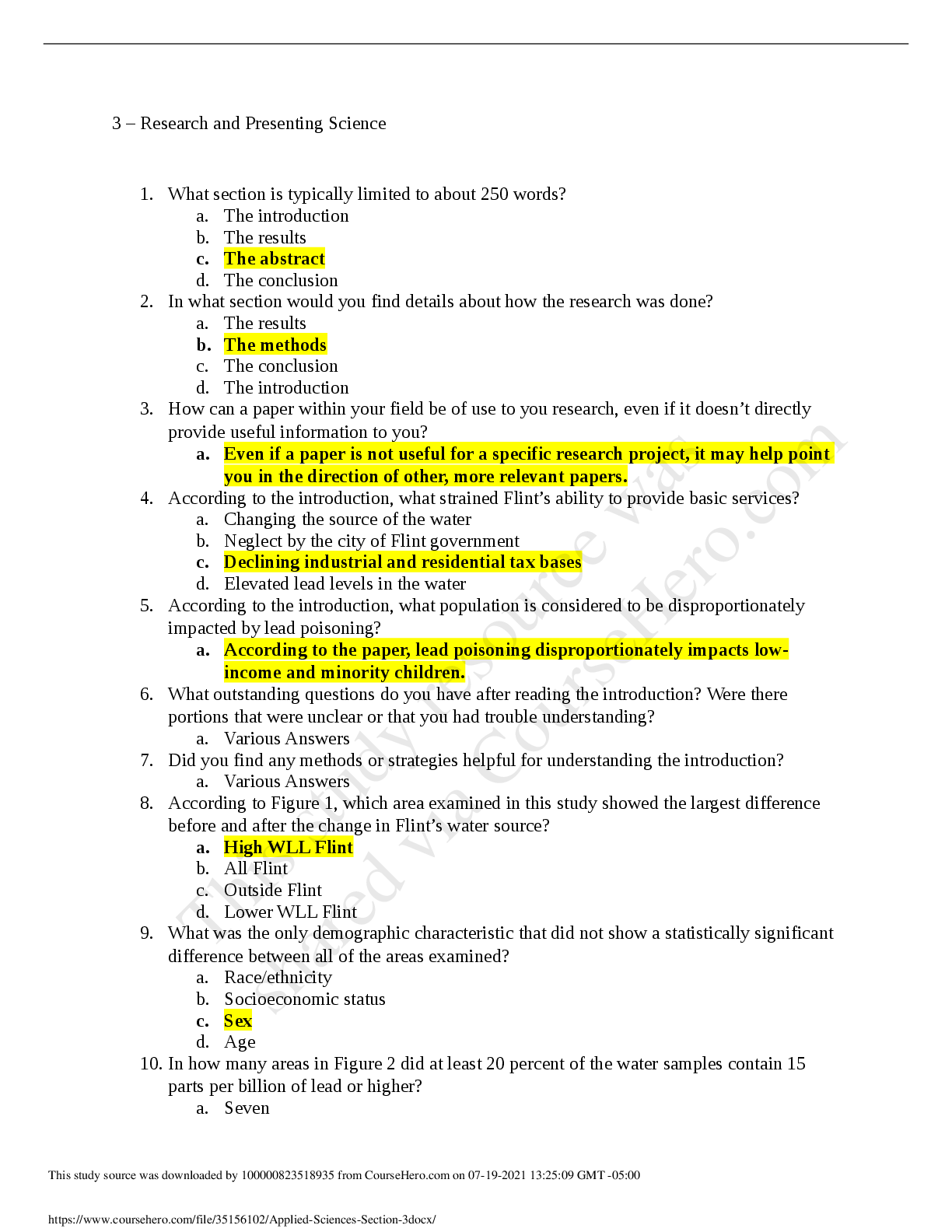
5/19/2019 Flying Weather Midterm: ATSC 113 971/98A Applied Meteorology
https://canvas.ubc.ca/courses/30630/quizzes/108261 1/19
Flying Weather Midterm
Due May 19 at 10pm Points 33 Questions 33
Available May 18 at 5am
...
5/19/2019 Flying Weather Midterm: ATSC 113 971/98A Applied Meteorology
https://canvas.ubc.ca/courses/30630/quizzes/108261 1/19
Flying Weather Midterm
Due May 19 at 10pm Points 33 Questions 33
Available May 18 at 5am May 19 at 10pm 1 day Time Limit 50 Minutes
Attempt History
Attempt Time Score
LATEST Attempt 1 48 minutes 30 out of 33
æ Correct answers are hidden.
Score for this quiz: 30 out of 33
Submitted May 19 at 5:36pm
This attempt took 48 minutes.
Incorrect Incorrect Question 1 0 / 1 pts
Mountain waves can form in the atmosphere if the air is ______ and winds
are _____ .
statically unstable / perpendicular to the mountain range
statically unstable / parallel to the mountain range
statically neutral / parallel to the mountain range
statically stable / parallel to the mountain range
statically stable / perpendicular to the mountain range
Question 2 1 / 1 pts
Which statement is FALSE?5/19/2019 Flying Weather Midterm: ATSC 113 971/98A Applied Meteorology
https://canvas.ubc.ca/courses/30630/quizzes/108261 2/19
CAT often has large horizontal extent
CAT is often found in thunderstorms
CAT often has thin vertical extent
CAT often forms as breaking atmospheric waves
CAT is created with wind shear
Question 3 1 / 1 pts
Obstacle wake turbulence can be expected
downwind of a mountain
to not usually be associated with mountains
upwind of a lake with breaking waves
upwind of a mountain
downwind of a lake with breaking waves
Question 4 1 / 1 pts
This type of ice forms on aircraft flying through clouds or rain where air
temperature is –15 to –20°C. For this type of ice, air pockets are trapped
between the frozen drops, scattering sunlight to make the ice look
white/milky:
Frost5/19/2019 Flying Weather Midterm: ATSC 113 971/98A Applied Meteorology
https://canvas.ubc.ca/courses/30630/quizzes/108261 3/19
Mixed ice
Clear ice
Rime ice
Black ice
Question 5 1 / 1 pts
(LG4a). The most violent stage of a thunderstorm cell, when there are both
up and downdrafts, is:
cumulus
residue
mature
dissipating
cirrus
Question 6 1 / 1 pts
The type of storm that is rotating as a mesocyclone is called a/an
dust devil
mesosphere
airmass thunderstorm5/19/2019 Flying Weather Midterm: ATSC 113 971/98A Applied Meteorology
https://canvas.ubc.ca/courses/30630/quizzes/108261 4/19
supercell
mammatus cloud
Question 7 1 / 1 pts
Which is FALSE? If you flew into a thunderstorm, the convective turbulence
would likely cause your aircraft to:
experience violent shaking
experience intense yawing motions
experience engine failure
experience intense rolling and pitching motions
be violently pushed up and down to different altitudes
Question 8 1 / 1 pts
Which statement is TRUE? The gust front
forms when downburst air hits the ground and spreads out.
is the bottom edge of the downburst.
is what pushes the thunderstorm along.
forms as the outside wall of a multivortex tornado.
is a largescale (synoptic) weather system associated with anticyclones.5/19/2019 Flying Weather Midterm: ATSC 113 971/98A Applied Meteorology
https://canvas.ubc.ca/courses/30630/quizzes/108261 5/19
Question 9 1 / 1 pts
Lightning
is the weather phenomenon most hazardous to aviation
is not usually a hazard to aircraft
causes fuel tanks to explode on modern composite aircraft
is the another word for Pstatic
affects only pilots flying IFR through thunderstorms
Question 10 1 / 1 pts
Which is FALSE? Hail can
break windscreens
accumulate on aircraft causing the aircraft weight to increase
occur outside of the visible thunderstorm cloud
dent the leading edge of aircraft wings
damage aircraft when parked outside on the ground
Question 11 1 / 1 pts
It is safe to fly near a tornado, but only when the tornado intensity is roughly:5/19/2019 Flying Weather Midterm: ATSC 113 971/98A Applied Meteorology
https://canvas.ubc.ca/courses/30630/quizzes/108261 6/19
EF5
(never safe to fly near a tornado)
EF3
EF2
EF4
Question 12 1 / 1 pts
Which raincloud is likely to be most turbulent?
nimbocirrus
altonimbus
cumulonimbus
nimbostratus
nimbofractus
Question 13 1 / 1 pts
Which cloud is NOT associated with mountains?
anabatic cumulus
fumulus
orographic thunderstorms5/19/2019 Flying Weather Midterm: ATSC 113 971/98A Applied Meteorology
https://canvas.ubc.ca/courses/30630/quizzes/108261 7/19
banner
lenticular
Incorrect Incorrect Question 14 0 / 1 pts
If low clouds cover 2/8 of the sky and midlevel clouds (not hidden behind the
low clouds) actually cover 3/8 of the sky, then the coverage of midlevel
clouds would be reported as ___?
3/8.
4/8.
5/8.
2/8.
1/8.
Question 15 1 / 1 pts
Which statement is correct regarding a cloud ceiling for aviation?
No aircraft is allowed to fly above the cloud ceiling.
The altitude of clouds below 20,000 feet altitude that cover less than half of the
sky is a cloud ceiling.
Cloud tops stop rising when they hit the cloud ceiling.5/19/2019 Flying Weather Midterm: ATSC 113 971/98A Applied Meteorology
https://canvas.ubc.ca/courses/30630/quizzes/108261 8/19
To be valid at all locations, cloud ceiling is given as an altitude above mean
sea level.
Cloud ceiling is the height above ground of the lowest layer of clouds reported
as broken or overcast.
Question 16 1 / 1 pts
If someone uses the word “visibility”, with no preceding adjective, to what are
they referring?
Vertical visibility
Overcast
Slant visibility
Oblique visibility
Horizontal visibility
Question 17 1 / 1 pts
Which glyph represents freezing drizzle?5/19/2019 Flying Weather Midterm: ATSC 113 971/98A Applied Meteorology
https://canvas.ubc.ca/courses/30630/quizzes/108261 9/19
glyph d
glyph e
glyph a
glyph g
glyph b
glyph c
glyph i
glyph h
glyph f5/19/2019 Flying Weather Midterm: ATSC 113 971/98A Applied Meteorology
https://canvas.ubc.ca/courses/30630/quizzes/108261 10/19
Question 18 1 / 1 pts
What are the two primary variables which determine whether takeoff and
landing can be VFR or must be IFR?
Ceiling and visibility
Visibility and precipitation
Cloudbase level and cloud coverage
Cloud coverage and visibility
Ceiling and cloud coverage
Question 19 1 / 1 pts
The night is clear and the winds are calm. The most likely type of fog that
would form over land is
steam
radiation
precipitation
convection
advection
Question 20 1 / 1 pts
What aspect of blowing snow would likely be most hazardous to aviation?5/19/2019 Flying Weather Midterm: ATSC 113 971/98A Applied Meteorology
https://canvas.ubc.ca/courses/30630/quizzes/108261 11/19
fast winds
ice accumulation on the aircraft
obscured landmarks
cold temperatures
buildup of static electric charge on the aircraft
Question 21 1 / 1 pts
As you gain altitude, air pressure (Hints: Linear = straight line. Exponential =
curved line.):
increases exponentially
increases linearly
is roughly constant
decreases exponentially
decreases linearly
Question 22 1 / 1 pts
Many light generalaviation airplanes can easily fly to altitudes of 13,000 ft. At
that altitude in an unpressurized aircraft, which symptom would you NOT
likely feel?
dizziness5/19/2019 Flying Weather Midterm: ATSC 113 971/98A Applied Meteorology
https://canvas.ubc.ca/courses/30630/quizzes/108261 12/19
improved coordination
impaired judgement
euphoria
drowsiness
Question 23 1 / 1 pts
For density altitude that is higher than normal, which is FALSE:
airplane engines generate less power
airplane wings get less lift
airplane propellers generate less thrust
airplanes need shorter runways to take off
airplanes cannot fly as high above sea level
Question 24 1 / 1 pts
The wind is 50 km/hour coming from 10° angle relative to the direction the
aircraft is pointing. The crosswind component (km/hour) with respect to the
aircraft is:5/19/2019 Flying Weather Midterm: ATSC 113 971/98A Applied Meteorology
https://canvas.ubc.ca/courses/30630/quizzes/108261 13/19
20
50
0
25
10
Question 25 1 / 1 pts
Which is FALSE? Hazardous wind shear at aerodromes can be caused by:
highpressure centers
fronts5/19/2019 Flying Weather Midterm: ATSC 113 971/98A Applied Meteorology
https://canvas.ubc.ca/courses/30630/quizzes/108261 14/19
boras
chinooks
channeling of winds through valleys
Question 26 1 / 1 pts
When thermals are aligned in rows, they are sometimes visible due to the
cloud streets
KelvinHelmholtz (KH) billows
special 3D glasses that most glider pilots wear
squall lines
arc cloud
Question 27 1 / 1 pts
Two atmospheric layers where average temperature decreases with
increasing altitude are:
stratosphere & mesosphere
troposphere & stratosphere
mesosphere & thermosphere
stratosphere & thermosphere5/19/2019 Flying Weather Midterm: ATSC 113 971/98A Applied Meteorology
https://canvas.ubc.ca/courses/30630/quizzes/108261 15/19
troposphere & mesosphere
Question 28 1 / 1 pts
Consider overcast conditions with fast wind. The static stability that is likely
for these conditions is:
standard
stable
normal
unstable
neutral
Question 29 1 / 1 pts
Which type of turbulence is made by humans, and would not otherwise occur
in nature?
forced
aircraft wake
mechanical
thermal
convective5/19/2019 Flying Weather Midterm: ATSC 113 971/98A Applied Meteorology
https://canvas.ubc.ca/courses/30630/quizzes/108261 16/19
Question 30 1 / 1 pts
Thunderstorms are NOT likely along ____ .
warm fronts
dry lines
occluded fronts
squall lines
cold fronts
Question 31 1 / 1 pts
Widespread stratiform cloud layers (and the associated IFR conditions and
possibly icing in winter) are found relative to which type of surface front?
behind of a cold front
ahead of a warm front
along a cold front
ahead of a cold front
behind a warm front
Question 32 1 / 1 pts
Suppose a 0.5 km thick layer of dry air has a temperature of 0 °C at the top
and 6 °C at the bottom. What is its static stability index, S (°C/km)?5/19/2019 Flying Weather Midterm: ATSC 113 971/98A Applied Meteorology
https://canvas.ubc.ca/courses/30630/quizzes/108261 17/19
4
6
2
2
6
4
Incorrect Incorrect Question 33 0 / 1 pts5/19/2019 Flying Weather Midterm: ATSC 113 971/98A Applied Meteorology
https://canvas.ubc.ca/courses/30630/quizzes/108261 18/19
Air with static stability index of S = 2 blowing over a mountain due to a wind
speed of M = 40 km/hour. If the width of the mountain range is 200 km, then
the Froude number for mountain waves is Fr = ___ .
3
1.0
0.2
2
0.55/19/2019 Flying Weather Midterm: ATSC 113 971/98A Applied Meteorology
https://canvas.ubc.ca/courses/30630/quizzes/108261 19/19
Quiz Score: 30 out of 33
[Show More]





![Recommended document preview for [Answer Key] American Military University GEOG 101 Week 5 Quiz](https://scholarfriends.com/storage/American-Military-University-GEOG-101-Week-5-Quiz.png)







 Charles Herrick - 100 Q&A About Alcoholism & Drug Addiction-Jones and Bartlett Publishers, Inc.png)