MN 551 quiz 1 [2021]
Question 1.
1. A nurse practitioner student is familiarizing herself with the overnight admissions to an acute medical unit of a
university hospital. Which of the following patients would the stu
...
MN 551 quiz 1 [2021]
Question 1.
1. A nurse practitioner student is familiarizing herself with the overnight admissions to an acute medical unit of a
university hospital. Which of the following patients would the student recognize as being least likely to have a
diagnosis of antiphospholipid syndrome in his or her medical history? (Points : 0.4)
A 66-year-old obese male with left-sided hemiplegia secondary to a cerebrovascular accident
A 90-year-old female resident of a long-term care facility who has been experiencing transient ischemic
attacks
A 30-year-old female with a diagnosis of left leg DVT and a pulmonary embolism
A 21-year-old male with a diagnosis of cellulitis and suspected endocarditis secondary to intravenous drug
use
Question 2.
2. Which of the following statements most accurately conveys an aspect of lymphatic system activity? (Points : 0.4)
B and T lymphocyte development begins in the bone marrow and ends in the peripheral lymphoid structures.
B cells and macrophages are released from the bone marrow in their completed state.
Stem cells in the lymph nodes initiate and regulate the process of white cell synthesis.
Leukocytes bypass vascular circulation and are distributed instead by the lymphatic system.
Question 3.
3. A 30-year-old man has spent 5 hours on a cross-country flight seated next to a passenger who has been sneezing
and coughing, and the man has been inhaling viral particles periodically. Which of the following situations would most
likely result in the stimulation of the man's T lymphocytes and adaptive immune system? (Points : 0.4)
Presentation of a foreign antigen by a familiar immunoglobulin
Recognition of a foreign MHC molecule
Recognition of a foreign peptide bound to a self MHC molecule
Cytokine stimulation of a T lymphocyte with macrophage or dendritic cell mediation
Question 4.
4. Following a course of measles, a 5-year-old girl developed scattered bruising over numerous body surfaces and
was diagnosed with immune thrombocytopenic purpura (ITP). As part of her diagnostic workup, blood work was
performed. Which of the following results is most likely to be considered unexpected by the health care team? (Points
: 0.4)
Increased thrombopoietin levels
Decreased platelet count
Normal vitamin K levels
Normal leukocyte levels
Question 5.
5. A 24-year-old woman presents with fever and painful, swollen cervical lymph nodes. Her blood work indicates
neutrophilia with a shift to the left. She most likely has: (Points : 0.4)
A mild parasitic infection
A severe bacterial infection
A mild viral infection
A severe fungal infection
Question 6.
6. A nurse practitioner is providing prenatal care and education for a first-time expectant mother, 22 weeks' gestation,
who has a diagnosis of a sexually transmitted infection. Which of the following statements by the expectant mother
demonstrates an adequate understanding of vertical disease transmission and congenital infections? (Points : 0.4)
“Gonorrhea and chlamydia pose the greatest risks of transmission from mother to child.”
“I know that my baby will need observation for HIV signs and symptoms in the weeks following my delivery.”
“My baby could become infected either across the placenta or during the birth itself.”
“Prophylactic immunization will reduce my baby's chance of being born with an illness.”Question 7.
7. A 16-year-old female has been brought to her primary care nurse practitioner by her mother due to the girl's
persistent sore throat and malaise. Which of the following facts revealed in the girl's history and examination would
lead the nurse practitioner to rule out infectious mononucleosis? (Points : 0.4)
The girl has a temperature of 38.1°C (100.6°F) and has enlarged lymph nodes.
Her liver and spleen are both enlarged.
Blood work reveals an increased white blood cell count.
Chest auscultation reveals crackles in her lower lung fields bilaterally.
Question 8.
8. Which of the following phenomena would be least likely to result in activation of the complement system? (Points :
0.4)
Recognition of an antibody bound to the surface of a microbe
The binding of mannose residues on microbial glycoproteins
Activation of Toll-like receptors (TLRs) on complement proteins
Direct recognition of microbial proteins
Question 9.
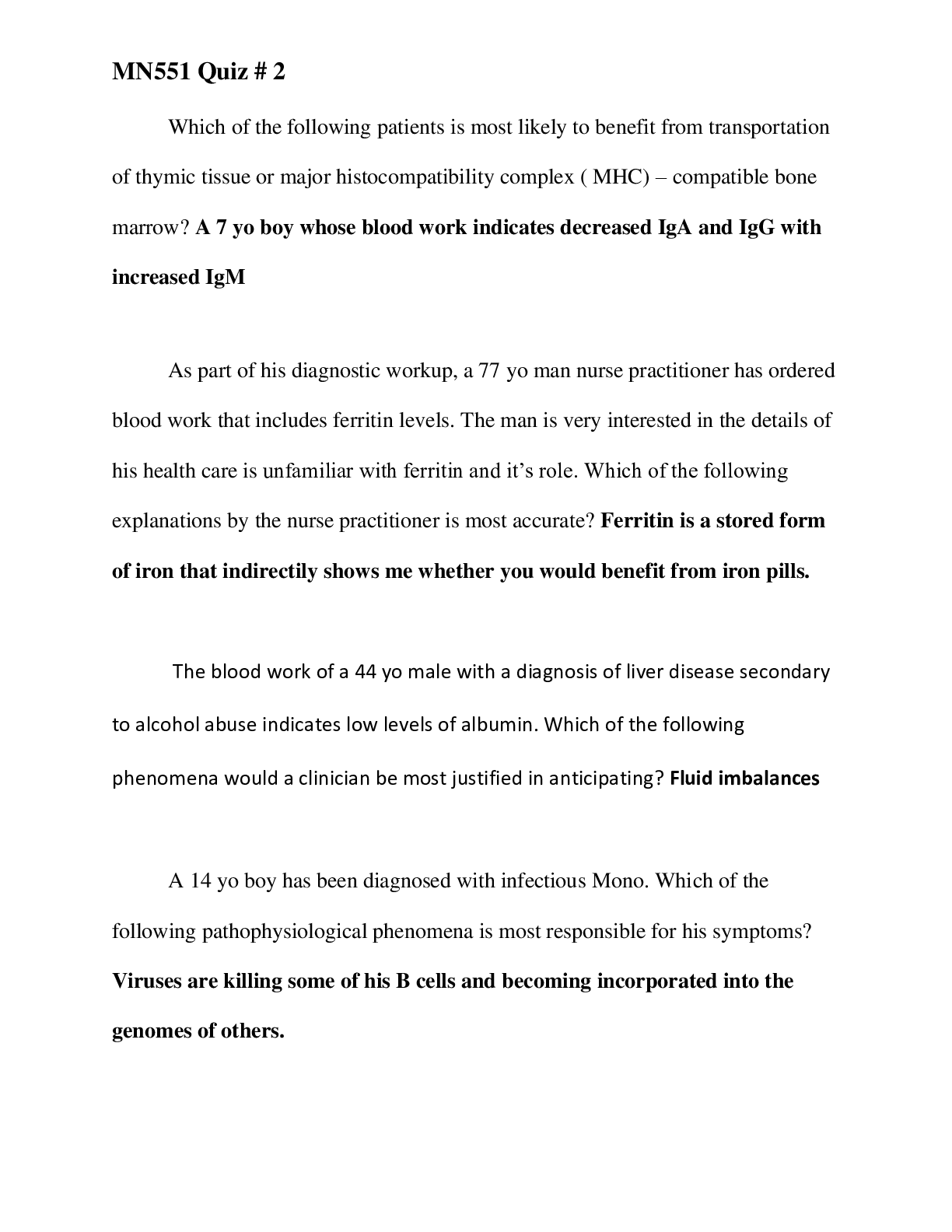
9. Which of the following patients is most likely to benefit from transplantation of thymic tissue or major
histocompatibility complex (MHC)-compatible bone marrow? (Points : 0.4)
A 12-year-old girl with a history of epilepsy and low IgG levels secondary to phenytoin use
A 7-year-old boy whose blood work indicates decreased IgA and IgG with increased IgM
A 6-year-old boy whose pre-B cells are incapable of translation to normal B cells
A 9-year-old girl who has a diagnosis of IgA deficiency
Question 10.
10. A 29-year-old construction worker got a sliver under his fingernail four days ago. The affected finger is now
reddened, painful, swollen, and warm to the touch. Which of the following hematological processes is most likely
occurring in response to the infection? (Points : 0.4)
Proliferation of immature neutrophils
High circulatory levels of myeloblasts
Increased segmented neutrophil production
Phagocytosis by myelocytes
Question 11.
11. The blood work of a 44-year-old male patient with a diagnosis of liver disease secondary to alcohol abuse
indicates low levels of albumin. Which of the following phenomena would a clinician be most justified in anticipating?
(Points : 0.4)
Impaired immune function
Acid-base imbalances
Impaired thermoregulation
Fluid imbalances
Question 12.
12. A 2-year-old girl has had repeated ear and upper respiratory tract infections since she was born. A pediatrician
has determined a diagnosis of transient hypogammaglobulinemia of infancy. What is the physiological origin of the
child's recurrent infections? (Points : 0.4)
Antibody production by plasma cells is compromised because of impaired communication between B and T
cells.
The child had a congenital absence of immunoglobulin G (IgG) antibodies and her body is only slowly
beginning to produce them independently.
The child was born with immunoglobulin A (IgA) and immunoglobulin (IgM) antibodies, suggesting
intrauterine infection.
The child lacks the antigen presenting cells integral to normal B-cell antibody production.Question 13.
13. A 22-year-old female who adheres to a vegan diet has been diagnosed with iron-deficiency anemia. Which of the
following components of her diagnostic blood work would be most likely to necessitate further investigation? (Points :
0.4)
Decreased mean corpuscular volume (MCV)
Decreased hemoglobin and hematocrit
Microcytic, hypochromic red cells
Decreased erythropoietin levels
Question 14.
14. A 66-year-old female patient has presented to the emergency department because of several months of
intermittently bloody stools that has recently become worse. The woman has since been diagnosed with a
gastrointestinal bleed secondary to overuse of nonsteroidal anti-inflammatory drugs that she takes for her arthritis.
The health care team would realize that which of the following situations is most likely? (Points : 0.4)
The woman has depleted blood volume due to her ongoing blood loss.
She will have iron-deficiency anemia due to depletion of iron stores.
The patient will be at risk for cardiovascular collapse or shock.
She will have delayed reticulocyte release.
Question 15.
15. A 60-year-old woman is suspected of having non-Hodgkin lymphoma (NHL). Which of the following aspects of her
condition would help to rule out Hodgkin lymphoma? (Points : 0.4)
Her neoplasm originates in secondary lymphoid structures.
The lymph nodes involved are located in a large number of locations in the lymphatic system.
The presence of Reed-Sternberg cells has been confirmed.
The woman complains of recent debilitating fatigue.
Question 16.
16. A child has been diagnosed with thalassemia. Which of the following other health problems is the child at risk for?
(Points : 0.4)
Hypocoagulation
Iron and ferritin deficiencies
Splenomegaly and hepatomegaly
Neutropenia
Question 17.
17. A tourist presented to a primary care health clinic complaining of malaise, fever, and headache. She has
subsequently been diagnosed with Rocky Mountain spotted fever, a pathology caused by Rickettsiaceae. Which of
the followed statements best captures a characteristic trait of Rickettsiaceae? (Points : 0.4)
They are eukaryotic.
They have both RNA and DNA.
They have a distinct spiral-shaped morphology.
They are neither gram-negative nor gram-positive.
Question 18.
18. A 60-year-old male patient with an acute viral infection is receiving interferon therapy. The nurse practitioner is
teaching the family of the patient about the diverse actions of the treatment and the ways that it differs from other
anti-infective therapies. Which of the following teaching points should the nurse practitioner exclude? (Points : 0.4)
“Interferon can help your father's unaffected cells adjacent to his infected cells produce antiviral proteins that
limit the spread of the infection.”
“Interferon can help limit the replication of the virus that's affecting your father.”
“Interferon helps your father's body recognize infected cells more effectively.”
“Interferon can bolster your father's immune system by stimulating natural killer cells that attack viruses.”Question 19.
19. A nurse practitioner is explaining to a 40-year-old male patient the damage that Mycobacterium tuberculosis could
do to lung tissue. Which of the following phenomena would underlie the nurse practitioner's explanation? (Points :
0.4)
Tissue destruction results from neutrophil deactivation.
Nonspecific macrophage activity leads to pulmonary tissue destruction and resulting hemoptysis.
Macrophages are unable to digest the bacteria, resulting in immune granulomas.
Neutrophils are ineffective against the Mycobacterium tuberculosis antigens.
Question 20.
20. A patient presented to the emergency department of the hospital with a swollen, reddened, painful leg wound and
has been diagnosed with methicillin-resistant Staphylococcus aureus cellulitis. The patient's nurse practitioner has
ordered a complete blood count and white cell differential. Which of the following blood components would the nurse
practitioner most likely anticipate to be elevated? (Points : 0.4)
Basophils
Eosinophils
Platelets
Neutrophils
Question 21.
21. A 14-year-old boy has been diagnosed with infectious mononucleosis. Which of the following pathophysiological
phenomena is most responsible for his symptoms? (Points : 0.4)
The Epstein-Barr virus (EBV) is lysing many of the boy's neutrophils.
Viruses are killing some of his B cells and becoming incorporated into the genomes of others.
The EBV inhibits the maturation of white cells within his peripheral lymph nodes.
The virus responsible for mononucleosis inhibits the maturation of myeloblasts into promyelocytes.
Question 22.
22. A couple who are expecting their first child have been advised by friends to consider harvesting umbilical cord
blood in order to have a future source of stem cells. The couple have approached their nurse practitioner with this
request and are seeking clarification of exactly why stem cells are valuable and what they might expect to gain from
harvesting them. How can the nurse practitioner best respond to the couple's inquiry? (Points : 0.4)
“Stem cells can help correct autoimmune diseases and some congenital defects.”
“Stem cells can be used to regenerate damaged organs should the need ever arise.”
“Stem cells can be used as a source of reserve cells for the entire blood production system.”
“Stem cells can help treat some cancers and anemias, but they must come from your child himself or
herself.”
Question 23.
23. A 40-year-old woman who experiences severe seasonal allergies has been referred by her family physician to an
allergist for weekly allergy injections. The woman is confused as to why repeated exposure to substances that set off
her allergies would ultimately benefit her. Which of the following phenomena best captures the rationale for allergy
desensitization therapy? (Points : 0.4)
Repeated exposure to offending allergens binds the basophils and mast cells that mediate the allergic
response.
Exposure to allergens in large, regular quantities overwhelms the IgE antibodies that mediate the allergic
response.
Repeated exposure stimulates adrenal production of epinephrine, mitigating the allergic response.
Injections of allergens simulate production of IgG, which blocks antigens from combining with IgE.
Question 24.
24. A nurse practitioner is teaching her colleagues about the role of cytokines in a variety of pathologies. Which of the
following teaching points best captures an aspect of the functions and nature of cytokines? (Points : 0.4) “A particular cytokine can have varied effects on different systems, a fact that limits their therapeutic use.”
“Cytokine production is constant over time, but effects are noted when serum levels cross a particular
threshold.”
“Most cytokines are produced by granular leukocytes, and different cells are capable of producing the same
cytokine.”
“Cytokine actions are self-limiting in that activation of one precludes activation of other cytokines with similar
actions.”
Question 25.
25. As part of his diagnostic workup, a 77-year-old man's nurse practitioner has ordered blood work that includes
ferritin levels. The man is very interested in the details of his health care and is unfamiliar with ferritin and its role. He
asks his nurse practitioner to explain the significance of it and the rationale for testing it. Which of the following
explanations by the nurse practitioner is most accurate? (Points : 0.4)
“Ferritin is the activated and usable form of iron that your red blood cells can use to transport oxygen.”
“Ferritin is a stored form of iron that indirectly shows me whether you would benefit from iron pills.”
“Ferritin is a protein-iron complex that allows your red blood cells to make use of the iron that you consume
in your diet.”
“Ferritin is the form of iron that is transported in your blood plasma to the red blood cells that need it.”A 30-year-old man has spent 5 hours on a cross-country flight seated next to a
passenger who has been sneezing and coughing, and the man has been inhaling viral
particles periodically. Which of the following situations would most likely result in the
stimulation of the man's T lymphocytes and adaptive immune system? (Points : 0.4)
Presentation of a foreign antigen by a familiar immunoglobulin
Recognition of a foreign MHC molecule
Recognition of a foreign peptide bound to a self MHC molecule
Cytokine stimulation of a T lymphocyte with macrophage or dendritic cell mediation
Question 2.2. A 22-year-old female who adheres to a vegan diet has been diagnosed
with iron-deficiency anemia. Which of the following components of her diagnostic
blood work would be most likely to necessitate further investigation? (Points : 0.4)
Decreased mean corpuscular volume (MCV)
Decreased hemoglobin and hematocrit
Microcytic, hypochromic red cells
Decreased erythropoietin levels
Question 3.3. A child has been diagnosed with thalassemia. Which of the
following other health problems is the child at risk for? (Points : 0.4)
Hypocoagulation
Iron and ferritin deficiencies
Splenomegaly and hepatomegaly
Neutropenia
Question 4.4. The blood work of a 44-year-old male patient with a diagnosis
of liver disease secondary to alcohol abuse indicates low levels of albumin.
Which of the following phenomena would a clinician be most justified in
anticipating? (Points : 0.4)
Impaired immune function
Acid-base imbalances
Impaired thermoregulation Fluid imbalances
Question 5.5. As part of his diagnostic workup, a 77-year-old man's
nurse practitioner has ordered blood work that includes ferritin levels.
The man is very interested in the details of his health care and is
unfamiliar with ferritin and its role. He asks his nurse practitioner to
explain the significance of it and the rationale for testing it. Which of the
following explanations by the nurse practitioner is most accurate?
(Points : 0.4)
“Ferritin is the activated and usable form of iron that your red blood cells can
use to transport oxygen.”
“Ferritin is a stored form of iron that indirectly shows me whether you would
benefit from iron pills.”
“Ferritin is a protein-iron complex that allows your red blood cells to make use
of the iron that you consume in your diet.”
“Ferritin is the form of iron that is transported in your blood plasma to the red
blood cells that need it.”
Question 6.6. A 24-year-old woman presents with fever and painful,
swollen cervical lymph nodes. Her blood work indicates neutrophilia
with a shift to the left. She most likely has: (Points : 0.4)
A mild parasitic infection
A severe bacterial infection
A mild viral infection
A severe fungal infection
Question 7.7. A nurse practitioner is providing prenatal care and
education for a first-time expectant mother, 22 weeks' gestation,
who has a diagnosis of a sexually transmitted infection. Which of
the following statements by the expectant mother demonstrates an
adequate understanding of vertical disease transmission and
congenital infections? (Points : 0.4) “Gonorrhea and chlamydia pose the greatest risks of transmission from
mother to child.”
“I know that my baby will need observation for HIV signs and symptoms
in the weeks following my delivery.”
“My baby could become infected either across the placenta or during the
birth itself.”
“Prophylactic immunization will reduce my baby's chance of being born
with an illness.”
Question 8.8. A 71-year-old male patient with a history of
myocardial infarction and peripheral vascular disease has
been advised by his nurse practitioner to begin taking 81 mg
aspirin once daily. Which of the following statements best
captures an aspect of the underlying rationale for the nurse
practitioner's suggestion? (Points : 0.4)
Platelet aggregation can be precluded through inhibition of prostaglandin
production by aspirin.
Aspirin helps to inhibit adenosine disphosphate (ADP) action and
minimizes platelet plug formation.
Aspirin can reduce unwanted platelet adhesion by inhibiting
thromboxane A2 (TXA2) synthesis.
Aspirin inhibits the conversion of fibrinogen into fibrin and consequent
platelet plug formation.
Question 9.9. A 29-year-old construction worker got a
sliver under his fingernail four days ago. The affected
finger is now reddened, painful, swollen, and warm to the
touch. Which of the following hematological processes is
most likely occurring in response to the infection?
(Points : 0.4)
Proliferation of immature neutrophils
High circulatory levels of myeloblasts
Increased segmented neutrophil production
Phagocytosis by myelocytesQuestion 10.10. Sputum samples from a patient with
pneumonia contain an infective agent that has a
peptidoglycan cell wall, expresses endotoxins,
replicates readily in broth and on agar, grows in
clusters, has pili, and does not stain when exposed to
crystal violet. This pneumonia is most likely: (Points :
0.4)
Chlamydial
Viral
Mycoplasmal
Bacterial
Question 11.11. A 16-year-old female has been
brought to her primary care nurse practitioner by
her mother due to the girl's persistent sore throat and
malaise. Which of the following facts revealed in
the girl's history and examination would lead the
nurse practitioner to rule out infectious
mononucleosis? (Points : 0.4)
The girl has a temperature of 38.1°C (100.6°F) and has enlarged
lymph nodes.
Her liver and spleen are both enlarged.
Blood work reveals an increased white blood cell count.
Chest auscultation reveals crackles in her lower lung fields
bilaterally.
Question 12.12. A 2-year-old girl has had
repeated ear and upper respiratory tract
infections since she was born. A pediatrician has
determined a diagnosis of transient
hypogammaglobulinemia of infancy. What is the
physiological origin of the child's recurrent
infections? (Points : 0.4) Antibody production by plasma cells is compromised because of
impaired communication between B and T cells.
The child had a congenital absence of immunoglobulin G (IgG)
antibodies and her body is only slowly beginning to produce them
independently.
The child was born with immunoglobulin A (IgA) and
immunoglobulin (IgM) antibodies, suggesting intrauterine infection.
The child lacks the antigen presenting cells integral to normal B�cell antibody production.
Question 13.13. A couple who are expecting
their first child have been advised by friends
to consider harvesting umbilical cord blood in
order to have a future source of stem cells.
The couple have approached their nurse
practitioner with this request and are seeking
clarification of exactly why stem cells are
valuable and what they might expect to gain
from harvesting them. How can the nurse
practitioner best respond to the couple's
inquiry? (Points : 0.4)
“Stem cells can help correct autoimmune diseases and some
congenital defects.”
“Stem cells can be used to regenerate damaged organs should
the need ever arise.”
“Stem cells can be used as a source of reserve cells for the
entire blood production system.”
“Stem cells can help treat some cancers and anemias, but they
must come from your child himself or herself.”
Question 14.14. A patient presented to the
emergency department of the hospital with
a swollen, reddened, painful leg wound
and has been diagnosed with methicillin-resistant Staphylococcus aureus cellulitis.
The patient's nurse practitioner has ordered
a complete blood count and white cell
differential. Which of the following blood
components would the nurse practitioner
most likely anticipate to be elevated?
(Points : 0.4)
Basophils
Eosinophils
Platelets
Neutrophils
Question 15.15. A tourist presented to a
primary care health clinic complaining
of malaise, fever, and headache. She has
subsequently been diagnosed with
Rocky Mountain spotted fever, a
pathology caused by Rickettsiaceae.
Which of the followed statements best
captures a characteristic trait of
Rickettsiaceae? (Points : 0.4)
They are eukaryotic.
They have both RNA and DNA.
They have a distinct spiral-shaped morphology.
They are neither gram-negative nor gram-positive.
Question 16.16. A 23-year-old man
has received a recent diagnosis of
appendicitis following 24 hours of
acute abdominal pain. The nurse
practitioner providing care for the
man is explaining that while it is
unpleasant, the inflammation of his
appendix is playing a role in his body's fight against the underlying
infectious process. Which of the
following teaching points should the
nurse practitioner eliminate from his
teaching for the patient? (Points :
0.4)
“Inflammation can help to remove the body tissue cells
that have been damaged by infection.”
“Inflammation will start your body on the path to
growing new, healthy tissue at the site of infection.
“Inflammation helps your body to produce the right
antibodies to fight the infection.”
“Inflammation ultimately aids in eliminating the initial
cause of the cell injury in your appendix.”
Question 17.17. A 60-year-old
male patient with an acute viral
infection is receiving interferon
therapy. The nurse practitioner is
teaching the family of the patient
about the diverse actions of the
treatment and the ways that it
differs from other anti-infective
therapies. Which of the following
teaching points should the nurse
practitioner exclude? (Points : 0.4)
“Interferon can help your father's unaffected cells
adjacent to his infected cells produce antiviral proteins that
limit the spread of the infection.”
“Interferon can help limit the replication of the virus
that's affecting your father.”
“Interferon helps your father's body recognize infected
cells more effectively.”
“Interferon can bolster your father's immune system
by stimulating natural killer cells that attack viruses.”Question 18.18. A nurse
practitioner is teaching her
colleagues about the role of
cytokines in a variety of
pathologies. Which of the
following teaching points best
captures an aspect of the
functions and nature of
cytokines? (Points : 0.4)
“A particular cytokine can have varied effects on
different systems, a fact that limits their therapeutic
use.”
“Cytokine production is constant over time, but
effects are noted when serum levels cross a particular
threshold.”
“Most cytokines are produced by granular
leukocytes, and different cells are capable of producing
the same cytokine.”
“Cytokine actions are self-limiting in that activation
of one precludes activation of other cytokines with
similar actions.”
Question 19.19. Following a
course of measles, a 5-year�old girl developed scattered
bruising over numerous body
surfaces and was diagnosed
with immune
thrombocytopenic purpura
(ITP). As part of her
diagnostic workup, blood
work was performed. Which
of the following results is
most likely to be considered
unexpected by the health care
team? (Points : 0.4) Increased thrombopoietin levels
Decreased platelet count
Normal vitamin K levels
Normal leukocyte levels
Question 20.20. A patient
has been admitted to an
inpatient medical unit of a
hospital with an acute viral
infection. The health care
team providing care for the
patient would recognize
which of the following
statements as an accurate
description of the role of
viruses in human
infections? (Points : 0.4)
Viruses have limited or absent genetic material
of their own.
Some viruses are capable of transforming
normal host cells into malignant cells.
Viruses are often implicated in cases of
transmissible neurodegenerative disease.
Viruses require stimulation after a latent period
before they are able to produce symptoms.
Question 21.21. Which
of the following patients
is most likely to benefit
from transplantation of
thymic tissue or major
histocompatibility
complex (MHC)-
compatible bone
marrow? (Points : 0.4) A 12-year-old girl with a history of epilepsy
and low IgG levels secondary to phenytoin use
A 7-year-old boy whose blood work indicates
decreased IgA and IgG with increased IgM
A 6-year-old boy whose pre-B cells are
incapable of translation to normal B cells
A 9-year-old girl who has a diagnosis of IgA
deficiency
Question 22.22. A 40-
year-old woman who
experiences severe
seasonal allergies has
been referred by her
family physician to an
allergist for weekly
allergy injections. The
woman is confused as
to why repeated
exposure to
substances that set off
her allergies would
ultimately benefit her.
Which of the
following phenomena
best captures the
rationale for allergy
desensitization
therapy? (Points : 0.4)
Repeated exposure to offending allergens
binds the basophils and mast cells that mediate
the allergic response.
Exposure to allergens in large, regular
quantities overwhelms the IgE antibodies that
mediate the allergic response.
Repeated exposure stimulates adrenal
production of epinephrine, mitigating the allergic response.
Injections of allergens simulate production
of IgG, which blocks antigens from combining
with IgE.
Question 23.23. A
66-year-old female
patient has
presented to the
emergency
department because
of several months of
intermittently
bloody stools that
has recently become
worse. The woman
has since been
diagnosed with a
gastrointestinal
bleed secondary to
overuse of
nonsteroidal anti�inflammatory drugs
that she takes for
her arthritis. The
health care team
would realize that
which of the
following situations
is most likely?
(Points : 0.4)
The woman has depleted blood volume
due to her ongoing blood loss.
She will have iron-deficiency anemia due
to depletion of iron stores.
The patient will be at risk for
cardiovascular collapse or shock. She will have delayed reticulocyte
release.
Question 24.24. A
44-year-old female
patient presents to
the emergency
department with
abnormal bleeding
and abdominal pain
that is later
attributed to
gallbladder disease.
Which of the
following diagnoses
would the medical
team be most
justified in
suspecting as a
cause of the
patient's bleeding?
(Points : 0.4)
Calcium deficiency
Vitamin K deficiency
Hemophilia B
Idiopathic ITP
Question 25.25.
A 60-year-old
woman is
suspected of
having non�Hodgkin
lymphoma (NHL).
Which of the
following aspects
of her condition
would help to rule
out Hodgkin
lymphoma?
(Points : 0.4)
Her neoplasm originates in secondary lymphoid structures.
The lymph nodes involved are located in
a large number of locations in the lymphatic
system.
The presence of Reed-Sternberg cells
has been confirmed.
The woman complains of recent
debilitating fatigue
[Show More]
![Preview of MN 551 quiz 1 [2021]](https://scholarfriends.com/storage/MN 551 quiz 1.png)

![Preview of MN 551 Unit 9 Quiz [2021]](https://scholarfriends.com/storage/MN 551 Unit 9 Quiz.png)
![Preview of MN551 Quiz 2 [2021]](https://scholarfriends.com/storage/MN551 Quiz 2.png)
![Preview of MN551 midterm [2021]](https://scholarfriends.com/storage/MN551 midterm.png)










.png)