Chapter 11: Dealing with Competition
GENERAL CONCEPT QUESTIONS
Multiple Choice
1. Michael Porter has identified five forces that determine the intrinsic long-run
attractiveness of a market or market segment. Which of
...
Chapter 11: Dealing with Competition
GENERAL CONCEPT QUESTIONS
Multiple Choice
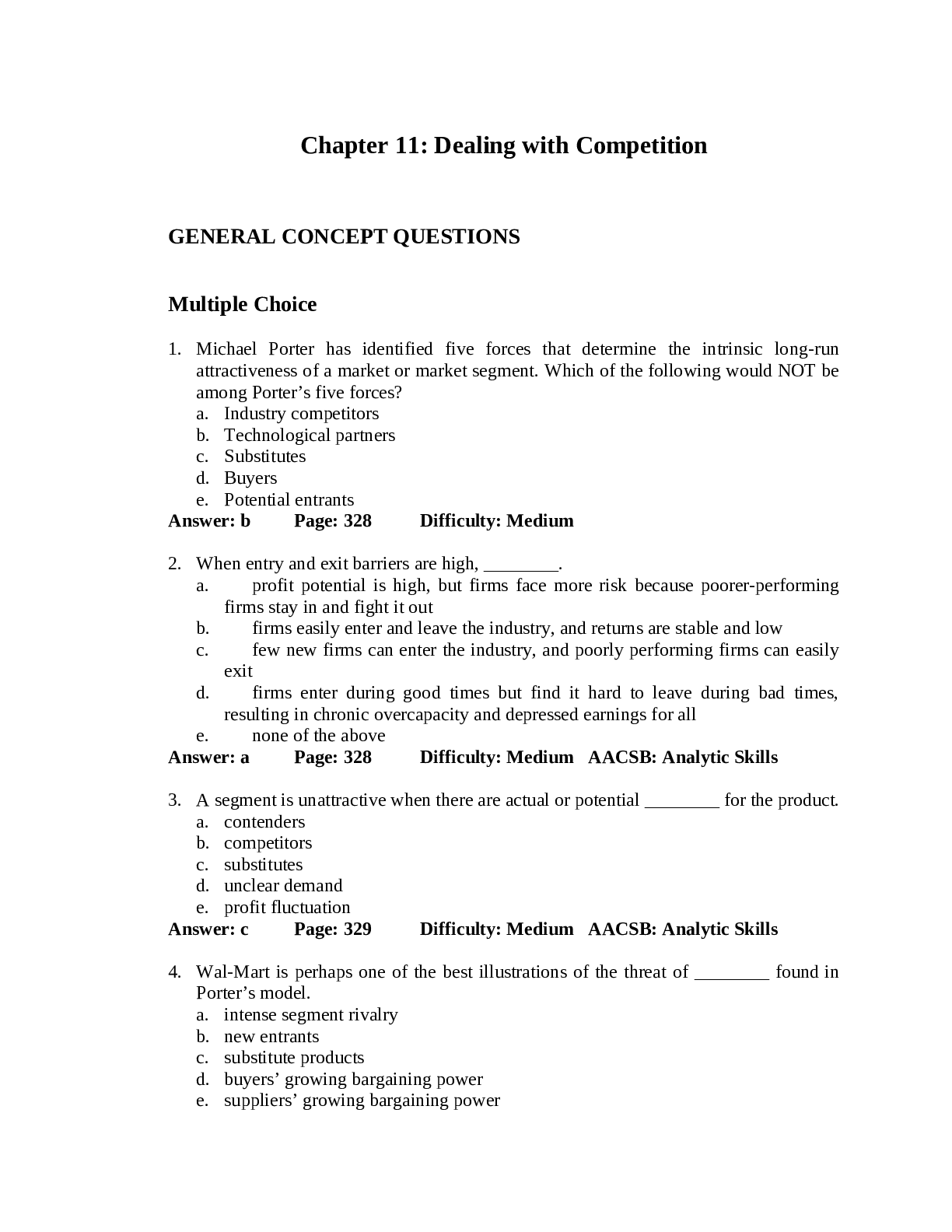
1. Michael Porter has identified five forces that determine the intrinsic long-run
attractiveness of a market or market segment. Which of the following would NOT be
among Porter’s five forces?
a. Industry competitors
b. Technological partners
c. Substitutes
d. Buyers
e. Potential entrants
Answer: b Page: 328 Difficulty: Medium
2. When entry and exit barriers are high, ________.
a. profit potential is high, but firms face more risk because poorer-performing
firms stay in and fight it out
b. firms easily enter and leave the industry, and returns are stable and low
c. few new firms can enter the industry, and poorly performing firms can easily
exit
d. firms enter during good times but find it hard to leave during bad times,
resulting in chronic overcapacity and depressed earnings for all
e. none of the above
Answer: a Page: 328 Difficulty: Medium AACSB: Analytic Skills
3. A segment is unattractive when there are actual or potential ________ for the product.
a. contenders
b. competitors
c. substitutes
d. unclear demand
e. profit fluctuation
Answer: c Page: 329 Difficulty: Medium AACSB: Analytic Skills
4. Wal-Mart is perhaps one of the best illustrations of the threat of ________ found in
Porter’s model.
a. intense segment rivalry
b. new entrants
c. substitute products
d. buyers’ growing bargaining power
e. suppliers’ growing bargaining power
Part 4: Building Strong Brands
Answer: d Page: 329 Difficulty: Hard AACSB: Reflective Thinking
Chapter 11: Dealing with Competition
5. A segment is unattractive if the company’s suppliers are able to raise prices or reduce
quantity supplied. Which of the following is the best illustration of the threat of
suppliers’ growing bargaining power?
a. Wal-Mart has almost no competitors in its marketspace.
b. Oil companies must purchase a significant amount of their product from OPEC.
c. McDonald’s is the largest fast-food franchise and is still growing.
d. The U.S. Post Office has merged package operations with FedEx.
e. Sears unsuccessfully attempted to compete with Wal-Mart and Kmart.
Answer: b Page: 329 Difficulty: Hard AACSB: Reflective Thinking
6. A(n) ________ is a group of firms that offer a product or class of products that are
close substitutes for one another.
a. industry
b. cartel
c. cooperative
d. monopoly
e. demand field
Answer: a Page: 330 Difficulty: Easy AACSB: Analytic Skills
7. Using the market approach, ________ are companies that satisfy the same customer
need.
a. partners
b. competitors
c. entrepreneurs
d. innovators
e. followers
Answer: b Page: 330 Difficulty: Medium
8. A group of firms following the same strategy in a given target market is called a(n)
________.
a. cartel
b. cabal
c. cooperative
d. informal alliance
e. strategic group
Answer: e Page: 330 Difficulty: Easy AACSB: Analytic Skills
9. An example of a strategic group in the appliance industry would be one where
________.
a. there is a large franchised dealer system
b. a common promotional theme is used
c. competitors have broad lines, medium manufacturing costs, low service
responsibility, and low prices
d. multinational operations are mandated
e. there is a value orientation rather than a cost orientation
Answer: c Page: 330 Difficulty: Medium AACSB: Reflective Thinking
[Show More]