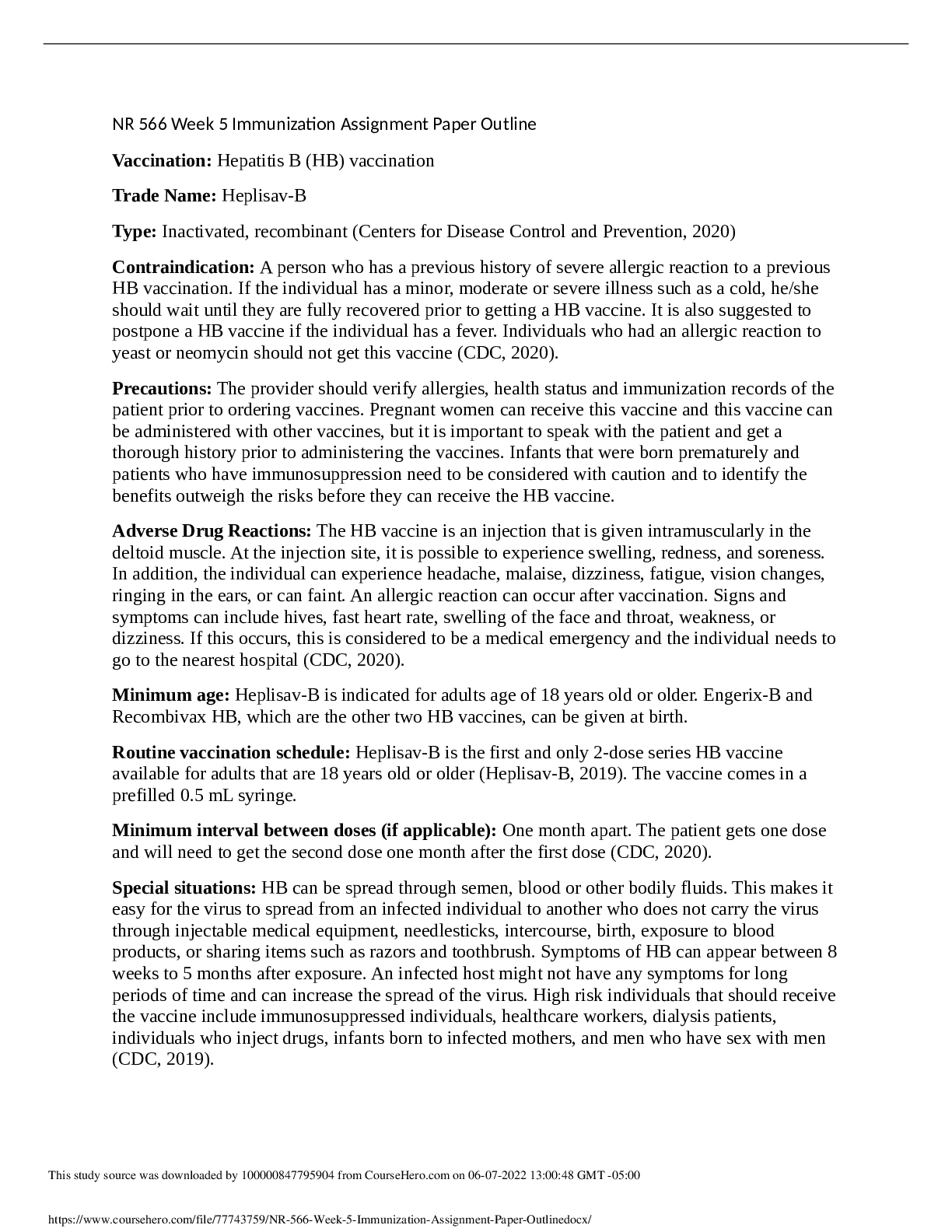
SOAP Note: Urinary Tract Infection
Identifying Data and Chief Complain
A 20-year-old female single and Hispanic patient comes to the clinic complaining of urgency and intermittent flow and “pain, burning, fever, bl
...
SOAP Note: Urinary Tract Infection
Identifying Data and Chief Complain
A 20-year-old female single and Hispanic patient comes to the clinic complaining of urgency and intermittent flow and “pain, burning, fever, blood in urine and low back pain”. She’s describes the pain and burning as moderate (4) when the symptoms started yesterday morning with “spots of bleeding in the toilet paper” and the pain progress to severe (7) in the afternoon with “a lot of red bleeding”. The patient refers that she went to the ER the in the evening and they administered IV fluids and Toradol I/M for pain. CBC and U/A tests were performed.
Patient says that the pain improved, but all symptoms came back after few hours. No medications were prescribed for home.
Subjective Symptoms
1. “Progressive and intense pain in low abdomen.”
2. The pain is associated with “burning, fever, chills and blood in urine.”
Subjective Data
Past medical history (PMH): Patient refers frequent migraines and a hiatal hernia. Patient refers no appetite or weight changes. No other chronic diseases reported.
Family history: Her mother is a 46-year-old woman with migraines and hiatal hernia history. Mother went under a surgery three weeks ago (lipoma “golf ball size” in left axilla}, no other chronic diseases reported. Her father is a 54-year-old man with no history of chronic diseases. Patient’s brother is a 22-year-old man with no history chronic diseases. Grandmother, from mother’s side, is alive and has hypertension, diabetes mellitus and history of urinary stones. . Grandfather from mother’s side, had an open heart surgery after a myocardial infarction ten years ago, he doesn’t has other chronic diseases. She doesn’t have knowledge about her other grandparents from father’s side health, both are alive.
Past social history (PSH): The patient doesn’t smoke or drink alcohol. She’s Catholic. The patient works part-time in a pizzeria five hours/three days a week. She study the sophomore year at University of Puerto Rico, Carolina Campus. She goes to the gym three or four times a week and the others days she “walks a lot at the university”. She states that her diet is high in protein and fiber, low in carbohydrates and includes lactate: milk, cheese and butter.
Immunization: All vaccines are up to date including Human Papilloma Virus, Varicella and Influenza (two months ago).
Allergies: No known allergies (NKA).
Surgical history: Never been submitted to a surgery.
Medication history: Patient refers that her gastroenterologist prescribed her Protonix (one a day
½ hour before breakfast) and Carafate (one cap) with each meal every day. She’s refers that “I never skip a dose”.
Subjective Review of Systems
Constitutional: Patient indicates she has fever, no chills, no weight changes and no fatigue. Skin: She indicates that doesn’t have lessions, acne dry skin, pruritus, nipple discharges, no nodules, no new moles, no dry hair and no eczema.
HEENT: She indicates no hear difficulty or tinitus, no congestion, no dental or swallowing problems and no vision problems with eyeglasses.
Respiratory: She indicates that doesn’t have rinhitis, dysnea, hemoptysis, cough or secretions. Gastrointestinal: She reports a hiatal hernia, no abdominal pain, no changes in appetite or weight loss, no changes in elimination frequency or consistency.
Cardiovascular: She indicates that doesn’t have edema, tachycardia, bradycardia, chestmapin, orthopnea or palpitations.
Gastrointestinal: She refers that she has an hiatal hernia, but doesn’t have apettite or weight changes, no abdominal pain, normal bowel movements and elimination, no indigestion or heart burn.
Genitourinary: She indicates that has burning, hematuria, dysuria and pain in the low abdomen. She indicates that doesn’t have genital lesions, no vaginal discharges or bleedings and that has a normal menstrual cycles every 26-28 days. She indicates that doen’t has past or present STD. Musculoskeletal: Patient indicates she doen’t have myalgias, any difficult to walk, no fractures or cramps.
Neurologic: She refers frequent migraines, no dizziness, no disorientation, no involuntary movements, no numbness or tingling, no anxiety or depression.
Hematologic: She indicates that doesn’t has for easy bruising, no nose or gums bleeding, no rectal or abnormal vaginal bleeding.
Endocrine: She indicates that doesn’t has hirsutism, mood changes, cold intolerance or mood changes.
Allergic: She indicates no allergies; no frequent colds or urticarial.
Objective Data (Physical Examination)
General appearance: Patient looks in shape and walks without difficulty. She has rictus of pain in her face. Patient is oriented in person, place, and time. Clothing is appropriate and it’s clean. Her height is 5 ft +3 in and weight is 125 pounds. Her BMI = 22.7/normal. Even though she was in pain, she was alert and responsive.
Vital signs: Blood pressure: 100/64 mmHg/normal. Oral temperature: 100.4 ˚F. Pulse: 105 beats per minutes. Respiration: 19 breaths per minute. Saturation of O2: 99%. Pain level: 8/10 (sliding scale).
Skin: The skin is intact; pink, clean, moisturize and with a healthy appearance. Turgor is good and no presence of scars, dryness, stretch marks, rash, lesions, acne or cysts were observed and/or palpate. Piercings in ears and umbilicus, no tattoos. Nails with longitudinal stretch marks and no presence of onychomycosis.
HEENT: Head: Patient with clean and normal hair distribution, implantation and quality in scalp. Palpating the skull, there is no presence of deformity or touch lumps parietal, occipital and temporal bones. The patient feels no pain reacts to pressure in the area of mastoid process.
Temporomandibular joint is palpable and symmetric, prompted the patient to clench her teeth and makes this action without any difficulty. The temporal artery is palpable and no evidence of any abnormality to the touch. Configuration and general appearance of the skull are observed normal. Face: Is inspected and it has a normal aspect and configuration. Her face is oval and eyes and ears are symmetrical. No presence of furrows or wrinkles in the skin of the face, has no marks or scars, nor acne or eczema. Reflexes and movements of the facial muscles are normal, no presence of involuntary movements of the eyes, mouth or cheeks. The facial skin is warm to the touch, it is pink and good turgor. The frontal sinuses, maxillary, ethmoid and sphenoid palpable, the patient reported feeling no discomfort or pain on pressure and percussion. Eyes: Eyebrows and eye lashes have good distribution and implantation. No eczema, flakes or dermatitis observed. Pupils
are equal and rounds with normal contraction and dilatation (accommodation). Eyes movements are normal and symmetrical to the face with no presence of exudate, redness or other findings that could suggest any disease. She uses eye glasses (myopia and astigmatism), no contact lenses.
Ears: have symmetry and not abnormal finds were noted at inspection and palpation. No presence of redness or discharges were observed at external and internal inspection. Nose: Looks normal and symmetric in face with no deviation of the bridge. No sensitivity or pain at palpation. No abnormal findings in the nostrils and nose interior, without rhinitis. Mouth and Throat.: Lips are pink, moisturized and have symmetry with the rest of the face. Teeth are completed, the tongue is pink. Oral mucosa is intact, no presence of gingivitis or aphtous. No exudate or redness is observed in the uvula and tonsils area during the physical examination. Neck: Presents a normal symmetry. The head movements are evaluated; up-down, left-right, front-back and performs with ease and range of motion. Lymph nodes are examined and palpable, two were find with an approximate 1.5 cm in diameter, painful and not attached to the deeper layers in the left and right cervical lymph node chain. Also in the neck, right anterior, a volume increase of 2 cm nodular observed. The thyroid gland is examined and has no presence of hypertrophy. The trachea is inspected and palpated, movement is normal and not findings of stiffness or obstruction. Godet sign isn’t observed.
Respiratory: Inspection begins at the front and back of the chest, both areas look normal. The skin color is even, without scars or alterations. Suprasternal retractions are not observed.
Respiratory movements are counted. The patient presents RF-19. The patient reported no pain during the superficial and deep palpation, the skin is warm to the touch and with elasticity.
Thoracic expandability is verified by performing the maneuver base and vertex, no abnormal findings. Fremitus is not present. There is no evidence of accumulation of liquids or gases during percussion posterior and anterior part of the chest. The supraclavicular region is ausculted and
respiratory sounds are normal. Lungs were heard at the back of the chest, asking the patient to cough. The lungs are clear to auscultation on bilateral bases without rhonchi, rales, or wheezing. The chest raises symmetrically, no sign of distress, and accessory muscle used.
Axilla: No palpable nodules (bilaterally).
Cardiovascular: Neck: The jugular veins are inspected, the carotid pulse is heard, no evidence of impairment. Pulses are regular. No JVD observed. Heart: Regular rhythm and the heart rate is 105/min probably caused by the moderate fever and pain. Spotlights the aortic, pulmonary and tricuspid are heard, no abnormal heart sounds are find. No murmurs found. The upper and lower extremities are inspected, no presence of edema.
Abdomen: Patient has a flat abdomen, follows respiratory movements and coughing fits regularly. Abdomen has no visible or palpable hernia, stretch marks, presence of collateral circulation, lesions and/or surgeries. Bowel sounds present at auscultation (9/min). No hepatomegaly, no distension, no hyper bloat or hypersensitivity at percussion and palpation. No painful on palpation superficially or deep, is soft and non-tender to palpation.
Genitourinary: No abnormal findings in palpation and percussion. Patient has hypersensitivity and moderate pain at pressure in the hypogastria area and in the renal points at pressure. The bilateral flanks were negative to palpation and to percussion.
Genitalia (Feminine Genitalia): Menarche at 13 years old. LMP: April 27, 2015. Gaba: 0, Para: 0. No discharges or any abnormality found during the physical examination. Patient sexually active. She’s under oral contraceptives. Inguinal area: No lymphadenopathy, no inguinal hernia noted.
Peripheral/vascular (Extremities): No evidence of edema in the upper and lower extremities or vascular spiders are observed. They are warm, without pain or deformities. Range of motion and strength are intact. Patient ambulates without difficulty. No presence of arm or leg pain during
palpation. Femoral, popliteal, posterior tibia and dorsal pedis pulses are presents. No abnormal findings. Hair distribution on lower extremities is not observed; patient’s legs are shaved.
Central Nervous System: Neurologic assessment is performed to the XII cranial nerves. No deviations or abnormalities are found.
Rectal: No internal or external warts or hemorrhoids were observed or palpated during the physical assessment.
Musculoskeletal: The patient has a normal gait and posture. Her jaws open and close normally. No deformations are observed in the bones of the skull and face. Scapular and pelvic girdles are symmetrical and shoulders and hips are at the same level. The spine has no visible deviations. The arms and legs are observed normal, keep long and proper proportion in relation to your body.
No swelling or redness is observed in the joints. The arc of active and passive motion is conserved in all joints. The patient reported no pain to the superficial and deep palpation of the spinous processes, as well as the joints, there is no limitation of movement or presence of inflammation.
The strength and muscle tone of the patient are preserved. The patient reported no pain, cramps and has had no presence of contractures. The shape of the bones, as well as the longitudinal axis are preserved. Patient has not suffered from fractures. There is no evidence of inflammation or edema in the soft tissues. No point of tenderness to palpation along the entire spine.
Diagnostic Studies (Laboratories)
CBC: Moderate leukocytes. U/A: cloudy with many bacteria.
Diagnosis
UTI/Acute Hemorrhagic Cystitis: According to McCance, Huether, Bashers and Rote (2010), UTI is an inflammation of the urinary epithelium usually caused by bacteria from the gut
flora. Can occur anywhere along the urinary tract including the urethra, prostate, bladder, ureter or kidney. UTIs are commonly classified by their location or complicating factors: cystitis is the bladder inflammation.
According to Mayo Foundation to Medical Education (2015), UTIs typically occur when bacteria outside the body enter the urinary tract through the urethra and begin to multiply. Most cases of cystitis are caused by a type of Escherichia coli (E. coli) bacteria.
Cystitis is more common in women because of the shorter urethra and the closeness of the urethra to the anus (increase possibility of bacterial contamination). Acute cystitis is an inflammation of the bladder and is the most common site of UTI. With mild inflammation, the mucosal is hyperemic (red). More advanced cases may show diffuse hemorrhage (termed hemorrhagic cystitis), pus formation, or suppurated exudates on the epithelial surface of the bladder (McCance et al., 2010). FNP arrives to this diagnosis with the information recollected in the physical assessment (subjective and objective data), CBC and U/A. A U/C and CT Scan have been performed, results are pending.
Differential Diagnosis
The acute onset of a urinary dysfunction could be an infection, stones or tumors obstructing the urinary tract. Renal function and disorders of kidneys may be consequence of many systemic diseases (McCance et al., 2010). The diagnosis of a urinary disease could not be based or determined only by history and physical examination (subjective and objective data).
Laboratories and some diagnostic studies are recommended, as CBC, U/A, U/C for specific microorganisms and CT Scan.
Urinary Tract Obstruction: It is an interference with the flow of urine at any site along the urinary tract. An obstruction may be anatomic or functional; it impedes flow proximal to the blockage, dilates the urinary system, increases risk for infection, and compromises renal function.
The severity of an obstructive uropathy is determined by the location of the obstructive lesion, whether one or both upper urinary tracts are involved, the severity of the blockage, its duration and the nature of the obstructions. FNP should perform more blood tests and a CT scan to obtain definitive results before arrives to this diagnosis and make a plan of action. Among the similarities with UTI, profuse bleeding and fever are not associated directly with this disease.
Kidney stones: Calculi or urinary stones are masses of crystals, protein or other substances that are a common cause of urinary tract obstruction in adults. The prevalence is
higher in women. The risk of the urinary calculi formation is influenced by a number of factors including age, gender, race, geographic location, seasonal factors, fluid intake, diet, occupation, genetic predisposition and other conditions including urinary tract infection, hypertension and obesity. FNP has considered this disease as a possible diagnosis because the patient has dysuria, pain and blood in urine. Among the similarities with UTI, the patient has leukocytosis, fever, bleeding is profusely and no minerals were found in urine, reason for which this differential
diagnosis was discarded after having the complete elements for evaluation.
Plan of Care (POC)
The PCO in this case involves two phases to deal with the acute presentation of hemorrhagic cystitis. The first phase is to treat the sudden presentation of the disease focused in the alleviation of the symptoms and the treatment of disease. The second phase will be the education and recommendations to the patient in order to prevent future recurrences of the infection.
Management of Hemorrhagic Cystitis: According to Basler, J. and Stanley, B. (2015) in Medscape, the guidelines for the management of hemorrhagic cystitis are: 1) clot evacuation, 2) Wide lumen catheter, 3) Saline or water irrigation and, 4) Antibacterial or antiviral therapy.
Pharmacological Treatment for the Acute Hemorrhagic Cystitis: To control the pain, NSAIDs, to treat the infection and for prophylaxis, an antibiotic is prescribed. (Clark, Finkel, Rey & Whalen, 2015).
Naproxen: 500 mg every 4-6 hrs for pain (PRN).
Ciprofloxacin: 500 mg Q12hr for 7 days, therapeutic and prophylaxis. (Pending U/C results for specific microorganism). Ciprofloxacin is effective in the treatment of uncomplicated and complicated urinary tract infections. (Clark et al., 2015).
Patient Education
The PCP should educate the patient about how to protect against future contagious with microorganisms that can cause UTI/Cystitis.
According to Medscape (2015) recommendations for Hemorrhagic Cystitis Treatment and Management, the patient should remain well hydrated after the resolution of the hematuria. In addition to the pharmacological treatment, PCP will recommend to the patient postcoital urination. Factors related to behavior, such as urinating after intercourse and increased fluid intake do not protect against recurrence. However, these risk factors have not been fully evaluated and many experts recommend postcoital urination because the uropathogenic removes the urethra and is a low-risk practice, Intramed (2015).
Follow-up and Prognosis
The patient must follow-up with his primary care provider (PCP) in two weeks. The PCP will assess patient’s respond to the treatment and will perform CBC, U/A and U/C.
References
Cystitis. (2015). Retrieved May 15, 2015, from http://www.mayoclinic.org/diseases- conditions/cystitis/basics/causes/con-20024076
Harvey, R. (2015). Pharmacology (6th ed.). Baltimore, MD: Lippincott Williams & Wilkins. IntraMed - Art?culos - Infecciones recurrentes del tracto urinario. (2015). Retrieved May 15,
2015, from http://www.intramed.net/contenidover.asp?contenidoID=80490
Maldonado, D., Zúñiga, C. & Uzelac, P. (2005). Soap for family medicine. Philadelphia, PA: Lippincott Williams & Wilkins.
McCance, K., Huether, S., Brashers, V. & Rote, N. (2010). Pathophysiology, the biologic basis for disease in adults and children (6th ed.). Maryland, MO: Mosby Elsevier.
Stanley, D., & Joseph, B. (2015). Hemorrhagic Cystitis Treatment & Management. Retrieved May 15, 2015, from http://emedicine.medscape.com/article/2056130-treatment
[Show More]



 Correct Study Guide, Download to Score A.png)