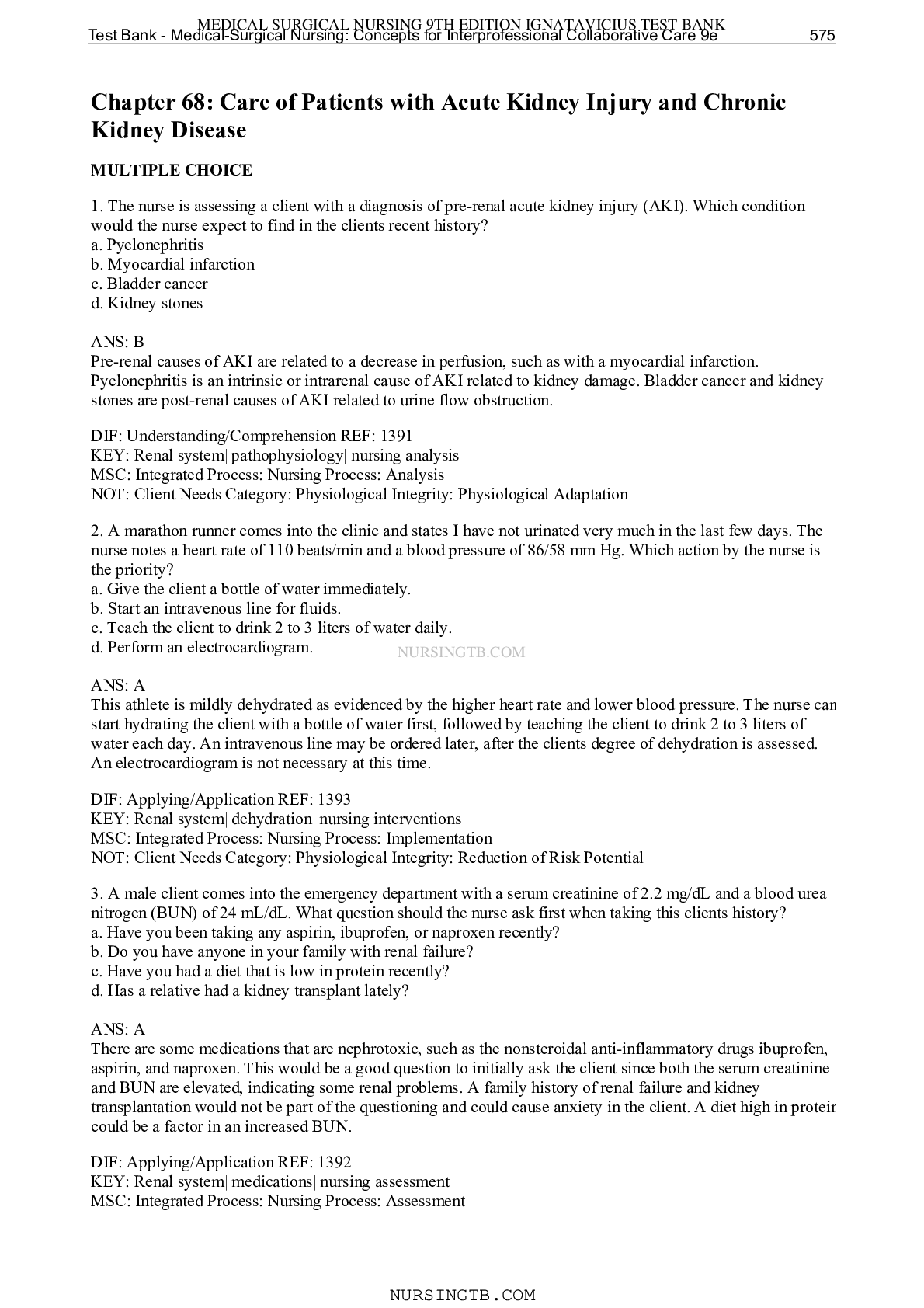
Chapter 68: Care of Patients with Acute Kidney Injury and Chronic
Kidney Disease
MULTIPLE CHOICE
1. The nurse is assessing a client with a diagnosis of pre-renal acute kidney injury (AKI). Which condition
would the n
...
Chapter 68: Care of Patients with Acute Kidney Injury and Chronic
Kidney Disease
MULTIPLE CHOICE
1. The nurse is assessing a client with a diagnosis of pre-renal acute kidney injury (AKI). Which condition
would the nurse expect to find in the clients recent history?
a. Pyelonephritis
b. Myocardial infarction
c. Bladder cancer
d. Kidney stones
ANS: B
Pre-renal causes of AKI are related to a decrease in perfusion, such as with a myocardial infarction. Pyelonephritis is an intrinsic or intrarenal cause of AKI related to kidney damage. Bladder cancer and kidney
stones are post-renal causes of AKI related to urine flow obstruction. DIF: Understanding/Comprehension REF: 1391
KEY: Renal system| pathophysiology| nursing analysis
MSC: Integrated Process: Nursing Process: Analysis
NOT: Client Needs Category: Physiological Integrity: Physiological Adaptation
2. A marathon runner comes into the clinic and states I have not urinated very much in the last few days. The
nurse notes a heart rate of 110 beats/min and a blood pressure of 86/58 mm Hg. Which action by the nurse is
the priority?
a. Give the client a bottle of water immediately. b. Start an intravenous line for fluids. c. Teach the client to drink 2 to 3 liters of water daily. d. Perform an electrocardiogram.
ANS: A
This athlete is mildly dehydrated as evidenced by the higher heart rate and lower blood pressure. The nurse can
start hydrating the client with a bottle of water first, followed by teaching the client to drink 2 to 3 liters of
water each day. An intravenous line may be ordered later, after the clients degree of dehydration is assessed. An electrocardiogram is not necessary at this time. DIF: Applying/Application REF: 1393
KEY: Renal system| dehydration| nursing interventions
MSC: Integrated Process: Nursing Process: Implementation
NOT: Client Needs Category: Physiological Integrity: Reduction of Risk Potential
3. A male client comes into the emergency department with a serum creatinine of 2.2 mg/dL and a blood urea
nitrogen (BUN) of 24 mL/dL. What question should the nurse ask first when taking this clients history?
a. Have you been taking any aspirin, ibuprofen, or naproxen recently?
b. Do you have anyone in your family with renal failure?
c. Have you had a diet that is low in protein recently?
d. Has a relative had a kidney transplant lately?
ANS: A
There are some medications that are nephrotoxic, such as the nonsteroidal anti-inflammatory drugs ibuprofen, aspirin, and naproxen. This would be a good question to initially ask the client since both the serum creatinine
and BUN are elevated, indicating some renal problems. A family history of renal failure and kidney
transplantation would not be part of the questioning and could cause anxiety in the client. A diet high in protein
could be a factor in an increased BUN. DIF: Applying/Application REF: 1392
KEY: Renal system| medications| nursing assessment
MSC: Integrated Process: Nursing Process: Assessment
Test Bank - Medical-Surgical Nursing: Concepts for Interprofessional Collaborative Care 9e 575
NURSINGTB.COM
MEDICAL SURGICAL NURSING 9TH EDITION IGNATAVICIUS TEST BANK
NURSINGTB.COM
NOT: Client Needs Category: Physiological Integrity: Reduction of Risk Potential
4. A client is admitted with acute kidney injury (AKI) and a urine output of 2000 mL/day. What is the major
concern of the nurse regarding this clients care?
a. Edema and pain
b. Electrolyte and fluid imbalance
c. Cardiac and respiratory status
d. Mental health status
ANS: B
This client may have an inflammatory cause of AKI with proteins entering the glomerulus and holding the
fluid in the filtrate, causing polyuria. Electrolyte loss and fluid balance is essential. Edema and pain are not
usually a problem with fluid loss. There could be changes in the clients cardiac, respiratory, and mental health
status if the electrolyte imbalance is not treated. DIF: Applying/Application REF: 1395
KEY: Renal system| pathophysiology| dehydration
MSC: Integrated Process: Nursing Process: Analysis
NOT: Client Needs Category: Physiological Integrity: Physiological Adaptation
5. A client with acute kidney injury has a blood pressure of 76/55 mm Hg. The health care provider ordered
1000 mL of normal saline to be infused over 1 hour to maintain perfusion. The client is starting to develop
shortness of breath. What is the nurses priority action?
a. Calculate the mean arterial pressure (MAP). b. Ask for insertion of a pulmonary artery catheter. c. Take the clients pulse. d. Slow down the normal saline infusion.
ANS: D
The nurse should assess that the client could be developing fluid overload and respiratory distress and slow
down the normal saline infusion. The calculation of the MAP also reflects perfusion. The insertion of a
pulmonary artery catheter would evaluate the clients hemodynamic status, but this should not be the initial
action by the nurse. Vital signs are also important after adjusting the intravenous infusion. DIF: Applying/Application REF: 1395
KEY: Renal system| hemodynamic status| nursing intervention
MSC: Integrated Process: Nursing Process: Implementation
NOT: Client Needs Category: Safe and Effective Care Environment: Management of Care
6. A client has a serum potassium level of 6.5 mmol/L, a serum creatinine level of 2 mg/dL, and a urine output
of 350 mL/day. What is the best action by the nurse?
a. Place the client on a cardiac monitor immediately. b. Teach the client to limit high-potassium foods. c. Continue to monitor the clients intake and output. d. Ask to have the laboratory redraw the blood specimen.
ANS: A
The priority action by the nurse should be to check the cardiac status with a monitor. High potassium levels
can lead to dysrhythmias. The other choices are logical nursing interventions for acute kidney injury but not
the best immediate action. DIF: Applying/Application REF: 1400
KEY: Renal system| electrolyte imbalance| nursing intervention
MSC: Integrated Process: Nursing Process: Implementation
NOT: Client Needs Category: Physiological Integrity: Physiological Adaptation
7. A client has just had a central line catheter placed that is specific for hemodialysis. What is the most
appropriate action by the nurse?
a. Use the catheter for the next laboratory blood draw.
Test Bank - Medical-Surgical Nursing: Concepts for Interprofessional Collaborative Care 9e 576
NURSINGTB.COM
MEDICAL SURGICAL NURSING 9TH EDITION IGNATAVICIUS TEST BANK
NURSINGTB.COM
b. Monitor the central venous pressure through this line. c. Access the line for the next intravenous medication. d. Place a heparin or heparin/saline dwell after hemodialysis.
ANS: D
The central line should have a heparin or heparin/saline dwell after hemodialysis treatment. The central line
catheter used for dialysis should not be used for blood sampling, monitoring central venous pressures, or
giving drugs or fluids. DIF: Remembering/Knowledge REF: 1414
KEY: Renal system| vascular access device| nursing intervention
MSC: Integrated Process: Nursing Process: Implementation
NOT: Client Needs Category: Safe and Effective Care Environment: Safety and Infection Control
8. A client in the intensive care unit is started on continuous venovenous hemofiltration (CVVH). Which
finding is the cause of immediate action by the nurse?
a. Blood pressure of 76/58 mm Hg
b. Sodium level of 138 mEq/L
c. Potassium level of 5.5 mEq/L
d. Pulse rate of 90 beats/min
ANS: A
Hypotension can be a problem with CVVH if replacement fluid does not provide enough volume to maintain
blood pressure. The specially trained nurse needs to monitor for ongoing fluid and electrolyte replacement. The
sodium level is normal and the potassium level is slightly elevated, which could be normal findings for
someone with acute kidney injury. A pulse rate of 90 beats/min is normal. DIF: Applying/Application REF: 1397
KEY: Renal system| dialysis| nursing intervention
MSC: Integrated Process: Nursing Process: Implementation
NOT: Client Needs Category: Safe and Effective Care Environment: Management of Care
9. The nurse is caring for four clients with chronic kidney disease. Which client should the nurse assess first
upon initial rounding?
a. Woman with a blood pressure of 158/90 mm Hg
b. Client with Kussmaul respirations
c. Man with skin itching from head to toe
d. Client with halitosis and stomatitis
ANS: B
Kussmaul respirations indicate a worsening of chronic kidney disease (CKD). The client is increasing the rate
and depth of breathing to excrete carbon dioxide through the lungs. Hypertension is common in most clients
with CKD, and skin itching increases with calcium-phosphate imbalances, another common finding in CKD. Uremia from CKD causes ammonia to be formed, resulting in the common findings of halitosis and stomatitis. DIF: Applying/Application REF: 1399
KEY: Renal system| nursing assessment| respiratory system
MSC: Integrated Process: Nursing Process: Assessment
NOT: Client Needs Category: Safe and Effective Care Environment: Management of Care
10. The charge nurse of the medical-surgical unit is making staff assignments. Which staff member should be
assigned to a client with chronic kidney disease who is exhibiting a low-grade fever and a pericardial friction
rub?
a. Registered nurse who just floated from the surgical unit
b. Registered nurse who just floated from the dialysis unit
c. Registered nurse who was assigned the same client yesterday
d. Licensed practical nurse with 5 years experience on this floor
ANS: C
Test Bank - Medical-Surgical Nursing: Concepts for Interprofessional Collaborative Care 9e 577
NURSINGTB.COM
MEDICAL SURGICAL NURSING 9TH EDITION IGNATAVICIUS TEST BANK
NURSINGTB.COM
The client is exhibiting symptoms of pericarditis, which can occur with chronic kidney disease. Continuity of
care is important to assess subtle differences in clients. Therefore, the registered nurse (RN) who was assigned
to this client previously should again give care to this client. The float nurses would not be as knowledgeable
about the unit and its clients. The licensed practical nurse may not have the education level of the RN to assess
for pericarditis. DIF: Applying/Application REF: 1400
KEY: Renal system| supervision-assignment| patient-centered care
MSC: Integrated Process: Nursing Process: Analysis
NOT: Client Needs Category: Safe and Effective Care Environment: Management of Care
11. A male client with chronic kidney disease (CKD) is refusing to take his medication and has missed two
hemodialysis appointments. What is the best initial action for the nurse?
a. Discuss what the treatment regimen means to him. b. Refer the client to a mental health nurse practitioner. c. Reschedule the appointments to another date and time. d. Discuss the option of peritoneal dialysis.
ANS: A
The initial action for the nurse is to assess anxiety, coping styles, and the clients acceptance of the required
treatment for CKD. The client may be in denial of the diagnosis. While rescheduling hemodialysis
appointments may help, and referral to a mental health practitioner and the possibility of peritoneal dialysis are
all viable options, assessment of the clients acceptance of the treatment should come first. DIF: Applying/Application REF: 1401
KEY: Renal system| patient-centered care| coping
MSC: Integrated Process: Caring
NOT: Client Needs Category: Psychosocial Integrity
12. A client is taking furosemide (Lasix) 40 mg/day for management of chronic kidney disease (CKD). To
detect the positive effect of the medication, what action of the nurse is best?
a. Obtain daily weights of the client. b. Auscultate heart and breath sounds. c. Palpate the clients abdomen. d. Assess the clients diet history.
ANS: A
Furosemide (Lasix) is a loop diuretic that helps reduce fluid overload and hypertension in clients with early
stages of CKD. One kilogram of weight equals about 1 liter of fluid retained in the client, so daily weights are
necessary to monitor the response of the client to the medication. Heart and breath sounds should be assessed if
there is fluid retention, as in heart failure. Palpation of the clients abdomen is not necessary, but the nurse
should check for edema. The diet history of the client would be helpful to assess electrolyte replacement since
potassium is lost with this diuretic, but this does not assess the effect of the medication. DIF: Applying/Application REF: 1405
KEY: Renal system| diuretics| nursing interventions
MSC: Integrated Process: Nursing Process: Implementation
NOT: Client Needs Category: Physiological Integrity: Pharmacological and Parenteral Therapies
13. A client is diagnosed with chronic kidney disease (CKD). What is an ideal goal of treatment set by the
nurse in the care plan to reduce the risk of pulmonary edema?
a. Maintaining oxygen saturation of 89%
b. Minimal crackles and wheezes in lung sounds
c. Maintaining a balanced intake and output
d. Limited shortness of breath upon exertion
ANS: C
With an optimal fluid balance, the client will be more able to eject blood from the left ventricle without
increased pressure in the left ventricle and pulmonary vessels. Other ideal goals are oxygen saturations greater
Test Bank - Medical-Surgical Nursing: Concepts for Interprofessional Collaborative Care 9e 578
NURSINGTB.COM
MEDICAL SURGICAL NURSING 9TH EDITION IGNATAVICIUS TEST BANK
NURSINGTB.COM
than 92%, no auscultated crackles or wheezes, and no demonstrated shortness of breath. DIF: Applying/Application REF: 1403
KEY: Renal system| pulmonary edema| nursing goal
MSC: Integrated Process: Nursing Process: Analysis
NOT: Client Needs Category: Safe and Effective Care Environment: Management of Care
14. A client has a long history of hypertension. Which category of medications would the nurse expect to be
ordered to avoid chronic kidney disease (CKD)?
a. Antibiotic
b. Histamine blocker
c. Bronchodilator
d. Angiotensin-converting enzyme (ACE) inhibitor
ANS: D
ACE inhibitors stop the conversion of angiotensin I to the vasoconstrictor angiotensin II. This category of
medication also blocks bradykinin and prostaglandin, increases renin, and decreases aldosterone, which
promotes vasodilation and perfusion to the kidney. Antibiotics fight infection, histamine blockers decrease
inflammation, and bronchodilators increase the size of the bronchi; none of these medications helps slow the
progression of CKD in clients with hypertension. DIF: Applying/Application REF: 1406
KEY: Renal system| hypertension| medications| angiotensin-converting enzyme (ACE) inhibitors MSC:
Integrated Process: Nursing Process: Analysis
NOT: Client Needs Category: Physiological Integrity: Pharmacological and Parenteral Therapies
15. A 70-kg adult with chronic renal failure is on a 40-g protein diet. The client has a reduced glomerular
filtration rate and is not undergoing dialysis. Which result would give the nurse the most concern?
a. Albumin level of 2.5 g/dL
b. Phosphorus level of 5 mg/dL
c. Sodium level of 135 mmol/L
d. Potassium level of 5.5 mmol/L
ANS: A
Protein restriction is necessary with chronic renal failure due to the buildup of waste products from protein
breakdown. The nurse would be concerned with the low albumin level since this indicates that the protein in
the diet is not enough for the clients metabolic needs. The electrolyte values are not related to the proteinrestricted diet. DIF: Applying/Application REF: 1406
KEY: Renal system| nutrition| nursing assessment
MSC: Integrated Process: Nursing Process: Assessment
NOT: Client Needs Category: Physiological Integrity: Reduction of Risk Potential
16. The nurse is teaching a client with chronic kidney disease (CKD) about the sodium restriction needed in the
diet to prevent edema and hypertension. Which statement by the client indicates more teaching is needed?
a. I am thrilled that I can continue to eat fast food. b. I will cut out bacon with my eggs every morning. c. My cooking style will change by not adding salt. d. I will probably lose weight by cutting out potato chips.
ANS: A
Fast food restaurants usually serve food that is high in sodium. This statement indicates that more teaching
needs to occur. The other statements show a correct understanding of the teaching. DIF: Remembering/Knowledge REF: 1407
KEY: Renal system| nutrition| patient education
MSC: Integrated Process: Teaching/Learning
NOT: Client Needs Category: Physiological Integrity: Basic Care and Comfort
Test Bank - Medical-Surgical Nursing: Concepts for Interprofessional Collaborative Care 9e 579
NURSINGTB.COM
MEDICAL SURGICAL NURSING 9TH EDITION IGNATAVICIUS TEST BANK
NURSINGTB.COM
17. A client is placed on fluid restrictions because of chronic kidney disease (CKD). Which assessment finding
would alert the nurse that the clients fluid balance is stable at this time?
a. Decreased calcium levels
b. Increased phosphorus levels
c. No adventitious sounds in the lungs
d. Increased edema in the legs
ANS: C
The absence of adventitious sounds upon auscultation of the lungs indicates a lack of fluid overload and fluid
balance in the clients body. Decreased calcium levels and increased phosphorus levels are common findings
with CKD. Edema would indicate a fluid imbalance. DIF: Applying/Application REF: 1405
KEY: Renal system| fluid and electrolyte imbalance| nursing analysis
MSC: Integrated Process: Nursing Process: Analysis
NOT: Client Needs Category: Physiological Integrity: Reduction of Risk Potential
18. A client with chronic kidney disease (CKD) is experiencing nausea, vomiting, visual changes, and
anorexia. Which action by the nurse is best?
a. Check the clients digoxin (Lanoxin) level. b. Administer an anti-nausea medication. c. Ask if the client is able to eat crackers. d. Get a referral to a gastrointestinal provider.
ANS: A
These signs and symptoms are indications of digoxin (Lanoxin) toxicity. The nurse should check the level of
this medication. Administering antiemetics, asking if the client can eat, and obtaining a referral to a specialist
all address the clients symptoms but do not lead to the cause of the symptoms. DIF: Applying/Application REF: 1407
KEY: Renal system| medications| digoxin
MSC: Integrated Process: Nursing Process: Implementation
NOT: Client Needs Category: Physiological Integrity: Pharmacological and Parenteral Therapies
19. The nurse is taking the vital signs of a client after hemodialysis. Blood pressure is 110/58 mm Hg, pulse 66
beats/min, and temperature is 99.8 F (37.6 C). What is the most appropriate action by the nurse?
a. Administer fluid to increase blood pressure. b. Check the white blood cell count. c. Monitor the clients temperature. d. Connect the client to an electrocardiographic (ECG) monitor.
ANS: C
During hemodialysis, the dialysate is warmed to increase diffusion and prevent hypothermia. The clients
temperature could reflect the temperature of the dialysate. There is no indication to check the white blood cell
count or connect the client to an ECG monitor. The other vital signs are within normal limits. DIF: Applying/Application REF: 1411
KEY: Renal system| dialysis| nursing intervention
MSC: Integrated Process: Nursing Process: Implementation
NOT: Client Needs Category: Physiological Integrity: Physiological Adaptation
20. The nurse is teaching the main principles of hemodialysis to a client with chronic kidney disease. Which
statement by the client indicates a need for further teaching by the nurse?
a. My sodium level changes by movement from the blood into the dialysate. b. Dialysis works by movement of wastes from lower to higher concentration. c. Extra fluid can be pulled from the blood by osmosis. d. The dialysate is similar to blood but without any toxins.
ANS: B
Test Bank - Medical-Surgical Nursing: Concepts for Interprofessional Collaborative Care 9e 580
NURSINGTB.COM
MEDICAL SURGICAL NURSING 9TH EDITION IGNATAVICIUS TEST BANK
NURSINGTB.COM
Dialysis works using the passive transfer of toxins by diffusion. Diffusion is the movement of molecules from
an area of higher concentration to an area of lower concentration. The other statements show a correct
understanding about hemodialysis. DIF: Remembering/Knowledge REF: 1411
KEY: Renal system| dialysis| patient education
MSC: Integrated Process: Teaching/Learning
NOT: Client Needs Category: Health Promotion and Maintenance
21. The charge nurse is orienting a float nurse to an assigned client with an arteriovenous (AV) fistula for
hemodialysis in her left arm. Which action by the float nurse would be considered unsafe?
a. Palpating the access site for a bruit or thrill
b. Using the right arm for a blood pressure reading
c. Administering intravenous fluids through the AV fistula
d. Checking distal pulses in the left arm
ANS: C
The nurse should not use the arm with the AV fistula for intravenous infusion, blood pressure readings, or
venipuncture. Compression and infection can result in the loss of the AV fistula. The AV fistula should be
monitored by auscultating or palpating the access site. Checking the distal pulse would be an appropriate
assessment. DIF: Applying/Application REF: 1412
KEY: Renal system| patient safety| injury prevention| dialysis
MSC: Integrated Process: Nursing Process: Implementation
NOT: Client Needs Category: Safe and Effective Care Environment: Safety and Infection Control
22. A client is assessed by the nurse after a hemodialysis session. The nurse notes bleeding from the clients
nose and around the intravenous catheter. What action by the nurse is the priority?
a. Hold pressure over the clients nose for 10 minutes. b. Take the clients pulse, blood pressure, and temperature. c. Assess for a bruit or thrill over the arteriovenous fistula. d. Prepare protamine sulfate for administration.
ANS: D
Heparin is used with hemodialysis treatments. The bleeding alerts the nurse that too much anticoagulant is in
the clients system and protamine sulfate should be administered. Pressure, taking vital signs, and assessing for
a bruit or thrill are not as important as medication administration. DIF: Applying/Application REF: 1412
KEY: Renal system| patient safety| heparin
MSC: Integrated Process: Nursing Process: Implementation
NOT: Client Needs Category: Physiological Integrity: Pharmacological and Parenteral Therapies
23. A nurse is caring for a client who is scheduled for a dose of cefazolin and vitamins at this time. Hemodialysis for this client is also scheduled in 60 minutes. Which action by the nurse is best?
a. Administer cefazolin since the level of the antibiotic must be maintained. b. Hold the vitamins but administer the cefazolin. c. Hold the cefazolin but administer the vitamins. d. Hold all medications since both cefazolin and vitamins are dialyzable.
ANS: D
Both the cefazolin and the vitamins should be held until after the hemodialysis is completed because they
would otherwise be removed by the dialysis process. DIF: Applying/Application REF: 1415
KEY: Renal system| dialysis| medications| antibiotics
MSC: Integrated Process: Nursing Process: Implementation
NOT: Client Needs Category: Physiological Integrity: Pharmacological and Parenteral Therapies
Test Bank - Medical-Surgical Nursing: Concepts for Interprofessional Collaborative Care 9e 581
NURSINGTB.COM
MEDICAL SURGICAL NURSING 9TH EDITION IGNATAVICIUS TEST BANK
NURSINGTB.COM
24. A client is having a peritoneal dialysis treatment. The nurse notes an opaque color to the effluent. What is
the priority action by the nurse?
a. Warm the dialysate solution in a microwave before instillation. b. Take a sample of the effluent and send to the laboratory. c. Flush the tubing with normal saline to maintain patency of the catheter. d. Check the peritoneal catheter for kinking and curling.
ANS: B
An opaque or cloudy effluent is the first sign of peritonitis. A sample of the effluent would need to be sent to
the laboratory for culture and sensitivity in order to administer the correct antibiotic. Warming the dialysate in
a microwave and flushing the tubing are not safe actions by the nurse. Checking the catheter for obstruction is
a viable option but will not treat the peritonitis. DIF: Applying/Application REF: 1419
KEY: Renal system| dialysis| infection
MSC: Integrated Process: Nursing Process: Implementation
NOT: Client Needs Category: Safe and Effective Care Environment: Safety and Infection Control
25. The nurse is teaching a client how to increase the flow of dialysate into the peritoneal cavity during
dialysis. Which statement by the client demonstrates a correct understanding of the teaching?
a. I should leave the drainage bag above the level of my abdomen. b. I could flush the tubing with normal saline if the flow stops. c. I should take a stool softener every morning to avoid constipation. d. My diet should have low fiber in it to prevent any irritation.
ANS: C
Inflow and outflow problems of the dialysate are best controlled by preventing constipation. A daily stool
softener is the best option for the client. The drainage bag should be below the level of the abdomen. Flushing
the tubing will not help with the flow. A diet high in fiber will also help with a constipation problem. DIF: Applying/Application REF: 1420
KEY: Renal system| dialysis| patient education
MSC: Integrated Process: Teaching/Learning
NOT: Client Needs Category: Health Promotion and Maintenance
26. A client with chronic kidney disease states, I feel chained to the hemodialysis machine. What is the nurses
best response to the clients statement?
a. That feeling will gradually go away as you get used to the treatment. b. You probably need to see a psychiatrist to see if you are depressed. c. Do you need help from social services to discuss financial aid?
d. Tell me more about your feelings regarding hemodialysis treatment.
ANS: D
The nurse needs to explore the clients feelings in order to help the client cope and enter a phase of acceptance
or resignation. It is common for clients to be discouraged because of the dependency of the treatment, especially during the first year. Referrals to a mental health provider or social services are possibilities, but
only after exploring the clients feelings first. Telling the client his or her feelings will go away is dismissive of
the clients concerns. DIF: Applying/Application REF: 1415
KEY: Renal system| dialysis| coping MSC: Integrated Process: Caring
NOT: Client Needs Category: Psychosocial Integrity
27. A client is recovering from a kidney transplant. The clients urine output was 1500 mL over the last 12-hour
period since transplantation. What is the priority assessment by the nurse?
a. Checking skin turgor
b. Taking blood pressure
c. Assessing lung sounds
d. Weighing the client
Test Bank - Medical-Surgical Nursing: Concepts for Interprofessional Collaborative Care 9e 582
NURSINGTB.COM
MEDICAL SURGICAL NURSING 9TH EDITION IGNATAVICIUS TEST BANK
NURSINGTB.COM
ANS: B
By taking blood pressure, the nurse is assessing for hypotension that could compromise perfusion to the new
kidney. The nurse then should notify the provider immediately. Skin turgor, lung sounds, and weight could
give information about the fluid status of the client, but they are not the priority assessment. DIF: Applying/Application REF: 1422
KEY: Renal system| postoperative nursing| transplantation
MSC: Integrated Process: Nursing Process: Assessment
NOT: Client Needs Category: Physiological Integrity: Reduction of Risk Potential
28. A nurse reviews these laboratory values of a client who returned from kidney transplantation 12 hours ago:
Sodium 136 mEq/L
Potassium 5 mEq/L
Blood urea nitrogen (BUN) 44 mg/dL
Serum creatinine 2.5 mg/dL
What initial intervention would the nurse anticipate?
a. Start hemodialysis immediately. b. Discuss the need for peritoneal dialysis. c. Increase the dose of immunosuppression. d. Return the client to surgery for exploration.
ANS: C
The client may need a higher dose of immunosuppressive medication as evidenced by the elevated BUN and
serum creatinine levels. This increased dose may reverse the possible acute rejection of the transplanted
kidney. The client does not need hemodialysis, peritoneal dialysis, or further surgery at this point. DIF: Applying/Application REF: 1422
KEY: Renal system| transplantation| nursing analysis
MSC: Integrated Process: Nursing Process: Analysis
NOT: Client Needs Category: Physiological Integrity: Reduction of Risk Potential
MULTIPLE RESPONSE
1. The nurse is caring for five clients on the medical-surgical unit. Which clients would the nurse consider to
be at risk for post-renal acute kidney injury (AKI)? (Select all that apply.)
a. Man with prostate cancer
b. Woman with blood clots in the urinary tract
c. Client with ureterolithiasis
d. Firefighter with severe burns
e. Young woman with lupus
ANS: A, B, C
Urine flow obstruction, such as prostate cancer, blood clots in the urinary tract, and kidney stones
(ureterolithiasis), causes post-renal AKI. Severe burns would be a pre-renal cause. Lupus would be an
intrarenal cause for AKI. DIF: Understanding/Comprehension REF: 1392
KEY: Renal system| pathophysiology
MSC: Integrated Process: Nursing Process: Analysis
NOT: Client Needs Category: Physiological Integrity: Physiological Adaptation
2. A nurse is caring for a postoperative 70-kg client who had major blood loss during surgery. Which findings
by the nurse should prompt immediate action to prevent acute kidney injury? (Select all that apply.)
a. Urine output of 100 mL in 4 hours
b. Urine output of 500 mL in 12 hours
c. Large amount of sediment in the urine
d. Amber, odorless urine
e. Blood pressure of 90/60 mm Hg
Test Bank - Medical-Surgical Nursing: Concepts for Interprofessional Collaborative Care 9e 583
NURSINGTB.COM
MEDICAL SURGICAL NURSING 9TH EDITION IGNATAVICIUS TEST BANK
NURSINGTB.COM
ANS: A, C, E
The low urine output, sediment, and blood pressure should be reported to the provider. Postoperatively, the
nurse should measure intake and output, check the characteristics of the urine, and report sediment, hematuria, and urine output of less than 0.5 mL/kg/hour for 3 to 4 hours. A urine output of 100 mL is low, but a urine
output of 500 mL in 12 hours should be within normal limits. Perfusion to the kidneys is compromised with
low blood pressure. The amber odorless urine is normal. DIF: Applying/Application REF: 1422
KEY: Renal system| nursing assessment| postoperative nursing
MSC: Integrated Process: Nursing Process: Assessment
NOT: Client Needs Category: Safe and Effective Care Environment: Management of Care
3. A client is hospitalized in the oliguric phase of acute kidney injury (AKI) and is receiving tube feedings. The
nurse is teaching the clients spouse about the kidney-specific formulation for the enteral solution compared to
standard formulas. What components should be discussed in the teaching plan? (Select all that apply.)
a. Lower sodium
b. Higher calcium
c. Lower potassium
d. Higher phosphorus
e. Higher calories
ANS: A, C, E
Many clients with AKI are too ill to meet caloric goals and require tube feedings with kidney-specific formulas
that are lower in sodium, potassium, and phosphorus, and higher in calories than are standard formulas. DIF: Remembering/Knowledge REF: 1396
KEY: Renal system| nutritional requirements| patient education
MSC: Integrated Process: Teaching/Learning
NOT: Client Needs Category: Health Promotion and Maintenance
4. The nurse is teaching a client with diabetes mellitus how to prevent or delay chronic kidney disease (CKD). Which client statements indicate a lack of understanding of the teaching? (Select all that apply.)
a. I need to decrease sodium, cholesterol, and protein in my diet. b. My weight should be maintained at a body mass index of 30. c. Smoking should be stopped as soon as I possibly can. d. I can continue to take an aspirin every 4 to 8 hours for my pain. e. I really only need to drink a couple of glasses of water each day.
ANS: B, D, E
Weight should be maintained at a body mass index (BMI) of 22 to 25. A BMI of 30 indicates obesity. The use
of nonsteroidal anti-inflammatory drugs such as aspirin should be limited to the lowest time at the lowest dose
due to interference with kidney blood flow. The client should drink at least 2 liters of water daily. Diet
adjustments should be made by restricting sodium, cholesterol, and protein. Smoking causes constriction of
blood vessels and decreases kidney perfusion, so the client should stop smoking. DIF: Applying/Application REF: 1401
KEY: Renal system| lifestyle factors| patient education
MSC: Integrated Process: Teaching/Learning
NOT: Client Needs Category: Health Promotion and Maintenance
5. A nurse is giving discharge instructions to a client recently diagnosed with chronic kidney disease (CKD). Which statements made by the client indicate a correct understanding of the teaching? (Select all that apply.)
a. I can continue to take antacids to relieve heartburn. b. I need to ask for an antibiotic when scheduling a dental appointment. c. Ill need to check my blood sugar often to prevent hypoglycemia. d. The dose of my pain medication may have to be adjusted. e. I should watch for bleeding when taking my anticoagulants.
Test Bank - Medical-Surgical Nursing: Concepts for Interprofessional Collaborative Care 9e 584
NURSINGTB.COM
MEDICAL SURGICAL NURSING 9TH EDITION IGNATAVICIUS TEST BANK
NURSINGTB.COM
ANS: B, C, D, E
In discharge teaching, the nurse must emphasize that the client needs to have an antibiotic prophylactically
before dental procedures to prevent infection. There may be a need for dose reduction in medications if the
kidney is not excreting them properly (antacids with magnesium, antibiotics, antidiabetic drugs, insulin, opioids, and anticoagulants). DIF: Applying/Application REF: 1409
KEY: Renal system| patient education| medication safety
MSC: Integrated Process: Teaching/Learning
NOT: Client Needs Category: Health Promotion and Maintenance
6. A client is undergoing hemodialysis. The clients blood pressure at the beginning of the procedure was
136/88 mm Hg, and now it is 110/54 mm Hg. What actions should the nurse perform to maintain blood
pressure? (Select all that apply.)
a. Adjust the rate of extracorporeal blood flow. b. Place the client in the Trendelenburg position. c. Stop the hemodialysis treatment. d. Administer a 250-mL bolus of normal saline. e. Contact the health care provider for orders.
ANS: A, B, D
Hypotension occurs often during hemodialysis treatments as a result of vasodilation from the warmed
dialysate. Modest decreases in blood pressure, as is the case with this client, can be maintained with rate
adjustment, Trendelenburg positioning, and a fluid bolus. If the blood pressure drops considerably after two
boluses and cooling dialysate, the hemodialysis can be stopped and the health care provider contacted. DIF: Applying/Application REF: 1415
KEY: Renal system| dialysis| patient safety
MSC: Integrated Process: Nursing Process: Implementation
NOT: Client Needs Category: Safe and Effective Care Environment: Safety and Infection Control
7. A client is unsure of the decision to undergo peritoneal dialysis (PD) and wishes to discuss the advantages of
this treatment with the nurse. Which statements by the nurse are accurate regarding PD? (Select all that apply.)
a. You will not need vascular access to perform PD. b. There is less restriction of protein and fluids. c. You will have no risk for infection with PD. d. You have flexible scheduling for the exchanges. e. It takes less time than hemodialysis treatments.
ANS: A, B, D
PD is based on exchanges of waste, fluid, and electrolytes in the peritoneal cavity. There is no need for
vascular access. Protein is lost in the exchange, which allows for more protein and fluid in the diet. There is
flexibility in the time for exchanges, but the treatment takes a longer period of time compared to hemodialysis. There still is risk for infection with PD, especially peritonitis. DIF: Remembering/Knowledge REF: 1410
KEY: Renal system| dialysis| patient education
MSC: Integrated Process: Teaching/Learning
NOT: Client Needs Category: Physiological Integrity: Basic Care and Comfort
SHORT ANSWER
1. A client in the intensive care unit with acute kidney injury (AKI) must maintain a mean arterial pressure
(MAP) of 65 mm Hg to promote kidney perfusion. What is the clients MAP if the blood pressure is 98/50 mm
Hg? (Record your answer using a whole number.) _____ mm Hg
ANS:
66 mm Hg
Test Bank - Medical-Surgical Nursing: Concepts for Interprofessional Collaborative Care 9e 585
NURSINGTB.COM
MEDICAL SURGICAL NURSING 9TH EDITION IGNATAVICIUS TEST BANK
NURSINGTB.COM
DIF: Applying/Application REF: 1395
KEY: Renal system| perfusion| mean arterial blood pressure| calculation
MSC: Integrated Process: Nursing Process: Implementation
NOT: Client Needs Category: Safe and Effective Care Environment: Safety and Infection Control
[Show More]


 Correct Study Guide, Download to Score A.png)
 Correct Study Guide, Download to Score A.png)
.png)
.png)

 Med Surg test Latest Verified Questions and all Correct Answers with Explanations Chapter 68 Management of Patients with Neurologic Trauma.png)
 (WRITTEN EXAM ACTUAL UPDATE QUESTIONS AND ANSWERS 2023).png)