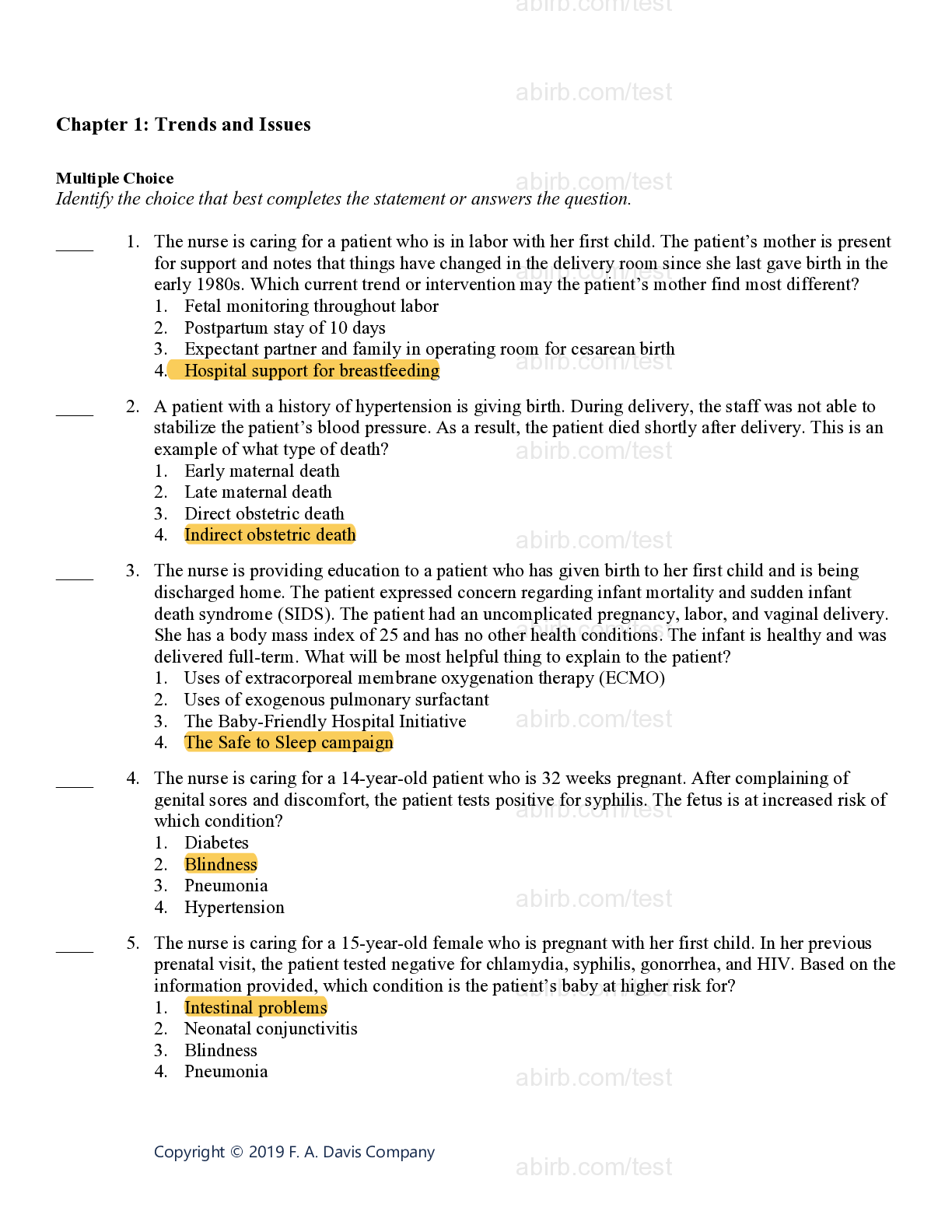
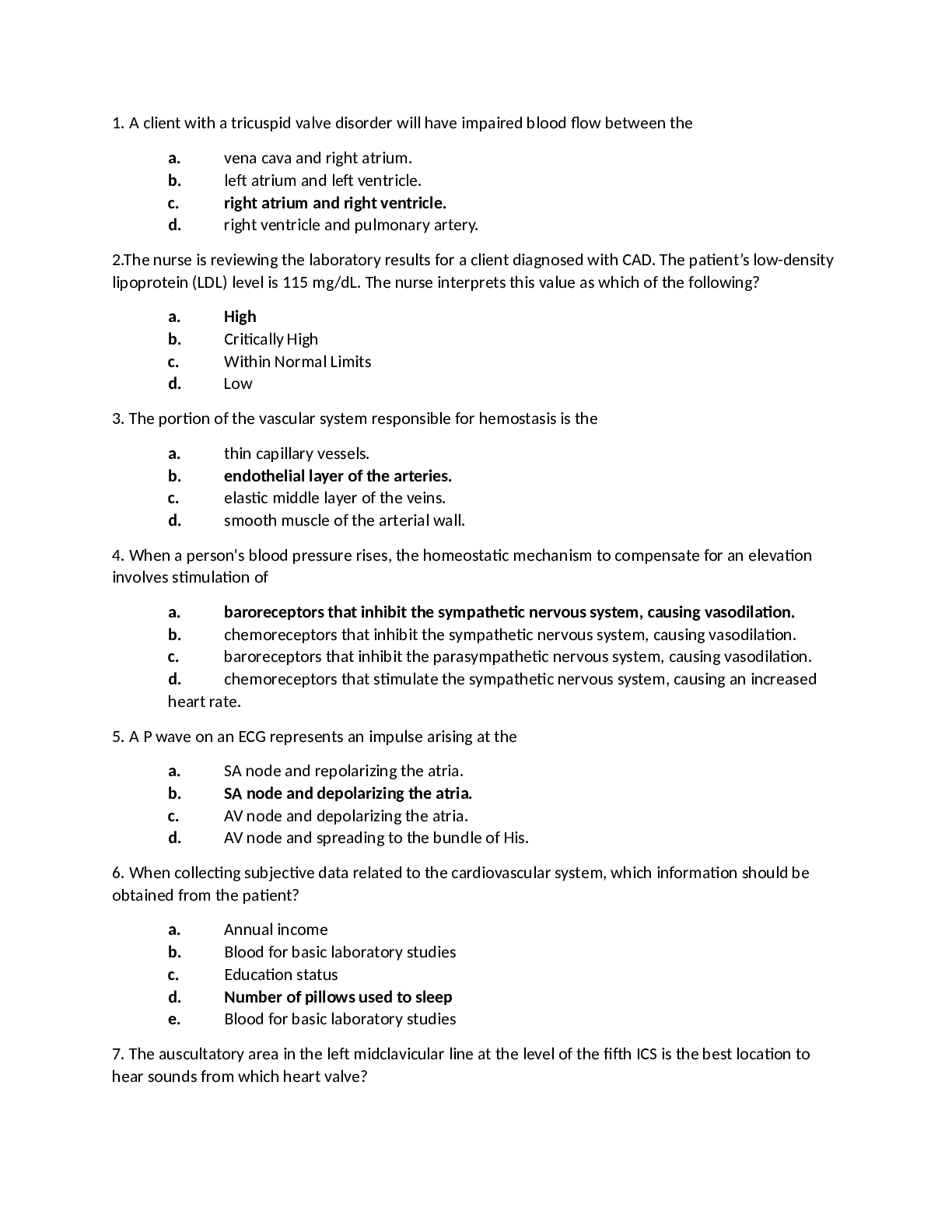
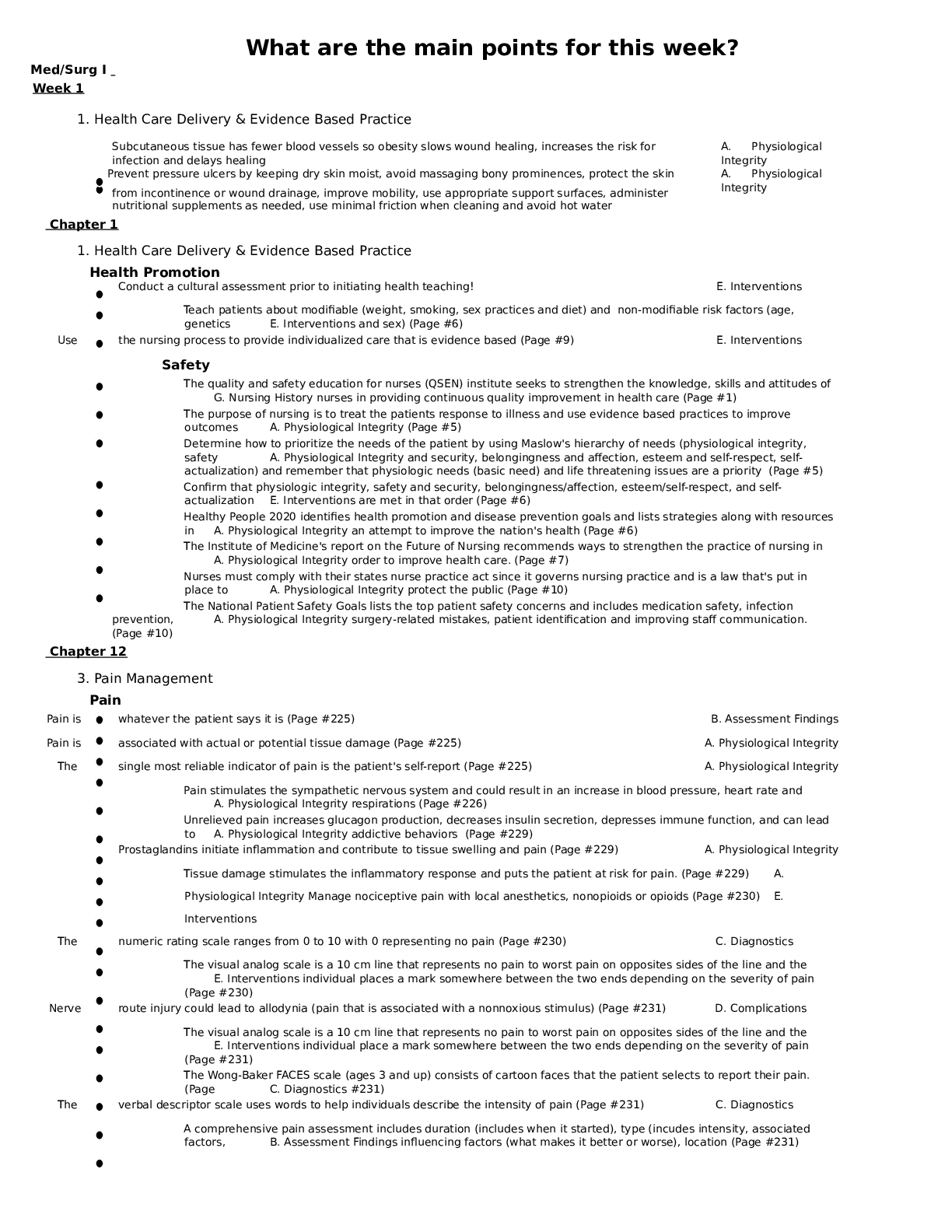
Chapter 01: Overview of Professional Nursing Concepts for Medical- Surgical Nursing
MULTIPLE CHOICE
1. A nurse wishes to provide client-centered care in all interactions. Which action by the nurse best
demonstrates th
...
Chapter 01: Overview of Professional Nursing Concepts for Medical- Surgical Nursing
MULTIPLE CHOICE
1. A nurse wishes to provide client-centered care in all interactions. Which action by the nurse best
demonstrates this concept?
a. Assesses for cultural influences affecting health care b. Ensures that all the clients basic needs are
met c. Tells the client and family about all upcoming tests d. Thoroughly orients the client and family to
the room
ANS: A
2. A nurse is caring for a postoperative client on the surgical unit. The clients blood pressure was 142/76
mm Hg 30 minutes ago, and now is 88/50 mm Hg. What action by the nurse is best?
a. Call the Rapid Response Team. b. Document and continue to monitor. c. Notify the primary care
provider. d. Repeat blood pressure measurement in 15 minutes.
ANS: A
3. A nurse is orienting a new client and family to the inpatient unit. What information does the nurse
provide to help the client promote his or her own safety?
a. Encourage the client and family to be active partners. b. Have the client monitor hand hygiene in
caregivers. c. Offer the family the opportunity to stay with the client. d. Tell the client to always wear his
or her armband.
ANS: A
4. A new nurse is working with a preceptor on an inpatient medical-surgical unit. The preceptor advises
the student that which is the priority when working as a professional nurse? a. Attending to holistic
client needs b. Ensuring client safety c. Not making medication errors d. Providing client-focused care
ANS: B
5. A client is going to be admitted for a scheduled surgical procedure. Which action does the nurse
explain is the most important thing the client can do to protect against errors?
a. Bring a list of all medications and what they are for. b. Keep the doctors phone number by the
telephone. c. Make sure all providers wash hands before entering the room. d. Write down the name of
each caregiver who comes in the room.
ANS: A
6. Which action by the nurse working with a client best demonstrates respect for autonomy?
a. Asks if the client has questions before signing a consent b. Gives the client accurate information
when questioned c. Keeps the promises made to the client and family d. Treats the client fairly compared
to other clients
ANS: A
7. A student nurse asks the faculty to explain best practices when communicating with a person from the
lesbian, gay, bisexual, transgender, and queer/questioning (LGBTQ) community. What answer by the
faculty is most accurate?
a. Avoid embarrassing the client by asking questions.
b. Dont make assumptions about their health needs. c. Most LGBTQ people do not want to share
information.
d. No differences exist in communicating with this population.
ANS: B
8. A nurse is calling the on-call physician about a client who had a hysterectomy 2 days ago and has pain
that is unrelieved by the prescribed narcotic pain medication. Which statement is part of the SBAR
format for communication? a. A: I would like you to order a different pain medication. b. B: This client
has allergies to morphine and codeine. c. R: Dr. Smith doesnt like nonsteroidal anti-inflammatory meds.
d. S: This client had a vaginal hysterectomy 2 days ago.
ANS: B
9. A nurse working on a cardiac unit delegated taking vital signs to an experienced unlicensed assistive
personnel (UAP). Four hours later, the nurse notes the clients blood pressure is much higher than
previous readings, and the clients mental status has changed. What action by the nurse would most
likely have prevented this negative outcome? a. Determining if the UAP knew how to take blood pressure
b. Double-checking the UAP by taking another blood pressure c. Providing more appropriate supervision
of the UAP d. Taking the blood pressure instead of delegating the task
ANS: C
10. A nurse is talking with a client who is moving to a new state and needs to find a new doctor and
hospital there. What advice by the nurse is best?
Test Bank - Medical-Surgical Nursing: Concepts for Interprofessional Collaborative Care 9e 6
a. Ask the hospitals there about standard nurse-client ratios. b. Choose the hospital that has the newest
technology. c. Find a hospital that is accredited by The Joint Commission. d. Use a facility affiliated with a
medical or nursing school.
ANS: C
11. A newly graduated nurse in the hospital states that, since she is so new, she cannot participate in
quality improvement (QI) projects. What response by the precepting nurse is best? a. All staff nurses are
required to participate in quality improvement here. b. Even being new, you can implement activities
designed to improve care. c. Its easy to identify what indicators should be used to measure quality. d.
You should ask to be assigned to the research and quality committee.
ANS:
MULTIPLE RESPONSE
1. A nurse is interested in making interdisciplinary work a high priority. Which actions by the nurse best
demonstrate this skill? (Select all that apply.) a. Consults with other disciplines on client care b.
Coordinates discharge planning for home safety c. Participates in comprehensive client rounding d.
Routinely asks other disciplines about client progress e. Shows the nursing care plans to other disciplines
ANS: A, B, C, D
2. A nurse manager wishes to ensure that the nurses on the unit are practicing at their highest levels of
competency. Which areas should the manager assess to determine if the nursing staff demonstrate
competency according to the Institute of Medicine (IOM) report Health Professions Education: A Bridge
to Quality? (Select all that apply.)
a. Collaborating with an interdisciplinary team b. Implementing evidence-based care c. Providing familyfocused care d. Routinely using informatics in practice e. Using quality improvement in client care
ANS: A, B, D, E
3. The nurse utilizing evidence-based practice (EBP) considers which factors when planning care? (Select
all that apply.) a. Cost-saving measures b. Nurses expertise c. Client preferences d. Research findings e.
Values of the client
ANS: B, C, D, E
4. A nurse manager wants to improve hand-off communication among the staff. What actions by the
manager would best help achieve this goal? (Select all that apply.) a. Attend hand-off rounds to coach
and mentor. b. Conduct audits of staff using a new template. c. Create a template of topics to include in
report. d. Encourage staff to ask questions during hand-off. e. Give raises based on compliance with
reporting.
ANS: A, B, C, D
DIF: Applying/Application REF: 5 KEY: SHARE| hand-off communication MSC: Integrated Process: Nursing
Process: Intervention NOT: Client Needs Category: Safe and Effective Care Environment: Management of
Care
Chapter 02: Overview of Health Concepts for Medical-Surgical Nursing
MULTIPLE CHOICE
1. Acid-base balance occurs when the pH level of the blood is between: a. 7.3 and 7.5 b. 7.35 and 7.45 c.
7.4 and 7.5 d. 7.25 and 7.35
ANS: B
2. The nurse would expect a patient with respiratory acidosis to have an excessive amount of a.
Hydrogen ions. b. Bicarbonate. c. Oxygen. d. Phosphate.
ANS: A
3. The best way for an individual to maintain acid-base balance is to a. avoid or quit smoking. b. exercise
regularly. c. eat healthy and well-balanced meals. d. All of the above.
ANS: D
4. The process to control cellular growth, replication, and differentiation to maintain homeostasis is
called: a. cellular regulation. b. cellular impairment. c. cellular reproduction. d. cellular tumor.
ANS: A
5. A defining characteristic of malignant (cancerous) cells is: a. they cannot spread to other tissues or
organs. b. they can invade healthy cells, tissues, and organs. c. they are not usually a health risk. d. none
of the above.
ANS: B
6. Specialized cells that circulate in the body to promote clotting are called: a. anticoagulants. b. proteins.
c. emboli. d. platelets.
ANS: D
7. An increase in platelet stickiness can lead to: a. hypercoagulability b. thromobocytopenia c. embolus
d. atrial fibrillation
ANS: A
8. Signs and symptoms of ________ thromobsis include localized redness, swelling, and warmth: a.
arterial
b. venous
c. partial d. atrial
ANS: B
9. A serious condition which is not locally observable and is typically manifested by decreased blood flow
to a distal extremity is known as __________ thrombosis. a. arterial b. venous c. partial d. atrial
ANS: A
10. A high-level thinking process that allows an individual to make decisions and judgments is known as:
a. amnesia b. personality c. reasoning d. memory
ANS: C
11. A form of inadequate cognition in older adults which is manifested by an acute, fluctuating
confusional state is known as: a. dementia b. delerium c. amnesia d. depression
ANS: B
12. The most common causes of decreased comfort for a patient are pain and ____________.
a. light-headedness b. nausea c. emotional stress d. depression
ANS: C
13. The inability to pass stool is known as ____________.
a. constipation b. obstipation c. diarrhea d. incontinence
ANS: B
14. Hypokalemia can occur in patients with prolonged diarrhea and is caused by a decrease in: a. calcium
b. magnesium c. sodium d. potassium
ANS: D
15. The minimum hourly urinary output in a patient should be at least:
a. 5 mL per hour b. 10 mL per hour c. 30 mL per hour d. 60 mL per hour
ANS: C
16. The best indicator of fluid volume changes in the body is: a. skin dryness b. weight changes c. blood
pressure d. pulse rate
ANS: C
17. Immunity which occurs when antibodies are passed from the mother to the fetus through the
placenta or through breast milk is called: a. natural passive b. artifical passive c. natural active d. artifical
active
ANS: A
18. A major serum protein that is below normal in patients who have inadequate nutrition is: a. Albumin
b. Globulin c. Fibrinogen d. Transferrin
ANS: A
Chapter 03: Common Health Problems of Older Adults
MULTIPLE CHOICE
1. A nurse working with older adults in the community plans programming to improve morale and
emotional health in this population. What activity would best meet this goal?
a. Exercise program to improve physical function b. Financial planning seminar series for older adults c.
Social events such as dances and group dinners d. Workshop on prevention from becoming an abuse
victim
ANS: A
2. A nurse caring for an older client on a medical-surgical unit notices the client reports frequent
constipation and only wants to eat softer foods such as rice, bread, and puddings. What assessment
should the nurse perform first?
a. Auscultate bowel sounds. b. Check skin turgor. c. Perform an oral assessment. d. Weigh the client.
ANS: C
3. A nursing faculty member working with students explains that the fastest growing subset of the older
population is which group? a. Elite old b. Middle old c. Old old d. Young old
ANS: C
4. A nurse is working with an older client admitted with mild dehydration. What teaching does the nurse
provide to best address this issue?
a. Cut some sodium out of your diet. b. Dehydration can cause incontinence. c. Have something to drink
every 1 to 2 hours. d. Take your diuretic in the morning.
ANS: C
5. A nurse caring for an older adult has provided education on high-fiber foods. Which menu selection by
the client demonstrates a need for further review? a. Barley soup b. Black beans c. White rice d. Whole
wheat bread
ANS: C
6. A home health care nurse is planning an exercise program with an older client who lives at home
independently but whose mobility issues prevent much activity outside the home. Which exercise
regimen would be most beneficial to this adult? a. Building strength and flexibility b. Improving exercise
endurance c. Increasing aerobic capacity d. Providing personal training
ANS: A
7. An older adult recently retired and reports being depressed and lonely. What information should the
nurse assess as a priority? a. History of previous depression b. Previous stressful events c. Role of work in
the adults life d. Usual leisure time activities
ANS: C
8. A nurse is assessing coping in older women in a support group for recent widows. Which statement by
a participant best indicates potential for successful coping? a. I have had the same best friend for
decades. b. I think I am coping very well on my own. c. My kids come to see me every weekend. d. Oh, I
have lots of friends at the senior center.
ANS: A
9. A home health care nurse has conducted a home safety assessment for an older adult. There are five
concrete steps leading out from the front door. Which intervention would be most helpful in keeping the
older adult safe on the steps? a. Have the client use a walker or cane on the steps. b. Install contrasting
color strips at the edge of each step. c. Instruct the client to use the garage door instead. d. Tell the client
to use a two-footed gait on the steps.
ANS: B
10. An older adult is brought to the emergency department because of sudden onset of confusion. After
the client is stabilized and comfortable, what assessment by the nurse is most important? a. Assess for
orthostatic hypotension. b. Determine if there are new medications. c. Evaluate the client for gait
abnormalities. d. Perform a delirium screening test.
ANS: B
11. An older adult client takes medication three times a day and becomes confused about which
medication should be taken at which time. The client refuses to use a pill sorter with slots for different
times, saying Those are for old people. What action by the nurse would be most helpful? a. Arrange
medications by time in a drawer. b. Encourage the client to use easy-open tops. c. Put color-coded
stickers on the bottle caps. d. Write a list of when to take each medication.
ANS: C
12. An older adult client is in the hospital. The client is ambulatory and independent. What intervention
by the nurse would be most helpful in preventing falls in this client? a. Keep the light on in the bathroom
at night. b. Order a bedside commode for the client. c. Put the client on a toileting schedule. d. Use
siderails to keep the client in bed.
ANS: A
13. An older client had hip replacement surgery and the surgeon prescribed morphine sulfate for pain.
The client is allergic to morphine and reports pain and muscle spasms. When the nurse calls the surgeon,
which medication should he or she suggest in place of the morphine?
a. Cyclobenzaprine (Flexeril) b. Hydromorphone hydrochloride (Dilaudid) c. Ketorolac (Toradol) d.
Meperidine (Demerol)
ANS: B
14. A nurse admits an older client from a home environment where she lives with her adult son and
daughter- in-law. The client has urine burns on her skin, no dentures, and several pressure ulcers. What
action by the nurse is most appropriate? a. Ask the family how these problems occurred. b. Call the
police department and file a report. c. Notify Adult Protective Services. d. Report the findings as per
agency policy.
ANS: D
15. A nurse caring for an older client in the hospital is concerned the client is not competent to give
consent for upcoming surgery. What action by the nurse is best? a. Call Adult Protective Services. b.
Discuss concerns with the health care team. c. Do not allow the client to sign the consent. d. Have the
clients family sign the consent.
ANS: B
MULTIPLE RESPONSE
1. A nursing student working in an Adult Care for Elders unit learns that frailty in the older population
includes which components? (Select all that apply.) a. Dementia b. Exhaustion c. Slowed physical activity
d. Weakness e. Weight gain
ANS: B, C, D
2. A home health care nurse assesses an older client for the intake of nutrients needed in larger amounts
than in younger adults. Which foods found in an older adults kitchen might indicate an adequate intake
of these nutrients? (Select all that apply.) a. 1% milk b. Carrots c. Lean ground beef d. Oranges e. Vitamin
D supplements
ANS: A, B, D, E
3. A nurse working with older adults assesses them for common potential adverse medication effects.
For what does the nurse assess? (Select all that apply.) a. Constipation b. Dehydration c. Mania d. Urinary
incontinence e. Weakness
ANS: A, B, E
4. A nurse manager institutes the Fulmer Spices Framework as part of the routine assessment of older
adults in the hospital. The nursing staff assesses for which factors? (Select all that apply.) a. Confusion b.
Evidence of abuse c. Incontinence d. Problems with behavior e. Sleep disorders
ANS: A, C, E
5. A visiting nurse is in the home of an older adult and notes a 7-pound weight loss since last months
visit. What actions should the nurse perform first? (Select all that apply.) a. Assess the clients ability to
drive or transportation alternatives. b. Determine if the client has dentures that fit appropriately.
Test Bank - Medical-Surgical Nursing: Concepts for Interprofessional Collaborative Care 9e 19
c. Encourage the client to continue the current exercise plan. d. Have the client complete a 3-day diet
recall diary. e. Teach the client about proper nutrition in the older population.
ANS: A, B, D
6. A hospitalized older adult has been assessed at high risk for skin breakdown. Which actions does the
registered nurse (RN) delegate to the unlicensed assistive personnel (UAP)? (Select all that apply.) a.
Assess skin redness when turning. b. Document Braden Scale results. c. Keep the clients skin dry. d.
Obtain a pressure-relieving mattress. e. Turn the client every 2 hours.
ANS: C, D, E
7. A nurse admits an older client to the hospital who lives at home with family. The nurse assesses that
the client is malnourished. What actions by the nurse are best? (Select all that apply.) a. Contact Adult
Protective Services or hospital social work. b. Notify the provider that the client needs a tube feeding. c.
Perform and document results of a Braden Scale assessment. d. Request a dietary consultation from the
health care provider. e. Suggest a high-protein oral supplement between meals.
ANS: C, D, E
Chapter 04: Assessment and Care of Patients with Pain
MULTIPLE CHOICE
1. A student asks the nurse what is the best way to assess a clients pain. Which response by the nurse is
best? a. Numeric pain scale b. Behavioral assessment c. Objective observation d. Clients self-report
ANS: D
2. A new nurse reports to the precepting nurse that a client requested pain medication, and when the
nurse brought it, the client was sound asleep. The nurse states the client cannot possibly sleep with the
severe pain the client described. What response by the experienced nurse is best?
a. Being able to sleep doesnt mean pain doesnt exist. b. Have you ever experienced any type of pain? c.
The client should be assessed for drug addiction. d. Youre right; I would put the medication back.
ANS: A
3. The nurse in the surgery clinic is discussing an upcoming surgical procedure with a client. What
information provided by the nurse is most appropriate for the clients long-term outcome?
a. At least you know that the pain after surgery will diminish quickly. b. Discuss acceptable pain control
after your operation with the surgeon. c. Opioids often cause nausea but you wont have to take them for
long. d. The nursing staff will give you pain medication when you ask them for it.
ANS: B
4. A nurse is assessing pain on a confused older client who has difficulty with verbal expression. What
pain assessment tool would the nurse choose for this assessment?
a. Numeric rating scale b. Verbal Descriptor Scale c. FACES Pain Scale-Revised d. Wong-Baker FACES Pain
Scale
ANS: C
5. The nurse is assessing a clients pain and has elicited information on the location, quality, intensity,
effect on functioning, aggravating and relieving factors, and onset and duration. What question by the
nurse would be best to ask the client for completing a comprehensive pain assessment?
a. Are you worried about addiction to pain pills? b. Do you attach any spiritual meaning to pain? c. How
high would you say your pain tolerance is? d. What pain rating would be acceptable to you?
ANS: D
6. A nurse is assessing pain in an older adult. What action by the nurse is best? a. Ask only yes-or-no
questions so the client doesnt get too tired. b. Give the client a picture of the pain scale and come back
later. c. Question the client about new pain only, not normal pain from aging. d. Sit down, ask one
question at a time, and allow the client to answer.
ANS: D
7. The nurse receives a hand-off report. One client is described as a drug seeker who is obsessed with
even tiny changes in physical condition and is on the light constantly asking for more pain medication.
When assessing this clients pain, what statement or question by the nurse is most appropriate?
a. Help me understand how pain is affecting you right now. b. I wish I could do more; is there anything I
can get for you? c. You cannot have more pain medication for 3 hours. d. Why do you think the
medication is not helping your pain?
ANS: A
8. A nurse on the medical-surgical unit has received a hand-off report. Which client should the nurse see
first?
a. Client being discharged later on a complicated analgesia regimen b. Client with new-onset abdominal
pain, rated as an 8 on a 0-to-10 scale c. Postoperative client who received oral opioid analgesia 45
minutes ago d. Client who has returned from physical therapy and is resting in the recliner
ANS: B
9. A nurse uses the Checklist of Nonverbal Pain Indicators to assess pain in a nonverbal client with
advanced dementia. The client scores a zero. What action by the nurse is best?
a. Assess physiologic indicators and vital signs. b. Do not give pain medication as no pain is indicated. c.
Document the findings and continue to monitor. d. Try a small dose of analgesic medication for pain.
ANS: A
10. A student nurse asks why several clients are getting more than one type of pain medication instead
of very high doses of one medication. What response by the registered nurse is best?
a. A multimodal approach is the preferred method of control. b. Doctors are much more liberal with pain
medications now. c. Pain is so complex it takes different approaches to control it. d. Clients are
consumers and they demand lots of pain medicine.
ANS: C
11. A client who had surgery has extreme postoperative pain that is worsened when trying to participate
in physical therapy. What intervention for pain management does the nurse include in the clients care
plan?
a. As-needed pain medication after therapy b. Client-controlled analgesia with a basal rate c. Pain
medications prior to therapy only d. Round-the-clock analgesia with PRN analgesics
ANS: D
12. A nurse on the postoperative inpatient unit receives a hand-off report on four clients using patientcontrolled analgesia (PCA) pumps. Which client should the nurse see first?
a. Client who appears to be sleeping soundly b. Client with no bolus request in 6 hours c. Client who is
pressing the button every 10 minutes d. Client with a respiratory rate of 8 breaths/min
ANS: D
13. A registered nurse (RN) and nursing student are caring for a client who is receiving pain medication
via patient-controlled analgesia (PCA). What action by the student requires the RN to intervene?
a. Assesses the clients pain level per agency policy b. Monitors the clients respiratory rate and sedation
c. Presses the button when the client cannot reach it d. Reinforces client teaching about using the PCA
pump
ANS: C
14. A client is put on twice-daily acetaminophen (Tylenol) for osteoarthritis. What finding in the clients
health history would lead the nurse to consult with the provider over the choice of medication? a.
25pack-year smoking history b. Drinking 3 to 5 beers a day c. Previous peptic ulcer d. Taking warfarin
(Coumadin)
ANS: B
15. A nurse is preparing to give a client ketorolac (Toradol) intravenously for pain. Which assessment
findings would lead the nurse to consult with the provider? a. Bilateral lung crackles b. Hypoactive bowel
sounds c. Self-reported pain of 3/10 d. Urine output of 20 mL/2 hr
ANS: D
16. A hospitalized client uses a transdermal fentanyl (Duragesic) patch for chronic pain. What action by
the nurse is most important for client safety?
a. Assess and record the clients pain every 4 hours. b. Ensure the client is eating a high-fiber diet. c.
Monitor the clients bowel function every shift.
d. Remove the old patch when applying the new one.
ANS: D
17. A hospitalized client has a history of depression for which sertraline (Zoloft) is prescribed. The client
also has a morphine allergy and a history of alcoholism. After surgery, several opioid analgesics are
prescribed. Which one would the nurse choose? a. Hydrocodone and acetaminophen (Lorcet) b.
Hydromorphone (Dilaudid) c. Meperidine (Demerol) d. Tramadol (Ultram)
ANS: B
18. A client has received an opioid analgesic for pain. The nurse assesses that the client has a Pasero
Scale score of 3 and a respiratory rate of 7 shallow breaths/min. The clients oxygen saturation is 87%.
What action should the nurse perform first?
a. Apply oxygen at 4 L/min. b. Attempt to arouse the client. c. Give naloxone (Narcan). d. Notify the
Rapid Response Team.
ANS: B
19. An older adult has diabetic neuropathy and often reports unbearable foot pain. About which
medication would the nurse plan to educate the client? a. Desipramine (Norpramin) b. Duloxetine
(Cymbalta) c. Morphine sulfate d. Nortriptyline (Pamelor)
ANS: B
20. An emergency department (ED) manager wishes to start offering clients nonpharmacologic pain
control methodologies as an adjunct to medication. Which strategy would be most successful with this
client population?
a. Listening to music on a headset b. Participating in biofeedback c. Playing video games d. Using guided
imagery
ANS: A
21. An older client who lives alone is being discharged on opioid analgesics. What action by the nurse is
most important? a. Discuss the need for home health care. b. Give the client follow-up information. c.
Provide written discharge instructions. d. Request a home safety assessment.
ANS: D
22. A nurse is caring for four clients receiving pain medication. After the hand-off report, which client
should the nurse see first? a. Client who is crying and agitated b. Client with a heart rate of 104
beats/min c. Client with a Pasero Scale score of 4 d. Client with a verbal pain report of 9
ANS: C
23. A nurse is caring for a client on an epidural patient-controlled analgesia (PCA) pump. What action by
the nurse is most important to ensure client safety? a. Assess and record vital signs every 2 hours. b.
Have another nurse double-check the pump settings. c. Instruct the client to report any unrelieved pain.
d. Monitor for numbness and tingling in the legs.
ANS: B
24. A postoperative client is reluctant to participate in physical therapy. What action by the nurse is best?
a. Ask the client about pain goals and if they are being met. b. Ask the client why he or she is being
uncooperative with therapy. c. Increase the dose of analgesia given prior to therapy sessions. d. Tell the
client that physical therapy is required to regain function.
ANS: A
25. A client is being discharged from the hospital after surgery on hydrocodone and acetaminophen
(Lorcet). What discharge instruction is most important for this client?
a. Call the doctor if the Lorcet does not relieve your pain. b. Check any over-the-counter medications for
acetaminophen. c. Eat more fiber and drink more water to prevent constipation. d. Keep your follow-up
appointment with the surgeon as scheduled.
ANS: B
Test Bank - Medical-Surgical Nursing: Concepts for Interprofessional Collaborative Care 9e 28
NOT: Client Needs Category: Physiological Integrity: Pharmacological and Parenteral Therapies
MULTIPLE RESPONSE
1. A faculty member explains to students the process by which pain is perceived by the client. Which
processes does the faculty member include in the discussion? (Select all that apply.) a. Induction b.
Modulation c. Sensory perception d. Transduction e. Transmission
ANS: B, C, D, E
2. A faculty member explains the concepts of addiction, tolerance, and dependence to students. Which
information is accurate? (Select all that apply.) a. Addiction is a chronic physiologic disease process. b.
Physical dependence and addiction are the same thing. c. Pseudoaddiction can result in withdrawal
symptoms. d. Tolerance is a normal response to regular opioid use. e. Tolerance is said to occur when
opioid effects decrease.
ANS: A, D, E
3. A postoperative client has an epidural infusion of morphine and bupivacaine (Marcaine). What actions
does the nurse delegate to the unlicensed assistive personnel (UAP)? (Select all that apply.) a. Ask the
client to point out any areas of numbness or tingling. b. Determine how many people are needed to
ambulate the client. c. Perform a bladder scan if the client is unable to void after 4 hours. d. Remind the
client to use the incentive spirometer every hour. e. Take and record the clients vital signs per agency
protocol.
ANS: C, D, E
4. A client with a broken arm has had ice placed on it for 20 minutes. A short time after the ice was
removed, the client reports that the effect has worn off and requests pain medication, which cannot be
given yet. What actions by the nurse are most appropriate? (Select all that apply.) a. Ask for a physical
therapy consult. b. Educate the client on cold therapy. c. Offer to provide a heating pad. d. Repeat the ice
application. e. Teach the client relaxation techniques.
ANS: B, D, E
5. A student nurse learns that there are physical consequences to unrelieved pain. Which factors are
included in this problem? (Select all that apply.) a. Decreased immune response b. Development of
chronic pain c. Increased gastrointestinal (GI) motility d. Possible immobility e. Slower healing
ANS: A, B, D, E
6. A nursing student is studying pain sources. Which statements accurately describe different types of
pain? (Select all that apply.) a. Neuropathic pain sometimes accompanies amputation. b. Nociceptive
pain originates from abnormal pain processing. c. Deep somatic pain is pain arising from bone and
connective tissues. d. Somatic pain originates from skin and subcutaneous tissues. e. Visceral pain is
often diffuse and poorly localized.
ANS: A, C, D, E
7. A nurse on the postoperative unit administers many opioid analgesics. What actions by the nurse are
best to prevent unwanted sedation as a complication of these medications? (Select all that apply.) a.
Avoid using other medications that cause sedation. b. Delay giving medication if the client is sleeping. c.
Give the lowest dose that produces good control. d. Identify clients at high risk for unwanted sedation. e.
Use an oximeter to monitor clients receiving analgesia.
ANS: A, C, D, E
8. A client reports a great deal of pain following a fairly minor operation. The surgeon leaves a
prescription for the nurse to administer a placebo instead of pain medication. What actions by the nurse
are most appropriate? (Select all that apply.)
a. Consult with the prescriber and voice objections. b. Delegate administration of the placebo to another
nurse. c. Give the placebo and reassess the clients pain. d. Notify the nurse manager of the physicians
request. e. Tell the client what the prescriber ordered.
ANS: A, D
Chapter 05: Genetic Concepts for Medical-Surgical Nursing
MULTIPLE CHOICE
1. A nurse is educating a client about genetic screening. The client asks why red-green color blindness, an
X- linked recessive disorder noted in some of her family members, is expressed more frequently in males
than females. How should the nurse respond? a. Females have a decreased penetrance rate for this gene
mutation and are therefore less likely to express the trait. b. Females have two X chromosomes and one
is always inactive. This inactivity decreases the effect of the gene. c. The incidence of X-linked recessive
disorders is higher in males because they do not have a second X chromosome to balance expression of
the gene. d. Males have only one X chromosome, which allows the X-linked recessive disorder to be
transmitted from father to son.
ANS: C
2. A client is typed and crossmatched for a unit of blood. Which statement by the nurse indicates a need
for further genetic education? a. Blood type is formed from three gene alleles: A, B, and O. b. Each blood
type allele is inherited from the mother or the father. c. If the clients blood type is AB, then the client is
homozygous for that trait. d. If the client has a dominant and a recessive blood type allele, only the
dominant will be expressed.
ANS: C
3. A nurse cares for a client of Asian descent who is prescribed warfarin (Coumadin). What action should
the nurse perform first? a. Schedule an international normalized ratio (INR) test to be completed each
day. b. Initiate fall precautions and strict activity limitations. c. Teach the client about bleeding
precautions, including frequent checks for any bruising. d. Confirm the prescription starts warfarin at a
lower-than-normal dose.
ANS: D
4. A nurse obtains health histories when admitting clients to a medical-surgical unit. With which client
should the nurse discuss predisposition genetic testing? a. Middle-aged woman whose mother died at
age 48 of breast cancer b. Young man who has all the symptoms of rheumatoid arthritis c. Pregnant
woman whose father has sickle cell disease d. Middle-aged man of Eastern European Jewish ancestry
ANS: A
5. A client who tests positive for a mutation in the BRCA1 gene allele asks a nurse to be present when
she discloses this information to her adult daughter. How should the nurse respond? a. I will request a
genetic counselor who is more qualified to be present for this conversation. b. The test results can be
confusing; I will help you interpret them for your daughter. c. Are you sure you want to share this
information with your daughter, who may not test positive for this gene mutation? d. This conversation
may be difficult for both of you; I will be there to provide support.
ANS: D
6. A nurse consults a genetic counselor for a client whose mother has Huntington disease and is
considering genetic testing. The client states, I know I want this test. Why do I need to see a counselor?
How should the nurse respond? a. The advanced practice nurse will advise you on whether you should
have children or adopt. b. Genetic testing can be a stressful experience. Counseling can provide support
and education throughout the process. c. There is no cure for this disease. The counselor will determine
if there is any benefit to genetic testing. d. Genetic testing is expensive. The counselor will advocate for
you and help you obtain financial support.
ANS: B
7. A health care provider prescribes genetic testing for a client who has a family history of colorectal
cancer. Which action should the nurse take before scheduling the client for the procedure? a. Confirm
that informed consent was obtained and placed on the clients chart. b. Provide genetic counseling to the
client and the clients family members. c. Assess if the client is prepared for the risk of psychological side
effects. d. Respect the clients right not to share the results of the genetic test.
ANS: A
8. A nurse cares for an adult client who has received genetic testing. The clients mother asks to receive
the results of her daughters genetic tests. Which action should the nurse take? a. Obtain a signed
consent from the client allowing test results to be released to the mother. b. Invite the mother and other
family members to participate in genetic counseling with the client. c. Encourage the mother to undergo
genetic testing to determine if she has the same risks as her child. d. Direct the mother to speak with the
client and support the clients decision to share or not share the results.
ANS: D
9. A nurse cares for a client who has a genetic mutation that increases the risk for colon cancer. The
client states that he does not want any family to know about this result. How should the nurse respond?
a. It is required by law that you inform your siblings and children about this result so that they also can
be tested and monitored for colon cancer. b. It is not necessary to tell your siblings because they are
adults, but you should tell your children so that they can be tested before they decide to have children of
their own. c. It is not required that you tell anyone about this result. However, your siblings and children
may also be at risk for colon cancer and this information might help them. d. It is your decision to
determine with whom, if anyone, you discuss this test result. However, you may be held liable if you
withhold this information and a family member gets colon cancer.
ANS: C
10. A nurse cares for a client who has a specific mutation in the a1AT (alpha1-antitrypsin) gene. Which
action should the nurse take? a. Teach the client to perform monthly breast self-examinations and
schedule an annual mammogram. b. Support the client when she shares test results and encourages
family members to be screened for cancer. c. Advise the client to limit exposure to secondhand smoke
and other respiratory irritants. d. Obtain a complete health history to identify other genetic problems
associated with this gene mutation.
ANS: C
11. A nurse cares for a pregnant client who has a family history of sickle cell disease. The client is unsure
if she wants to participate in genetic testing. What action should the nurse take? a. Provide information
about the risks and benefits of genetic testing. b. Empathize with the client and share a personal story
about a hereditary disorder. c. Teach the client that early detection can minimize transmission to the
fetus. d. Advocate for the client and her baby by encouraging genetic testing.
ANS: A
12. A nurse cares for a client who recently completed genetic testing and received a negative result. The
client states, I feel guilty because so many of my family members are carriers of this disease and I am
not. How should the nurse respond? a. You are not genetically predisposed for this disease but you could
still become ill. Lets discuss a plan for prevention. b. Since many of your family members are carriers, you
should undergo further testing to verify the results are accurate. c. We usually encourage clients to
participate in counseling after receiving test results. Can I arrange this for you?
d. It is normal to feel this way. I think you should share this news with your family so that they can
support you.
ANS: C
MULTIPLE RESPONSE
1. A nurse cares for a client who recently completed genetic testing that revealed that she has a BRCA1
gene mutation. Which actions should the nurse take next? (Select all that apply.) a. Discuss potential
risks for other members of her family. b. Assist the client to make a plan for prevention and risk
reduction. c. Disclose the information to the medical insurance company. d. Recommend the client
complete weekly breast self-examinations. e. Assess the clients response to the test results. f. Encourage
support by sharing the results with family members.
ANS: A, B, E
2. A nurse completes pedigree charts for clients at a community health center. Which diagnosis should
the nurse refer for carrier genetic testing? (Select all that apply.) a. Huntington disease b. Breast cancer c.
Hemophilia d. Colorectal cancer e. Sickle cell disease f. Cystic fibrosis
ANS: C, E, F
3. A nurse teaches clients about patterns of inheritance for genetic disorders among adults. Which
disorders have an autosomal dominant pattern of inheritance? (Select all that apply.) a. Breast cancer b.
Alzheimers disease c. Hemophilia d. Huntington disease e. Marfan syndrome f. Cystic fibrosis
ANS: A, D, E
Chapter 06: Rehabilitation Concepts for Chronic and Disabling Health Problems
MULTIPLE CHOICE
1. A nurse assesses a client recovering from coronary artery bypass graft surgery. Which assessment
should the nurse complete to evaluate the clients activity tolerance? a. Vital signs before, during, and
after activity b. Body image and self-care abilities c. Ability to use assistive or adaptive devices d. Clients
electrocardiography readings
ANS: A
2. A nurse teaches a client with a past history of angina who has had a total knee replacement. Which
statement should the nurse include in this clients teaching prior to beginning rehabilitation activities? a.
Use analgesics before and after activity, even if you are not experiencing pain. b. Let me know if you start
to experience shortness of breath, chest pain, or fatigue. c. Do not take your prescribed beta blocker
until after you exercise with physical therapy. d. If you experience knee pain, ask the physical therapist to
reschedule your therapy.
ANS: B
3. A rehabilitation nurse prepares to move a client who has new bilateral leg amputations. Which is the
best approach? a. Use the bear-hug method to transfer the client safely. b. Ask several members of the
health care team to carry the client. c. Utilize the facilitys mechanical lift to move the client. d. Consult
physical therapy before performing all transfers.
ANS: C
4. A nurse performs passive range-of-motion exercises on a semiconscious client and meets resistance
while attempting to extend the right elbow more than 45 degrees. Which action should the nurse take
next? a. Splint the joint and continue passive range of motion to the shoulder only. b. Progressively
increase joint motion 5 degrees beyond resistance each day. c. Apply weights to the right distal extremity
before initiating any joint exercise. d. Continue to move the joint only to the point at which resistance is
met.
ANS: D
5. A nurse cares for a client with decreased mobility. Which intervention should the nurse implement to
decrease this clients risk of fracture? a. Apply shoes to improve foot support. b. Perform weight-bearing
activities. c. Increase calcium-rich foods in the diet. d. Use pressure-relieving devices.
ANS: B
6. A rehabilitation nurse cares for a client who has generalized weakness and needs assistance with
activities of daily living. Which exercise should the nurse implement? a. Passive range of motion b. Active
range of motion c. Resistive range of motion d. Aerobic exercise
ANS: B
7. A nurse plans care for a client who is bedridden. Which assessment should the nurse complete to
ensure to prevent pressure ulcer formation?
a. Nutritional intake and serum albumin levels
b. Pressure ulcer diameter and depth c. Wound drainage, including color, odor, and consistency d.
Dressing site and antibiotic ointment application
ANS: A
8. A nurse teaches a client about performing intermittent self-catheterization. The client states, I am not
sure if I will be able to afford these catheters. How should the nurse respond?
a. I will try to find out whether you qualify for money to purchase these necessary supplies. b. Even
though it is expensive, the cost of taking care of urinary tract infections would be even higher. c. Instead
of purchasing new catheters, you can boil the catheters and reuse them up to 10 times each. d. You can
reuse the catheters at home. Clean technique, rather than sterile technique, is acceptable.
ANS: D
9. A nurse delegates the ambulation of an older adult client to an unlicensed nursing assistant (UAP).
Which statement should the nurse include when delegating this task?
a. The client has skid-proof socks, so there is no need to use your gait belt. b. Teach the client how to use
the walker while you are ambulating up the hall. c. Sit the client on the edge of the bed with legs
dangling before ambulating. d. Ask the client if pain medication is needed before you walk the client in
the hall.
ANS: C
10. A nurse assesses a client who is admitted with hip problems. The client asks, Why are you asking
about my bowels and bladder? How should the nurse respond? a. To plan your care based on your
normal elimination routine. b. So we can help prevent side effects of your medications. c. We need to
evaluate your ability to function independently. d. To schedule your activities around your elimination
pattern.
ANS: A
11. A nurse is caring for a client who has a spinal cord injury at level T3. Which intervention should the
nurse implement to assist with bladder dysfunction?
a. Insert an indwelling urinary catheter. b. Stroke the medial aspect of the thigh. c. Use the Cred
maneuver every 3 hours. d. Apply a Texas catheter with a leg bag.
ANS: C
12. A nurse teaches a client who has a flaccid bladder. Which bladder training technique should the
nurse teach? a. Stroking the medial aspect of the thigh b. Valsalva maneuver c. Self-catheterization d.
Frequent toileting
ANS: B
13. A rehabilitation nurse cares for a client who is wheelchair bound. Which intervention should the
nurse implement to prevent skin breakdown?
a. Place pillows under the clients heels. b. Have the client do wheelchair push-ups. c. Perform wound
care as prescribed. d. Massage the clients calves and feet with lotion.
ANS: B
14. A nurse assists a client with left-sided weakness to walk with a cane. What is the correct order of
steps for gait training with a cane? 1. Apply a transfer belt around the clients waist. 2. Move the cane and
left leg forward at the same time. 3. Guide the client to a standing position. 4. Move the right leg one
step forward. 5. Place the cane in the clients right hand. 6. Check balance and repeat the sequence. a. 3,
1, 5, 4, 2, 6 b. 1, 3, 5, 2, 4, 6 c. 5, 3, 1, 2, 4, 6 d. 3, 5, 1, 4, 2, 6
ANS: B
DIF: Remembering/Knowledge REF: 95 KEY: Rehabilitation care| exercise MSC: Integrated Process:
Nursing Process: Implementation NOT: Client Needs Category: Health Promotion and Maintenance
MULTIPLE RESPONSE
1. A nurse collaborates with an occupational therapist when providing care for a rehabilitation client.
With which activities should the occupational therapist assist the client? (Select all that apply.) a.
Achieving mobility b. Attaining independence with dressing c. Using a walker in public d. Learning
techniques for transferring e. Performing activities of daily living (ADLs) f. Completing job training
ANS: B, E
2. An interdisciplinary team is caring for a client on a rehabilitation unit. Which team members are
paired with the correct roles and responsibilities? (Select all that apply.) a. Speech-language pathologist
Evaluates and retrains clients with swallowing problems b. Physical therapist Assists clients with
ambulation and walker training c. Recreational therapist Assists physical therapists to complete
rehabilitation therapy d. Vocational counselor Works with clients who have experienced head injuries
e. Registered dietitian Develops client-specific diets to ensure client needs are met
ANS: A, B, E
3. A rehabilitation nurse is caring for an older adult client who states, I tire easily. How should the nurse
respond? (Select all that apply.) a. Schedule all of your tasks for the morning when you have the most
energy. b. Use a cart to push your belongings instead of carrying them. c. Your family should hire
someone who can assist you with daily chores. d. Plan to gather all of the supplies needed for a chore
prior to starting the activity. e. Try to break large activities into smaller parts to allow rest periods
between activities.
ANS: B, D, E A
4. A nurse is caring for clients as a member of the rehabilitation team. Which activities should the nurse
complete as part of the nurses role? (Select all that apply.) a. Maintain the safety of adaptive devices by
monitoring their function and making repairs. b. Coordinate rehabilitation team activities to ensure
implementation of the plan of care. c. Assist clients to identify support services and resources for the
coordination of services. d. Counsel clients and family members on strategies to cope with disability. e.
Support the clients choices by acting as an advocate for the client and family.
ANS: B, E
Chapter 07: End-of-Life Care
MULTIPLE CHOICE
1. A nurse cares for a dying client. Which manifestation of dying should the nurse treat first? a. Anorexia
b. Pain c. Nausea d. Hair loss
ANS: B
2. A nurse plans care for a client who is nearing end of life. Which question should the nurse ask when
developing this clients plan of care? a. Is your advance directive up to date and notarized? b. Do you
want to be at home at the end of your life? c. Would you like a physical therapist to assist you with
range-of-motion activities? d. Have your children discussed resuscitation with your health care provider?
ANS: B
3. A nurse is caring for a client who has lung cancer and is dying. Which prescription should the nurse
question? a. Morphine 10 mg sublingual every 6 hours PRN for pain level greater than 5 b. Albuterol
(Proventil) metered dose inhaler every 4 hours PRN for wheezes c. Atropine solution 1% sublingual every
4 hours PRN for excessive oral secretions d. Sodium biphosphate (Fleet) enema once a day PRN for
impacted stool
ANS: A
4. A client tells the nurse that, even though it has been 4 months since her sisters death, she frequently
finds herself crying uncontrollably. How should the nurse respond?
a. Most people move on within a few months. You should see a grief counselor. b. Whenever you start
to cry, distract yourself from thoughts of your sister.
c. You should try not to cry. Im sure your sister is in a better place now. d. Your feelings are completely
normal and may continue for a long time.
ANS: D
5. After teaching a client about advance directives, a nurse assesses the clients understanding. Which
statement indicates the client correctly understands the teaching? a. An advance directive will keep my
children from selling my home when Im old. b. An advance directive will be completed as soon as Im
incapacitated and cant think for myself. c. An advance directive will specify what I want done when I can
no longer make decisions about health care. d. An advance directive will allow me to keep my money out
of the reach of my family.
ANS: C
6. A nurse teaches a client who is considering being admitted to hospice. Which statement should the
nurse include in this clients teaching? a. Hospice admission has specific criteria. You may not be a viable
candidate, so we will look at alternative plans for your discharge. b. Hospice care focuses on a holistic
approach to health care. It is designed not to hasten death, but rather to relieve symptoms. c. Hospice
care will not help with your symptoms of depression. I will refer you to the facilitys counseling services
instead. d. You seem to be experiencing some difficulty with this stage of the grieving process. Lets talk
about your feelings.
ANS: B
7. A nurse is caring for a dying client. The clients spouse states, I think he is choking to death. How
should the nurse respond? a. Do not worry. The choking sound is normal during the dying process. b. I
will administer more morphine to keep your husband comfortable. c. I can ask the respiratory therapist
to suction secretions out through his nose. d. I will have another nurse assist me to turn your husband
on his side.
ANS: D
8. The nurse is teaching a family member about various types of complementary therapies that might be
effective for relieving the dying clients anxiety and restlessness. Which statement made by the family
member indicates understanding of the nurses teaching?
a. Maybe we should just hire an around-the-clock sitter to stay with Grandmother. b. I have some of her
favorite hymns on a CD that I could bring for music therapy. c. I dont think that shell need pain
medication along with her herbal treatments. d. I will burn therapeutic incense in the room so we can
stop the anxiety pills.
ANS: B
9. A nurse is caring for a terminally ill client who has just died in a hospital setting with family members
at the bedside. Which action should the nurse take first?
a. Call for emergency assistance so that resuscitation procedures can begin. b. Ask family members if
they would like to spend time alone with the client. c. Ensure that a death certificate has been
completed by the physician. d. Request family members to prepare the clients body for the funeral
home.
ANS: B
10. A nurse assesses a client who is dying. Which manifestation of a dying client should the nurse assess
to determine whether the client is near death?
a. Level of consciousness b. Respiratory rate c. Bowel sounds d. Pain level on a 0-to-10 scale
ANS: B
11. A nurse is caring for a client who is terminally ill. The clients spouse states, I am concerned because
he does not want to eat. How should the nurse respond?
a. Let him know that food is available if he wants it, but do not insist that he eat. b. A feeding tube can
be placed in the nose to provide important nutrients. c. Force him to eat even if he does not feel hungry,
or he will die sooner. d. He is getting all the nutrients he needs through his intravenous catheter.
ANS: A
12. A nurse discusses inpatient hospice with a client and the clients family. A family member expresses
concern that her loved one will receive only custodial care. How should the nurse respond? a. The goal
of palliative care is to provide the greatest degree of comfort possible and help the dying person enjoy
whatever time is left. b. Palliative care will release you from the burden of having to care for someone in
the home. It does not mean that curative treatment will stop. c. A palliative care facility is like a nursing
home and costs less than a hospital because only pain medications are given. d. Your relative is unaware
of her surroundings and will not notice the difference between her home and a palliative care facility.
ANS: A
13. An intensive care nurse discusses withdrawal of care with a clients family. The family expresses
concerns related to discontinuation of therapy. How should the nurse respond?
a. I understand your concerns, but in this state, discontinuation of care is not a form of active
euthanasia. b. You will need to talk to the provider because I am not legally allowed to participate in the
withdrawal of life support. c. I realize this is a difficult decision. Discontinuation of therapy will allow the
client to die a natural death. d. There is no need to worry. Most religious organizations support the
clients decision to stop medical treatment.
ANS: C
14. A hospice nurse is caring for a variety of clients who are dying. Which end-of-life and death ritual is
paired with the correct religion? a. Roman Catholic Autopsies are not allowed except under special
circumstances. b. Christian Upon death, a religious leader should perform rituals of bathing and
wrapping the body in cloth. c. Judaism A person who is extremely ill and dying should not be left alone.
d. Islam An ill or dying person should receive the Sacrament of the Sick.
ANS: C
MULTIPLE RESPONSE
1. A hospice nurse is caring for a dying client and her family members. Which interventions should the
nurse implement? (Select all that apply.)
a. Teach family members about physical signs of impending death. b. Encourage the management of
adverse symptoms. c. Assist family members by offering an explanation for their loss. d. Encourage
reminiscence by both client and family members. e. Avoid spirituality because the clients and the nurses
beliefs may not be congruent.
ANS: A, B, D
2. A nurse admits an older adult client to the hospital. Which criterion should the nurse use to determine
if the client can make his own medical decisions? (Select all that apply.)
a. Can communicate his treatment preferences b. Is able to read and write at an eighth-grade level c. Is
oriented enough to understand information provided d. Can evaluate and deliberate information e. Has
completed an advance directive
ANS: A, C, D
3. A hospice nurse plans care for a client who is experiencing pain. Which complementary therapies
should the nurse incorporate in this clients pain management plan? (Select all that apply.)
a. Play music that the client enjoys. b. Massage tissue that is tender from radiation therapy. c. Rub
lavender lotion on the clients feet. d. Ambulate the client in the hall twice a day. e. Administer
intravenous morphine.
ANS: A, C
4. A nurse teaches a clients family members about signs and symptoms of approaching death. Which
manifestations should the nurse include in this teaching? (Select all that apply.)
a. Warm and flushed extremities b. Long periods of insomnia c. Increased respiratory rate d. Decreased
appetite e. Congestion and gurgling
ANS: D, E
Chapter 08: Concepts of Emergency and Trauma Nursing
MULTIPLE CHOICE
1. An emergency room nurse assesses a client who has been raped. With which health care team
member should the nurse collaborate when planning this clients care? a. Emergency medicine physician
b. Case manager c. Forensic nurse examiner d. Psychiatric crisis nurse
ANS: C
2. The emergency department team is performing cardiopulmonary resuscitation on a client when the
clients spouse arrives at the emergency department. Which action should the nurse take first? a.
Request that the clients spouse sit in the waiting room. b. Ask the spouse if he wishes to be present
during the resuscitation. c. Suggest that the spouse begin to pray for the client. d. Refer the clients
spouse to the hospitals crisis team.
ANS: B
3. An emergency room nurse is triaging victims of a multi-casualty event. Which client should receive
care first?
a. A 30-year-old distraught mother holding her crying child b. A 65-year-old conscious male with a head
laceration c. A 26-year-old male who has pale, cool, clammy skin d. A 48-year-old with a simple fracture
of the lower leg
ANS: C
4. While triaging clients in a crowded emergency department, a nurse assesses a client who presents
with symptoms of tuberculosis. Which action should the nurse take first? a. Apply oxygen via nasal
cannula. b. Administer intravenous 0.9% saline solution. c. Transfer the client to a negative-pressure
room.
d. Obtain a sputum culture and sensitivity.
ANS: C
5. A nurse is triaging clients in the emergency department (ED). Which client should the nurse prioritize
to receive care first?
a. A 22-year-old with a painful and swollen right wrist b. A 45-year-old reporting chest pain and
diaphoresis c. A 60-year-old reporting difficulty swallowing and nausea d. An 81-year-old with a
respiratory rate of 28 breaths/min and a temperature of 101 F
ANS: B
6. A nurse is evaluating levels and functions of trauma centers. Which function is appropriately paired
with the level of the trauma center?
a. Level I Located within remote areas and provides advanced life support within resource capabilities b.
Level II Located within community hospitals and provides care to most injured clients c. Level III Located
in rural communities and provides only basic care to clients d. Level IV Located in large teaching hospitals
and provides a full continuum of trauma care for all clients
ANS: B
7. Emergency medical technicians arrive at the emergency department with an unresponsive client who
has an oxygen mask in place. Which action should the nurse take first? a. Assess that the client is
breathing adequately. b. Insert a large-bore intravenous line. c. Place the client on a cardiac monitor. d.
Assess for the best neurologic response.
ANS: A
8. A trauma client with multiple open wounds is brought to the emergency department in cardiac arrest.
Which action should the nurse take prior to providing advanced cardiac life support? a. Contact the oncall orthopedic surgeon. b. Don personal protective equipment. c. Notify the Rapid Response Team. d.
Obtain a complete history from the paramedic.
ANS: B
9. A nurse is triaging clients in the emergency department. Which client should be considered urgent?
a. A 20-year-old female with a chest stab wound and tachycardia b. A 45-year-old homeless man with a
skin rash and sore throat c. A 75-year-old female with a cough and a temperature of 102 F d. A 50-yearold male with new-onset confusion and slurred speech
ANS: C
10. An emergency department nurse is caring for a client who has died from a suspected homicide.
Which action should the nurse take?
a. Remove all tubes and wires in preparation for the medical examiner. b. Limit the number of visitors to
minimize the familys trauma. c. Consult the bereavement committee to follow up with the grieving
family. d. Communicate the clients death to the family in a simple and concrete manner.
ANS: D
11. An emergency department (ED) case manager is consulted for a client who is homeless. Which
intervention should the case manager provide?
a. Communicate client needs and restrictions to support staff. b. Prescribe low-cost antibiotics to treat
community-acquired infection. c. Provide referrals to subsidized community-based health clinics. d. Offer
counseling for substance abuse and mental health disorders.
ANS: C
12. An emergency department nurse is caring for a client who is homeless. Which action should the
nurse take to gain the clients trust? a. Speak in a quiet and monotone voice. b. Avoid eye contact with
the client. c. Listen to the clients concerns and needs. d. Ask security to store the clients belongings.
ANS: C
13. A nurse is triaging clients in the emergency department. Which client should the nurse classify as
nonurgent? a. A 44-year-old with chest pain and diaphoresis b. A 50-year-old with chest trauma and
absent breath sounds c. A 62-year-old with a simple fracture of the left arm d. A 79-year-old with a
temperature of 104 F
ANS: C
MULTIPLE RESPONSE
1. A nurse is caring for clients in a busy emergency department. Which actions should the nurse take to
ensure client and staff safety? (Select all that apply.) a. Leave the stretcher in the lowest position with
rails down so that the client can access the bathroom. b. Use two identifiers before each intervention
and before mediation administration. c. Attempt de-escalation strategies for clients who demonstrate
aggressive behaviors. d. Search the belongings of clients with altered mental status to gain essential
medical information. e. Isolate clients who have immune suppression disorders to prevent hospitalacquired infections.
ANS: B, C, D
2. An emergency department (ED) nurse is preparing to transfer a client to the trauma intensive care
unit. Which information should the nurse include in the nurse-to-nurse hand-off report? (Select all that
apply.) a. Mechanism of injury b. Diagnostic test results c. Immunizations d. List of home medications e.
Isolation precautions
ANS: A, B, E
3. An emergency room nurse is caring for a trauma client. Which interventions should the nurse perform
during the primary survey? (Select all that apply.) a. Foley catheterization b. Needle decompression c.
Initiating IV fluids d. Splinting open fractures e. Endotracheal intubation f. Removing wet clothing g.
Laceration repair
ANS: B, C, E, F
4. The complex care provided during an emergency requires interdisciplinary collaboration. Which
interdisciplinary team members are paired with the correct responsibilities? (Select all that apply.) a.
Psychiatric crisis nurse Interacts with clients and families when sudden illness, serious injury, or death of
a loved one may cause a crisis b. Forensic nurse examiner Performs rapid assessments to ensure clients
with the highest acuity receive the quickest evaluation, treatment, and prioritization of resources c.
Triage nurse Provides basic life support interventions such as oxygen, basic wound care, splinting, spinal
immobilization, and monitoring of vital signs d. Emergency medical technician Obtains client histories,
collects evidence, and offers counseling and follow- up care for victims of rape, child abuse, and
domestic violence e. Paramedic Provides prehospital advanced life support, including cardiac
monitoring, advanced airway management, and medication administration
ANS: A, E
5. A nurse prepares to discharge an older adult client home from the emergency department (ED).
Which actions should the nurse take to prevent future ED visits? (Select all that apply.) a. Provide
medical supplies to the family. b. Consult a home health agency. c. Encourage participation in community
activities. d. Screen for depression and suicide. e. Complete a functional assessment.
ANS: D, E
Chapter 09: Care of Patients with Common Environmental Emergencies
MULTIPLE CHOICE
1. On a hot humid day, an emergency department nurse is caring for a client who is confused and has
these vital signs: temperature 104.1 F (40.1 C), pulse 132 beats/min, respirations 26 breaths/min, blood
pressure 106/66 mm Hg. Which action should the nurse take? a. Encourage the client to drink cool water
or sports drinks. b. Start an intravenous line and infuse 0.9% saline solution. c. Administer
acetaminophen (Tylenol) 650 mg orally. d. Encourage rest and re-assess in 15 minutes.
ANS: B
2. While at a public park, a nurse encounters a person immediately after a bee sting. The persons lips are
swollen, and wheezes are audible. Which action should the nurse take first?
a. Elevate the site and notify the persons next of kin. b. Remove the stinger with tweezers and
encourage rest. c. Administer diphenhydramine (Benadryl) and apply ice. d. Administer an EpiPen from
the first aid kit and call 911.
ANS: D
3. A client presents to the emergency department after prolonged exposure to the cold. The client is
difficult to arouse and speech is incoherent. Which action should the nurse take first?
a. Reposition the client into a prone position. b. Administer warmed intravenous fluids to the client. c.
Wrap the clients extremities in warm blankets. d. Initiate extracorporeal rewarming via hemodialysis.
ANS: B
4. An emergency department nurse cares for a middle-aged mountain climber who is confused and
exhibits bizarre behaviors. After administering oxygen, which priority intervention should the nurse
implement?
a. Administer dexamethasone (Decadron). b. Complete a minimental state examination. c. Prepare the
client for computed tomography of the brain. d. Request a psychiatric consult.
ANS: A
5. An emergency department nurse assesses a client admitted after a lightning strike. Which assessment
should the nurse complete first? a. Electrocardiogram (ECG) b. Wound inspection c. Creatinine kinase d.
Computed tomography of head
ANS: A
[Show More]


![Preview of ATI Med-SURG Proctored Exam [2021 / 2022] - Chamberlain College of Nursing | UPDATED & GRA](https://scholarfriends.com/storage/ATI Med-Surg free A21.png)







.png)
.png)