Nursing, Hypovolemic Shock, Cardiogenic Shock, Septic Shock SHOCK • Sepsis-Septicemia-Bacteremia-Septic Shock-Whole-body inflammatory process resulting in acute critical illness. Systemic Inflammatory Response Syndrome-S
...
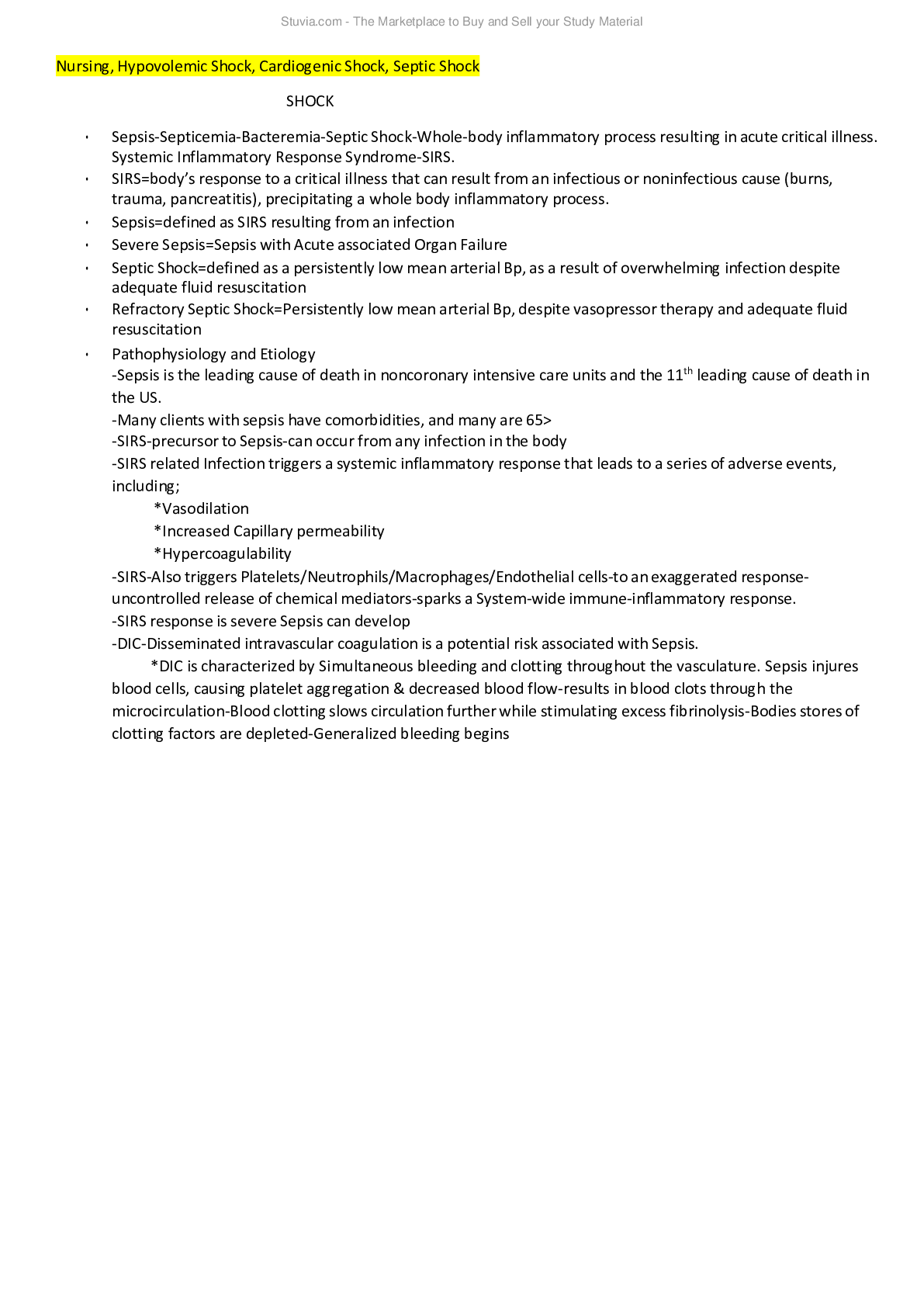
Nursing, Hypovolemic Shock, Cardiogenic Shock, Septic Shock SHOCK • Sepsis-Septicemia-Bacteremia-Septic Shock-Whole-body inflammatory process resulting in acute critical illness. Systemic Inflammatory Response Syndrome-SIRS. • SIRS=body’s response to a critical illness that can result from an infectious or noninfectious cause (burns, trauma, pancreatitis), precipitating a whole body inflammatory process. • Sepsis=defined as SIRS resulting from an infection • Severe Sepsis=Sepsis with Acute associated Organ Failure • Septic Shock=defined as a persistently low mean arterial Bp, as a result of overwhelming infection despite adequate fluid resuscitation • Refractory Septic Shock=Persistently low mean arterial Bp, despite vasopressor therapy and adequate fluid resuscitation • Pathophysiology and Etiology -Sepsis is the leading cause of death in noncoronary intensive care units and the 11th leading cause of death in the US. -Many clients with sepsis have comorbidities, and many are 65> -SIRS-precursor to Sepsis-can occur from any infection in the body -SIRS related Infection triggers a systemic inflammatory response that leads to a series of adverse events, including; *Vasodilation *Increased Capillary permeability *Hypercoagulability -SIRS-Also triggers Platelets/Neutrophils/Macrophages/Endothelial cells-to an exaggerated response-uncontrolled release of chemical mediators-sparks a System-wide immune-inflammatory response. -SIRS response is severe Sepsis can develop -DIC-Disseminated intravascular coagulation is a potential risk associated with Sepsis. *DIC is characterized by Simultaneous bleeding and clotting throughout the vasculature. Sepsis injures blood cells, causing platelet aggregation & decreased blood flow-results in blood clots through the microcirculation-Blood clotting slows circulation further while stimulating excess fibrinolysis-Bodies stores of clotting factors are depleted-Generalized bleeding begins Disseminated Intravascular Coagulation Description • In this condition, known to many as DIC, an exaggerated clotting process leads to the formation of clots in the microcirculation. • This thromboembolus formation may result in bleeding and vascular occlusion of the organs. Nursing Considerations • Prevent the complication through early identification of clients at high risk for DIC. • Remove the underlying cause. • Monitor vital signs; assess for bleeding and signs of shock. • Prepare for oxygen therapy, volume replacement, blood component therapy, and possibly heparin therapy. • Administer anticoagulants as prescribed during the early phase of DIC. • Administer cryoprecipitated clotting factors, as prescribed, when DIC progresses and hemorrhage is the primary problem. • Monitor for complications associated with fluid and blood replacement and heparin therapy. • Monitor urine output and maintain at 30 mL/hr (renal failure is a complication of DIC). • Etiology -Sepsis due to infection begins with Septicemia-presence of pathogens and their TOXINS in the blood *Bacteria/Viruses/Fungi/Rickets and certain types of Protozoa may also lead to septic shock *Bacteremia-presence of bacteria and their TOXINS in the blood stream is a common cause of Sepsis -Sepsis is most often the result of; * Gram + bacteria-Staphylococcus & Streptococcus, but may also follow; * Gram – infections-Pseudomonas sp. & E. coli, Klebsiella sp. Incidence of Gram – sepsis has greatly increased *6% of cases are related to fungal infections *Increase of Sepsis in Elderly & non-Caucasian populations/ due to Increase in Invasive procedures/ Immunosuppressive therapy/Antimicrobial resistance -Urinary system-Catheterizations, suprapubic tubes, cystoscopy -Respiratory system-Suctioning/Aspiration/Tracheostomy/Endotracheal tubes/Respiratory therapy/Mechanical ventilators -GI system-Peptic ulcers/Ruptured appendix/Peritonitis -Integumentary System-Surgical wounds/IV/Intra-arterial catheters/Invasive monitoring/Decubitus/Burns/Trauma -Female reproductive system-Abortion/Infections-intrapartal or postpartal periods/Tampon use/STI’s -PNEUMONIA/BLOODSTREAM INFECTIONS/KIDNEY & URINARY TRACT INFECTIONS/ABDOMINAL INFECTIONS • Risk Factors -AT RISK-Clients who are Hospitalized/Debilitating chronic illnesses/Poor Nutritional Status -Risk advanced by Invasive procedures or surgery/Elderly patients/Immunocompromised clients ELDERLY/NB BABY/PREGNANT WOMAN/LONG TERM HEALTH CONDITIONS & COMORBIDITIES/IMMUNOSUPPRESSED/WOUNDS OR INJURIES-BURNS/INVASIVE FOREIGN DEVICES -Immunosuppressed client is vulnerable to overwhelming infection resulting in; *Circulatory failure *Hypo or Hyper-thermia *Tachypnea *Mental changes *Inadequate tissue perfusion *HoTN -Factors contributing to massive infections include; *Inadequate Neutrophil production *Abnormal Granulocytes-not able to be phagocytic *Erosions through normal barriers *Altered Bone Marrow production-caused by chemotherapy/radiation -Toxic Shock Syndrome-virulent form of Septic Shock-bacterial ENDOTOXINS diffuse from the site of infection in the vagina into the circulations. *Manifestations of Toxic Shock Syndrome-Extreme HoTN/Hyperpyrexia/HA/Myalgia/Confusion/Rash/V&D • Prevention -Monitor infants carefully for early signs of sepsis-educate parents -Cancer patients on active treatment-immunosuppressed-Give prophylactic antibiotics because of increased risk -Pneumonia a major cause of Sepsis-Immunizations against organisms-H. Influenza & S. pneumononiae. -IV & Catheter use-ASEPTIC Technique & GOOD HAND WASHING • Clinical Manifestations -Manifestations of Sepsis include; *Fever or Hypothermia *Tachycardia *Tachypnea *Peripheral Vasodilation *Septic Shock *Mental status changes. *REFRACTORY HoTN-low Bp that does not respond to treatment/LETHARGY or CONFUSION/DIFFICULTY BREATING/RAPID HEART RATE/COOL-PALE EXTEMITIES/EXTREME WEAKNESS & LIGHT HEADEDNESS/N&V -Hemodynamic monitoring shows an Increase in Cardiac Output -LABS-show abnormal CBC (Leukocytosis or Leukopenia), Alteration in Clotting Factors (Thrombocytosis or Thrombopenia), and Elevated LIVER ENZYMES, C Reactive Protein, & Creatinine levels. Hypophosphatemia and Positive blood culture are anticipated. -Septic Shock has an early phase and a late phase; *Early phase-Warm phase=Vasodilation resulting in HoTN-due to intense vasodilation and fluid shifts due to increased capillary permeability, Weakness/Warm flushed skin. -Bp normal to HoTN -Pulse-increased & thread -Respirations-rapid & deep -Skin-warm & flushed -Mental status-alert, oriented anxious -Urine output
[Show More]





.png)











.png)