Troy University - MGT 6681 Quiz Review. Latest 2021.1. Organizations often experience performance improvement after loosening, rather than tightening, their commandand-control structures. If tightening those structures w
...
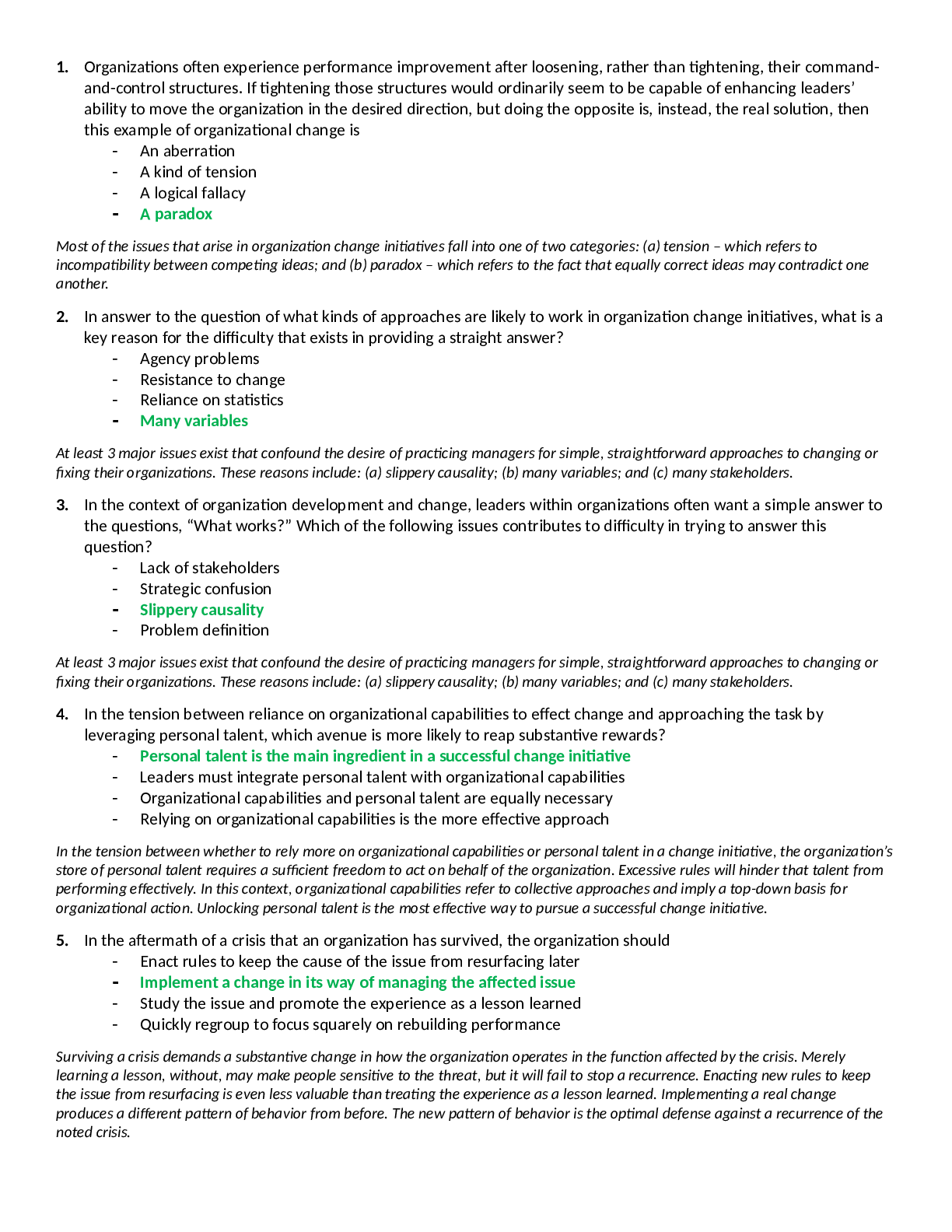
Troy University - MGT 6681 Quiz Review. Latest 2021.1. Organizations often experience performance improvement after loosening, rather than tightening, their commandand-control structures. If tightening those structures would ordinarily seem to be capable of enhancing leaders’
ability to move the organization in the desired direction, but doing the opposite is, instead, the real solution, then
this example of organizational change is
- An aberration
- A kind of tension
- A logical fallacy
- A paradox
Most of the issues that arise in organization change initiatives fall into one of two categories: (a) tension – which refers to
incompatibility between competing ideas; and (b) paradox – which refers to the fact that equally correct ideas may contradict one
another.
2. In answer to the question of what kinds of approaches are likely to work in organization change initiatives, what is a
key reason for the difficulty that exists in providing a straight answer?
- Agency problems
- Resistance to change
- Reliance on statistics
- Many variables
At least 3 major issues exist that confound the desire of practicing managers for simple, straightforward approaches to changing or
fixing their organizations. These reasons include: (a) slippery causality; (b) many variables; and (c) many stakeholders.
3. In the context of organization development and change, leaders within organizations often want a simple answer to
the questions, “What works?” Which of the following issues contributes to difficulty in trying to answer this
question?
- Lack of stakeholders
- Strategic confusion
- Slippery causality
- Problem definition
At least 3 major issues exist that confound the desire of practicing managers for simple, straightforward approaches to changing or
fixing their organizations. These reasons include: (a) slippery causality; (b) many variables; and (c) many stakeholders.
4. In the tension between reliance on organizational capabilities to effect change and approaching the task by
leveraging personal talent, which avenue is more likely to reap substantive rewards?
- Personal talent is the main ingredient in a successful change initiative
- Leaders must integrate personal talent with organizational capabilities
- Organizational capabilities and personal talent are equally necessary
- Relying on organizational capabilities is the more effective approach
In the tension between whether to rely more on organizational capabilities or personal talent in a change initiative, the organization’s
store of personal talent requires a sufficient freedom to act on behalf of the organization. Excessive rules will hinder that talent from
performing effectively. In this context, organizational capabilities refer to collective approaches and imply a top-down basis for
organizational action. Unlocking personal talent is the most effective way to pursue a successful change initiative.
5. In the aftermath of a crisis that an organization has survived, the organization should
- Enact rules to keep the cause of the issue from resurfacing later
- Implement a change in its way of managing the affected issue
- Study the issue and promote the experience as a lesson learned
- Quickly regroup to focus squarely on rebuilding performance
Surviving a crisis demands a substantive change in how the organization operates in the function affected by the crisis. Merely
learning a lesson, without, may make people sensitive to the threat, but it will fail to stop a recurrence. Enacting new rules to keep
the issue from resurfacing is even less valuable than treating the experience as a lesson learned. Implementing a real change
produces a different pattern of behavior from before. The new pattern of behavior is the optimal defense against a recurrence of the
noted crisis.
6. One of the major reasons for the infeasibility of prescribing an unambiguous, universally applicable method of
changing an organization is
- Many stakeholders
- Volatile competition
- Regulatory constraints
- Shifting priorities
At least 3 major issues exist that confound the desire of practicing managers for simple, straightforward approaches to changing or
fixing their organizations. These reasons include: (a) slippery causality; (b) many variables; and (c) many stakeholders.
7. Incremental change:
- Kaikaku
- Kanban
- Kaizen
- Keiretsu
The Japanese term for incremental change is kaizen. Writers in the innovation literature propose that kaikaku and kaizen, which are
at opposite levels of depth in terms of change initiatives, must go together to provide for the optimal pace of innovative change
available to an organization.
8. How important is the pursuit of rapid change in a change initiative, given the threat of the so-called acceleration
trap?
- Speed creates momentum, but a methodical approach prevents destabilizing the system
- Moving too slower will cause instability, so a faster pace of change is always advisable
- Every change initiative requires both a fast and a slow component to maintain equilibrium
- Pursuing change quickly leads to rash decisions and discarding of establish procedures
Every change initiative needs to be able to maintain its momentum. Members of the organization affected by the change or who are
instrumental in effective it need to stay cognizant of the progress and relevance of the ongoing effort. Therefore, slowing down a
change initiative is risker than speeding it up. Nevertheless, the change initiative must also follow a methodical course, with as clear
a map of the trajectory as possible. Therefore, a rapid pace is advisable, but speed for the sake of speed will destabilize the system.
9. The literature on organizational change can be difficult for most people to grasp, for a number of reasons. Once such
reason is appearance, within the literature, of
- Fluid boundaries
- A slio effect
- False positives
- Mission drift
At least 5 key characteristics of the literature on organization change serve to dissuade practicing managers from attempting to
master the research and apply it to real situations. These characteristics include: (a) multiple perspectives; (b) conceptual spread; (c)
fluid boundaries; (d) rich history; and (e) varied settings.
10. What is the ideal leadership structure for a change initiative?
- An outside consultant should assume the main leadership role
- An energetic change campion is ideal for motivating the change
- A guiding coalition is the most effective way to organize leadership
- People in formal leadership positions should serve as the change leaders
While organization change initiatives are often successful when guided by a charismatic change champion, such as a new CEO, the
most reliable leadership structure to promote change is the use of a guiding coalition of leaders who dedicate considerable time and
energy to the change initiative while it is occurring.
11. What percentage of business schools around the world have AACSB accreditation?
- Over 50%
- Fewer than 5%
- Approximately 25%
- Almost 75%
[Show More]