Handwashing - The single most effective way to stop the spread of infection
Medical Asepsis - Reducing the number of organisms in an environment (ex. cleaning
the tub with disinfectant before giving a patient a bath)
...
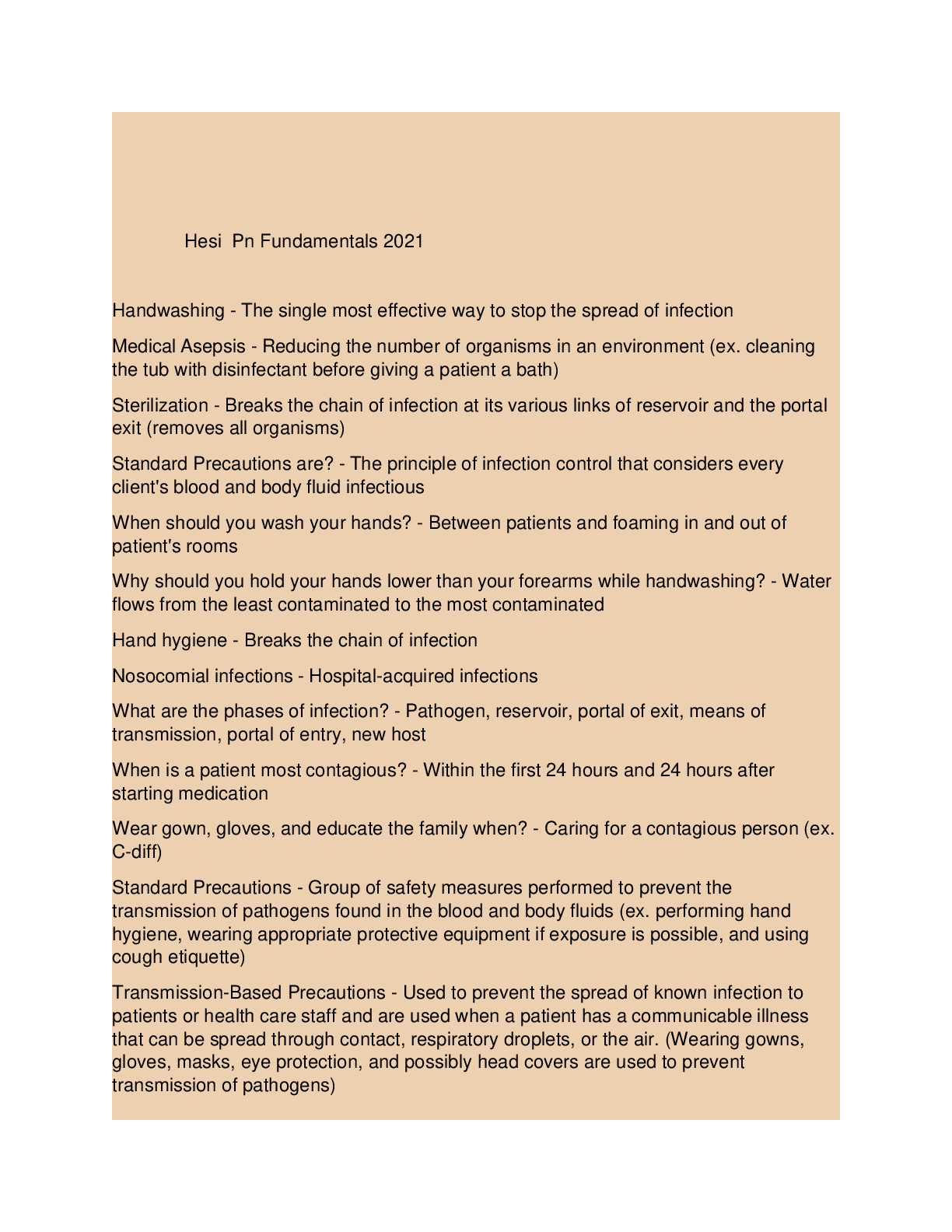
Handwashing - The single most effective way to stop the spread of infection
Medical Asepsis - Reducing the number of organisms in an environment (ex. cleaning
the tub with disinfectant before giving a patient a bath)
Sterilization - Breaks the chain of infection at its various links of reservoir and the portal
exit (removes all organisms)
Standard Precautions are? - The principle of infection control that considers every
client's blood and body fluid infectious
When should you wash your hands? - Between patients and foaming in and out of
patient's rooms
Why should you hold your hands lower than your forearms while handwashing? - Water
flows from the least contaminated to the most contaminated
Hand hygiene - Breaks the chain of infection
Nosocomial infections - Hospital-acquired infections
What are the phases of infection? - Pathogen, reservoir, portal of exit, means of
transmission, portal of entry, new host
When is a patient most contagious? - Within the first 24 hours and 24 hours after
starting medication
Wear gown, gloves, and educate the family when? - Caring for a contagious person (ex.
C-diff)
Standard Precautions - Group of safety measures performed to prevent the
transmission of pathogens found in the blood and body fluids (ex. performing hand
hygiene, wearing appropriate protective equipment if exposure is possible, and using
cough etiquette)
Transmission-Based Precautions - Used to prevent the spread of known infection to
patients or health care staff and are used when a patient has a communicable illness
that can be spread through contact, respiratory droplets, or the air. (Wearing gowns,
gloves, masks, eye protection, and possibly head covers are used to prevent
transmission of pathogens
[Show More]

![Preview of HESI Critical Care TEST BANK RN 2021 [50 Questions /Answers]](https://scholarfriends.com/storage/Critical_Care_HESI_notes___.png)