Chapter 9
Concept Questions:
1. Payback Period and Net Present Value [LO1, 2] If a project with conventional cash
flows has a payback period less than the project’s life, can you definitively state the
algebraic sign
...
Chapter 9
Concept Questions:
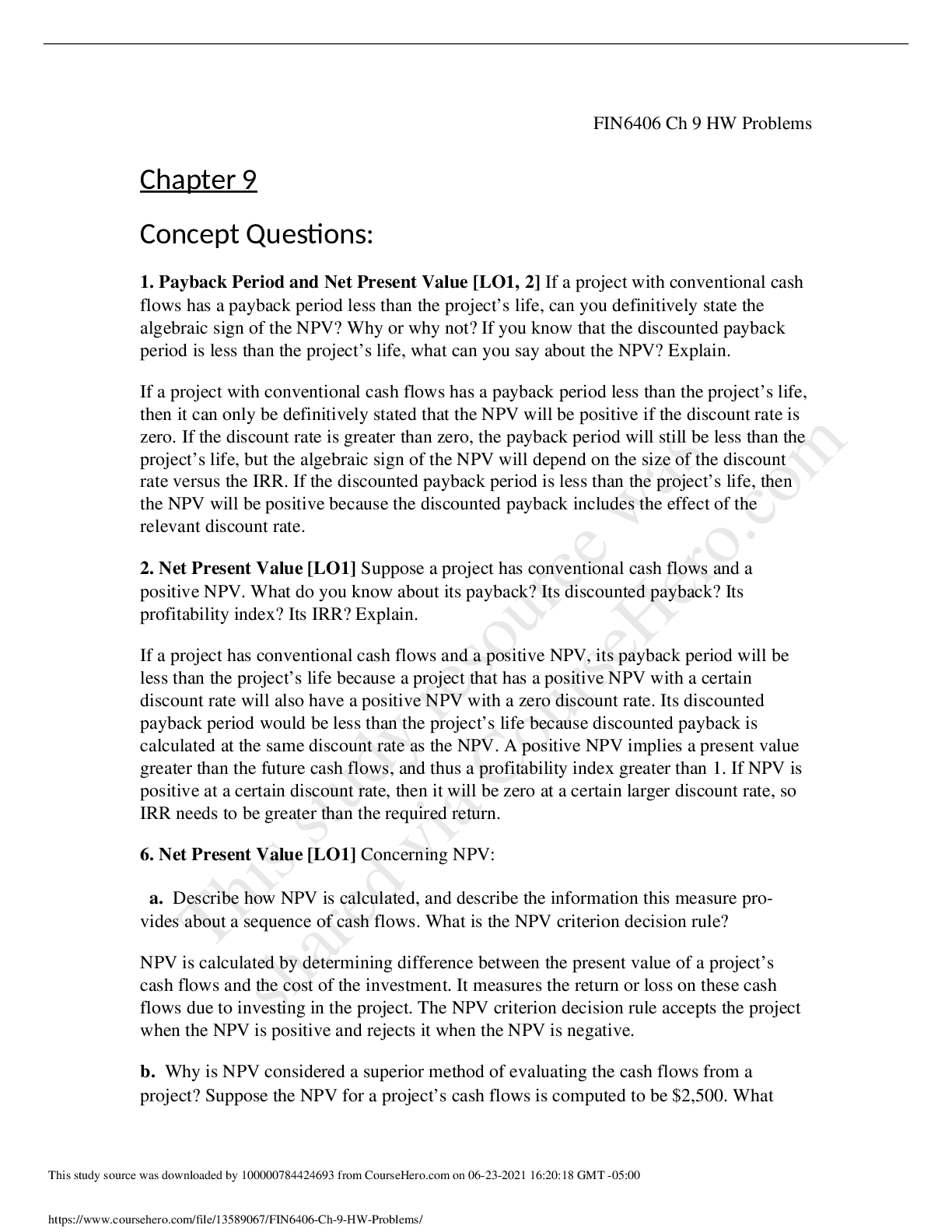
1. Payback Period and Net Present Value [LO1, 2] If a project with conventional cash
flows has a payback period less than the project’s life, can you definitively state the
algebraic sign of the NPV? Why or why not? If you know that the discounted payback
period is less than the project’s life, what can you say about the NPV? Explain.
If a project with conventional cash flows has a payback period less than the project’s life,
then it can only be definitively stated that the NPV will be positive if the discount rate is
zero. If the discount rate is greater than zero, the payback period will still be less than the
project’s life, but the algebraic sign of the NPV will depend on the size of the discount
rate versus the IRR. If the discounted payback period is less than the project’s life, then
the NPV will be positive because the discounted payback includes the effect of the
relevant discount rate.
2. Net Present Value [LO1] Suppose a project has conventional cash flows and a
positive NPV. What do you know about its payback? Its discounted payback? Its
profitability index? Its IRR? Explain.
If a project has conventional cash flows and a positive NPV, its payback period will be
less than the project’s life because a project that has a positive NPV with a certain
discount rate will also have a positive NPV with a zero discount rate. Its discounted
payback period would be less than the project’s life because discounted payback is
calculated at the same discount rate as the NPV. A positive NPV implies a present value
greater than the future cash flows, and thus a profitability index greater than 1. If NPV is
positive at a certain discount rate, then it will be zero at a certain larger discount rate, so
IRR needs to be greater than the required return.
6. Net Present Value [LO1] Concerning NPV:
a. Describe how NPV is calculated, and describe the information this measure provides about a sequence of cash flows. What is the NPV criterion decision rule?
NPV is calculated by determining difference between the present value of a project’s
cash flows and the cost of the investment. It measures the return or loss on these cash
flows due to investing in the project. The NPV criterion decision rule accepts the project
when the NPV is positive and rejects it when the NPV is negative.
b. Why is NPV considered a superior method of evaluating the cash flows from a
project? Suppose the NPV for a project’s cash flows is computed to be $2,500. What
does this number represent with respect to the firm’s shareholders?
NPV is considered a superior method of evaluating the cash flows from a project because
it is able to rank projects of different sizes over varying periods of time to determine the
most profitable course of action. A project with a NPV of $2,500 means that the wealth
of the firm’s shareholders is expected to cumulatively increase by $2,500 if the project is
accepted.
7. Internal Rate of Return [LO5] Concerning IRR:
a. Describe how the IRR is calculated, and describe the information this measure
provides about a sequence of cash flows. What is the IRR criterion decision rule?
The IRR is calculated as the breakeven point. It is the discount rate that is used to
calculate a zero NPV for a series of cash flows. The IRR criterion decision rule accepts
the project when the IRR is greater than the discount rate, and rejects it when the IRR is
less than the discount rate.
b. What is the relationship between IRR and NPV? Are there any situations in which
you might prefer one method over the other? Explain.
IRR is the discount rate that causes the NPV to be zero. It is preferred to use the NPV
because IRR results can be off for projects with nonconventional cash flows, however
either can be used dependably on projects with conventional cash flows.
c. Despite its shortcomings in some situations, why do most financial managers use
IRR along with NPV when evaluating projects? Can you think of a situation in which
IRR might be a more appropriate measure to use than NPV? Explain.
IRR is frequently used so financial analysts can speak in relative terms rather than in
definitive dollar terms. Percent gains and losses can be more telling of the overall
situation than that of dollar amounts. IRR might be a more appropriate measure to use
than NPV when the discount rate is uncertain. The IRR would still give the appropriate
discount rate for a zero NPV, whereas the NPV would return an unreliable value.
12. Capital Budgeting in NotForProfit Entities [LO1] Are the capital budgeting
criteria we discussed applicable to notforprofit corporations? How should such entities
make capital budgeting decisions? What about the U.S. government? Should it evaluate
spending proposals using these techniques?
The capital budgeting criteria discussed are applicable to notforprofit corporations.
These entities need to allocate their capital efficiently, just as any corporation. However,
determining the required returns of these entities can be difficult seeing as much of their
revenues are not tangible. The U.S. government should use realistic cost/benefit analysis
for balancing the budget.
[Show More]