NR222 Unit One Outline – Nursing and Health Promotion
P&P Chapter 1, 6, and 33
Edelman Chapter 1 and 3
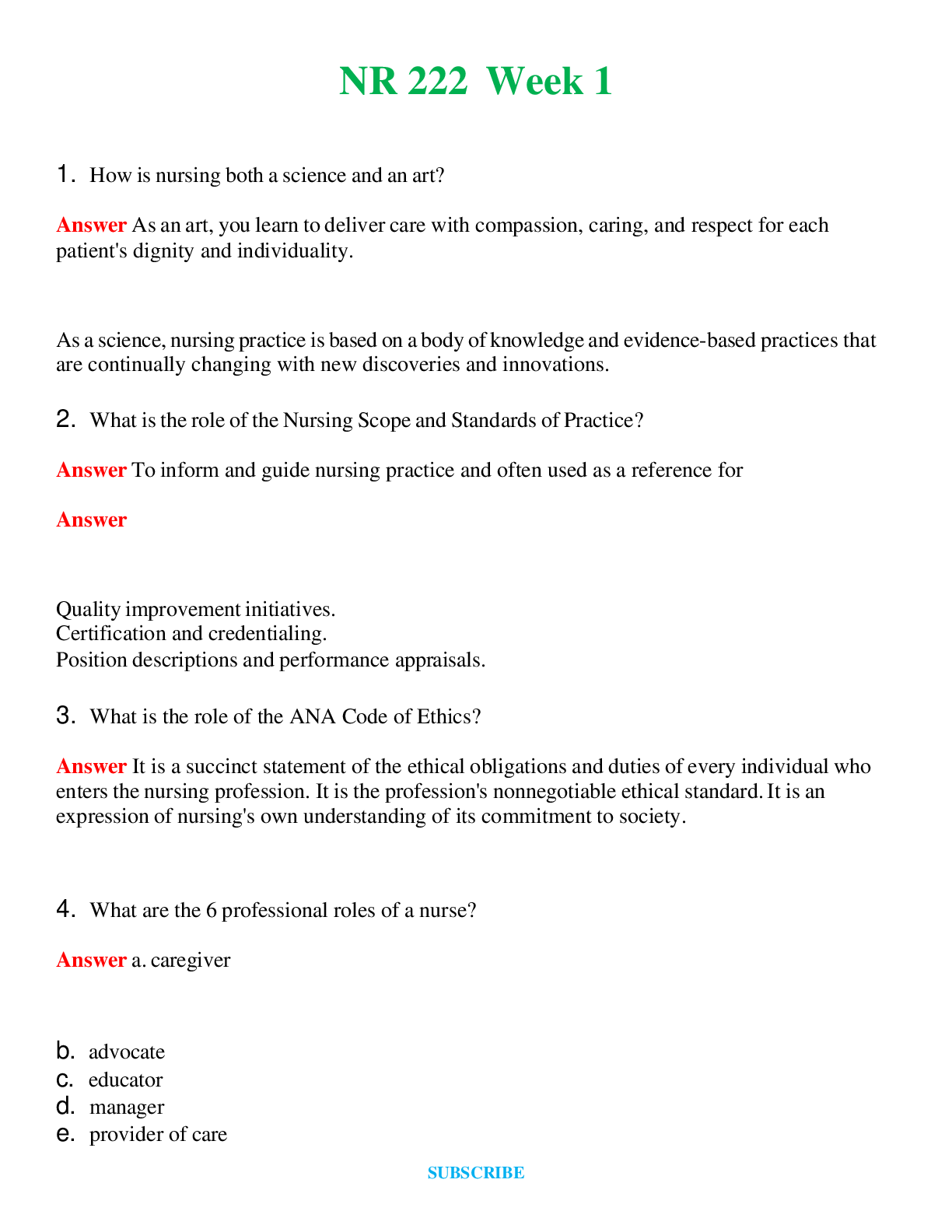
1. How is nursing both a science and an art?
a. Nursing requires a blend of the most current knowledge and practi
...
NR222 Unit One Outline – Nursing and Health Promotion
P&P Chapter 1, 6, and 33
Edelman Chapter 1 and 3
1. How is nursing both a science and an art?
a. Nursing requires a blend of the most current knowledge and practice standards with an
insightful and compassionate approach to patient care.
2. What is the role of the Nursing Scope and Standards of Practice?
a. The scope and standards of practice guide nurses to make significant and visible
contributions that improve the health and well-being of all individuals, communities,
and populations
3. What is the role of the ANA Code of Ethics?
a. The code of ethics is the philosophical ideals of right and wrong that define the
principles you will use to provide care to your patients
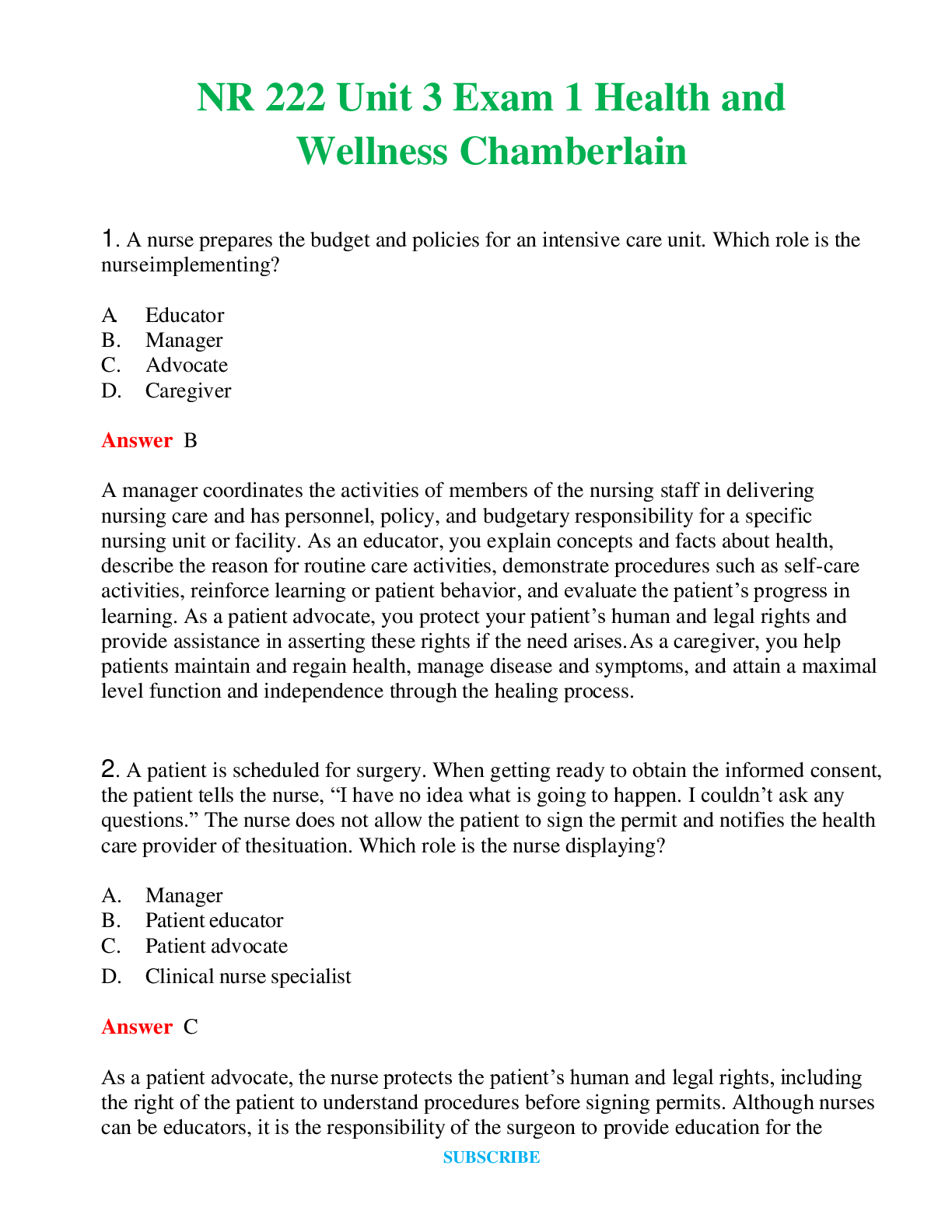
4. What are the 6 professional roles of a nurse?
a. Roles
i. Autonomy and Accountability: independent nursing interventions with out
medical orders/ taking accountability for your quality of nursing care
ii. Caregiver: help maintain and regain health, manage disease and symptoms, and
attain a maximal level of function and independence through the healing
process
iii. Advocate: protect the patient’s human and legal rights and provide assistance in
asserting these rights if the need arises
iv. Educator: explain concepts and facts about health
v. Communicator: focus on nurse-patient relationship, get to know their strengths,
weaknesses, and needs
vi. Manager: coordinate activities of the nursing staff in delivering nursing care and
has personnel, policy, and budgetary responsibility for nursing agency.
5. What are career development and advancement opportunities for a nurse?
a. Provider of Care: direct patient care
b. Advanced Practice RN: the most independently functioning nurse.
i. APRN has advanced education in pathophysiology, pharmacology, and physical
assessment and certification and expertise in a specialized area of practice
ii. There are four core roles for the APRN:
1. clinical nurse specialist (CNS)
a. an expert clinician in a specialized area of practice. The specialty
may be identified by a population (e.g., geriatrics), a setting
(e.g., critical care), a disease specialty (e.g., diabetes), a type of
care (e.g., rehabilitation), or a type of problem (e.g., pain)
2. certified nurse practitioner (CNP)
a. provides health care to a group of patients, usually in an
outpatient, ambulatory care, or community-based setting
3. certified nurse midwife (CNM)
a. educated in midwifery and is certified by the American College
of Nurse-Midwives.
4. certified RN anesthetist (CRNA)
a. advanced education from a nurse anesthesia–accredited
program
c. Nurse Educator: works primarily in schools of nursing, staff development departments of
health care agencies, and patient education departments.
d. Nurse Administrator: manages patient care and the delivery of specific nursing services
within a health care agency.
e. Nurse Researcher: conducts evidence-based practice and research to improve nursing
care and further define and expand the scope of nursing practice
[Show More]