Week 5 Midterm Study Guide
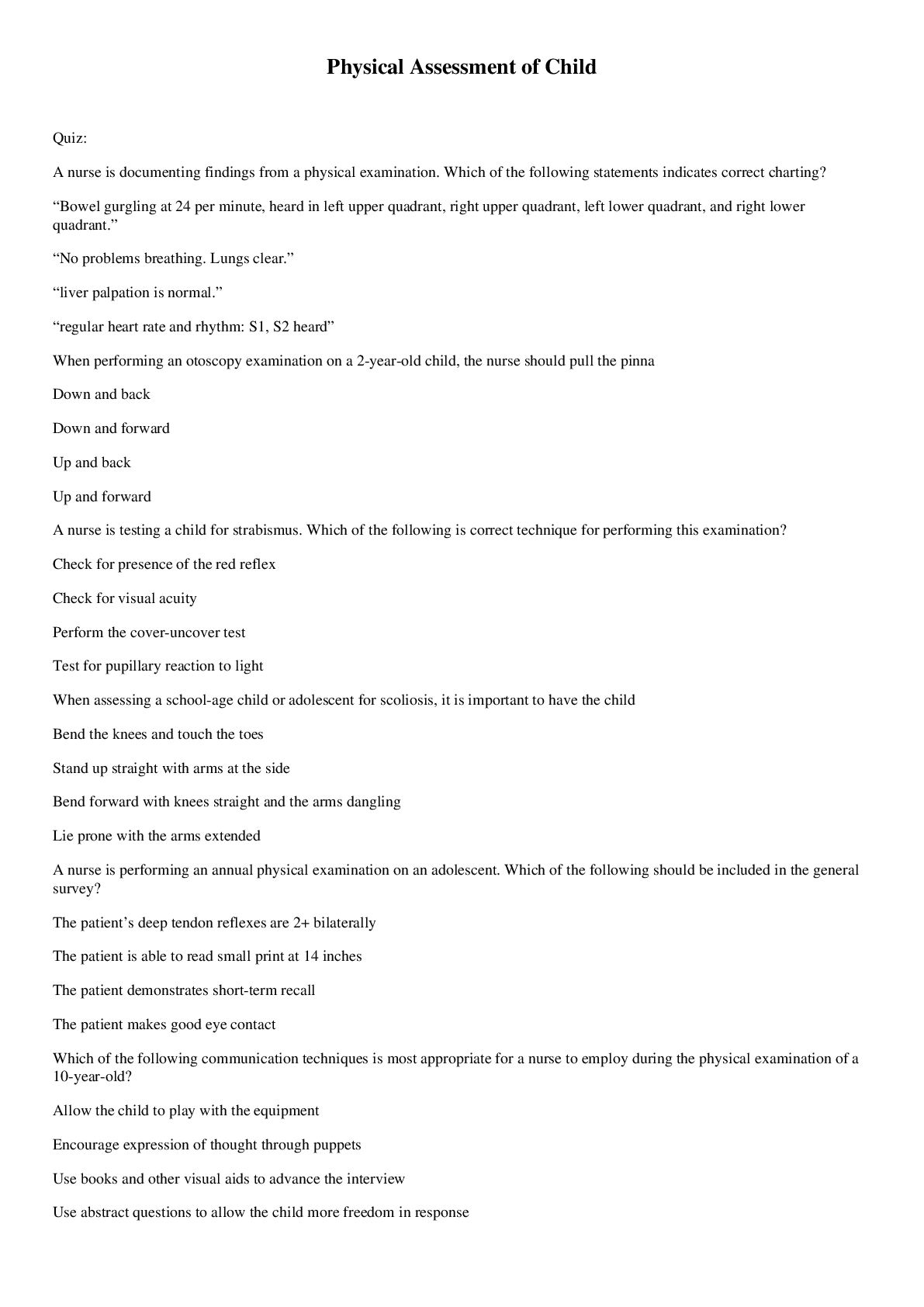
A patient tells the nurse that she has had abdominal pain for the past week. What would be the best response by the nurse?
1. “Can you point to where it hurts?”
2. “We’ll talk more about t
...
Week 5 Midterm Study Guide
A patient tells the nurse that she has had abdominal pain for the past week. What would be the best response by the nurse?
1. “Can you point to where it hurts?”
2. “We’ll talk more about that later in the interview.”
3. “What have you had to eat in the last 24 hours?”
4. “Have you ever had any surgeries on your abdomen?”
A patient’s laboratory data reveal an elevated thyroxine level. The nurse would proceed with anexamination of the:
A 6-month-old infant has been brought to the well-child clinic for a check-up. She is currently sleeping. What should the examiner do first?
When preparing to examine a 6-year-old child, which action is most appropriate?
68-year-old woman is in the eye clinic for a checkup. She tells the nurse that she has been having trouble with reading the paper, sewing, and even seeing the faces of her grandchildren. On examination, the nurse notes that she has some loss of central vision but her peripheral vision is normal. These findings suggest that:
In assessing a patient’s major risk factors for heart disease, which would the nurse want to include when taking a history?
1.Family history, hypertension, stress, age
2.Personality type, high cholesterol, diabetes, smoking
3.Smoking, hypertension, obesity, diabetes, high cholesterol
4.Alcohol consumption, obesity, diabetes, stress, high cholesterol
A teenage patient comes to the emergency department with complaints of an inability to breathe and a sharp pain in the left side of his chest. The assessment findings include cyanosis, tachypnea, tracheal deviation to the right, decreased tactile fremitus on the left, hyperresonance on the left, and decreased breath sounds on the left. The nurse interprets that these assessment findings are consistent with:
During a hearing assessment the nurse practitioner finds that sound lateralizes to the patient’s left ear with the Weber test. What can the nurse practitioner conclude from this?
The most important reason to share information and offer brief teaching while performing the physical examination is to help:
1.the examiner feel more comfortable and gain control of the situation.
2.build rapport and increase the patient’s confidence in the examiner.
3.the patient understand his or her disease process and treatment modalities.
4.the patient identify questions about his or her disease and potential areas of patient education.
In assessing the sclera of a black patient, which of the following would be an expected finding?
During an examination, the nurse knows that the best way to palpate the lymph nodes in the neck is described by which statement?
The nurse is obtaining a history from a 30-year-old male patient and is concerned about health promotion activities. Which of the following questions would be appropriate to use to assess health promotion activities for this patient?
1. “Do you perform testicular self-exams?”
2. “Have you ever noticed any pain in your testicles?”
3. “Have you had any problems with passing your urine?”
4. “Do you have any history of sexually transmitted disease?”
When examining a 16-year-old male teenager, the examiner should:
Which of the following statements regarding the aging adult and abdominal assessment is true?
In recording the childhood illnesses of a patient who denies having had any, which of the following notes by the nurse would be most accurate?
1. Patient denies usual childhood illnesses.
2. Patient states he was a “very healthy” child.
3. Patient states sister had measles, but he didn’t.
4. Patient denies measles, mumps, rubella, chickenpox, pertussis, or strep throat.
A patient's thyroid is enlarged, and the nurse is preparing to auscultate the thyroid for the presence of a bruit. A bruit is a:
During an examination, the nurse knows that Paget’s disease would be indicated by which of the following findings?
A patient is unable to read the 20/100 line on the Snellen chart. The nurse practitioner would
Which technique of assessment is used to determine the presence of crepitus, swelling, and pulsations?
During a cardiac assessment on an adult patient in the hospital for “chest pain,” the nurse finds the following: jugular vein pulsations 4 cm above sternal angle when he is elevated at 45 degrees, BP 98/60, HR 130; ankle edema; difficulty in breathing when supine; and an S3 on auscultation. Which of the following best explains the cause of these findings?
1.Fluid overload
2.Atrial septal defect
3.Myocardial infarction
4.Heart failure
Primary muscles of respiration include:
A patient comes into the clinic complaining of pain in her right eye. On examination, the nurse sees a pustule at the lid margin that is painful to touch, red, and swollen. The nurse recognizes that this is
During an examination of a patient’s abdomen, the nurse practitioner notes that the abdomen is rounded and firm to the touch. During percussion, the nurse practitioner notes a drum-like quality of the sound across the quadrants. This type of sound indicates:
In preforming auscultation of heart sunds, which sequence would the nurse use?
A patient comes into the emergency department after an accident at work. A machine blew dust into his eyes and he was not wearing safety glasses. The nurse examines his corneas by shining a light from the side across the cornea. What findings would suggest that he has suffered a corneal abrasion?
During a hearing assessment the nurse practitioner finds that sound lateralizes to the patient’s left ear with the Weber test. What can the nurse practitioner conclude from this?
[Show More]


.png)



.png)
.png)