WEEK 3: SICK CHILD CLINICAL CASE PRESENTATION
4 unread replies.9595 replies.
PURPOSE
The purpose of this assignment is for learners to:
• Have the opportunity to integrate knowledge and skills learned throughout all
...
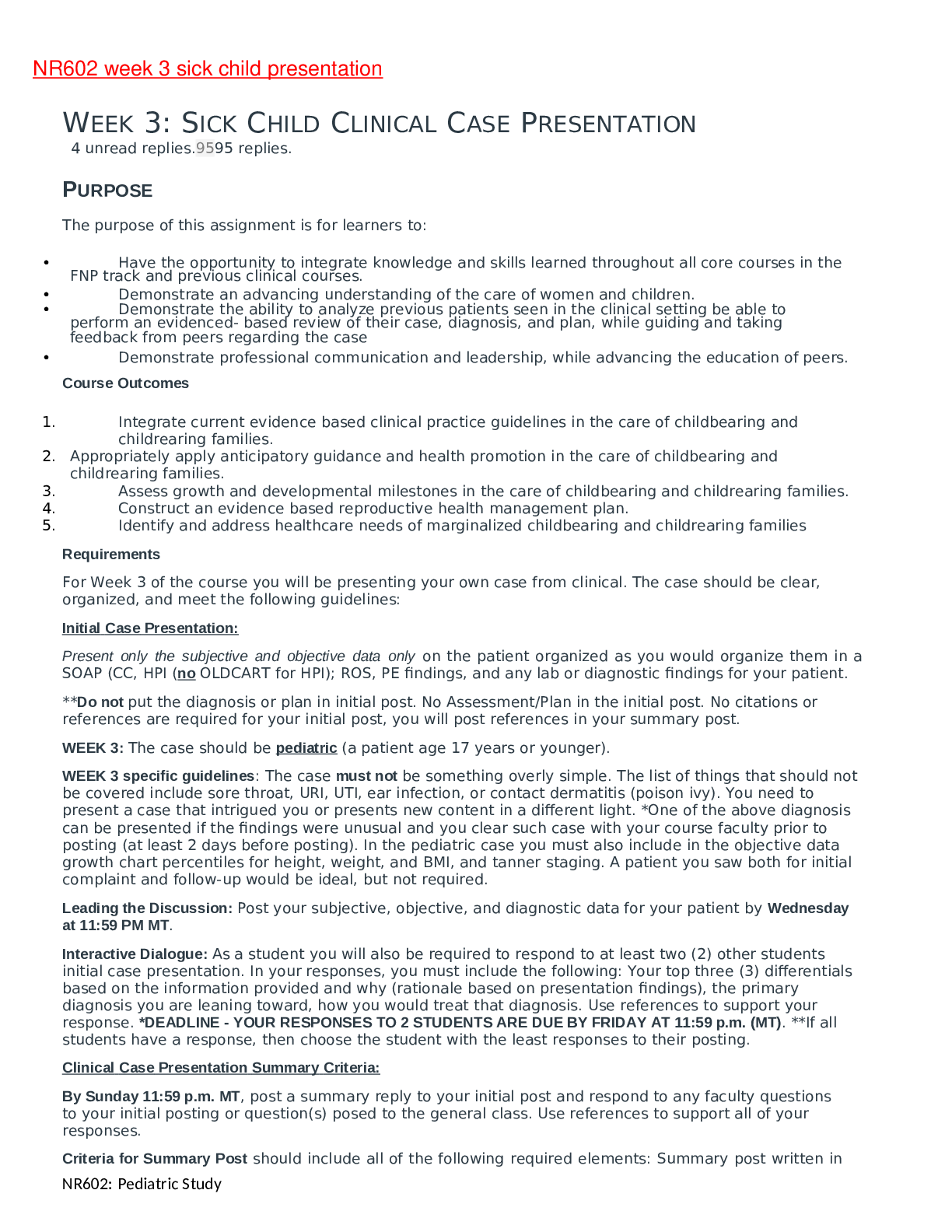
WEEK 3: SICK CHILD CLINICAL CASE PRESENTATION
4 unread replies.9595 replies.
PURPOSE
The purpose of this assignment is for learners to:
• Have the opportunity to integrate knowledge and skills learned throughout all core courses in the FNP track and
previous clinical courses.
• Demonstrate an advancing understanding of the care of women and children.
• Demonstrate the ability to analyze previous patients seen in the clinical setting be able to perform an evidenced�based review of their case, diagnosis, and plan, while guiding and taking feedback from peers regarding the case
• Demonstrate professional communication and leadership, while advancing the education of peers.
Course Outcomes
1. Integrate current evidence based clinical practice guidelines in the care of childbearing and childrearing families.
2. Appropriately apply anticipatory guidance and health promotion in the care of childbearing and childrearing
families.
3. Assess growth and developmental milestones in the care of childbearing and childrearing families.
4. Construct an evidence based reproductive health management plan.
5. Identify and address healthcare needs of marginalized childbearing and childrearing families
Requirements
For Week 3 of the course you will be presenting your own case from clinical. The case should be clear, organized, and
meet the following guidelines:
Initial Case Presentation:
Present only the subjective and objective data only on the patient organized as you would organize them in a SOAP
(CC, HPI (no OLDCART for HPI); ROS, PE findings, and any lab or diagnostic findings for your patient.
**Do not put the diagnosis or plan in initial post. No Assessment/Plan in the initial post. No citations or references are
required for your initial post, you will post references in your summary post.
WEEK 3: The case should be pediatric (a patient age 17 years or younger).
WEEK 3 specific guidelines: The case must not be something overly simple. The list of things that should not be covered
include sore throat, URI, UTI, ear infection, or contact dermatitis (poison ivy). You need to present a case that intrigued you
or presents new content in a different light. *One of the above diagnosis can be presented if the findings were unusual and
you clear such case with your course faculty prior to posting (at least 2 days before posting). In the pediatric case you must
also include in the objective data growth chart percentiles for height, weight, and BMI, and tanner staging. A patient you
saw both for initial complaint and follow-up would be ideal, but not required.
Leading the Discussion: Post your subjective, objective, and diagnostic data for your patient by Wednesday at 11:59 PM
MT.
Interactive Dialogue: As a student you will also be required to respond to at least two (2) other students initial case
presentation. In your responses, you must include the following: Your top three (3) differentials based on the information
provided and why (rationale based on presentation findings), the primary diagnosis you are leaning toward, how you would
treat that diagnosis. Use references to support your response. *DEADLINE - YOUR RESPONSES TO 2 STUDENTS ARE
DUE BY FRIDAY AT 11:59 p.m. (MT). **If all students have a response, then choose the student with the least responses
to their posting.
Clinical Case Presentation Summary Criteria:
By Sunday 11:59 p.m. MT, post a summary reply to your initial post and respond to any faculty questions to your initial
posting or question(s) posed to the general class. Use references to support all of your responses.
Criteria for Summary Post should include all of the following required elements: Summary post written in paragraph(s)
type format (No SOAP note for Summary Post); discuss primary and any applicable secondary diagnoses along with
treatment plan for each diagnosis. Scholarly and evidence based in-text citation support for all of the listed diagnoses;NR602: Pediatric Study Topics
Scholarly and evidence based in-text citation for each treatment plan. Differential diagnoses are eliminated. Summarize
your peer's posts to your presentation.
*Remember not to use any patient identifiers in your posting (this would be full names or disclosure of clinic name,
preceptor name, et cetera). Please include age, gender, and race.
**To see view the grading criteria/rubric, please click on the 3 dots in the box at the end of the solid gray bar
above the discussion board title and then Show Rubric.
Search entries or author Filter replies by unread Unread Collapse replies Expand replies
Subscribed
Collapse SubdiscussionKristan Bannister
KRISTAN BANNISTER
Nov 10, 2019Nov 10 at 12:37pm
Manage Discussion Entry
NR603 Week 3 Sick Child Clinical Case Presentation
Patient Information: The patient S.P. is a 6-year-old Hispanic female who presented to the primary care clinic with her
mother.
Chief Complaint: S.P. reported “tummy pain” to her mother, along with a low-grade temp of 99.8, positive for nausea,
vomiting and diarrhea for 3 days.
History of Presenting Illness: S.P. mother reports that the abdominal discomfort began and diarrhea, to her knowledge,
approximately three days ago. Approximately one day later, the nausea, vomiting presented. The fever was first noticed
yesterday, although S. P’s mother did not take her temperature prior, so she is unsure if she was febrile at time of
symptoms first presenting. The last temperature recorded was 99.8 at home. The diarrhea is reported as semi watery in
consistency, with occurrences approximately four times per day. No blood in stools reported. S.P does not appear to be
urinating as much according to mother. S. P’s mother reports that S.P. is not eating and drinking as she previously was,
and not engaging with usual activities of play. Mother is unaware of any weight loss. S. P’s mother has held her from
school at the onset of her noticing the fever. Treatment measures include supportive care, which consists of soup, juice,
and Tylenol PRN.
Review of Symptoms:
Constitutional: Positive fatigue and fever.
HEENT: Denies symptoms
Skin: Negative for rash, itching. Skin warm, dry.
Cardiovascular: No concerns reported
Respiratory: No concerns reported
Gastrointestinal: Positive for generalized GI discomfort and diarrhea x3 days; Positive for nausea, vomiting x2 days.
Negative for hematochezia.
Genitourinary: Decreased urinary output reported.
Neurological: No headache, dizziness reported. No change in bowel control.
Lymphatic: No issues reported.
Allergies: No known drug or food allergies
Physical Examination Findings:
Constitutional: Height: 44 inches; weight: 43 pounds. BMI: 15.6; BMI percentile: 55%. Height Percentile: 26.1%. Weight
Percentile: 38.6%. Tanner Stage: 1. Appears well nourished and of appropriate size for age.
Reply Reply to Week 3: Sick Child Clinical Case Presentation
•NR602: Pediatric Study Topics
o
Collapse SubdiscussionKristan Bannister
KRISTAN BANNISTER
Nov 12, 2019Nov 12 at 1:32pm
Manage Discussion Entry
Dr McPeters and class,
I forgot to include some of my vital signs for my presentation
B/P-98/62, R-22, T-99.8, P-120
Sorry about that,
Kristan
[Show More]